
Hollywood's Dirty Little Secret Got a Standing Ovation Last Night — The 2026 Oscars Just Proved Everyone Uses AI and Nobody Wants to Talk About It
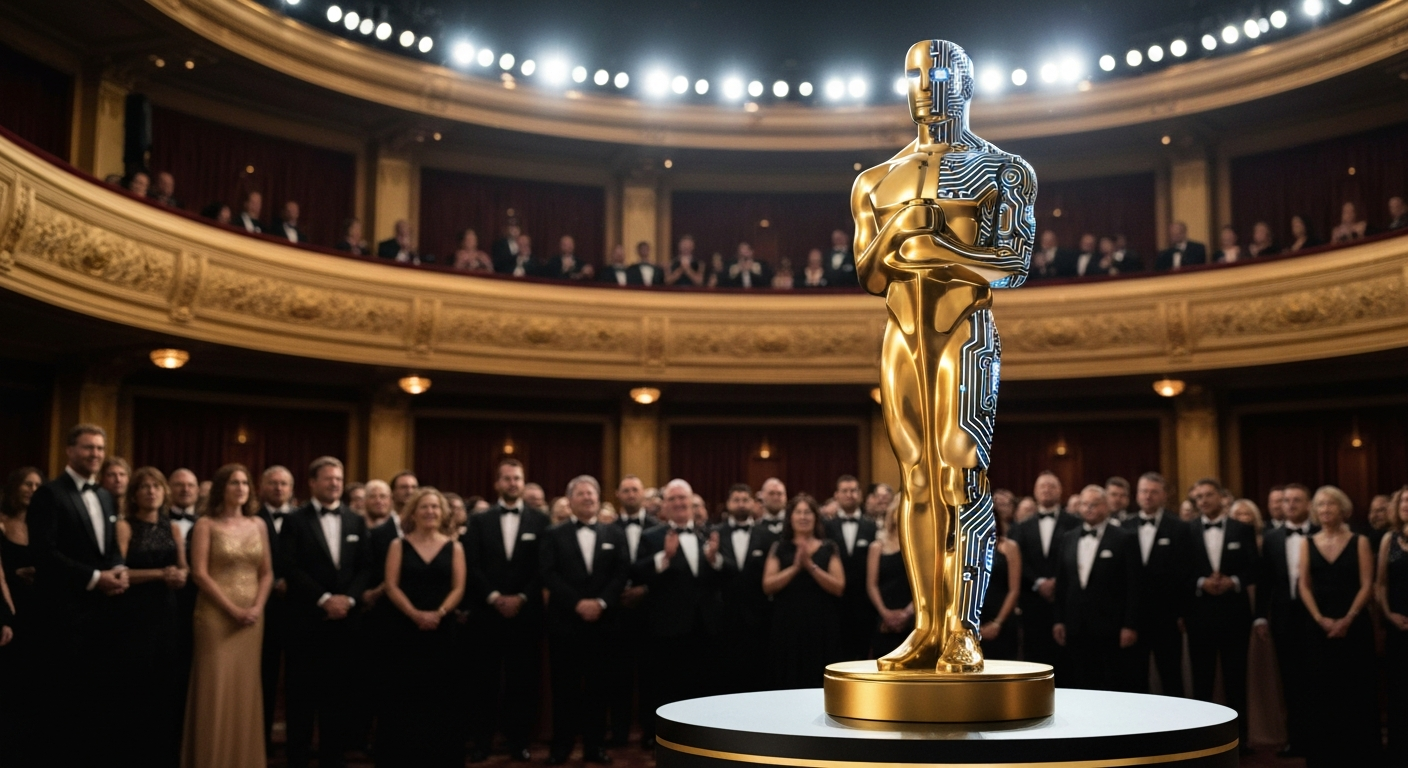
Summary
The 98th Academy Awards was a historic night. But the most shocking moment wasn't the winners — it was the collective hypocrisy Hollywood displayed toward AI. An industry that gave a standing ovation to an anti-AI speech while swallowing a $600M AI company gets dissected here.
Key Points
Hollywood's AI 'Don't Ask, Don't Tell' Policy
The Academy maintains that AI usage 'neither helps nor harms' a film's Oscar chances — a stance that's not a policy but deliberate evasion. As The Brutalist showed, films honest about AI usage faced smear campaigns from rival campaigns, and every studio internalized the lesson: never talk about AI publicly again.
Netflix's $600M InterPositive Acquisition
Just four days before the Oscars, Netflix finalized the acquisition of Ben Affleck's AI startup InterPositive for up to $600M. This massive investment in a 16-employee company reveals how strategically critical AI has become in Hollywood.
Autumn Durald Arkapaw's Historic Win and Structural Industry Issues
Sinners cinematographer Autumn Durald Arkapaw became the first woman and first woman of color to win Best Cinematography in the Academy's 98-year history. Only three women had ever been nominated before her.
K-pop 'Golden' Makes Oscar History
KPop Demon Hunters' 'Golden' became the first K-pop song to win Best Original Song. Performed by HUNTRIX members Rei Ami, EJAE, and Audrey Nuna, the song with seven credited writers broke records as the first with more than four writers to win.
SAG-AFTRA AI Protections and Their Limitations
SAG-AFTRA established AI protection provisions covering actors' voice and likeness. However, these protections apply only to 'visible AI,' leaving thousands of invisible AI applications in VFX, color grading, sound design, and scheduling completely unaddressed by any union contract.
Positive & Negative Analysis
Positive Aspects
- AI accelerates democratization of filmmaking
AI editing tools like InterPositive can provide small production companies with studio-level post-production quality. Work that once required millions in VFX budgets is becoming dramatically cheaper, creating opportunities for more diverse voices in filmmaking.
- Audiences may not actually care about AI usage
The fact that Adrien Brody won Best Actor despite The Brutalist's AI controversy is telling. Both audiences and voters judged that the quality of the final product matters more than production purity.
- Opens new creative possibilities
AI enables visual expressions, sound effects, and storytelling aids that humans couldn't have imagined. AI tools free creators from repetitive mechanical work to focus on pure creative decisions.
- Can help address historical inequalities
As Autumn Durald Arkapaw's historic win shows, structural inequality persists in Hollywood. The spread of AI tools lowers technical barriers that traditionally depended on specific networks and apprenticeship-style training.
Concerns
- Lack of transparency erodes audience trust
Studios actively concealing AI usage amounts to audience deception. As The Brutalist controversy showed, the problem wasn't AI use itself but getting caught using it secretly. Hollywood's Don't Ask, Don't Tell policy creates a ticking time bomb for long-term credibility.
- Worker protection blind spots are expanding
SAG-AFTRA protections cover only actors' voice and likeness, while tens of thousands of VFX artists, editors, and sound designers receive no protection against AI replacement.
- Standards of artistic authenticity become ambiguous
Without clear AI standards from the Academy, the definition of 'human creation' grows increasingly blurred. At some point, the very concept of 'human-made film' risks becoming meaningless.
- Industry power concentration deepens
Given AI technology's high costs, major studios and streaming platforms are likely to monopolize AI tools. Netflix's InterPositive acquisition represents investment at a scale inaccessible to smaller studios.
- AI dependency concerns extend to global content like K-pop
'Golden's historic win is worth celebrating, but the K-pop industry itself is rapidly depending on AI composition, AI choreography generation, and AI virtual idols. Fundamental questions about creation origins and ownership will erupt simultaneously across all genres and cultures.
Outlook
The 2026 Oscars didn't just hand out golden statues last night. They inadvertently staged a dress rehearsal for the most consequential debate that will consume the entertainment industry for the next decade: how to reconcile the economic imperative of AI adoption with the cultural mythology of human artistic genius.
In the short term — over the next one to six months — expect the Don't Ask, Don't Tell dynamic to intensify before it breaks. The Paramount-Warner Bros. Discovery merger, valued at $110.9 billion, is heading toward a shareholder vote on March 20, just five days from now. If approved, this combined entertainment behemoth will face immediate pressure to justify its mountain of debt exceeding $90 billion, and AI-driven cost reduction will be the first lever pulled. When two of Hollywood's legacy studios merge under financial duress, headcount reductions euphemistically described as 'operational efficiencies' will hit VFX departments, editing bays, and post-production houses within the first two quarters. Netflix's $600 million InterPositive acquisition gives them a concrete head start in this race, and competitors will scramble to catch up or acquire their own AI tooling. We'll likely see two to three more major AI company acquisitions by entertainment conglomerates before summer. Meanwhile, SAG-AFTRA's upcoming 2026 TV/Theatrical Agreement negotiations will attempt to expand AI protections beyond actors to cover writers and below-the-line workers, but the negotiations will be contentious because studios now have a financial model that depends on AI savings.
The bull case for the short term: transparency wins out sooner than expected. One brave studio — perhaps A24, which has always positioned itself as the anti-establishment player — comes forward with a comprehensive AI disclosure policy for all its productions. This creates a competitive differentiation strategy where 'AI-transparent filmmaking' becomes a mark of artistic integrity, similar to how 'practical effects' became a badge of honor after audiences grew tired of CGI overload. Early adopters of transparency are rewarded with audience trust and critical goodwill, creating a market incentive for honesty.
The bear case for the short term: a major scandal erupts when an investigative journalist or whistleblower reveals that a Best Picture contender at a future awards show used AI far more extensively than disclosed — not for voice enhancement or background VFX, but for core creative decisions like script doctoring, performance editing, or even generating entire dialogue sequences. This revelation triggers a public backlash that makes The Brutalist controversy look like a mild disagreement, forces the Academy to adopt emergency rules, and potentially leads to award revocations. The fallout damages audience trust in all films, not just the offending one.
In the medium term — six months to two years — the entertainment industry will undergo a structural transformation comparable to the transition from silent films to talkies. The comparison isn't hyperbolic. When sound arrived in cinema, it didn't just add a technical capability — it destroyed existing careers, created new ones, reshaped the economics of production, and fundamentally altered the audience's relationship with the medium. AI is doing the same thing, but faster and across every dimension of content creation simultaneously.
By mid-2027, expect the major studios and streamers to have established internal AI divisions with dedicated budgets exceeding $1 billion annually. Amazon, which already integrates AI across its e-commerce and cloud businesses, will leverage its MGM acquisition to become the first entertainment company to publicly quantify AI's contribution to its content pipeline — not because Amazon is more honest than Netflix or Disney, but because Amazon's culture treats efficiency metrics as brand assets rather than liabilities.
The Academy will be forced to create an AI Disclosure Committee by the 2027 awards season, requiring all submissions to file a standardized report detailing AI usage across every phase of production. This won't be a ban on AI — the industry's economics make that impossible — but a transparency framework modeled loosely on financial disclosure regulations. Films that fail to disclose will face disqualification, not for using AI, but for lying about it.
On the creative side, a new generation of filmmakers who grew up with AI tools will start producing work that doesn't treat AI as a dirty secret but as a declared medium. Just as directors like Christopher Nolan made 'shot on IMAX' or 'shot on film' a creative statement, emerging directors will make 'co-created with AI' a feature, not a bug. The first openly AI-collaborative film to earn major critical acclaim will shift the conversation from 'is this cheating?' to 'is this good?'
K-pop's Oscar breakthrough with 'Golden' will accelerate a broader trend of non-English-language content dominating global entertainment. By 2028, expect at least two non-English-language films to compete for Best Picture in the same year — not as curiosities in the International Feature Film category, but as mainstream contenders.
The long-term trajectory — two to five years — is where things get genuinely uncomfortable. By 2029 or 2030, the line between 'human-made' and 'AI-made' entertainment will be meaningless to most consumers. Not because AI will have replaced human creativity — it won't — but because the hybrid model will be so deeply embedded that trying to separate human and machine contributions will be like trying to identify which notes in a modern pop song were played by a human versus sequenced by software.
The bull case for the long term envisions a creative renaissance. AI handles the mechanical aspects of filmmaking — continuity, color matching, audio leveling, scene transitions, scheduling — freeing human artists to focus entirely on vision, emotion, storytelling, and the ineffable spark that makes art transcend craft. In this scenario, more films get made, at lower cost, by more diverse creators, and the quality ceiling rises because the best human minds are no longer wasting time on tasks that machines do better.
The base case is messier but more realistic. AI becomes an accepted tool in entertainment production, similar to CGI's trajectory from 'controversial trick' in the 1990s to 'invisible industry standard' by the 2010s. The Academy establishes disclosure rules that everyone follows perfunctorily. Studios use AI to cut costs and increase output. Some jobs disappear. New jobs emerge. The net employment effect is negative in the short term but stabilizes in the medium term. Hollywood remains Hollywood.
The bear case is genuinely dystopian. Consolidation accelerates to the point where three or four global companies control 90% of scripted entertainment. These companies use AI not just to reduce costs but to optimize content for algorithmic engagement, producing films and shows that are technically competent but creatively hollow. Artistic originality becomes a niche luxury good, and the cultural ecosystem that produced 'Sinners' and 'One Battle After Another' slowly starves.
I believe the base case is most likely, with elements of both the bull and bear scenarios playing out simultaneously in different segments of the industry. But here's what I know for certain: last night's Oscars were the last ceremony where Hollywood could pretend AI wasn't in the room. From now on, the machine is at the table, whether the invitation says so or not.
Sources / References
- The Oscars' AI Lie: Don't Ask, Don't Tell — The Ankler
- Will Arnett Rallies Against AI in Impassioned Animation Defense From Oscars Stage — The Wrap
- Netflix may have paid $600 million for Ben Affleck's AI startup — TechCrunch
- Sinners DP Autumn Durald Arkapaw Makes Oscar History — Variety
- KPop Demon Hunters Wins Best Original Song Oscar For Golden — Deadline
- What Hollywood Is Hiding Heading into the Oscars — PetaPixel
- The Paramount-Warner Bros Deal Explained — Variety
- Artificial Intelligence — SAG-AFTRA Member Resources — SAG-AFTRA