
The Server Company Nobody Watched for a Decade Just Pulled Off the AI Comeback of the Century
Summary
Hewlett Packard Enterprise (NYSE: HPE) delivered one of the most jarring earnings surprises in enterprise technology history when it reported fiscal Q2 2026 non-GAAP EPS of $0.79 — a 49% beat against the consensus estimate of $0.53 — alongside quarterly revenue of $10.68 billion, representing 40% year-over-year growth. Agentic AI server orders more than doubled quarter-over-quarter, driving a record $5.9 billion AI backlog that signals a structural acceleration in enterprise on-premises AI infrastructure demand far beyond what analysts had modeled. The central argument here is that HPE's performance, combined with a guidance revision 136% above its original long-term targets, marks a genuine inflection point in how enterprises procure AI infrastructure — driven not by hype but by the hard constraints of data sovereignty, regulatory compliance, and the latency requirements unique to agentic AI workloads. Goldman Sachs immediately raised its price target from $32 to $79, a 147% increase, while Morgan Stanley moved from $33 to $71, reflecting a wholesale re-rating of HPE from a legacy hardware vendor to a critical agentic AI infrastructure provider. This analysis examines the structural mechanism by which agentic AI creates durable on-premises server demand, the competitive implications for the broader AI investment landscape, and scenario-based projections from near-term stock dynamics through a five-year horizon.
Key Points
Why Agentic AI Creates Structural On-Premises Server Demand
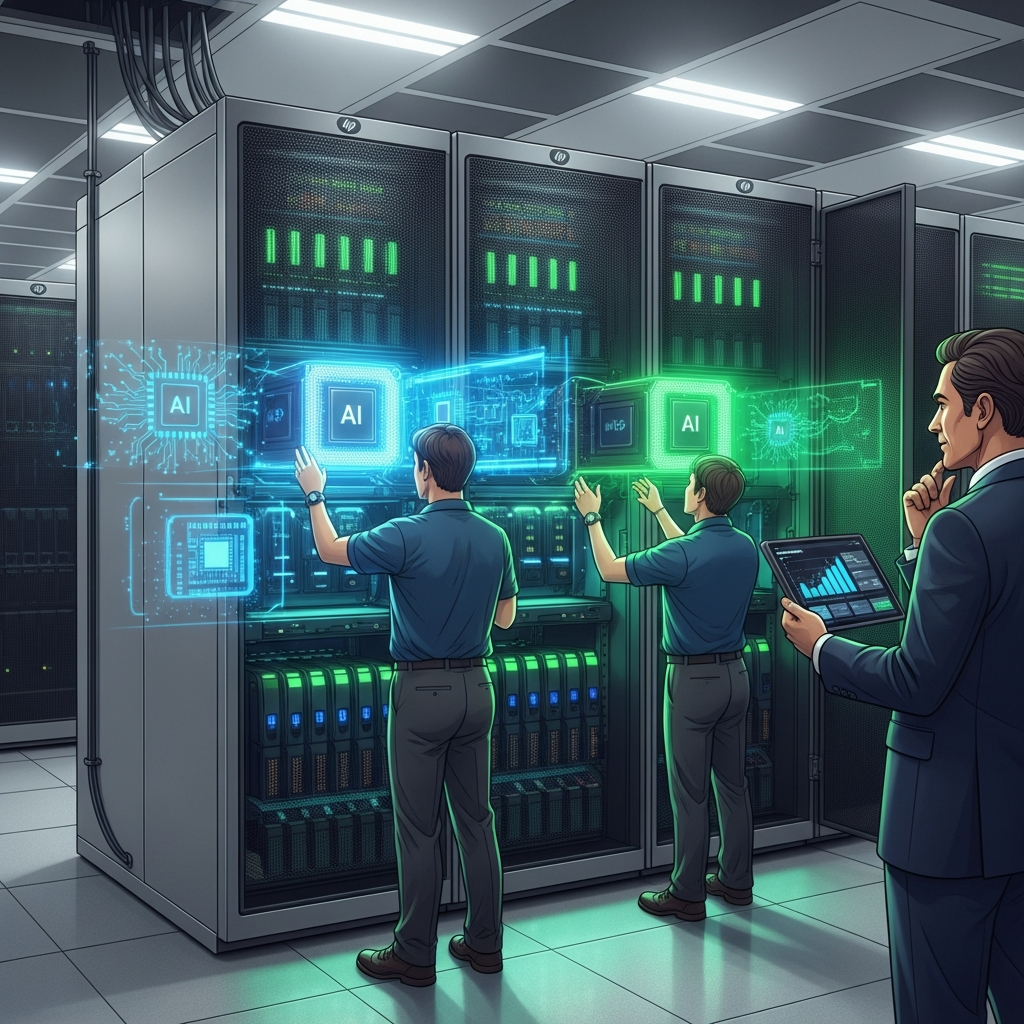
Agentic AI represents a categorically different infrastructure problem compared to the generative AI models that dominated the technology conversation in 2023 and 2024. Unlike a large language model that sits passively and responds to user prompts, an agentic AI system operates autonomously — it reads live internal databases, executes multi-step decisions across interconnected business systems, processes sensitive operational data in real time, and loops through planning-action-validation cycles that require persistent compute adjacency to the data itself. This architecture creates two hard constraints that public cloud infrastructure cannot resolve, regardless of how fast the underlying connectivity becomes.
The first constraint is latency. A financial institution integrating agentic AI into trading execution workflows cannot tolerate the round-trip time to a cloud data center measured in tens of milliseconds — at that latency, the trading edge disappears entirely. The second constraint is data sovereignty. Hospitals running agentic AI over patient records, semiconductor manufacturers running it over proprietary process control data, defense agencies running it over classified operational systems — these organizations are legally, contractually, and in many cases criminally prohibited from routing that data through a shared public cloud provider. AMD's technical documentation confirms that agentic AI workloads require a CPU-to-GPU ratio of approximately 1:1 to 1.4:1, meaning every GPU rack in an agentic deployment needs a corresponding CPU server rack for orchestration, tool invocation, and iterative reasoning. This is an on-premises server problem, not a cloud problem. NTT DATA's 2026 enterprise AI research found that 35% of Chief AI Officers identify building AI in "private or sovereign environments" as their top adoption barrier, and only 38% express high confidence in cloud security for sensitive AI workloads. The EU AI Act's Annex III high-risk provisions, effective August 2026, further codify on-premises deployment as a legal mandate in multiple regulated industries. The result is a demand category for on-premises AI servers that is non-discretionary, growing at IDC's projected 42% CAGR, and anchored in requirements that will intensify rather than ease over time.
HPE Q2 FY2026 by the Numbers — Why This Beat Was Structurally Different
The Q2 FY2026 earnings release on June 1, 2026 marked the first time in HPE's post-split history that the company produced numbers capable of forcing a complete reappraisal of its business identity across the investment community. Non-GAAP EPS came in at $0.79, representing 107% year-over-year growth and a 49% beat against the $0.53 consensus. Revenue reached $10.68 billion, up 40% year over year, with the Server segment delivering $5.5 billion (up 32.7% YoY) and the Networking segment contributing an extraordinary $2.69 billion (up 148.2% YoY, with 21.6% operating margins). AI Systems new orders of $1.8 billion in the single quarter drove the cumulative AI backlog to $5.9 billion, up 20% from the prior quarter. Free cash flow came in at $915 million, representing a $1.8 billion improvement year over year.
Management raised FY2026 guidance to EPS of $3.35–3.45 and revenue growth of 29–33% — guidance that exceeds what HPE originally targeted for FY2028, two full years ahead of plan. The critical distinction between this and a standard earnings beat is the demand quality underlying the guidance. HPE's $5.9 billion AI backlog consists entirely of signed, contracted commitments from enterprise and sovereign government clients — not speculative pipeline projections, not letters of intent, not analyst estimates. CEO Antonio Neri's comment on the earnings call that the pipeline sits at "multiples" of the current record backlog implies that the contracted demand visible today is the beginning, not the peak, of the buildout cycle. The stock's two-session 60% appreciation was not a momentum trade — it was a market updating a decade-old mental model.
The AI Investment Chain Is More Complex Than the Standard Playbook Assumed
For three years, the dominant AI investment thesis operated as a clean two-step supply chain: NVIDIA manufactures high-margin GPUs, hyperscalers purchase those GPUs to build cloud AI infrastructure, and enterprises access AI through cloud APIs or SaaS applications. In this model, on-premises server vendors like HPE were structurally irrelevant — the investment flowed to chip designers, cloud platforms, and application-layer software. HPE's Q2 results demonstrate that a third major spending path exists that this model completely ignored: enterprises and governments buying their own AI server hardware to build private, controlled, sovereign AI infrastructure.
According to Tom's Hardware, the four major hyperscalers combined are spending $725 billion on AI infrastructure in 2026 — a 77% increase over 2025. But that spending is concentrated almost entirely in hyperscaler-owned data centers, not enterprise deployments. The on-premises and sovereign AI segments operate on a completely separate procurement cycle, driven by regulatory mandates and data residency requirements rather than hyperscaler capex decisions. Goldman Sachs forecasts $7.6 trillion in cumulative global AI capex between 2026 and 2031, with the transition to agentic AI identified as the primary demand catalyst. Dell's AI-optimized server revenue grew 757% year over year to $16.1 billion in its most recent quarter — confirming that the enterprise server category is not a niche. Investors who built AI portfolios around the NVIDIA-to-cloud-to-SaaS chain were systematically underweighting a parallel and equally large spending wave.
HPE's 136% Guidance Revision — Why This Reflects Real Demand, Not Promotional Overreach
Corporate executives almost never raise long-term guidance by 136% above prior targets without a demand environment that has moved beyond anything their planning models anticipated. The standard playbook is to set conservative guidance and consistently beat it — sandbagging is so normalized on Wall Street that any meaningful upside in guidance language is read as a serious signal. When HPE essentially declared its five-year plan obsolete within two years of execution, the market was correct to take that signal at face value, and here is why the demand behind it appears genuine rather than promotional.
First, 61% to 64% of HPE's AI backlog originates from enterprise and sovereign government clients — organizations whose procurement processes involve 12-to-18-month cycles, legal review, compliance sign-off, and finance committee approval before a purchase commitment appears in a vendor's backlog. These are not impulse decisions. Second, CFO Marie Myers confirmed on the call that Juniper Networks integration synergies are already running at $450 million annually against a $600 million target originally set for 2028 — the deal is outperforming its business case. Third, Constellation Research's analysis of HPE's Q2 commentary noted that the pipeline behind the $5.9 billion backlog — potential orders not yet contracted — remains at "multiples" of that figure, implying strong replenishment as existing contracts convert to revenue. The counterargument raised by Motley Fool deserves acknowledgment: after adjusting for Juniper's inclusion, organic comparable revenue growth is approximately "high teens" rather than the headline 40%. That context is fair and matters for year-over-year comparisons. But it does not explain the doubling of AI server orders, the pipeline commentary, or the 61-64% sovereign demand composition — those are purely organic signals.
HPE's 10-Year Strategic Positioning: How a Liability Became a Moat
When HP split in 2015, the market consensus was painfully clear: HP Inc. got the recognizable consumer brand, and HPE got the legacy business that the cloud would gradually obsolete. For most of the following eight years, that view was difficult to argue against. HPE traded in a $10–$17 range from 2016 through 2023, becoming synonymous with "cheap but cheap for a reason" in portfolio manager conversations. Every major cloud migration narrative — enterprises moving workloads off on-premises iron to AWS, Azure, and GCP — seemed to confirm that HPE's business model was structurally in decline.
What the narrative missed entirely was what HPE was doing with that time. The $1.3 billion acquisition of Cray in 2019 brought HPE world-class supercomputing architecture — precisely the multi-node, ultra-low-latency compute fabric that agentic AI's distributed workloads require. The strengthening of Aruba Networks for edge computing created a technology layer between cloud and enterprise that agentic AI's hybrid deployment models naturally inhabit. Continuous HPC investment generated reference customers — national laboratories, defense agencies, tier-one financial institutions — that generate sovereign AI demand at the core of HPE's current backlog. The Juniper Networks acquisition added AI-native networking with silicon photonics technology that reduces AI cluster latency by up to 30% compared to conventional networking. In retrospect, these moves form a coherent preparation for exactly the infrastructure environment that agentic AI created. The AMD comeback story offers a useful parallel: written off as irrelevant against Intel's dominance, then resurgent with Ryzen and EPYC when the market shifted. HPE's narrative arc is structurally similar — the capabilities dismissed as the wrong answer turned out to be precisely what the next paradigm required.
Positive & Negative Analysis
Positive Aspects
- Unmatched On-Premises Positioning in a Non-Discretionary Market
HPE's competitive position in enterprise AI server infrastructure is not merely strong — it is structurally defensible in a way that most competitors cannot easily replicate. The Cray acquisition gave HPE a supercomputing heritage that earns deep trust from government agencies, national laboratories, and regulated industries — precisely the organizations mandating on-premises AI deployment. HPE and Dell form the effective duopoly in enterprise-grade AI servers, but HPE's advantage in HPC and sovereign deployments gives it access to the highest-margin segment of that market. The $5.9 billion AI backlog is a starting point, not a ceiling: CEO Neri has explicitly described the pipeline as sitting at "multiples" of that figure, implying sustained replenishment well into FY2027 and FY2028. IDC's 42% CAGR projection for accelerated AI servers through 2028 means the market itself is expanding fast enough that HPE can grow aggressively without having to take share from competitors. Every new data sovereignty regulation enacted globally — from the EU AI Act already in force to emerging frameworks in Japan, India, and Brazil — effectively mandates on-premises AI infrastructure and creates non-discretionary demand that channels directly to HPE's order book. SMCI's corporate governance crisis has already redirected a cohort of enterprise customers to Dell and HPE, further concentrating the field into a two-player structure with high switching costs and long procurement cycles.
- High-Quality Revenue Growth With Operating Leverage Confirmation
The combination of 40% year-over-year revenue growth and 107% EPS growth demonstrates that HPE is not simply adding topline scale by discounting prices or accepting worse unit economics — it is expanding revenue and simultaneously improving profitability. The Networking segment, which includes Juniper's AI-native capabilities, delivered 21.6% operating margins in Q2, which is exceptional for a hardware-adjacent business and signals that the product mix is tilting toward higher-margin offerings. GAAP gross margins improved by 810 basis points year over year to 36.5%, a structural improvement that tracks with increasing AI server content and Juniper integration synergies. Free cash flow improved by $1.8 billion year over year to $915 million, confirming that earnings growth is converting into real distributable cash rather than being absorbed by working capital expansion. This profile is the opposite of Oracle's experience when it announced massive AI infrastructure investment — investors feared that cost would precede revenue by years, and the stock fell. HPE's model captures demand that customers bring with capital already committed, without HPE taking on inventory or construction risk. The result is a capital-efficient demand capture structure that consistently produces better risk-adjusted returns than proprietary AI infrastructure build-outs, and one that scales operating leverage as volume increases.
- NVIDIA Partnership Creates Durable Technology Advantage
HPE's relationship with NVIDIA goes beyond standard OEM supply agreements — it is a strategic co-development partnership where HPE is positioned as a preferred enterprise distribution channel for NVIDIA's most advanced compute architectures. The ProLiant DL394 Gen12 with NVIDIA Vera CPU was jointly designed to address the specific bottlenecks that make agentic AI workloads difficult on conventional server hardware: the monolithic architecture eliminates NUMA latency issues from multi-socket designs, 1.2 TB/s aggregate memory bandwidth handles the data movement demands of multi-agent reasoning loops, and NIST quantum-resistant security certification addresses a government procurement prerequisite that competitors have not yet met. NVIDIA has a strong incentive to maintain HPE's preferred status because HPE provides enterprise and sovereign market access that hyperscaler partnerships cannot substitute. When NVIDIA launches Blackwell Ultra and Rubin architectures in late 2026 and early 2027, HPE's partnership structure gives it a time-to-market advantage over second-tier OEMs that could translate into substantial incremental backlog from enterprises running upgrade cycles. This technology partnership reinforces customer stickiness: enterprises that build agentic AI infrastructure around HPE and NVIDIA jointly create switching costs that benefit both partners and make HPE's revenue streams more predictable over multi-year infrastructure replacement cycles.
- GreenLake Subscription Model Drives Business Model Transformation
GreenLake represents HPE's most significant long-term value creation lever, and the market has not yet fully priced its potential impact on the company's multiple. The model allows enterprise customers to consume on-premises HPE infrastructure as a monthly subscription rather than upfront capital expenditure — directly addressing the CFO's dilemma in an environment where AI ROI uncertainty makes large hardware investments difficult to budget. For HPE's investors, the financial transformation is profound: hardware revenue valued at 15–18x earnings gradually converts to recurring revenue that can justify 25–35x earnings multiples. If GreenLake recurring revenue share increases from approximately 30% today to 40% over the next two to three years — a realistic trajectory given the structural tailwinds — multiple expansion alone could add 40–60% to HPE's intrinsic value independent of any revenue growth. This is not a speculative outcome: it is the financial engineering that Morgan Stanley and Goldman Sachs are both beginning to incorporate into their revised models. Every quarter that GreenLake's share of total revenue increases moves HPE further from its "hardware discount" classification and closer to the "platform company" valuation that its recurring revenue profile increasingly justifies. For long-term investors, tracking the GreenLake revenue percentage in every quarterly report is arguably more important than tracking total revenue growth.
- Management Confidence Backed by Contracted Demand, Not Pipeline Speculation
The 136% guidance revision above prior long-term targets is extraordinary in isolation. What makes it credible rather than promotional is the character of the demand behind it: every dollar of HPE's $5.9 billion AI backlog represents a signed contract that has cleared legal review, compliance approval, and financial authorization within a customer organization. Regulated-industry procurement cycles — banking, healthcare, defense, critical infrastructure — typically run 12 to 18 months from initial engagement to signed commitment. By the time a deal appears in HPE's backlog, it has survived every organizational hurdle that typically kills enterprise technology purchases. The pipeline sitting at "multiples" of the backlog means that a similarly rigorous process is simultaneously underway for an even larger pool of potential orders, continuously replenishing the contracted queue. CFO Marie Myers' confirmation of $450 million in Juniper synergies against a $600 million 2028 target is additional evidence of disciplined execution that validates management's operational credibility on large-scale programs. For institutional investors, this combination of confirmed backlog, credible pipeline description, and demonstrated acquisition integration performance creates the rare condition where multi-quarter earnings visibility is genuinely high — a premium the market has begun to price through Goldman Sachs and Morgan Stanley's revised targets, with room to continue as each quarterly report validates the thesis.
Concerns
- Hardware Cycle Risk: The Initial Buildout Wave Will Eventually Crest
The most legitimate risk to HPE's current trajectory is the cyclical nature inherent to all infrastructure hardware businesses. The surge in AI server orders has the characteristics of an "initial deployment concentration effect" — enterprises across multiple industries are making large first-time AI infrastructure investments simultaneously, driven by converging regulatory deadlines, competitive anxiety, and first-mover pressure. When that initial wave of on-premises AI buildouts completes — a process that could peak sometime in 2027 or 2028 — the replacement and incremental expansion cycle that follows will have fundamentally different demand characteristics. Historical precedent is instructive: the cloud server buildout of 2017–2019 created explosive, above-trend growth for infrastructure hardware vendors, followed by a meaningful demand air pocket in 2020 as the initial deployment cohort completed and the market settled into steady-state operation. If agentic AI on-premises deployments follow a similar S-curve, HPE faces a period of growth deceleration in FY2028–FY2029 even if the long-term structural thesis proves correct. The stock, having been re-rated to a growth company multiple, would be acutely vulnerable to any earnings miss or guidance reduction in that period — creating the risk of both an EPS shortfall and a simultaneous multiple compression hitting simultaneously. This is the "hardware cycle doom loop" dynamic that has punished AI infrastructure stocks repeatedly, and HPE is not immune to it despite the stronger structural thesis supporting current demand.
- AI Server Margin Profile Carries Structural Compression Risk
AI servers have a dramatically different component cost structure from conventional enterprise servers, and the margin implications deserve scrutiny. A high-density agentic AI server rack requires NVIDIA GPU systems priced at tens of thousands of dollars per unit, HBM memory (where SK Hynix holds 62% of global capacity with 2026 production already fully pre-sold at year-start), advanced networking hardware, and specialized power and cooling infrastructure. These components collectively drive material costs that compress gross margins compared to conventional x86 server configurations, even at premium AI server selling prices. Motley Fool's analysis of HPE's Q2 noted that the Cloud & AI segment operating margin of 12.4%, after adjusting for Juniper acquisition effects, is essentially flat year over year — suggesting that explosive AI server volume is not yet translating into meaningful segment profitability improvement. The competitive threat compounds this risk: Dell is targeting $60 billion in annual AI server revenue, Lenovo is investing heavily in AI server manufacturing efficiency, and Super Micro continues to pursue share despite its 2024–2025 governance challenges. As competitive intensity increases, pricing power for AI servers will erode, and if NVIDIA's GPU pricing continues to rise while HBM supply remains tight, HPE's ability to pass through component cost increases to customers — while maintaining competitive pricing against Dell — becomes the central question for margin sustainability. Oracle's stock decline on its $80 billion AI infrastructure announcement serves as a reminder that markets penalize revenue-without-profitability narratives quickly.
- Dell's $60 Billion AI Server Ambition Creates Unavoidable Competitive Pressure
HPE's Q2 results have not gone unnoticed by its most capable and best-resourced competitor. Dell Technologies reported AI-optimized server revenue of $16.1 billion in its most recent fiscal Q1 alone — 757% year-over-year growth — and has raised its full-year AI server target to $60 billion annually. Dell's enterprise sales organization is arguably the deepest and most geographically comprehensive in the world, with direct relationships in virtually every large enterprise on the planet and a global service and support network capable of delivering, configuring, and maintaining AI server deployments at a scale that HPE currently cannot match in all markets. While HPE's advantages in HPC, sovereign AI, and government relationships are real and meaningful, Dell's broader commercial enterprise reach gives it first-look access to the majority of AI server procurement decisions. The pick-and-shovels market is growing fast enough that both HPE and Dell can expand simultaneously in the near term, but as the market matures and price competition intensifies — particularly in the non-sovereign commercial segment where differentiation is harder to sustain — the dynamics will increasingly favor the player with the lower cost structure and greater customer coverage. HPE's strategic response of concentrating on higher-margin sovereign and regulated-enterprise segments is sound, but it requires continuous product and technology differentiation to prevent Dell from encroaching on what HPE currently considers its primary moat.
- Valuation Premium After 60% Surge Compresses the Margin of Safety
After a 60% price appreciation in two trading sessions, HPE no longer trades at a hardware discount. The stock's move has repriced it from a "legacy IT company valued at 15x earnings" framework to an embedded growth premium that depends on agentic AI demand continuing to expand, margins holding as AI server mix increases, and GreenLake's recurring revenue share growing on schedule. Any of these assumptions failing to materialize on the timeline the current price implies creates the risk of both an earnings shortfall and a simultaneous derating of the multiple — the double-hit pattern that has produced the largest drawdowns in AI hardware stocks historically. Super Micro Computer's trajectory is the most directly applicable cautionary example: shares rose approximately 10x at peak on AI server demand enthusiasm in 2024, then fell more than 80% when accounting concerns and growth deceleration materialized simultaneously. While HPE's structural position is considerably stronger than SMCI's at its peak — better governance, diversified revenue, deeper enterprise relationships — the pattern of AI hardware stocks repricing sharply downward when even one growth assumption is missed is well-established. Retail investors entering after the post-earnings surge at current valuations are effectively paying for a specific set of forward execution assumptions that have not yet been validated. Dollar-cost-averaging across multiple quarters, rather than concentrated entry at the peak of post-earnings euphoria, is the more risk-adjusted posture.
- Agentic AI Enterprise ROI Remains Unvalidated at Production Scale
HPE's entire bull case rests on the foundational assumption that agentic AI delivers measurable, sustainable productivity gains to the enterprises making infrastructure investments that populate HPE's backlog. This assumption has not been validated at scale. The generative AI investment cycle of 2023–2024 established a troubling precedent: enterprises collectively spent hundreds of billions on AI tools, pilots, and infrastructure, yet fewer than one-third of C-suite decision-makers could identify specific, quantifiable financial returns from those investments, according to Gartner's 2025 enterprise AI survey. Forrester projects that 25% of planned AI spending in 2026 will be deferred to 2027 specifically due to ROI uncertainty. Gartner predicts that more than 40% of agentic AI projects initiated between 2025 and 2027 will be canceled before reaching production deployment — citing cost overruns, data quality problems, governance gaps, and unclear business value as the primary failure modes. If agentic AI follows generative AI's "impressive in demo, disappointing in production" trajectory — particularly in complex enterprise environments where integration with legacy systems is harder than pilots suggest — enterprises will pause or cancel additional infrastructure investments. HPE's $5.9 billion contracted backlog is real and insulated from short-term sentiment shifts, but the pipeline that Neri describes at "multiples" of that backlog is not contracted. It represents intention. If enterprise AI decision-makers begin seeing evidence that agentic AI ROI is not materializing on the promised timeline, that unconverted pipeline will shrink — and HPE's FY2027 and FY2028 guidance will prove to have been built on overly optimistic adoption assumptions.
Outlook
The near-term picture — roughly the next one to six months — looks constructive for HPE despite the 60% two-day price surge that will inevitably invite profit-taking and consolidation. The key insight is that consolidation after a repricing of this magnitude is healthy, not a reversal signal, because the demand underlying the stock move is not sentiment-driven. It is contractual. HPE's fiscal Q3 2026 results, expected in September, will be the first genuine test of thesis sustainability. The three metrics I would watch most carefully are: first, whether the AI backlog grows beyond $5.9 billion toward $6.5–$7 billion, which would confirm demand is continuing to outpace fulfillment; second, whether management's "pipeline at multiples of backlog" characterization holds in the Q3 commentary; and third, whether gross margins in the Server and Cloud & AI segments hold or expand as AI server volume scales. If all three hold, HPE likely tests the $65–$72 range by the Q3 print. If the backlog plateaus or management softens pipeline language, the stock could retrace toward $45–$50 as the post-surprise premium compresses.
The NVIDIA catalyst is also a meaningful near-term variable that deserves its own consideration. HPE introduced the ProLiant DL394 Gen12 with NVIDIA's Vera CPU specifically architected for agentic AI, featuring 1.2 TB/s aggregate memory bandwidth, LPDDR5X DRAM, and a monolithic design that eliminates the NUMA latency issues inherent in multi-socket server architectures. It is also the first server certified to satisfy NIST's quantum-resistant security requirements — a designation that will become an explicit procurement prerequisite for U.S. government and defense clients within the next 18 months. When NVIDIA's Blackwell Ultra and Rubin architectures begin shipping in late 2026 and early 2027, HPE will almost certainly be among the first OEMs with qualified enterprise-grade systems. Every NVIDIA architecture generation creates a refresh cycle in the enterprise market, and HPE's OEM partnership structure means it captures that cycle disproportionately — particularly in the sovereign and regulated segments that Dell's volume-focused model does not serve as effectively.
Looking out six months to two years, the medium-term thesis rests on whether the structural demand driver — agentic AI in data-sovereign and regulated environments — continues to expand at the rate the data suggests it will. The IDC figures are compelling: the accelerated AI server market is growing at a 42% five-year CAGR, with accelerated servers projected to account for more than 75% of all AI infrastructure spending by 2028. Goldman Sachs estimates cumulative global AI capex of $7.6 trillion between 2026 and 2031, explicitly identifying the shift to "Agentic AI, or AI 2.0" as the primary spending catalyst. Dell'Oro Group forecasts that 2026 will be the first year global data center capex exceeds $1 trillion. These projections are not built on optimism — they are derived from already-committed hyperscaler budgets, multi-year enterprise procurement cycles, and regulatory compliance timelines that are legally mandated. HPE's on-premises and sovereign AI segments represent spending that neither hyperscalers nor SaaS vendors can capture. That is a permanently defensible market position, not a temporary gap in the cloud migration thesis.
The GreenLake subscription platform is arguably the most underappreciated element of HPE's medium-term value narrative. GreenLake allows enterprise customers to consume HPE's on-premises infrastructure on a pay-as-you-go subscription model rather than large upfront capital expenditures. In a CFO environment where pressure to shift capex to opex is intense — and where AI ROI uncertainty makes large upfront AI server investments difficult to justify internally — GreenLake removes the single biggest friction point in the enterprise procurement cycle. For HPE's investors, the financial transformation is even more compelling: every dollar of one-time hardware revenue that migrates to GreenLake recurring revenue is valued at a meaningfully higher earnings multiple. Hardware companies with lumpy, cyclical revenue trade at 15–18x earnings. Platform companies with predictable recurring revenue routinely command 25–35x. If HPE's recurring revenue mix rises from approximately 30% today toward 40% over the next two to three years, multiple expansion alone — independent of revenue or earnings growth — could represent 40–60% additional intrinsic value. This is precisely the re-rating narrative that Goldman Sachs and Morgan Stanley are beginning to price into their revised targets.
On the longer-term horizon through 2028–2031, the most significant structural driver is regulatory-driven demand fragmentation around data sovereignty. The EU AI Act's Annex III high-risk provisions, effective August 2026, impose penalties of up to €35 million or 7% of global annual revenue for violations — and they explicitly mandate on-premises or sovereign-adjacent AI deployments in healthcare, critical infrastructure, financial services, and public safety. Similar regulatory frameworks are emerging or already enacted in Japan, South Korea, India, the UAE, and Brazil. This legislative fragmentation of global AI infrastructure is not a transitional condition that will resolve as cloud security improves. It is a permanent feature of how sovereign nations are choosing to govern AI. Every new data sovereignty law enacted anywhere in the world is, in practical terms, a non-discretionary purchase order for an on-premises AI server. HPE's "Sovereign by Design" strategy, announced in early 2026, explicitly positions the company to be the preferred vendor for organizations that need AI infrastructure that never crosses a jurisdictional border. By 2028, sovereign and regulated-enterprise AI could represent 30–40% of total enterprise AI server spending — a segment where HPE has few credible competitors at meaningful scale.
The scenario analysis breaks down as follows. In the bull case, agentic AI adoption accelerates ahead of Gartner's projection that 40% of enterprise apps will incorporate AI agents by end of 2026, EU and Asia-Pacific regulatory tailwinds push sovereign AI deployments to scale simultaneously, and Juniper synergies exceed the $600 million target ahead of 2028. HPE's AI server revenue reaches $25 billion by FY2028, GreenLake recurring revenue exceeds 40%, and the stock re-rates to a 26–28x earnings multiple supporting a target range of $90–$105. Probability: approximately 25%. In the base case, FY2027 guidance of 8–12% revenue growth and 12–16% EPS growth materializes at the midpoint, agentic AI adoption follows the Gartner schedule, and competitive pressure from Dell stays manageable. The stock trades between $58 and $78 over the next 18 months as re-rating narrative gradually broadens institutional ownership. Probability: 50%. In the bear case, AI infrastructure investment cycles peak in mid-2027 as Forrester's projected 25% spending deferral materializes, Gartner's warning that 40%+ of agentic AI projects will be canceled by end of 2027 proves accurate, and Dell's $60 billion AI server ambition triggers margin-destroying price competition. Revenue growth decelerates to mid-single digits and the stock retreats to $32–$42 as the hardware discount reasserts itself. Probability: 25%.
There are two specific conditions that would cause me to completely revise this framing. The first is if agentic AI fails to demonstrate measurable, documented enterprise ROI within the next 18 months. Generative AI established a cautionary precedent in 2023–2024: enterprises invested hundreds of billions in AI tooling and infrastructure, yet fewer than one-third of C-suite decision-makers could identify specific quantifiable returns, according to Gartner. If agentic AI follows the same "impressive in demo, disappointing in production" trajectory, enterprises will halt or defer additional infrastructure commitments, and HPE's pipeline will fail to convert into backlog at the rate Neri's commentary implies. The second condition is supply chain disruption at the component level. AI servers depend heavily on HBM memory — SK Hynix holds 62% of global HBM capacity, and 2026 production was already fully pre-sold at the start of the year — and on advanced networking hardware. Any significant component tightening would delay HPE's ability to fulfill its existing backlog and push revenue recognition further out, potentially triggering customer deferrals or contract renegotiations. HPE's CEO acknowledged memory supply constraints persisting through at least FY2027 in the earnings call. Watching HBM allocation news will tell you a great deal about which scenario is actually unfolding.
For investors following this story, the quarterly metrics that matter most — in order of importance — are: the AI backlog trajectory (growing beyond $5.9B is strongly bullish; plateauing is a warning), the GreenLake recurring revenue share of total revenue, gross margin trends in the Server and Cloud & AI segments, and Dell's AI server revenue figures as a competitive share indicator. The structural thesis here is solid and well-supported by regulatory and technical evidence. But hardware cycles are real, execution risk is real, and the stock has already repriced substantially to reflect a specific set of assumptions that must be validated quarter by quarter. Position sizing that reflects ongoing uncertainty — rather than treating the post-earnings price as a new floor — is the appropriate approach for investors who believe the long-term narrative but respect the near-term unknowns.
Sources / References
- HPE Reports Fiscal 2026 Second Quarter Results — HPE Newsroom
- HPE Stock Surges After Q2 Earnings Beat — CNBC
- HPE Stock Extends Gains as AI Server Demand Accelerates — CNBC
- HPE Stock Soars on Record Backlog, Booming AI Server Business — Yahoo Finance
- HPE Reports Strong Earnings Surge Amid AI Infrastructure Boom — GuruFocus
- HPE Stock Explodes: Finally Seen as an AI Play — Yahoo Finance
- HPE Rockets 25%, Supermicro Climbs 5% as AI Server Demand Lights Up Q2 Earnings — 247 Wall Street