
ManpowerGroup Surges ~34% — The Jobs Aren't Coming Back. The Ladder Is Being Sawed Off.
Summary
ManpowerGroup (NYSE: MAN) posted a close-to-close gain of approximately 34% on July 16, 2026 — rising from $39.02 to $52.36 — after a Q2 2026 earnings report showed revenue of $4.86 billion and U.S. Manpower brand growth of 16% for an eighth consecutive quarter, with Q3 guidance EPS of $0.96 to $1.06 beating the Street consensus of $0.88 by 9% to 21% at the midpoint. Before treating this as a straightforward bullish signal, investors must absorb one structurally critical detail: Benzinga reported that 19.9% of ManpowerGroup's public float — approximately 6.75 million shares — was held short entering earnings, meaning the ~34% close-basis move was substantially amplified by short-covering rather than fundamental revaluation alone. What the underlying data actually reveals is not a recovering labor market but a deeply bifurcated one in which AI infrastructure construction is exploding demand for experienced skilled tradespeople — robotics technician openings up 107%, HVAC engineers up 67%, electricians up 18% — while simultaneously erasing the entry-level positions that once formed the pipeline into those exact roles. iRecruit's data center construction labor market report estimates a current shortfall of 349,000 to 499,000 workers, and the global data center capital expenditure pipeline of $3 trillion over five years creates a structural demand floor that extends well beyond a single earnings cycle. ManpowerGroup's surge is best interpreted not as a signal of labor market health but as market recognition of a deeply fractured labor market's new power dynamics — and the distinction matters enormously for both investors and workers navigating these conditions in real time.
Key Points
The ~34% Surge Anatomy: Earnings Beat and Short-Squeeze Amplification
ManpowerGroup's Q2 2026 earnings report showed adjusted EPS of $0.99 against a consensus of $0.96, U.S. Manpower brand growth of 16% for an eighth consecutive quarter, and Q3 guidance EPS of $0.96 to $1.06 — clearing the $0.88 Street consensus by 9% to 21% at the midpoint. These numbers are genuinely strong. But the ~34% close-to-close price move requires a more forensic explanation, and that explanation centers on one number that most coverage buried or omitted: Benzinga reported that 19.9% of ManpowerGroup's public float — roughly 6.75 million shares — was held in short positions entering the print. When earnings came in well above expectations, short sellers were forced to cover their positions by buying the stock at whatever price it was trading at — a mechanical wave of buy orders that amplifies the fundamental rerating far beyond what the earnings themselves would justify in a normally distributed market. The intraday high reached $52.77, representing a 35.24% spike from the prior close at its peak. My analytical decomposition of the move places roughly 20 percentage points in genuine fundamental revaluation — the market recognizing that ManpowerGroup is structurally more valuable in an AI-infrastructure-buildout world than its prior 0.1x price-to-sales ratio implied. The remaining approximately 14 percentage points represent the short-covering technical premium — a one-time mechanical event that will gradually deflate as those positions close out and forced buyers are replaced by voluntary ones. Investors entering the stock after the surge must understand they are paying at the post-squeeze price level and should expect a reversion leg before a cleaner fundamental re-entry opportunity appears in the $45 to $50 range, approximately 5% to 14% below the current close of $52.36. Understanding this decomposition is not just an academic exercise: it determines whether the stock is a buy at current prices or a patient wait for the technical overhang to clear.
Quantitative Evidence for Labor Market Bifurcation: Demand Up 107%, Net Headcount Still Falling
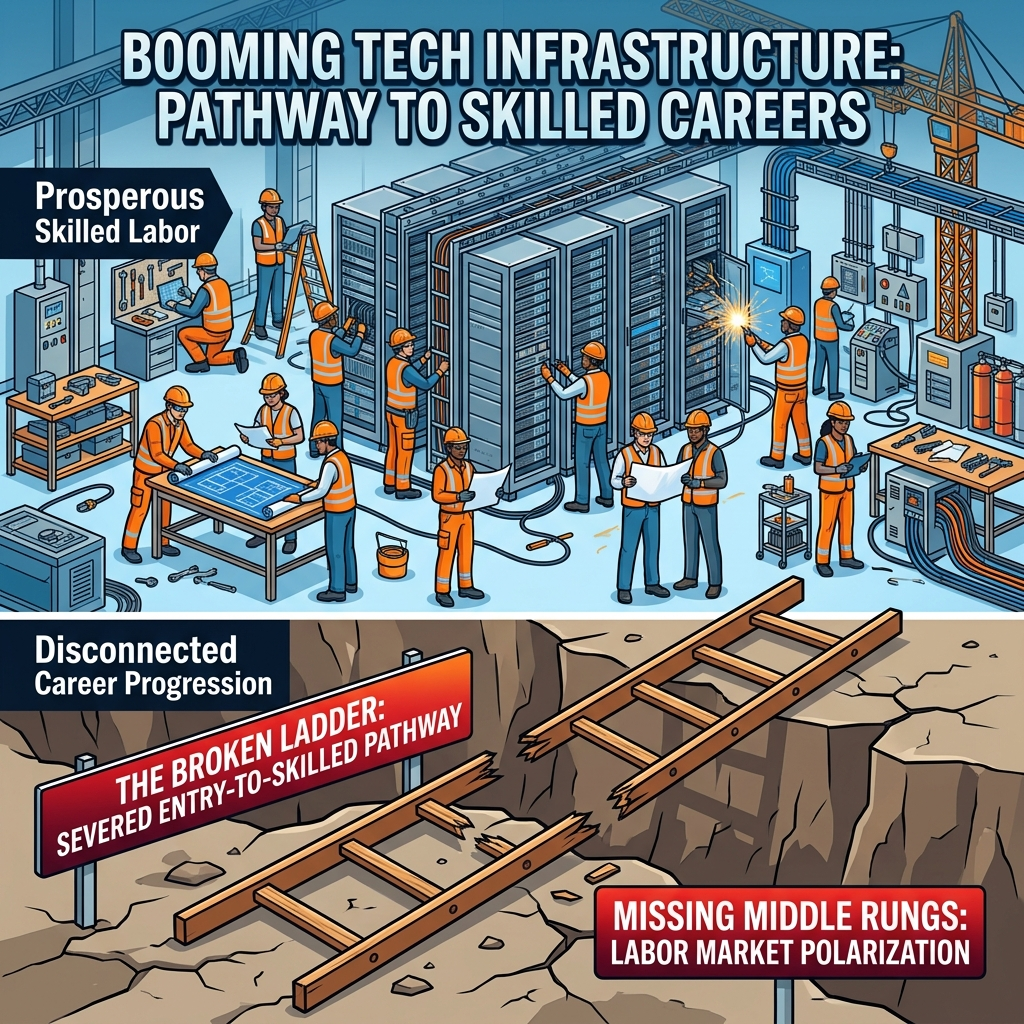
Randstad's analysis of more than 50 million job postings since late 2022 produces the clearest quantitative picture of what "labor market bifurcation" actually means in concrete numbers. Robotics technician demand is up 107%. HVAC engineers are up 67%. Industrial automation technicians are up 51%. Construction workers are up 30%. Welders are up 25%. Electricians are up 18%. Skilled trades as a category are growing 19 percentage points faster than white-collar roles and three times faster than professional services. Yet simultaneously, in manufacturing — the sector generating most of this skilled-trade demand — 100 workers are leaving for every 102 entering, meaning the sector is still in net attrition despite the demand surge. One in four skilled-trade workers globally is approaching retirement age. This is the statistical signature of a labor market where the floors are being vacated faster than new entrants can fill them, while the ceiling is demanding workers who cannot be created fast enough. The reason for the disconnect is structural, not cyclical: AI and automation have eliminated the entry-level positions that once served as the first-rung pipeline into skilled trades. A worker who would have spent two years in a call center learning basic process discipline and then moved into manufacturing operations can no longer find that first-rung job — the position has been automated away. The ladder still exists above the second rung, but the bottom rungs are gone. ManpowerGroup's business model profits specifically from that absence, and the Randstad data makes it quantitatively precise: as long as the demand side grows faster than the supply pipeline can respond — and the demographic math confirms it will for at least five years — ManpowerGroup's intermediary premium is structurally anchored.
ManpowerGroup's AI Dual Strategy: Efficiency from Displacement, Revenue from Creation
ManpowerGroup has constructed what I consider the most defensible AI-era positioning in its sector: it profits from both what AI destroys and what AI creates. On the destruction side, it deploys AI internally to radically reduce the cost of its own operations — CSO Becky Frankiewicz reported that AI-powered screening tools cut time-to-match by 67% within nine months of deployment. The Hubert platform and PowerSuite drove more than 25,000 AI-led interviews in the past six months, building a proprietary dataset of hiring outcomes that compounds matching accuracy over time and creates a competitive advantage difficult to replicate. The cost-savings roadmap targets $200 million cumulative by 2028: $20 million from back-office streamlining in 2026 and $80 million from front-office AI deployment starting in 2027. The AI cost savings reduce the human headcount ManpowerGroup itself needs to operate, capturing the same productivity gains it is simultaneously placing workers to enable in client facilities. On the creation side, the AI buildout generates explosive surge in demand for the skilled workers who physically construct data centers, fabrication plants, and manufacturing facilities — exactly the category ManpowerGroup's U.S. Manpower brand places. The company's 2026 Talent Shortage Report noted that AI-related skills overtook traditional engineering skills in employer demand rankings for the first time ever — a signal that Experis, its IT staffing division, may also begin recovering as demand for AI software professionals accelerates alongside the hardware buildout. Partnership-channel revenue is projected at $50 million to $100 million this year, with roughly 100 verified leads. At 70% AI-sales-engine coverage by year-end, the internal AI transformation is not aspirational — it is operationally underway and already generating measurable efficiency metrics in a live production environment.
Data Center Construction Labor Shortage: 349,000 to 499,000 Workers Missing Today
iRecruit's data center construction labor market report puts numbers to what the earnings strength reflects at a structural level. In 2026, the U.S. data center construction sector is short 349,000 to 499,000 workers right now — not a projected future shortage, but the actual current state. A single modern hyperscale data center campus now requires 4,000 to 5,000 workers at peak construction, compared to approximately 750 workers for the previous generation of facilities. Electrical work alone accounts for 45% to 70% of total data center construction costs, and electricians will need 300,000 additional workers over the next decade beyond current supply levels. At the project economics level, a 60 MW data center delayed by one month costs the operator approximately $14.2 million. Given that consequence, operators willingly pay a 30% wage premium over standard construction market rates to secure scarce talent — which is why traveling electricians on data center projects earn $120,000 to $200,000 annually. Against this backdrop, global data center capital spending is projected to reach $3 trillion over the next five years, and data center capacity must grow 130% by 2030 to meet projected AI computational demand. The 41% of existing skilled trade workers who are projected to retire by 2031 will remove a massive cohort from the available workforce at exactly the moment when replacement demand is accelerating most sharply. This combination — surging demand, shrinking supply, near-zero ability to rapidly train replacements, and extremely high economic cost of delay — is the structural foundation of ManpowerGroup's pricing power and the reason that the recent earnings strength is not coincidental or cyclical but genuinely structural in nature.
Reshoring Demand: Structural Tailwind or Policy-Dependent Bubble?
ManpowerGroup's growth narrative rests on two distinct demand pillars that investors need to evaluate with very different risk frameworks. The first pillar — AI infrastructure construction demand — is driven by big-tech competitive necessity. When Apple, Nvidia, Microsoft, and Google spend hundreds of billions on data centers and AI manufacturing facilities, they do so because survival in the AI market requires it — not because of policy. This demand is essentially policy-independent. The second pillar — manufacturing reshoring demand — is structurally different. IoT Analytics documented that corporate citations of tariffs as a reshoring motivation surged 454% year over year, which reveals the policy dependency explicitly: the reshoring motivation is substantially reduced if the tariff structure changes. The White House announced investment commitments from Apple ($600 billion), Nvidia ($500 billion), and multiple other companies — but IoT Analytics simultaneously notes that reshoring employment lags investment announcements by two to four years. The current reality: from April 2025 through March 2026, U.S. manufacturing employment still declined by a net 75,000 workers despite all the announced investment. That is improving from the prior period's 170,000 net decline, but it is a long way from a boom. Manufacturing hourly wages crossing $30.10 per hour can be read either as healthy demand-driven wage growth or as cost inflation driven by supply scarcity — and the second interpretation is more consistent with the employment data. ManpowerGroup investors should separately model the AI-infrastructure pillar (structurally durable, policy-independent, driven by existential competitive logic) and the reshoring pillar (policy-dependent, vulnerable to administration change, showing investment before employment) and weight their forward scenarios accordingly. Conflating the two creates false confidence in the combined growth rate's durability.
Positive & Negative Analysis
Positive Aspects
- Most Direct Physical Beneficiary of the AI Infrastructure Buildout
ManpowerGroup benefits from AI infrastructure investment in a way that is fundamentally different from — and arguably more durable than — the benefits accruing to semiconductor companies, cloud platforms, or software firms. Nvidia sells GPUs. Microsoft and Google operate data centers. ManpowerGroup supplies the humans who physically build those data centers, and building physical infrastructure is the one step in the AI value chain that cannot be automated away within the relevant investment horizon. The company's positioning at the downstream end of AI capital expenditure means it captures spending that must be deployed before a single GPU goes online. This positioning also explains why ManpowerGroup was priced at a 0.1x price-to-sales ratio before the earnings surge — the market mistakenly classified it as a business AI would make obsolete, when in fact AI makes it structurally more necessary. The global data center spending projection of $3 trillion over five years and the 130% capacity growth requirement by 2030 represent a capital expenditure base that does not depend on any single company's competitive success — it represents the aggregate commitment of an entire industry to a physical infrastructure buildout. ManpowerGroup's exposure to this theme carries lower binary risk than betting on individual platform winners in foundation models or cloud services, while capturing the infrastructure spending that all the AI competitors must make regardless of who ultimately wins the platform race. The combination of structural necessity, multi-year demand visibility, and institutional competitive pressure means this demand does not turn off when administrations change or when individual companies underperform — it is baked into the physical reality of the AI transition itself.
- A Business Model That Profits from Both Directions of Labor Market Disruption
ManpowerGroup has constructed what is arguably the most balanced labor-cycle business model in its peer group. The Manpower brand — its largest revenue segment and the current growth engine — profits when companies need to hire aggressively, as in the current AI infrastructure buildout. The Talent Solutions division — which provides outplacement, retraining, and workforce restructuring services — profits when companies are downsizing, restructuring, or redeploying workers displaced by automation. This structural hedging means ManpowerGroup has meaningful revenue protection in economic expansion (placement fees surge) and economic contraction (restructuring and outplacement fees surge). The Americas segment's 14.4% growth confirms placement-side strength in the current environment. Talent Solutions recovered from -1% in Q1 to essentially flat in Q2, signaling that the restructuring-and-redeployment side is also reactivating as AI-driven workforce reshuffling accelerates. Experis — the IT staffing division — currently runs at -2%, but ManpowerGroup's own 2026 Talent Shortage Report finding that AI skills have overtaken traditional engineering skills in employer demand rankings signals Experis's recovery is probable as digital talent demand catches up. No single labor market environment kills all three segments simultaneously, which gives the portfolio a natural volatility-dampening structure that pure staffing plays or pure outplacement firms cannot replicate. The result is a company with revenue engines that run at different speeds at different points in the economic cycle — a structural resilience that most investors in this sector significantly underestimate.
- AI Automation Internalized — The Margin Story Is Real, Not Just Aspirational
ManpowerGroup is not merely talking about AI in its public communications — it is operationally deploying AI in ways that are already generating measurable, audited efficiency improvements at production scale. CSO Becky Frankiewicz's report of a 67% reduction in time-to-match within nine months of AI screening deployment is not a lab result or a pilot program — it is a live metric from a company placing real workers in real positions across thousands of clients. The Hubert platform and PowerSuite together have now conducted more than 25,000 AI-led interviews, building a proprietary dataset of hiring outcomes that improves the matching algorithm over time and creates a compounding competitive advantage that is genuinely difficult to replicate quickly. The financial translation: the $200 million cumulative cost-savings target through 2028 represents the conversion of AI efficiency into margin points. At a company with $19 billion in annual revenue and 2.1% EBITDA margins, a margin expansion to 3.5% represents roughly $270 million in additional EBITDA annually — an improvement that at current multiples would add approximately $15 to $20 per share in equity value. The 2026 roadmap saves $20 million from back-office consolidation; the 2027-onward roadmap saves $80 million annually from front-office AI deployment. Partnership revenue alone is projected at $50 million to $100 million this year. The pipeline of 100 verified leads signals that the commercial model is executing, not just experimenting. Investors who wait for the margin inflection to appear in quarterly numbers will be paying a significantly higher multiple for the same structural insight that is already hiding in the cost-savings roadmap today.
- 72% Talent Shortage Plus Retirement Wave Creates a Multi-Year Structural Demand Moat
ManpowerGroup's own research found that 72% of employers globally report difficulty finding the talent they need — the highest level in the survey's history. That figure alone describes a market environment structurally favorable for labor intermediaries, but when you layer in the retirement timeline, the picture becomes even more acute. Forty-one percent of the current skilled trade workforce is projected to retire by 2031, which means the supply side of the market will shrink significantly within five years regardless of any demand-side developments. Against that supply contraction, BLS projects electrician employment growing 9% between 2024 and 2034, generating 81,000 new and replacement openings annually. The 10-year pipeline of vocational trainees entering skilled trades cannot possibly offset the retirement wave plus the demand acceleration simultaneously — the math simply doesn't work. ManpowerGroup's 80-country network, built over decades of mapping skilled worker pools and establishing placement relationships, represents an asset that cannot be replicated in 18 to 24 months by a competitor entering the AI-infrastructure staffing market. A company controlling access to a scarce, hard-to-find commodity in a market facing structural supply tightening has textbook conditions for sustained pricing power that extends over multiple business cycles. The labor market dynamics here are not a short-term imbalance that will self-correct through a price signal — they are a structural multi-year shortage driven by demographics, 30 years of underinvestment in vocational education, and demand acceleration driven by a technology buildout that shows no sign of reversing. ManpowerGroup's moat is built on scarcity that is both measurable and durable.
- Valuation Rerating Has Room to Run — Starting from a Near-Zero Multiple Base
Even after the ~34% surge, ManpowerGroup's valuation case remains structurally interesting from a rerating standpoint. The price-to-sales ratio was 0.1x before the earnings print — roughly one-tenth of the professional services industry average of 1.0x and one-fifth of the staffing sector average of approximately 0.5x. A ~34% price increase on 0.1x gets you to approximately 0.14x — still a fraction of sector norms. Simply Wall Street's valuation screening reportedly showed five of six value checks still indicating undervaluation post-surge. Robert W. Baird's $72 target, representing a 37.7% premium to the current price, is derived from a 2027 EPS estimate of approximately $5.00 applied at a PE multiple of 14 to 15 times — a multiple that is reasonable for a company growing above 10% annually with improving margins. If the margin expansion story delivers — EBITDA moving from 2.1% toward 3.5% — the EPS math improves further, and the multiple the market assigns to a "technology-enabled labor platform" rather than a "staffing agency" would also re-rate upward on that reclassification alone. The Experis division, which currently drags on overall growth at -2%, contributes significant optionality: if it returns to positive growth by capturing AI software talent demand as the digital and physical infrastructure buildouts converge, ManpowerGroup becomes a dual-growth engine company with both its largest and its highest-margin segments expanding simultaneously. That convergence scenario, if it materializes, would move the stock materially above any current published analyst target.
Concerns
- A Substantial Portion of the ~34% Move Was Mechanically Driven by Short-Covering
The ~34% close-to-close gain on July 16 substantially overstates the fundamental improvement in ManpowerGroup's business on any single day. With 19.9% of the public float — 6.75 million shares — held short entering the print, the mechanics of the move are straightforward: when earnings beat significantly across every major metric, short sellers are forced to buy back shares to cover their positions, creating a forced buying wave that amplifies the initial fundamental move. I estimate roughly 14 of the ~34 percentage points in the move are attributable to this short-covering dynamic rather than new fundamental discovery. That 14-point technical premium is, by definition, a one-time event: once the 6.75 million short shares are fully covered, the forced-buying demand disappears entirely, and the only buyers remaining are those evaluating ManpowerGroup on its own fundamental merits at the post-squeeze price. Stocks that surge on short-squeeze mechanics historically experience a 10% to 20% reversion in the two to four weeks following the squeeze, as fast-money participants who bought the momentum sell into normal trading conditions. Technical indicators at the post-surge close — RSI in overbought territory, price at the upper Bollinger Band — confirm elevated near-term reversion probability. Investors evaluating whether to initiate a position today should model their entry as though they were paying the post-squeeze price for a business that, on pure fundamentals, may be 10% to 14% cheaper within a month's time. The prudent approach is to wait for the technical overhang to clear before establishing a full-sized position, rather than chasing what may be the final legs of a short-covering wave.
- Reshoring Demand Is Tariff-Dependent and Vulnerable to Policy Reversal
A meaningful portion of ManpowerGroup's current growth, particularly in the manufacturing and logistics verticals, is attributable to reshoring demand that is explicitly and demonstrably driven by the Trump administration's tariff policy. IoT Analytics' finding that corporate citations of tariffs as a reshoring motivation surged 454% year over year is impressive as a leading indicator — but it simultaneously reveals the dependency: if the tariff structure changes, the motivation calculus changes with it. The 2028 presidential election introduces a structural policy-change risk that current prices do not adequately discount. A new administration with different trade policy preferences could reduce or eliminate the tariff differential that makes domestic manufacturing economically rational relative to imports, which would cause some of the reshoring investment commitments to be reconsidered or delayed. Additionally, the current gap between investment announcements and actual employment creation — the net 75,000 manufacturing job loss from April 2025 through March 2026 despite hundreds of billions in committed investment — reveals that the reshoring narrative is running substantially ahead of the employment reality. The risk is that policy changes prematurely in the window between investment commitment and hiring activation, stranding ManpowerGroup with a demand pipeline that contracted before it reached full employment-creation velocity. This risk compounds with the geographic concentration risk: ManpowerGroup's Northern European and APME segments are already in negative or near-zero growth, meaning if U.S. reshoring-driven demand softens even moderately, the company has no offsetting geographic growth engine to draw on. ManpowerGroup investors should track polling data and trade policy signals as a leading indicator for this segment's durability, not just the earnings reports.
- ManpowerGroup's Own Employment Survey Shows 33 of 42 Countries Deteriorating
There is a striking and uncomfortable contradiction embedded in ManpowerGroup's current investment narrative: the company's own Q3 2026 Employment Outlook Survey — one of the world's most closely watched labor market indicators, produced and distributed by ManpowerGroup itself — shows 33 out of 42 countries reporting deteriorating hiring intentions versus the prior quarter. The global Net Employment Outlook fell 5 percentage points to 26%. Hiring intentions at large enterprises — ManpowerGroup's primary client segment — weakened most sharply. This means the company's own proprietary leading indicator is flashing amber-to-red for the global business it sells, even as the stock surges to multi-year highs driven by U.S.-specific momentum. Germany, the heart of European manufacturing and one of ManpowerGroup's largest non-U.S. markets, deteriorated to -14.4% in constant currency. APME sits at -1.2%. Experis — the highest-margin division — is at -2% revenue growth. The Northern Europe segment grew just 3.9%. The entire bull case rests on a single country delivering 16% growth while the rest of the world either stagnates or contracts. That geographic concentration is not inherently fatal — the U.S. AI infrastructure cycle is genuinely powerful — but it means the entire valuation premium depends entirely on U.S. momentum being sustained without interruption. Any deceleration in the U.S. — from macro headwinds, higher rates, a slowdown in data center construction permitting, or trade policy reversal — removes the only leg the growth story is standing on, with no other regional segment positioned to absorb the impact.
- Construction Automation Technology Will Structurally Erode Core Demand Over the Medium Term
ManpowerGroup's current growth is powered primarily by demand for physical construction labor — electricians, HVAC technicians, robotics technicians, industrial automation specialists — in the data center and manufacturing facility buildout. This is precisely the category of work that construction automation technology is targeting. Current construction robotics cannot handle the highly variable, judgment-intensive environment of large-scale data center construction at scale — irregular terrain, non-standard specifications, permit variations, and real-time engineering problem-solving create complexity that today's systems cannot navigate economically or reliably. But the technology is advancing rapidly. Venture capital investment in construction automation startups accelerated materially in 2025 and 2026. Major construction firms are actively piloting robotic systems for repetitive high-cost tasks — rebar placement, conduit installation, structured cabling — that collectively represent meaningful portions of total labor hours on large construction projects. If construction automation achieves even 20% to 30% displacement of current labor requirements on data center sites by 2028 to 2029, ManpowerGroup's highest-growth placement category will begin contracting in absolute terms. This risk does not appear in today's consensus estimates, which model ManpowerGroup's current growth rates forward without structural demand-erosion discounts. The investor base is currently paying for the near-term scarcity premium without pricing the medium-term technology-substitution risk — a dynamic that historically reverses sharply when substitution evidence begins appearing in placement volume data quarters before it shows up in annual guidance revisions.
- A 2.1% EBITDA Margin Means Operating Leverage Cuts Brutally in Both Directions
ManpowerGroup's 2.1% EBITDA margin is not simply a characteristic of the staffing industry's structural thin-margin model — it is a specific financial vulnerability that investors must model explicitly and stress-test carefully. At 2.1% EBITDA margins on $19 billion in revenue, the company generates approximately $399 million in EBITDA annually. A 5% revenue decline — entirely plausible in a cyclical downturn, a reshoring policy reversal, or a construction-cycle slowdown — does not produce a 5% EBITDA decline. Because a significant portion of ManpowerGroup's cost base is fixed or semi-fixed (corporate infrastructure, technology platforms, management overhead, sales organization), a 5% revenue decline typically produces a 20% to 30% EBITDA decline, depending on the variable-to-fixed cost split. The company would move from approximately $399 million in EBITDA toward $280 million to $320 million — a range that, at current multiples, implies substantial equity value destruction. UBS's $41 price target — the most bearish in the current analyst consensus — is implicitly pricing in some version of this leverage reversal scenario. The company's AI cost-savings program is specifically designed to shift the variable-to-fixed ratio by automating functions that currently require human headcount, but the full savings don't arrive until 2028. If a macroeconomic shock or policy reversal hits ManpowerGroup's revenue in 2026 or 2027 — before the cost base has been meaningfully restructured — the low-margin structure provides almost no buffer between revenue deceleration and earnings collapse. The current ratio of 1.12 and debt-to-equity of 0.50 indicate the balance sheet can absorb a moderate downturn, but equity holders will feel the earnings-per-share impact of this margin leverage with unusual intensity in either direction.
Outlook
Looking out one to three months, ManpowerGroup's price momentum is likely to persist from the residual effect of the earnings surprise and the aftershock of the short-covering wave. That said, a 10% to 15% technical pullback from the ~34% surge is entirely plausible — and, I would argue, healthy. Q3 guidance EPS of $0.96 to $1.06 gives the bulls a fundamental floor, and I expect new technical support to form in the $45 to $48 range as fast-money profit-taking meets longer-duration buyers who missed the initial move. The short-squeeze effect is almost by definition a one-time event: once the 6.75 million short-position shares have been covered, that mechanical buying demand disappears. I attribute roughly 14 percentage points of the ~34% move to the short-covering technical factor — as opposed to fundamental revaluation — and that portion should gradually deflate back toward underlying value, placing fair value on pure fundamentals in the $45 to $50 range, approximately 5% to 14% below the current close of $52.36. That pullback zone is where disciplined new entrants should be watching, rather than chasing the post-squeeze print.
Let me put the short-squeeze data in full context, because its implications extend beyond just explaining the magnitude of the move. The fact that 19.9% of the public float — 6.75 million shares — was sold short entering earnings tells you something important about the conviction of that bearish community: a substantial cohort of sophisticated investors had actively concluded that ManpowerGroup's growth story was either wrong, overstated, or unsustainable at the prevailing price. That level of short interest does not appear from casual skepticism. When Q2 proved the thesis correct — and did so emphatically on both EPS and forward guidance — those shorts were caught on the wrong side of a fundamental rerating and had no choice but to cover at any price. The result is the ~34% headline. But the lingering implication is this: the shorts who covered during the squeeze have now exited. The next chapter of the bull case must be made to entirely new long-only buyers evaluating fundamentals on a clean slate. That makes the Q3 earnings report the single most important data point for the next six months of price action.
In the three-to-six month window, the most important macro variable is the Federal Reserve's rate trajectory intersecting with the labor data. If the Fed holds rates stable or begins easing, construction project financing becomes more accessible and the physical infrastructure buildout accelerates. In that scenario, ManpowerGroup's U.S. Manpower brand growth rate could expand from 16% toward 18% to 20%. If inflation re-ignites and rates rise, some new construction projects get delayed or shelved, and the growth rate probably softens toward 12% to 13%. The November 2026 midterm elections add another dimension: pre-election political pressure historically pushes trade policy toward greater protectionism, which would add tailwind to the reshoring argument and could lift ManpowerGroup's manufacturing, aerospace, and logistics placements further. The interplay between the Fed, inflation data, and trade policy over the next two quarters will do more to shape ManpowerGroup's revenue trajectory than anything within its own control.
The Q3 earnings release is the definitive verification event for the medium-term thesis. If ManpowerGroup delivers at or above the $1.01 midpoint of its own guidance, the market will begin reclassifying the stock from "short-squeeze recovery play" to "consistent earnings compounder in a structural demand cycle." If it misses, the prior narrative — technically-amplified overshoot — snaps back and the stock revisits the $40 to $44 zone. Within the Q3 report, I'm watching three specific numbers. First: does U.S. Manpower brand growth hold at 16% or accelerate, or does it decelerate toward single digits? Second: does Experis — currently at -2% revenue growth, recovering from a Q1 trough of -9% — flip into positive territory for the first time? Third: does EBITDA margin show any movement above the current 2.1%, signaling that the AI cost-savings program is bending the curve in real time? These three numbers together will determine the six-month price direction more than any macro event or analyst note.
At the six-to-twelve month horizon, the investment-announcement-to-employment lag becomes the central structural driver. The White House announced commitments from Apple ($600 billion), Nvidia ($500 billion), GlobalFoundries ($16 billion), Stellantis ($13 billion), Johnson & Johnson ($55 billion), and AstraZeneca ($50 billion) in U.S.-based manufacturing and technology infrastructure. IoT Analytics is explicit: reshoring employment typically lags the investment announcement by two to four years. The investments committed in 2024 and 2025 are on track to translate into physical hiring demand beginning in H2 2026 and accelerating sharply through 2027. If that timeline holds, ManpowerGroup enters a 12-to-18 month window of accelerating demand precisely when its existing worker networks and AI-matching infrastructure are most mature — the sequential combination of demand acceleration and internal efficiency gains creates a window in which both revenue growth and margin improvement could compound simultaneously.
To put that pipeline in quantitative perspective: if Apple deploys $600 billion over four years, that's roughly $150 billion annually inside the U.S. Assign a conservative 20% to physical construction, and you're looking at $30 billion per year in direct construction demand from that single company alone. Nvidia's $500 billion commitment generates a similar math for AI fabrication and data center physical infrastructure. When these projects reach active construction phases between 2026 and 2028, the Americas segment — currently growing 14.4% — could plausibly expand to 20% or more annual growth. The critical caveat is that this is the optimistic scenario in which all announced commitments execute on schedule. Real-world delivery risk, permit delays, supply-chain friction, and macroeconomic variability mean the realized timeline will differ. But the direction of the demand vector is unambiguous and backed by publicly committed capital.
The counterdata I cannot ignore sits alongside all of that optimism. From April 2025 through March 2026, U.S. manufacturing employment declined by a net 75,000 workers — an improvement from the 170,000 net loss in the prior 12 months, but not a boom by any reasonable definition. The White House's characterization that "manufacturing is roaring back" reflects the administration's own framing. Manufacturing hourly wages crossing $30.10 per hour can be interpreted as healthy demand-driven wage growth — or as cost inflation driven by supply scarcity. The second interpretation is more consistent with the underlying employment data. ManpowerGroup benefits from this wage inflation in the short term because it drives up the placement fees it can charge, but clients facing sharply higher labor costs eventually reconsider project scope and timelines, which becomes a medium-term revenue headwind if the inflation is supply-driven rather than demand-driven.
In the one-to-two year window, my central question is whether the AI infrastructure investment cycle holds at its current intensity through 2028. I believe it does, and here's the arithmetic: global data center spending is projected to reach $3 trillion over five years; by 2030, data center capacity needs to grow 130% to meet projected AI computational demand; the shortage of data center construction workers — currently 349,000 to 499,000 — will not close meaningfully within two years given the 2-to-5 year training timelines for skilled trades; and 41% of the existing workforce is approaching retirement. BLS projects electrician employment growing 9% between 2024 and 2034, generating 81,000 openings annually even accounting for retirements. The structural case for ManpowerGroup's core demand dynamic to persist through 2028 rests on arithmetic that doesn't require favorable assumptions — it's just the math of an industry where demand is growing faster than supply can possibly respond.
The financial transformation ManpowerGroup has outlined is where the investment case becomes genuinely interesting to model. Back-office savings of $20 million in 2026 and front-office savings of $80 million starting in 2027 add up to $200 million cumulative by 2028. At a company running $19 billion in annual revenue and currently generating EBITDA margins of 2.1%, a margin expansion to 3.5% represents roughly $270 million in additional annual EBITDA. Q3 guidance's midpoint at $1.01 EPS, annualized, implies roughly $4.00 in annual EPS. If margin expansion to 3.5% is fully reflected, incremental EPS of approximately $3.50 to $4.00 becomes achievable on current revenue — pushing total EPS toward $7.50 to $8.00 in the 2027 to 2028 timeframe. At a PE multiple of 12 to 14 times — appropriate for a labor intermediary with improving and still-expanding margins — that produces a target price range of $90 to $112, well above Baird's current $72 target. This is the number behind the optimistic scenario, and it is not a stretch — it is the straightforward math of margin expansion at scale.
The two-to-three year competitive outlook is more nuanced. Randstad, Adecco, and Robert Half are all pursuing the AI infrastructure staffing opportunity, and specialist niche firms focused specifically on data center construction labor are growing quickly with lower overhead structures. ManpowerGroup's structural advantages are real — an 80-country network, decades of U.S. customer relationships, and a mature AI-matching infrastructure that competitors are still building. But staffing is intrinsically a low-switching-cost industry. Enterprise clients evaluate vendors on fill rates, time-to-fill, placement quality, and price. When the price differential exceeds the fill-rate advantage, clients switch. The excess margins ManpowerGroup earns today from being the earliest mover in AI infrastructure staffing will likely begin compressing by 2028 as competition matures. The strategic priority for management in this window is locking in long-term exclusive supplier relationships that preserve the structural advantage beyond the competitive normalization phase.
Looking out to the two-to-five year range, the most significant structural risk to ManpowerGroup's core demand base is the progress of construction automation technology. Current robotics cannot handle the heterogeneous, judgment-intensive environment of large-scale data center construction at scale — irregular site conditions, varied specifications, permit variations, and real-time problem-solving create complexity that today's systems cannot navigate economically. But the technology is advancing rapidly, and venture capital investment in construction automation startups accelerated in 2025 and 2026. If construction robots achieve meaningful deployment capability by 2028 to 2029, the specific skilled-trade categories that are currently ManpowerGroup's highest-growth placement segments will begin contracting. This risk does not appear in today's consensus estimates, which project current growth rates forward without structural demand-erosion discounts. ManpowerGroup's golden window likely runs through approximately 2029 — after which the advantage starts eroding from both the technology side and the competition side simultaneously.
The geographic concentration risk also contains its own medium-term opportunity. Currently, ManpowerGroup's growth is almost entirely U.S.-driven: Americas at +14.4%, Southern Europe at +7.4%, Northern Europe at +3.9%, APME at -1.2%. The EU has been emphasizing AI sovereignty and expanding its domestic data center investment agenda. Japan, South Korea, and India have each announced multi-trillion-won and multi-billion-dollar AI infrastructure programs. If the European and Asian buildout cycles enter active construction phases in 2028 to 2029, ManpowerGroup's currently stagnant Northern Europe and APME segments could become the next growth engines precisely as the U.S. cycle begins to mature. This relay-growth scenario — international markets picking up as the U.S. decelerates — is the long-term bull thesis's second act and the most likely source of value creation beyond 2030.
Let me map the three scenarios explicitly. The bull case — probability 25% to 30% — requires the AI infrastructure buildout to sustain through 2028, Experis to flip positive in Q4 2026, and the AI cost-savings roadmap to achieve its $200 million cumulative target. In this scenario, Baird's $72 target is the floor, not the ceiling, and 2027 to 2028 EPS of $5 to $6 supports prices in the high $80s to low $100s. The base case — probability 40% to 45% — has the company growing U.S. Manpower in the high single digits, Experis recovering slowly, and EBITDA margins improving modestly toward 2.5% to 3.0% by 2028, anchoring the price near Truist's $50 target. The bear case — probability 25% to 30% — involves U.S. momentum decelerating sharply, global NEO continuing to deteriorate, and the short-squeeze premium evaporating without sufficient fundamental support, taking the stock toward the UBS $41 target or below. The realized outcome will hinge more on the Q3 and Q4 2026 earnings prints than on any macro variable.
Every scenario in this analysis shares one uncomfortable thread: ManpowerGroup's optimal outcome requires the labor market bifurcation to persist. The worse the broken-ladder problem gets — the more thoroughly AI removes entry-level positions while demand for experienced trades surges — the more valuable ManpowerGroup's intermediary position becomes. If policy succeeds in rebuilding vocational pipelines and reconnecting the labor market's severed rungs, ManpowerGroup's pricing premium shrinks. If AI progress accelerates the destruction of those rungs without the policy response keeping pace, ManpowerGroup's intermediary value grows further. For investors, the monitoring checklist is four indicators tracked quarterly: U.S. Manpower brand growth rate (below 10% signals cycle peak), Experis revenue growth (first positive quarter signals dual-growth engine activation), EBITDA margin trajectory (above 2.5% signals AI savings bending the curve), and ManpowerGroup's own NEO survey (watch for deteriorating-countries count to stop rising). Three of four moving in the positive direction simultaneously raises the bull scenario probability materially. Three of four moving negative is your signal to reassess the thesis entirely.
Sources / References
- SEC Form 8-K: ManpowerGroup Q2 2026 Official Earnings Filing (Revenue $4.86B, Adjusted EPS $0.99, Net EPS $1.13) — U.S. Securities and Exchange Commission
- ManpowerGroup Q2 2026 Segment-Level Results Detail (U.S. Manpower +16%, Americas +14.4%) — ManpowerGroup Investor Relations
- Short Squeeze and Earnings: Why ManpowerGroup Stock Spiked on Thursday (19.9% Float Short, 35.24% Intraday High) — Benzinga
- Electricians: Occupational Outlook Handbook (2024–2034 Projected +9%, 81,000 Annual Openings) — U.S. Bureau of Labor Statistics
- AI Can't Build Data Centers: Global Demand for Skilled Trades Soars in the AI Era (50M+ Job Postings Analysis; Robotics +107%, HVAC +67%) — Randstad
- Data Center Construction Labor Market Report (349K–499K Current Shortage, $3 Trillion 5-Year Spend Projection) — iRecruit
- U.S. Manufacturing Reshoring Boom: What the Data Says (Tariff Citations +454%, Hourly Wages $30.10, Net -75,000 Manufacturing Jobs Apr 2025–Mar 2026) — IoT Analytics
- Trump Effect: American Manufacturing Is Roaring Back as Factory Activity Hits Four-Year High (Apple $600B, Nvidia $500B U.S. Investment Commitments) — The White House
- Q3 2026 ManpowerGroup Employment Outlook Survey (42 Countries, 33 Deteriorating, Global NEO 26%) — ManpowerGroup