
$81.6 Billion Earned, $50 Billion Market Surrendered — The Hidden Fear Inside NVIDIA's Record Numbers
Summary
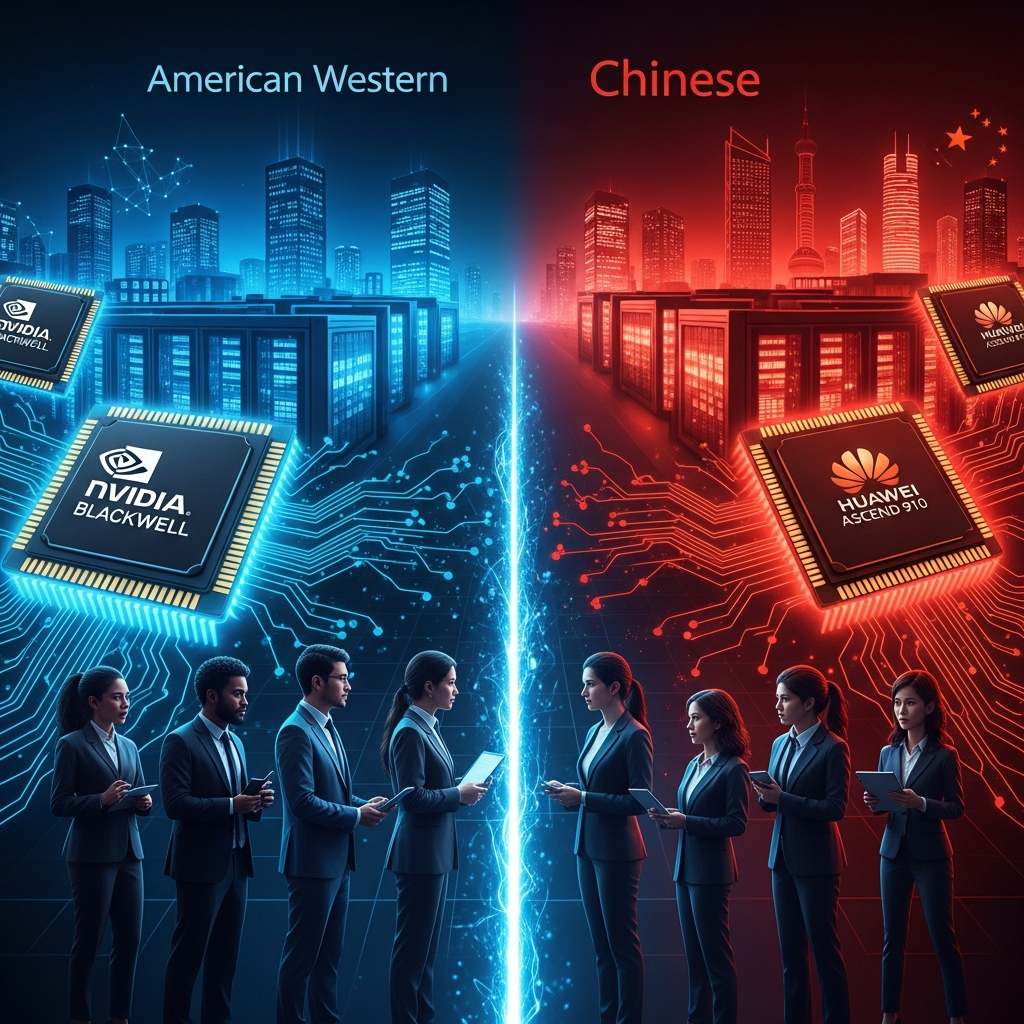
NVIDIA's Q1 FY2027 results, reported May 20, 2026, set historic semiconductor industry records with quarterly revenue of $81.6 billion (up 85% year-over-year), data center revenue of $75.2 billion (up 92%), an operating margin of 66%, and GAAP net income of $28.7 billion — yet the very next day, CEO Jensen Huang publicly acknowledged on CNBC that the Chinese AI chip market had effectively been ceded to Huawei, marking the first time a major semiconductor executive openly declared surrender of an entire national market to a domestic competitor. The U.S. government's H20 chip export ban is expected to cost the company approximately $8 billion in Q2 revenue alone, representing nearly 9% of management's own $91 billion forward guidance for that quarter. Morgan Stanley projects that by 2030, Chinese companies will command 86% of China's AI chip market — a potential $50 billion annual opportunity that NVIDIA may have permanently lost access to, with Huawei's Ascend series now positioned as the dominant supplier to the world's most populous AI market. This divergence between record-breaking financial performance and an extraordinary strategic retreat in the world's second-largest economy creates a paradox that demands deeper scrutiny than the headline numbers alone can provide. The article examines the structural geopolitical risks hidden beneath NVIDIA's unprecedented earnings, analyzes the emerging "AI Iron Curtain" scenario in which global AI infrastructure bifurcates into two incompatible ecosystems, and identifies the key variables that investors and industry observers must monitor across short-, medium-, and long-term horizons.
Key Points
NVIDIA's Historic Q1 FY2027 Records and What Three Consecutive Quarters of Acceleration Actually Mean
NVIDIA's Q1 FY2027 results represent a new ceiling for what a semiconductor company can achieve in a single quarter, and the trajectory matters as much as the absolute numbers. Revenue of $81.6 billion — up 85% year-over-year — combined with data center sales of $75.2 billion (up 92%), a 66% operating margin, and GAAP net income of $28.7 billion ($1.17 EPS) is a stack of records that defies the normal physics of large-number base effects in financial reporting. Three consecutive quarters of accelerating growth in a company that was already generating tens of billions per quarter is a pattern that essentially does not appear in semiconductor industry history. Management's Q2 guidance of $91 billion, issued alongside a 25x dividend increase, signals that leadership sees no cyclical deceleration in the near horizon. The Blackwell architecture, whose full production ramp begins in the second half of FY2027, provides additional fuel. If the $91 billion guidance holds and the Blackwell second-half ramp accelerates as expected, annualized revenue exceeding $350 billion for the full fiscal year becomes a realistic scenario — placing NVIDIA in a financial category previously occupied only by energy giants and national economies. The dividend expansion, in particular, is significant: growth-stage semiconductor companies don't typically increase dividends by 25x unless management has extraordinary confidence in the durability of cash flows well into the future.
Jensen Huang's China Surrender and What It Actually Means for the Global AI Order
When Jensen Huang told CNBC on May 21, 2026 that the Chinese AI chip market had been "ceded" to Huawei, it was the kind of statement that gets written into semiconductor industry history books — and not just for its financial implications. This was not routine CEO commentary about a challenging market segment. This was the world's most valuable chip company's chief executive publicly declaring that an entire national market — belonging to the world's second-largest economy — had been formally written off. The U.S. government's progressive tightening of semiconductor export controls since 2022 created a dynamic where NVIDIA repeatedly engineered around the rules with China-specific, deliberately performance-limited products: the H800 after the A100 was blocked, the H20 after the H800 was blocked. The 2025 H20 ban ended that game entirely. The Q2 impact is approximately $8 billion in lost revenue — nearly 9% of management's own guidance. Morgan Stanley's projection that Chinese companies will command 86% of China's AI chip market by 2030 implies that the revenue foregone isn't just one quarter's China sales but a potentially $50 billion annual market permanently reallocated to domestic Chinese suppliers with zero near-term path for NVIDIA to re-enter. The strategic calculus of whether this outcome was inevitable, or whether different policy choices on either side could have preserved meaningful market access, will define the debate around U.S. semiconductor policy for the remainder of this decade.
The AI Infrastructure Monopoly: Why NVIDIA's Greatest Strength Is Also Its Most Consequential Vulnerability
NVIDIA's estimated 80%-plus share of the data center GPU market creates a situation without clear historical precedent: a single company controls the essential hardware infrastructure for the most transformative technology development of the early 21st century. The CUDA software ecosystem is the invisible structural cement holding this monopoly in place. Decades of developer investment, thousands of optimized neural network libraries, and the entire optimization stack for PyTorch and TensorFlow are all tuned specifically for NVIDIA hardware. Hardware competition alone cannot displace this advantage — a competitor matching Blackwell's benchmark scores tomorrow would still face three to five years of software ecosystem investment before matching the full-stack customer value proposition that CUDA delivers. AMD's ROCm and Intel's oneAPI have been working at this problem for years with limited market-share impact, which tells you something about how difficult this moat is to breach. But this same fortress is what drives every major technology company on earth to invest billions in escape routes. Google's TPU program, Amazon's Trainium, Microsoft's Maia chip development, Meta's MTIA — all are explicitly designed to reduce NVIDIA pricing leverage over AI development costs. The monopoly's strength is precisely what accelerates the pace and funding level of the challenges to it, creating a structural paradox that will define the competitive landscape through the end of this decade.
The Huawei Boomerang: How U.S. Export Policy Funded Its Own Successor
The deepest unintended consequence of U.S. semiconductor export control policy may be the systematic creation of a state-backed, well-funded, technically improving challenger to NVIDIA's global market position. Huawei's Ascend 910B and 910C chips currently lag NVIDIA's H100 on inference performance benchmarks by roughly 30-40%, depending on the specific workload measured. But with something close to monopoly status in China's AI chip market now secured through the effective elimination of NVIDIA as a competitor, Huawei gains access to the revenue base needed to fund the most aggressive AI chip R&D program in the history of Chinese semiconductor development. Morgan Stanley's 86% market share projection by 2030 implies Huawei and domestic peers generating $40 billion-plus annually in AI chip revenue — funds that recirculate directly into next-generation Ascend architectures and the CANN software stack that must underpin Chinese AI development at scale. The deeper strategic concern is ecosystem bifurcation: currently the global AI research community operates almost entirely on the CUDA/NVIDIA stack, meaning open-source model development, weight sharing, and cross-institutional research collaboration all happen within a single technical environment. If Huawei's CANN stack achieves genuine dominance inside China, the interoperability between the two worlds disappears, creating a permanent research divide that is the technological equivalent of Cold War scientific isolation.
Agentic AI and Sovereign AI: The Two Growth Engines That Define NVIDIA's Post-China Trajectory
NVIDIA's management has articulated two specific demand vectors positioned to fill the China revenue gap and potentially exceed it, and both deserve serious analytical attention. The first is the transition from training-centric to inference-centric AI demand, driven by the emergence of Agentic AI — systems that don't merely respond to queries but autonomously plan, reason, coordinate, and execute complex multi-step tasks across extended time horizons. When AI agents are deployed at enterprise scale, inference demand could realistically exceed training demand by an order of magnitude or more, because inference runs continuously in production while training occurs episodically. Blackwell's architecture was specifically engineered for this transition, delivering 4x inference performance improvement and 25x energy efficiency gains over the prior generation. The second vector is Sovereign AI — the trend of national governments committing capital to build domestically controlled AI infrastructure so they aren't dependent on either American or Chinese cloud platforms for AI decisions that touch national security, healthcare, and economic planning. Saudi Arabia, the UAE, Japan, India, France, and Singapore are among the nations now committing tens of billions of dollars to sovereign AI infrastructure programs. This demand is strategically motivated and price-inelastic in ways that hyperscaler demand is not, representing a qualitatively more predictable customer base. Together, these two demand vectors may expand NVIDIA's total addressable market to two to three times current analyst consensus estimates — a genuine long-term upside that partially, and possibly fully, compensates for the China market's permanent loss.
Positive & Negative Analysis
Positive Aspects
- Removing the China Uncertainty Premium as a Structural Valuation Positive
For two consecutive years, every NVIDIA earnings cycle was shadowed by the same recurring anxiety: how much of the company's China revenue was at risk from the next round of export controls? Each new regulation announcement triggered sell-offs, and institutional investors who would otherwise hold full positions stayed underweight because of the perpetual "when's the next China rule change?" overhang that no analyst model could quantify with confidence. Jensen Huang's direct public acknowledgment of China market exit effectively removes that uncertainty premium from NVIDIA's valuation equation in a way that incremental quarterly disclosure never could. Management has now demonstrated they can issue $91 billion forward guidance while fully absorbing the H20 export ban — that's a powerful proof point that the rest of the world's AI demand is more than sufficient to compensate for the lost Chinese market. From a valuation modeling perspective, a revenue stream with quantifiable growth drivers and no geopolitical regulatory overhang commands a higher multiple than a larger but perpetually uncertain revenue base. Warren Buffett's principle applies with force here: predictable earnings streams command premium valuations compared to volatile ones. The clarity Jensen Huang's declaration provides represents a genuine structural improvement in how long-term institutional investors will model NVIDIA going forward.
- The $300 Billion Hyperscaler Capex Tailwind Is Structural, Not Cyclical
The AI infrastructure investment commitments from the world's largest technology companies are contracted, announced, and in most cases already under construction — they are not speculative forecasts. Microsoft has publicly committed more than $80 billion in AI infrastructure investment for 2026 alone. Amazon is projecting over $100 billion in capital expenditures across AWS infrastructure. Meta's AI infrastructure commitment exceeds $65 billion. Google's AI infrastructure spend is projected above $60 billion. The combined capital allocation from just these four hyperscalers approaches $300 billion in a single year, and a substantial fraction of that flows directly to NVIDIA GPU purchases at current technology capability levels. More importantly, this demand is structurally analogous to the post-2020 cloud infrastructure spending wave, which proved irreversible once it began because competitive dynamics made not investing in cloud capability an existential threat to enterprise technology companies. AI capability is following the same irreversibility logic — companies that don't build AI infrastructure now risk falling permanently behind in cloud services, enterprise software, search, and productivity tooling. This structural demand floor is what makes NVIDIA's near-term revenue visibility unusually strong relative to the historical semiconductor cycle, and it provides genuine protection against moderate slowdowns in any single vertical.
- Blackwell's Generational Technical Lead Extends the Competitive Moat
The Blackwell architecture represents a generational advance rather than an incremental improvement over the prior generation, and the gap it creates with competitors is widening rather than narrowing as each quarter passes. Delivering 4x inference performance improvement and 25x energy efficiency gains in a single architectural transition is the kind of advancement that sets new industry benchmarks that take years for competitors to match. But Blackwell's advantage extends beyond aggregate performance scores in standardized benchmarks. The NVLink interconnect system, the integrated transformer engine optimized for modern large language model architectures, and the multi-chip interconnect topology of Blackwell DGX systems are all co-designed around the specific workload characteristics of large-scale AI inference — which is precisely the workload that becomes economically dominant in the Agentic AI era Jensen Huang describes. CUDA's software layer multiplies this hardware advantage: every optimization library, every memory management framework, every distributed training and inference technique that runs on Blackwell has years of engineering investment behind it. A competitor matching Blackwell's headline hardware specifications in 2026 would still require three to five years of software ecosystem development before matching the full-stack value proposition that CUDA's network effects deliver. This software-hardware integration moat is qualitatively different from any advantage AMD, Google, or Amazon currently possesses in the AI chip space.
- Sovereign AI Creates Geopolitically Durable Revenue Outside the Hyperscaler Concentration
The Sovereign AI demand trend represents a qualitatively distinct customer segment from hyperscalers, and that distinction matters for long-term revenue predictability. Hyperscaler customers like Microsoft, Google, and Amazon are sophisticated, cost-conscious buyers who are simultaneously NVIDIA's best customers and its most motivated competitors — they are building in-house silicon programs explicitly to reduce NVIDIA's leverage over their AI development costs. National governments building Sovereign AI infrastructure are motivated primarily by strategic autonomy, not cost optimization. They want domestic AI capability regardless of price premium, because the alternative — dependency on either American or Chinese cloud platforms for AI decisions touching national security, healthcare, or economic planning — is politically untenable. Saudi Arabia's NEOM-related AI infrastructure commitments, the UAE's G42 AI partnerships, Japan's national AI supercomputing programs, and India's IndiaAI mission all represent Sovereign AI buyers who are structurally price-inelastic and multi-year committed. As more national governments recognize AI capability as a sovereignty asset rather than a commercial service, this cohort will grow substantially. NVIDIA's established manufacturing relationships through TSMC and its global system integrator network position it as the default vendor for sovereign deployment. The geographic distribution of sovereign customers — across dozens of countries — also meaningfully reduces the customer concentration risk that has historically been a valuation drag.
Concerns
- The Huawei Boomerang: A 5-7 Year Competitor With Structural Advantages NVIDIA Can't Match
The most serious long-term competitive threat to NVIDIA's global market position is not AMD, Google, or Amazon — it is Huawei, and the mechanism that created this threat is U.S. policy itself. By eliminating NVIDIA from the Chinese market, export controls handed Huawei a captive customer base representing 86% of a $50 billion annual market by 2030. That revenue base funds R&D at a scale that no private company would rationally justify in a competitive environment. Huawei's Ascend chips currently lag NVIDIA's H100 by roughly 30-40% on inference benchmarks, but the combination of government backing, domestic market exclusivity, and massive R&D budgets creates a compounding dynamic that closed performance gaps can close over a five-to-seven-year horizon. Huawei's playbook after the 2019 U.S. smartphone chip sanctions is instructive: rather than collapsing, Huawei built HarmonyOS, developed its own silicon at scale, and regained domestic Chinese market leadership in handsets. If the AI chip trajectory mirrors the smartphone precedent — and there are structural reasons to believe it could — then by 2031-2033, a Huawei with a mature Ascend ecosystem and competitive CANN software stack could credibly challenge NVIDIA on price-to-performance in Southeast Asia, the Middle East, Africa, and Latin America. Those are markets NVIDIA currently serves without serious competition, and their loss would be a meaningful long-term revenue event that today's financial models do not adequately capture.
- The Cisco Parallel: What Happens When Infrastructure Investment Cycles Break Unexpectedly
NVIDIA's growth story rests on a foundational assumption that deserves more explicit stress-testing than it typically receives in bullish analysis: that hyperscaler AI investment sustains at current or higher levels for the foreseeable future. The uncomfortable structural parallel to Cisco Systems in 1999-2001 deserves serious attention from any investor holding NVIDIA at current multiples. Cisco was the undisputed essential infrastructure vendor for internet buildout. Router demand appeared infinite. Every major brokerage had a bullish thesis with escalating price targets. Then when the investment cycle reversed — triggered not by Cisco's failure but by the broader realization that internet ROI wasn't materializing at the scale expected — Cisco's stock lost more than 80% from its peak, and the company spent two decades trying to recover its former growth trajectory. The mechanism is identical to the risk facing NVIDIA today: when the expected returns from AI investment are seriously questioned at the institutional level, capex plans get revised downward faster than supply chains can absorb, and the company with the most concentrated exposure to that capex cycle takes the deepest hit. NVIDIA's current P/E ratio above 50x means that even a modest deceleration in its growth rate produces violent valuation multiple compression. This is not a prediction that NVIDIA replicates Cisco's fate — the AI thesis is more grounded than internet speculation was. But the structural similarity between the two situations demands explicit modeling rather than dismissal.
- Customer Concentration and the BigTech In-House Chip Defection Risk
NVIDIA's revenue is heavily concentrated among four to five hyperscaler customers, and those customers are simultaneously the most sophisticated buyers in the world and the most motivated to reduce their dependency on NVIDIA. Microsoft, Meta, Google, and Amazon collectively drive a disproportionate share of NVIDIA's data center GPU revenue, meaning that a significant capex reduction by even one of them creates an outsized impact on NVIDIA's growth rate. More structurally concerning, each of these companies is running billion-dollar in-house chip programs explicitly designed to reduce NVIDIA pricing leverage: Google's TPU v5 is handling growing internal AI workloads, Amazon's Trainium 2 is offering AWS customers a cost-optimized alternative, Microsoft's Maia chip is in active development, and Meta's MTIA program is targeting specific internal inference workloads. None of these programs will displace NVIDIA across the full range of AI applications in the near term — the CUDA moat is too deep for that. But as AI workloads standardize and hyperscalers optimize for well-understood, recurring computational tasks, the economic case for in-house silicon strengthens with each passing quarter. The current demand-exceeds-supply environment masks this risk because NVIDIA doesn't need to discount to win business. When supply normalizes and the investment cycle matures, NVIDIA's customer concentration creates a structural vulnerability that multi-year bull cases consistently underweight.
- Geopolitical Risk as a Permanent Structural Discount Factor
NVIDIA now operates in an environment where U.S. government export control policy can eliminate significant revenue streams with little notice, incomplete transparency into timing, and no direct recourse for the company. The H20 ban was the most dramatic example, but there is no structural reason to believe it was the last. The Trump administration's China trade policy could escalate further — imposing restrictions on chip sales to third countries suspected of re-exporting to China, adding new chip performance thresholds to the export control list, or requiring end-use verification at a scale that NVIDIA cannot operationally guarantee. Simultaneously, European regulatory scrutiny through the EU AI Act and Digital Markets Act could eventually target NVIDIA's CUDA software bundling practices as anticompetitive market behavior, which would strike at the foundation of the software moat that makes NVIDIA's pricing power structural. Taiwan Strait tensions introduce a separate category of geopolitical risk: NVIDIA's manufacturing partner TSMC concentrates its most advanced node production in Hsinchu, and any military or economic disruption affecting Taiwan's semiconductor output would immediately cascade through NVIDIA's supply chain. These geopolitical variables cannot be modeled with precision, but they create a risk environment that rationally justifies a structural discount from any valuation based solely on earnings trajectory — a discount that is only partially reflected in current consensus price targets.
- Global AI Ecosystem Fragmentation and the Structural Damage to Open Innovation
The AI Iron Curtain scenario carries consequences for the trajectory of global AI progress that extend well beyond NVIDIA's own revenue line, but those consequences ultimately feed back into the pace of AI capability development that creates demand for next-generation GPU architectures. If the open-source AI community — currently built almost entirely on CUDA, running on PyTorch and TensorFlow frameworks deeply optimized for NVIDIA hardware — splits along geopolitical lines, the collaborative network effects that have driven AI progress since 2017 are severed. Research published on NVIDIA hardware becomes difficult to reproduce on Huawei hardware. Model weights trained on CUDA can't be efficiently deployed on CANN. Cross-border scientific collaboration that produced GPT-3, LLaMA, Stable Diffusion, and hundreds of research breakthroughs becomes structurally harder. For NVIDIA specifically, this fragmentation is not primarily a near-term financial event — NVIDIA doesn't depend on Chinese research contributions to its revenue. But over a ten-year horizon, the fracturing of the global AI research commons slows the pace of AI capability advancement that generates demand for each successive generation of NVIDIA GPUs. More immediately, the geopolitical split creates a multilateral humanitarian and development problem for the dozens of countries that were never party to the U.S.-China semiconductor conflict: developing-world AI developers unable to purchase NVIDIA hardware at scale, and unable to access functional software ecosystems for Huawei chips outside China's sphere, risk permanent exclusion from the AI revolution's first and most consequential wave.
Outlook
In the near term — the next one to six months — NVIDIA faces simultaneous forces pulling the stock in opposite directions. The most immediate event is the Q2 FY2027 earnings report, where management's own $91 billion guidance becomes the primary test. The fact that management issued that number while fully absorbing the $8 billion H20 export hit signals extraordinary confidence in demand from the rest of the world. I estimate the probability of hitting that guidance at over 85%, because the AI infrastructure investment plans of Microsoft, Meta, Google, and Amazon have already been publicly committed. Microsoft's $80 billion, Meta's $65 billion, Amazon's $100 billion-plus — these are contracted capital expenditures in motion, and a meaningful fraction of each flows directly to NVIDIA GPU purchases. The Blackwell architecture ramp in the second half of FY2027 provides additional near-term revenue catalyst.
There are near-term variables that demand attention alongside the revenue momentum. The Trump administration's China trade policy is genuinely unpredictable — it could further tighten export controls, add third-country re-export restrictions, or signal partial relief, and any of those outcomes would trigger sharp NVIDIA stock moves in either direction. NVIDIA's current P/E ratio above 50x means the stock is priced for sustained extraordinary growth, and even a modest earnings miss could produce a 10-15% correction. More subtly, Wall Street's skepticism about whether AI investment ROI will materialize at scale is beginning to gather momentum. The question — "are these hyperscalers actually going to earn back what they're spending on AI?" — is getting louder in analyst circles, and if that doubt becomes consensus, it creates a structural headwind for every GPU-dependent earnings thesis.
Looking to the medium term — six months to two years — the most critical development to monitor is the evolution of the competitive landscape. NVIDIA holds 80%-plus of the data center GPU market today, but maintaining that level into 2027-2028 requires more optimism than the evidence supports. Google's TPU v5 is already absorbing a meaningful share of Google's internal AI workloads. Amazon's Trainium 2 is demonstrating credible price-to-performance economics for AWS customers choosing between vendors. AMD's MI300X is leveraging memory bandwidth superiority to take share in specific high-memory workload categories. My working estimate is that NVIDIA's data center GPU market share drifts down to the 70-75% range by late 2027. That remains a commanding position, but the transition from "monopoly" to "dominant incumbent" carries measurable P/E multiple compression risk.
Even more consequential in the medium term is Huawei's technology development trajectory. Industry estimates put the Ascend 910B/910C at roughly 60-70% of NVIDIA H100 inference performance — a 30-40% gap. But with near-monopoly status in China's AI chip market now secured, Huawei gains the revenue base to fund the most aggressive AI chip R&D program in Chinese history. Morgan Stanley's projection of 86% domestic market control by 2030 implies Huawei generating $40 billion-plus annually — capital that recirculates directly into closing the performance gap and expanding the CANN software ecosystem. I believe Huawei can realistically narrow the performance gap from 30-40% to 15-20% by 2028. At that level, it's more than competitive enough for China's domestic AI market. That matters because a technically capable, financially robust Huawei eventually looks beyond China's borders to Southeast Asia, the Middle East, and Africa — markets NVIDIA currently serves without serious competition.
Over the long term — two to five years — the single most important variable shaping NVIDIA's trajectory is whether AI infrastructure demand remains durable. The entire growth story rests on sustained hyperscaler AI investment. The problem is that stable, scalable ROI from AI services remains concentrated in a small number of applications and companies. Microsoft's Copilot and Google's Gemini-based products represent genuine, recurring AI monetization. But most enterprise AI investment remains in a pre-monetization phase — companies spending heavily on AI capability without yet demonstrating proportional revenue return. If a broad consensus forms over the next two to three years that AI investment returns are falling short of expectations, the hyperscaler capex cycle could break faster than anyone currently projects.
The structural parallel to what happened to Cisco during the dot-com collapse is uncomfortable but analytically necessary. Cisco was the essential infrastructure vendor for internet buildout. Router demand seemed infinite. Every analyst had a bullish case. And when the investment cycle reversed — driven by the realization that expected returns weren't materializing — Cisco's stock lost more than 80% from its peak. I am not predicting NVIDIA replicates that outcome. The AI investment thesis is more grounded than internet speculation was in 2000. But the structural similarity between "essential infrastructure monopolist in an accelerating investment cycle" deserves serious weight in any long-term model.
The AI Iron Curtain scenario is the second long-term variable that could define NVIDIA's ultimate ceiling. If the world genuinely bifurcates into a NVIDIA/CUDA ecosystem — encompassing the U.S., Europe, Japan, Korea, and allied nations — and a Huawei/CANN ecosystem encompassing China, Russia, and an increasing fraction of the developing world, the consequences extend well beyond NVIDIA's revenue line. Almost all current open-source AI models are developed, trained, and deployed on the CUDA software stack. Huawei's proprietary software layer expanding inside China means that interoperability between the two ecosystems disappears. AI research communities fracture along geopolitical lines. Models can't be freely shared across the divide. Techniques developed on one platform can't be efficiently ported to the other. The pace of global AI progress slows — not because either camp is technically inferior, but because the collaborative network effects that have driven AI advancement since 2017 are severed. The genuine long-term losers are countries that cannot afford entry into either camp: African AI developers unable to purchase NVIDIA hardware at scale, Southeast Asian researchers unable to access functional software ecosystems for Huawei chips outside China.
Scenario analysis across three paths: In the bull case (probability roughly 25%), the AI infrastructure investment cycle sustains through 2028-2029, NVIDIA's annual revenue crosses $400 billion, and Agentic AI scales faster than expected, driving inference demand past training demand by 10x. Sovereign AI programs across dozens of governments fill the China revenue gap and then exceed it. In this scenario, NVIDIA's market capitalization approaches $5 trillion and the company enters a phase of genuine cash-return compounding. In the base case (probability roughly 50%), AI investment moderates beginning in 2027, NVIDIA's market share settles in the 70-75% range, and annual revenue stabilizes in the $300-350 billion range. Huawei closes the performance gap but doesn't threaten NVIDIA in markets outside China. The stock's valuation multiple compresses modestly, producing mid-single-digit annual returns from current levels. In the bear case (probability roughly 25%), AI investment ROI disappointment spreads by mid-2027, hyperscaler capex falls 20-30%, and Google, Amazon, and AMD collectively pull NVIDIA's share below 60%. The company remains large and profitable, but the growth rate collapse triggers multiple compression that sends the stock down 30-40% from current levels.
A historical parallel is worth examining in detail. NVIDIA's current position most closely resembles Intel in the late 1990s and early 2000s. Intel was the unambiguous essential chip provider for the PC era. The "Intel Inside" brand was a civilizational constant. Its market dominance seemed absolute, and credible alternatives were dismissed. Then the smartphone revolution began, Intel proved unable to adapt its x86 architecture to the ARM model that mobile required, manufacturing process development fell behind TSMC, and a two-decade structural decline followed that has never fully reversed. The paradigm-shift risk analogous to mobile for NVIDIA would come from quantum computing achieving commercial viability, neuromorphic chips optimized for inference workloads, or photonic computing substrates that could make GPU-based training look as dated as mainframe computing looks today. Full commercial viability within five years for these technologies seems unlikely. But on a ten-year horizon, investors should hold the current GPU-centric AI paradigm with open hands, not clenched fists. The companies that held Intel as irreplaceable in 2000 experienced a painful education in paradigm impermanence.
The cascading structural effects of the current moment are worth summarizing explicitly. As a first-order effect, U.S. export controls eliminate NVIDIA's Chinese revenue. As a second-order effect, Huawei monopolizes China's AI chip market and funds its own ecosystem at scale. As a third-order effect, the global AI ecosystem bifurcates into two incompatible technology stacks. As a fourth-order effect, developing-world countries that can access neither premium NVIDIA hardware nor China's regionally-restricted ecosystem are permanently excluded from the first wave of the AI revolution — creating an AI access gap that compounds into economic, educational, and medical capability gaps over the following decade.
There are conditions under which this outlook would prove wrong. U.S.-China relations could improve unexpectedly, leading to export control relaxation and renewed NVIDIA market access in China. Huawei's technology development could stall due to component shortages, talent constraints from educational restrictions, or internal management failures. The AI investment cycle could run considerably longer than historical capex cycles suggest, sustaining NVIDIA's growth well into the 2030s. If any of these reversals materialize, the China exit would register as a temporary noise event in an otherwise uninterrupted growth story. But based on current data and prevailing geopolitical momentum, the combined probability of all three reversals occurring simultaneously is below 30%.
For investors holding NVIDIA positions: there is no immediate case for exiting. But the structural questions embedded in Jensen Huang's public China admission deserve more analytical weight than quarterly earnings enthusiasm typically allows. If you're carrying NVIDIA at more than 10% of a diversified portfolio, you may be systematically underpricing the structural risks embedded in a position this concentrated in a single AI infrastructure vendor. Diversifying across the semiconductor value chain — AMD for competition exposure, TSMC for manufacturing exposure, ASML for equipment exposure — deserves serious consideration. If NVIDIA is genuinely the Rockefeller Standard Oil of the AI era, understanding exactly how that monopoly eventually unravels is as essential as understanding why it exists in the first place.
Sources / References
- NVIDIA Q1 FY2027 Earnings: $81.6B Revenue and Three Straight Quarters of Acceleration — TIKR
- Nvidia's Jensen Huang Says China AI Chip Market Has Been Ceded to Huawei — CNBC
- NVIDIA's Earnings Are Hiding an $8 Billion China Problem — Vested Finance
- NVIDIA Q1 Revenue Jumps Despite China Export Setback — Futurum Group
- Did NVIDIA CEO Jensen Huang Just Unlock the $50 Billion China Market? — 247 Wall Street
- NVIDIA: China Revenue Constraints Don't Negate the Bull Case — Seeking Alpha
- NVIDIA Stock: Record Revenue, China Losses, and the End of the Gaming GPU Era — CoinPaper