
While the World Burned, Morgan Stanley Cashed In — The $3.43 Paradox
Summary
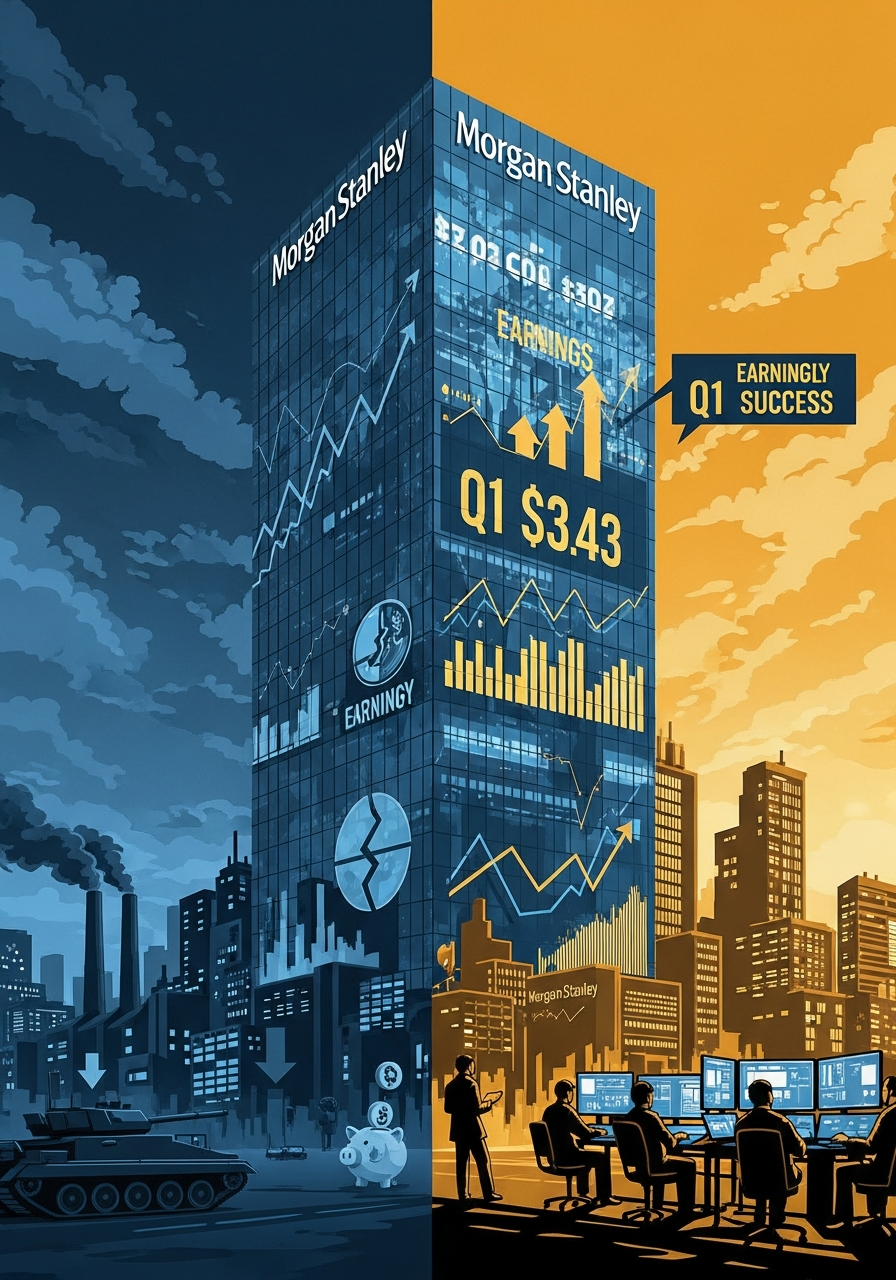
Morgan Stanley's Q1 2026 earnings delivered a stunning 14.3% beat over Wall Street consensus, posting an EPS of $3.43 against the expected $3.00, while revenues of $20.58 billion surpassed the $19.72 billion forecast by 4.4%, driven simultaneously by investment banking, FICC trading, and wealth management strength. In the same week, the IMF downgraded its global growth forecast to 3.1% and warned that war was darkening the economic outlook, trimming global trade volume growth to 2.8% as the Strait of Hormuz crisis sent oil prices 45% higher and sub-Saharan African growth fell to just 2.1%. The simultaneous existence of record investment bank earnings and deteriorating global economic fundamentals is not coincidental but structurally causal — uncertainty, volatility, and geopolitical disruption are the raw materials that investment banks convert into profit. This stark divergence exposes the deepest structural characteristics of financial capitalism, revealing how dramatically the gap between financial and real economies has widened in the 2020s, with the IMF's growth cuts and Morgan Stanley's record profits functioning not as contradictions but as two sides of the same structural equation. Dissecting Morgan Stanley's Q1 performance surfaces the most uncomfortable truth about how modern capitalism allocates its rewards — and raises the urgent question of whether Wall Street's banner quarter is a genuine economic green light or a flashing warning signal disguised as a victory lap.
Key Points
A 14.3% Earnings Beat — The Scale and Meaning of Morgan Stanley's Q1 Results
Morgan Stanley's Q1 2026 earnings per share of $3.43 represented a 14.3% beat over the Wall Street analyst consensus of $3.00, a margin of outperformance that surprised even the most optimistic forecasters on the Street. Revenue of $20.58 billion exceeded the $19.72 billion forecast by $860 million, a 4.4% beat driven by simultaneous strength across the three core businesses: investment banking advisory, FICC trading, and wealth management fee income. On the same day, Bank of America also beat expectations and traded up 1%, and JPMorgan delivered its own earnings beat — while Wells Fargo fell 5%, making the divergence within the banking sector impossible to ignore. This contrast is not merely a story of different business models performing differently in a given quarter; it is a structural signal that investment-banking-oriented financial institutions and retail-banking-oriented institutions now move in near-opposite directions when global economic stress rises. The S&P 500's 1.18% gain and the Nasdaq's 1.96% rise on that day reflected market-wide enthusiasm for the financial sector's strength, but the Wells Fargo decline was a warning that this enthusiasm was selective — and that selectivity is precisely where the most important analytical story lives.
IMF 3.1% vs. Wall Street Boom — The World Where Both Numbers Are True Simultaneously
The IMF's April 2026 World Economic Outlook downgraded global growth to 3.1% as a direct consequence of war and escalating trade conflict, reducing the global trade volume growth forecast to 2.8% and noting that the Strait of Hormuz crisis had sent oil prices 45% higher while sub-Saharan African growth fell to just 2.1%. These are the economic conditions of a world under genuine stress — rising energy costs, compressed trade flows, declining growth across developing markets, and pervasive uncertainty about geopolitical trajectories. The fact that Morgan Stanley delivered its highest earnings beat in recent quarters under precisely these conditions is not a contradiction that requires reconciliation; it is a causal relationship that demands explanation. The mechanism is straightforward once you see it: uncertainty drives defensive M&A, volatility explodes hedging demand in FICC markets, and anxious wealthy individuals and institutions turn to professional asset management in larger numbers and with greater urgency. All three of these channels flow directly into Morgan Stanley's core revenue drivers, which means that the worse the IMF's global assessment becomes, the more business Morgan Stanley tends to generate. This is the structural paradox at the heart of modern investment banking.
Uncertainty Is Investment Bank Fuel — The Uncomfortable Truth About Incentive Structures
Dissecting the revenue structure of a major investment bank reveals a positive correlation between uncertainty and profitability that has profound systemic implications. The FICC trading business generates its highest margins when the VIX is elevated and bid-ask spreads are wide — market conditions that cause individual investors to lose sleep while Morgan Stanley's trading desk captures the spread. The investment banking advisory business thrives when geopolitical risk compels companies to pursue defensive restructuring, cross-border acquisitions, and supply chain realignment — all of which generate advisory fees. The wealth management business grows its fee income when high-net-worth clients, spooked by volatility, increase their reliance on professional portfolio management and more frequently rebalance their holdings. The uncomfortable implication of this structure is that large investment banks do not have a strong systemic incentive to see the world become more stable. A catastrophic collapse like Lehman 2008 hurts everyone, including investment banks — but a sustained, moderate level of geopolitical and economic anxiety is, structurally speaking, close to optimal for their business model. This is not a conspiracy; it is basic incentive economics. The same logic that explains why hospitals don't profit from a perfectly healthy population explains why investment banks don't profit from a perfectly stable world.
The K-Shaped Split Inside Finance — Wells Fargo Down, Morgan Stanley Up
The simultaneous 5% decline in Wells Fargo and the earnings beat at Morgan Stanley on April 15th is a textbook illustration of K-shaped economic inequality operating inside the financial sector itself. Wells Fargo's primary business is serving ordinary American households — checking accounts, auto loans, mortgages, credit cards — businesses that suffer directly when economic conditions deteriorate, consumer confidence falls, and loan delinquency rates tick upward. Morgan Stanley's primary businesses serve corporations and wealthy individuals — businesses that don't merely survive economic turbulence but often benefit from it. This divergence does not stay contained within the financial industry. When retail banking underperforms, ordinary households face tighter credit access, lower interest income on savings, and reduced financial flexibility at exactly the moment they need it most. When investment banking outperforms, wealthy asset owners see their portfolios appreciate and their financial advisors generate strong returns, accelerating wealth accumulation at the top. The Federal Reserve's own data shows that the top 10% of American households own approximately 88% of all corporate equities. When Morgan Stanley's earnings beat drives its stock price higher, the overwhelming majority of that gain accrues to the narrow slice of the population that already holds significant wealth. That distributional reality is worth sitting with before celebrating Wall Street's success as national economic good news.
The 2007 Déjà Vu? — Why Record Profits Don't Guarantee System Safety
History has demonstrated more than once that record earnings at major investment banks can coexist with — and even precede — serious systemic instability. In 2006 and 2007, Goldman Sachs and Morgan Stanley were posting record results as the subprime mortgage market appeared to be performing robustly, only for the entire architecture to collapse with Lehman Brothers' bankruptcy in September 2008. The record profits of 2006-2007 were real, but they were being generated against a backdrop of rapidly accumulating leverage and opacity in the derivatives book that the earnings reports did not make visible. Claiming that 2026 is identical to 2007 would be an overstatement — regulatory requirements have changed meaningfully since then, and capital ratios at major banks are substantially stronger. But the lesson is durable: a strong quarterly earnings number does not certify that the underlying system is safe. The current systemic risks worth monitoring include the rapid expansion of the private credit market — where major institutions including Morgan Stanley have been increasing exposure aggressively — along with the concentration of commercial real estate loan maturities set to peak around 2027 in a market where remote work has permanently elevated office vacancy rates. Quarterly earnings beats do not make these structural vulnerabilities disappear; in fact, a period of unchallenged profitability has historically tended to coincide with the accumulation of risks that become visible only when the cycle turns.
Positive & Negative Analysis
Positive Aspects
- Demonstrated Resilience of the American Financial System Under Multi-Dimensional Stress
The fact that Morgan Stanley and several peer institutions delivered double-digit earnings beats in a quarter simultaneously marked by Strait of Hormuz tensions, US-China tariff re-escalation, and European recession concerns is meaningful empirical evidence that the American financial infrastructure retains significant shock-absorption capacity. The post-2008 reforms — Basel III capital requirements, mandatory stress testing, enhanced liquidity coverage ratios, and improved risk management mandates — appear to be functioning as intended when tested against genuine global turbulence. This systemic resilience is not merely a benefit to shareholders; it functions as a global public good. The US financial system's stability underpins the dollar's reserve currency status, supports the functioning of global capital markets, and provides the bedrock of confidence that allows corporations and governments around the world to plan and invest. If this system were to show cracks under the kind of multi-front stress experienced in Q1 2026, the cascade effects across global credit markets would be severe. The fact that it held — and more than held — provides a genuine floor of confidence for economic actors worldwide, and that should be acknowledged honestly even by those, like me, who are deeply skeptical of the distributional implications of how that resilience is achieved.
- The M&A Market Recovery as a Positive Economic Barometer
Morgan Stanley's outperformance in investment banking advisory signals that strategic deal-making activity is returning to life after a prolonged period of deal drought driven by rate uncertainty and macroeconomic hesitation. Whether the M&A activity is defensive or opportunistic in nature, the fact that corporate managements are committing to major transactions suggests they have achieved sufficient visibility into the future to justify the inherent risk of a major acquisition or merger. Global M&A deal volume in Q1 2026 showed year-over-year recovery, and this is not trivial data — it indicates that the paralysis of the rate-hiking cycle is beginning to lift in at least some sectors. M&A activity is not purely a wealth transfer mechanism: at its best, it accelerates industry restructuring, channels capital toward higher-productivity uses, and facilitates the absorption of innovation-driven businesses into larger platforms that can scale them. The concentration of deal activity around AI and clean energy transition is particularly worth noting as a positive signal, suggesting that capital is actively finding its way to the sectors where productivity-enhancing investment is most urgently needed in the coming decade.
- Orderly Capital Reallocation Through Professional Wealth Management
The continued growth of Morgan Stanley's wealth management business has a systemic benefit that is easy to overlook: it helps ensure that capital reallocation during periods of market stress happens in an organized, professionally mediated way rather than through panic-driven retail selling. When high-net-worth clients work with experienced advisors to rebalance their portfolios in response to geopolitical disruption, the result tends to be thoughtful repositioning rather than sudden liquidation. This matters for market stability because large, disorderly sell-offs can trigger cascading price collapses that damage the wealth of a much broader range of market participants, not just the wealthy. E*TRADE's integration has also extended Morgan Stanley's advisory reach deeper into the retail investor segment, meaning this stabilizing influence operates across a wider range of account sizes than it did before the acquisition. In a world where algorithmic trading and social media-driven retail panic can amplify market dislocations rapidly, the presence of professional long-term wealth management at scale provides a meaningful counterweight — one that benefits the functioning of markets broadly, not just the clients directly served.
- Indirect Evidence of Credit System Health
The strong capital ratios and earnings quality demonstrated by major investment banks in Q1 2026 provide meaningful indirect evidence that the probability of a systemic bank failure event — of the kind that triggered the 2008 credit crunch — remains low in the near term. Morgan Stanley and its peers are reporting Common Equity Tier 1 (CET1) ratios comfortably above regulatory minimums, and loan delinquency metrics remain within manageable ranges. This matters enormously for the real economy because a sudden withdrawal of credit availability — a credit crunch — would represent a far more damaging shock than the gradual headwinds currently being generated by geopolitical turbulence and trade uncertainty. The fact that major banks are well-capitalized and generating strong returns on equity actually reduces the probability of credit rationing, which means businesses can still access financing for investment and operations. At a moment of considerable geopolitical uncertainty, the knowledge that the credit plumbing of the economy is holding under pressure is a genuine stabilizing factor — even for those who are rightly critical of the distributional structure through which that stability is maintained.
Concerns
- The Structural Entrenchment of Financial-Real Economy Divergence
The simultaneous occurrence of Morgan Stanley's $3.43 EPS and the IMF's growth downgrade is not a one-time anomaly — it is the latest data point in a long-running structural trend that has been accelerating since the post-2008 era of quantitative easing. The US financial sector's share of GDP has risen to approximately 8.5% in 2026 from 7.5% in 2006, and the mechanisms that drive this expansion — financial asset price inflation sustained by central bank liquidity, the concentration of gains among asset holders, and the structural advantage of financial institutions in capturing value from volatility — are not weakening. When the financial sector consistently grows faster than the real economy, the result over time is misallocation of talent and capital toward financial engineering and away from physical production and innovation, increasing fragility in the event of a correction, and a progressive erosion of the real economy's capacity to generate broadly shared prosperity. The career pipelines of elite universities increasingly feed into finance rather than manufacturing, medicine, or education, reflecting and reinforcing the structural incentive gap between what the financial sector pays and what the real economy can offer. History does not offer a single clear example of this structural divergence self-correcting without a painful adjustment phase — and the larger the divergence grows before correction arrives, the more painful and disruptive the eventual reckoning tends to be for the broadest range of economic participants.
- The Financial System Mechanism That Accelerates Wealth Inequality
The Wells Fargo decline and Morgan Stanley advance on April 15th illustrate that the financial system's internal structure actively accelerates wealth inequality rather than simply reflecting it. When retail banking underperforms — as Wells Fargo did — it means ordinary households face contracting access to affordable credit, declining returns on savings, and reduced financial flexibility. When investment banking outperforms — as Morgan Stanley did — it means that wealthy individuals and institutions see their assets appreciate, their deal-making facilitated, and their portfolio management optimized. With the top 10% of American households owning approximately 88% of all corporate equity, the wealth effects of Morgan Stanley's earnings beat accrue overwhelmingly to those who are already financially secure. This is not a temporary distributional outcome — it is a structural feature of how the current financial system operates, and it tends to compound over time. As this divergence deepens, the political consequences accumulate: rising populist anger toward financial institutions, political pressure for punitive regulation, and potential systemic instability as the social contract around financial markets frays. Ironically, the financial system's structural enrichment of the already-wealthy may ultimately threaten the legitimacy and stability of the financial system itself.
- The Ethical Tension of Profiting from Instability
The fact that a significant portion of Morgan Stanley's FICC trading revenue is generated from the volatility created by wars and geopolitical crises creates genuine ethical tension that the financial industry rarely confronts honestly. When the Strait of Hormuz crisis sent oil prices 45% higher, the people bearing the most acute pain from that spike were energy-importing developing nations and lower-income households facing surging transportation and heating costs. At the same time, Morgan Stanley's FICC trading desk was capturing widened bid-ask spreads on commodity derivatives, maximizing margins precisely because the markets were so volatile. Investment banks do not create the geopolitical crises that drive commodity volatility — that is an important clarification. But the fact that their revenue model systematically extracts profit from the financial consequences of human suffering is a systemic design question that deserves public scrutiny. More broadly, the incentive structure that makes sustained moderate instability optimal for investment bank profitability creates a subtle but real tension with the broader societal interest in stable, peaceful global conditions. This is not a moral accusation directed at individuals — it is a systems design problem that regulators and policymakers have consistently failed to address directly.
- The False Safety Signal From Strong Earnings — The Risk of Complacency
The danger that investors, regulators, and the public will interpret Morgan Stanley's record earnings as a broad signal of systemic safety is real and historically well-grounded in episodes of catastrophic miscalculation. In 2006 and 2007, consecutive record earnings at major investment banks provided false comfort about the stability of a financial system that was quietly accumulating catastrophic levels of leverage and opacity in structured credit products. The quarterly earnings reports were accurate — the banks were genuinely making money — but they provided no visibility into the structural vulnerabilities building underneath. Today's equivalent risks include the rapid and largely opaque expansion of the private credit market, where major institutions have been taking on exposures with limited secondary market liquidity and uncertain valuation methodology. The concentration of commercial real estate loan maturities around 2027 represents another cluster of embedded risk, particularly given persistently elevated office vacancy rates in major urban markets. Strong quarterly earnings do not neutralize these structural risks; in fact, prolonged periods of strong earnings tend to produce exactly the kind of risk management complacency that makes systemic shocks more likely and more severe when they eventually arrive.
Outlook
Let's talk about where this goes from here. I look at this in three time horizons — short, medium, and long term — and the scenarios diverge meaningfully at each stage. My honest conclusion is that none of these paths is straightforward for individual investors. Let me work through them one by one, because the details matter enormously here.
In the short term — call it one to six months out — Morgan Stanley is likely to maintain its current momentum. The post-earnings price action has already entered positive territory, and the broader market's enthusiasm on that 1.18% S&P 500 day could linger for some time. The two key variables in the near term are, first, what signal the Federal Reserve sends at its June FOMC meeting on rates. Markets are currently pricing in at least one rate cut in the second half of 2026 — if that expectation holds, financial stocks including Morgan Stanley have further upside. The second near-term variable is the Strait of Hormuz situation: if the crisis escalates, it paradoxically could mean more trading revenue for the FICC desk, but a genuine extreme scenario like a full blockade could destabilize the global financial system in ways that hurt even the strongest banks. The line between "profitable uncertainty" and "catastrophic uncertainty" is finer than markets typically acknowledge.
My short-term read is that Morgan Stanley's stock could climb another 5 to 10% from current levels, driven by market expectations that Q2 will also beat. On a price-to-earnings basis, the stock is trading around 13 to 14 times earnings, which is not in overheated territory relative to peers. But here is the critical thing to internalize: this near-term upside — if it materializes — would be driven not by economic improvement but by sustained uncertainty. That irony is something individual investors need to sit with deliberately. Short-term traders can ride this momentum, but without pre-defined entry and exit levels, it is very easy to get caught in the volatility reversal when it inevitably arrives. Momentum strategies work until they don't, and in financial stocks, the reversals tend to be sharp and sudden.
The medium-term picture — roughly six months to two years — is where things get genuinely complex and the dynamics shift. The central variable here is the timing and pace of the Federal Reserve's pivot to rate cuts. If the Fed begins cutting in Q4 2026 or Q1 2027, Morgan Stanley could enter a second earnings supercycle. Rate cuts boost bond prices, generating mark-to-market gains in the FICC portfolio, and simultaneously lower the cost of M&A financing, generating more deal advisory volume and fees. Anyone who remembers how Morgan Stanley's stock behaved the last time the Fed cut rates in 2019 will recognize the pattern that could repeat here — the stock moved decisively higher, and wealth management AUM grew rapidly as clients repositioned into riskier assets.
But the medium-term picture carries its most significant risk in the regulatory environment. When financial-real economy divergence becomes a sustained political flashpoint — and I believe it will — Congress could begin serious discussion of windfall profit taxes on major banks. Europe has already applied this logic to energy companies; the extension to financial institutions is not far-fetched. The political pressure is building. Even from historically pro-business corners of American politics, the rhetoric about Wall Street enriching itself while Main Street struggles is intensifying, and that rhetoric has a way of translating into legislation eventually. A surprise regulatory action could reprice financial stocks quickly and dramatically, regardless of underlying earnings quality.
The medium-term also brings the Basel III Endgame question to a head. The final implementation of enhanced capital requirements in the United States would reduce allowable leverage in trading books, creating meaningful downward pressure on earnings margins in precisely the FICC businesses that have been driving outperformance. My view is that this regulatory risk is significantly underpriced by the market relative to what it would actually mean for Morgan Stanley's structural profitability and return on equity targets. And there is a third medium-term headwind worth naming explicitly: competitive pressure in wealth management. Since the E*TRADE acquisition, Morgan Stanley has expanded its retail client base impressively, but Charles Schwab, Fidelity, and increasingly sophisticated AI-based wealth platforms are intensifying competition in this space. By 2027 or so, AI-powered advisory tools may be able to deliver genuinely personalized portfolio optimization that competes meaningfully with what human advisors offer at Morgan Stanley — at a fraction of the cost to the client. This is a medium-term fee compression story that I do not think the market has fully priced into the current valuation.
Looking at the long term — the two-to-five-year horizon — we hit the most fundamental structural question: can financial-real economy divergence sustain itself at its current magnitude? My honest view is that it cannot continue indefinitely. History shows that when the financial sector grows disproportionately relative to GDP, structural correction eventually follows, and the corrections are rarely gentle. The US financial sector's share of GDP is estimated at approximately 8.5% in 2026, higher than the 7.5% recorded in 2006 — the year before the fault lines in the financial system began to crack publicly. Historical precedent suggests that when this share approaches or crosses 9%, some form of structural adjustment becomes significantly more probable, though the timing and form are impossible to predict precisely.
The largest long-term structural variable is the maturation of digital assets and decentralized finance. Right now, traditional investment banks like Morgan Stanley extract enormous value from their role as intermediaries — in capital raising, M&A advisory, custody, and settlement. As blockchain-based financial infrastructure matures, a meaningful portion of these intermediary functions could be automated at the protocol level, compressing the fee pools that investment banks depend on. This transition will not happen violently within five years; it will be a gradual erosion of specific revenue streams. But whether Morgan Stanley can sustain its current fee structure through 2030 and beyond is something I am genuinely skeptical about — and I suspect its most strategic executives are skeptical about it too, which is why the firm has been making quiet moves into digital asset custody and tokenized securities.
Now let me lay out the scenarios explicitly, because abstract discussion of risk is less useful than a structured framework. In the bull case — which I assign roughly 25% probability — the Fed begins cutting in Q4 2026, the Strait of Hormuz situation resolves diplomatically, and the M&A market opens up in earnest as deal-making confidence returns. Under this scenario, Morgan Stanley's annual EPS could reach $14 or above, and the stock could climb 20 to 30% from current levels, entering a range of $130 to $140. The wealth management business would also benefit from rising asset prices, creating a self-reinforcing cycle of AUM growth and fee revenue. This is a genuinely good scenario for the stock, and it is plausible — just not the most likely path.
The base case is the most likely at approximately 50% probability. Rates hold roughly flat, geopolitical tensions stay elevated but avoid catastrophic escalation, and Morgan Stanley continues to modestly beat expectations through Q2, Q3, and Q4. Annual EPS lands in the $12 to $13 range, and the stock grinds 5 to 10% higher before consolidating near current levels. This is a world where uncertainty persists at roughly its current intensity — which, as we have established, is not entirely a bad operating environment for investment bank revenue. The challenge in this scenario is that investors who buy the stock expecting a bull case outcome will be disappointed by base case results, which can create volatility even when the underlying business is performing adequately.
The bear case — which I would put at 25% probability — involves either a genuine Strait of Hormuz blockade or an escalation of US-China trade tensions into financial sanctions territory. In the near term, even a serious escalation might briefly boost trading revenues, but if a genuine global credit crunch develops, counterparty risk and loan impairments would surge and total earnings would deteriorate sharply. Annual EPS could fall to the $9 to $10 range and the stock could correct 20% or more from current levels. What makes the bear case particularly worth watching closely is the private credit market. Major financial institutions including Morgan Stanley have been expanding their private credit exposure aggressively in recent years, reaching into corners of the lending market that traditional banks had vacated. A sharp economic slowdown could trigger a liquidity crisis in this relatively opaque market, where price discovery is limited and exit timing is constrained. Commercial real estate loan maturities are also set to peak around 2027, and with office vacancy rates elevated by the persistence of hybrid and remote work arrangements, the refinancing risk in this sector is non-trivial and broadly underappreciated.
One counterargument deserves honest engagement. I have emphasized the financial-real economy divergence throughout, but there is a more constructive reading of these results that I should not dismiss casually. Morgan Stanley's earnings beat could be interpreted as evidence of America's fundamental economic vitality — that the investment banking system is functioning effectively to allocate capital toward restructuring, innovation, and adaptation even in a slow-growth environment, and that M&A and capital markets activity signals ongoing corporate evolution. I do not dismiss this view entirely. There is real value in efficient capital allocation, even when the macro headlines are dark. But when you look carefully at who captures the benefits of that capital allocation activity, it is overwhelmingly those who already had substantial capital to begin with. That distributional reality is the asterisk that permanently accompanies the more optimistic reading.
Finally, let me offer something practical for anyone thinking about what to actually do with this analysis. This is not investment advice — it is a framework for navigating the financial-real economy divergence era we are living through. First, if you are considering an investment in major financial stocks like Morgan Stanley, consciously price the medium-term regulatory risk alongside the near-term momentum. These are not independent variables, and the regulatory risk is systematically underweighted in most retail investor frameworks. Second, if you want structural exposure to the financial-uncertainty premium rather than just equity upside from the stock price, volatility-linked ETFs or disciplined options strategies offer more direct access to the mechanism I have described here than simply buying individual bank stocks.
Third, and this is the most important point: do not allow Wall Street's success to create the illusion that the economy is broadly healthy. Morgan Stanley's $3.43 is not an economic thermometer. It is a measure of how efficiently the financial system extracts value from uncertainty — which is an entirely different measurement. The indicators that actually determine your economic future are wage growth rates, real consumer spending trends, and small business loan delinquency rates. Watch those carefully through the second half of 2026. They will tell you far more about your personal financial future than any investment bank's earnings call ever will. Ultimately, what Morgan Stanley's $3.43 is really telling you is not that the financial system is healthy for everyone — it is raising the question of who that financial system is actually working for. That question deserves a serious, honest answer.