
Urea Prices Surge 77%, a 3-Month Time Bomb — Hormuz Didn't Block Oil, It Blocked the World's Food Supply
Summary
The Hormuz blockade has triggered a fertilizer crisis sending urea prices up 77%. The FAO warns of irreversible damage within three months as the WFP estimates 45 million more people face acute hunger.
Key Points
Structural Priority Reversal: Oil Over Fertilizer
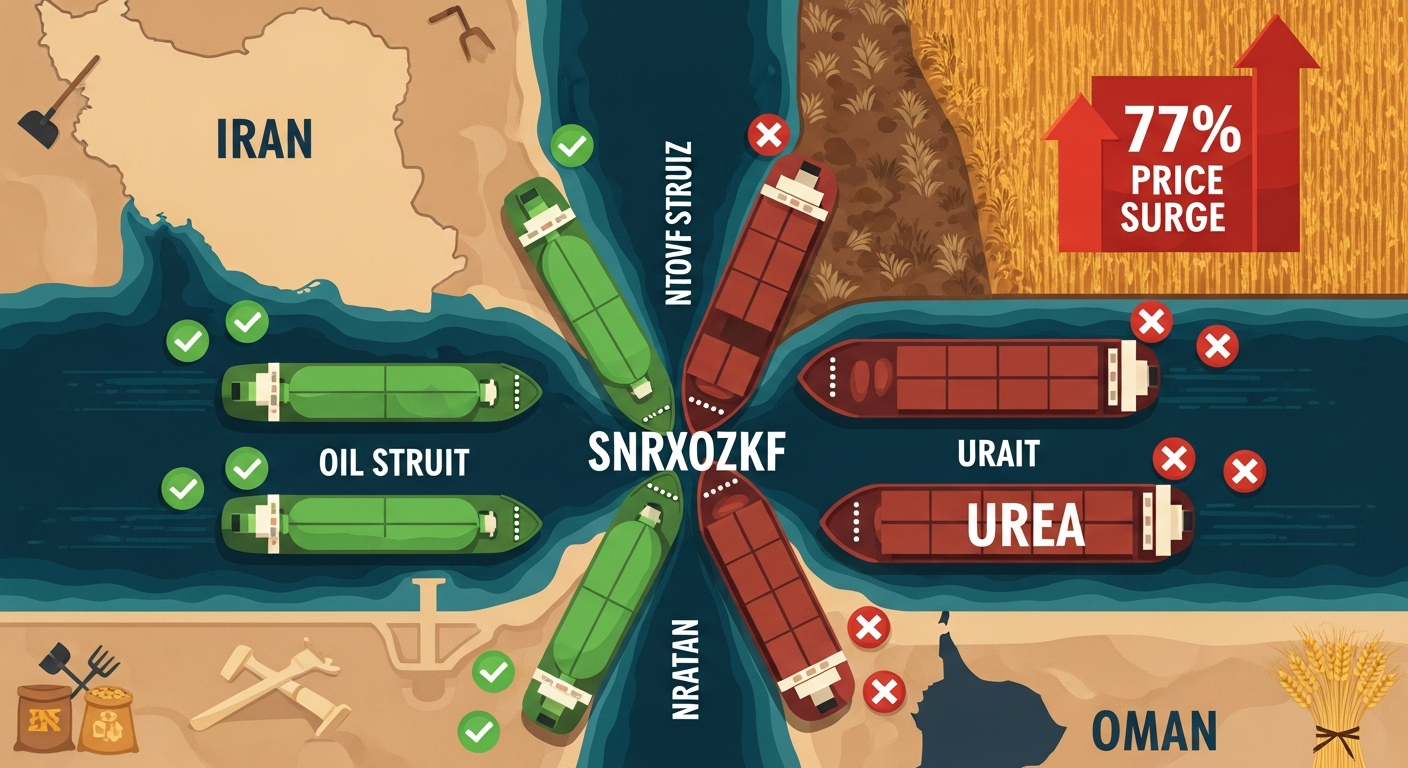
When the Strait of Hormuz faces blockade conditions, shipping vessels prioritize high-value crude oil cargo, systematically pushing fertilizer to the back of the queue. Oil has established safety nets including Strategic Petroleum Reserves and the IEA emergency release mechanism, but no comparable international safety framework exists for fertilizer. The vast majority of Middle Eastern nitrogen fertilizer transits through Hormuz, with Qatar, Saudi Arabia, and Iran ranking among the world's largest natural gas-based urea exporters. Under shipping constraints, market logic creates a structural inequality that systematically excludes fertilizer from priority cargo manifests. This means fertilizer sits in a dangerous blind spot during geopolitical conflicts, a vulnerability that has been neglected for decades with no corrective action taken.
77% Urea Price Surge Meets a Catastrophic Planting Calendar
Urea prices have skyrocketed from $400-490 per ton to $700-800, a 77% surge representing the steepest increase since the 2022 Russia-Ukraine war disruptions. This price explosion coincides precisely with the Northern Hemisphere spring planting season running from March through June, maximizing the damage to global crop production. The FAO's chief economist has warned that failure to act within three months could be irreversible, because missing the spring planting window means annual harvest volumes cannot be recovered regardless of subsequent interventions. The price pressure extends beyond nitrogen fertilizers, with potash prices climbing in tandem, meaning all three major fertilizer nutrients face simultaneous cost spikes. Corn futures on the Chicago exchange have already breached $7 per bushel, approaching levels not seen since the devastating 2012 U.S. drought, while soybean futures are trending toward $15.
Food Security Geopolitical Inequality
The cruelest dimension of this fertilizer crisis is how profoundly unequal its impact falls across the global population. Sub-Saharan Africa's fertilizer import dependency exceeds 90%, while Bangladesh relies on LNG imports for 99% of its needs and Pakistan for 72%. Developed nations can cushion the blow through government subsidies and strategic reserves, but developing countries have virtually zero buffer capacity against these price shocks. The WFP estimates that 45 million additional people face acute hunger risk from this disruption, with the true figure potentially climbing significantly higher as secondary effects compound. In conflict zones like Ethiopia, Somalia, and Sudan, the fertilizer crisis is acting as an accelerant on existing food instability, transforming a price problem into an unfolding humanitarian catastrophe.
China's Strategic Fertilizer Leverage
China, commanding roughly 30% of global fertilizer production, has been strategically restricting fertilizer exports under the pretext of protecting its domestic market. This pattern repeated in 2021 and 2022, but the simultaneous occurrence with the Hormuz blockade has multiplied its disruptive effect exponentially. With both pillars of global fertilizer supply simultaneously constrained, world agriculture finds itself operating with both arms tied behind its back. China is already conducting fertilizer diplomacy with African nations, expanding geopolitical influence in what can only be described as an agricultural extension of the Belt and Road Initiative. A dangerous new precedent is being established where fertilizer becomes a geopolitical weapon rivaling oil, and China's bargaining power in this arena could approach OPEC-level influence over global markets.
The Agflation Domino Effect
Rising fertilizer prices don't stop at the farm gate — they trigger chain reactions that shake the entire global price structure from agriculture through consumer goods. Helios AI analysis projects global grocery prices rising 12-18% by end of 2026, with cost increases propagating through feed prices into the livestock and dairy sectors. Damage to Brazilian soybean production reverberates through the edible oil market and disrupts biodiesel feedstock supplies, creating cascading shortages across multiple commodity chains. Margin compression at food companies accelerates consumer goods inflation broadly, meaning the fertilizer crisis eventually shows up in everything from bread prices to restaurant menus. In low-income countries where 50-70% of household income goes to food, a 15% price increase becomes a survival crisis rather than a budgeting inconvenience. The World Bank has warned that the 2026 global food price index could approach the levels that triggered the 2011 Arab Spring uprisings.
Positive & Negative Analysis
Positive Aspects
- A Decisive Catalyst for Agricultural Technology Innovation
This crisis is driving an explosive increase in investment for green ammonia, bio-fertilizers, and renewable energy-based fertilizer production technologies. In Europe, investment in green ammonia projects has more than tripled compared to 2025, with Denmark's Haldor Topsoe and Germany's ThyssenKrupp accelerating commercial deployment timelines to 2028.
- Accelerated Adoption of Precision Agriculture
Soaring fertilizer costs have transformed precision agriculture technology adoption from a nice-to-have efficiency play into a survival imperative for farmers worldwide. According to AgFunderNews, agtech startup investment surged 45% year-over-year in Q1 2026 alone.
- Building Domestic Fertilizer Production in Developing Nations
African and South Asian countries are moving decisively to break free from import dependency by expanding domestic fertilizer production capacity. Nigeria's Dangote Fertilizer has announced an expansion from 3 million to 5 million tons of annual capacity.
- Birth of a Global Strategic Fertilizer Reserve System
For the first time in history, the FAO and World Bank have begun jointly discussing a global fertilizer security initiative modeled after petroleum's strategic reserve framework.
- Supply Chain Diversification Away from Geopolitical Chokepoints
The current crisis has created the catalyst for fundamental restructuring of the Hormuz-dependent fertilizer supply architecture. Potash and phosphate production is expanding in politically stable countries including Canada, Australia, and Brazil.
Concerns
- Large-Scale Famine Crisis in Sub-Saharan Africa
Sub-Saharan Africa, with fertilizer import dependency exceeding 90%, is absorbing the most direct and devastating impact of this crisis. The WFP estimates that 45 million additional people face acute hunger risk, with actual numbers potentially climbing much higher.
- Agflation-Driven Social Instability in Low-Income Countries
The projected 12-18% surge in global grocery prices translates directly into social instability risk across low-income nations. The World Bank's warning that the food price index could approach 2011 levels carries an unmistakable historical echo of the Arab Spring.
- The Dangerous Precedent of Fertilizer Weaponization
If China's use of fertilizer export restrictions as geopolitical leverage proves successful, it creates a powerful incentive for other resource-holding nations to adopt the same playbook. A world where fertilizer becomes a geopolitical weapon fundamentally alters the premise of global food security.
- Food Nationalism Threatens to Paralyze Global Trade Systems
If nations retreat into protectionist self-preservation mode by restricting food and fertilizer exports simultaneously, the entire global food trade system faces potential paralysis. The 2022 precedents of India's wheat export ban and Indonesia's palm oil export suspension demonstrated exactly how quickly national food nationalism can shock global markets.
- The Cruel Time Gap Between Technological Promise and Present Reality
Green ammonia, bio-fertilizers, and other alternative technologies won't reach meaningful production scale until after 2030, but the food crisis is happening right now. Fertilizer plant construction requires a minimum of 3-5 years, and green ammonia currently accounts for less than 0.5% of total fertilizer production worldwide.
Outlook
The next three months represent the absolute golden window for this crisis. When the FAO warned that failure to act within three months could be irreversible, they were specifically referencing the final planting window for the Northern Hemisphere spring season. If fertilizer supplies are not normalized by June, corn and soybean planting across the U.S. Midwest will face delays or acreage reductions that cannot be made up later in the season. Corn futures on the Chicago exchange have already breached $7 per bushel, and soybeans are trending toward $15 — approaching the highest levels since the devastating 2012 U.S. drought. Europe is somewhat better positioned thanks to the EU's strategic fertilizer reserves, which cover approximately 2-3 months of demand.
India's situation is particularly urgent. As one of the world's largest fertilizer consumers, India domestically produces only about 70% of its demand. The remaining 30% comes from imports, and a significant portion of those imports transit through Hormuz from Middle Eastern producers. The Indian government allocated 1.71 trillion rupees (approximately $18.65 billion) for fertilizer subsidies in its 2026 budget, but whether this allocation can absorb the magnitude of the current price surge is a genuine open question. If India fails to secure adequate fertilizer supplies, the kharif season rice production will take a direct hit, with ripple effects spreading across the entire Southeast Asian rice market.
Looking at the six-month to one-year horizon, a structural reorganization of global fertilizer supply chains will begin in earnest. Russia, despite international sanctions, remains one of the world's largest fertilizer exporters. Paradoxically, the Hormuz blockade is driving increased demand for Russian fertilizer. The Carnegie Endowment's analysis captures this dynamic: Fertilizer has no morality. Hungry nations buy fertilizer wherever they can find it.
China's movements warrant the closest possible monitoring. Controlling approximately 30% of global fertilizer production, China holds what amounts to a valve on global supply volumes. China is already conducting fertilizer diplomacy with several African nations — essentially an agricultural extension of the Belt and Road Initiative. China's influence in the fertilizer market could strengthen to a level comparable to OPEC's current power in global oil markets.
Within one to two years, a fertilizer industry investment boom is highly likely. India has approved five new urea plant constructions, and Nigeria's Dangote Fertilizer has pledged to increase annual production from 3 million to 5 million tons. Denmark's Haldor Topsoe and Germany's ThyssenKrupp have declared they will accelerate commercial deployment of renewable energy-based ammonia plants to 2028.
However, a critical reality check is needed here. Building a fertilizer plant takes a minimum of 3-5 years. Green ammonia technology currently accounts for less than 0.5% of total global fertilizer production. Even with massive investment acceleration, technological alternatives won't reach meaningful production scale until well after 2030. The World Bank has already warned that the 2026 global food price index could approach levels seen during the 2011 Arab Spring.
Taking a longer-term view of 2-5 years, this crisis has the potential to fundamentally reshape the global agricultural paradigm. In the bull case — the most optimistic scenario — this crisis accelerates investment in green ammonia and bio-fertilizer technologies to the point where 15-20% of global fertilizer production transitions to renewable energy bases by 2030. I estimate this probability at approximately 20%.
In the base case — the most realistic scenario — the Hormuz crisis partially resolves through diplomatic channels, but the structural vulnerabilities remain intact. Fertilizer prices find a new equilibrium at $500-600 per ton, becoming the accepted new normal. I estimate this probability at approximately 55%.
In the bear case — the most pessimistic scenario — the Hormuz blockade extends indefinitely and China further tightens fertilizer export restrictions. Global fertilizer supply remains 20% or more below demand for over a year. Food prices surge 30-40% or more, and large-scale famine materializes across Sub-Saharan Africa and South Asia. I estimate the probability at approximately 25%.
Even if this particular crisis resolves favorably, the structural vulnerabilities of the global fertilizer supply chain remain completely unchanged. Over 40% of the world's fertilizer production is concentrated in geopolitically high-risk regions. If not this time, then next time, a fertilizer crisis will inevitably recur.
The broader context makes this even more concerning. The Hormuz blockade coincides with La Nina conditions, creating a compound crisis where geopolitical disruption and climate disruption hit the food system simultaneously. Rising fertilizer prices drive up animal feed costs, which propagate directly into the livestock and dairy sectors. This is the agflation domino effect — a crisis that begins with fertilizer pricing and ends up shaking the entire global consumer price structure.
Korea's situation also deserves mention. Korea imports the vast majority of its fertilizer raw materials, and the painful urea crisis of 2021 demonstrated just how vulnerable the supply chain really is. This time the scale is different — urea serves as a raw material not only for fertilizer but also for diesel exhaust fluid (AdBlue), meaning the fertilizer crisis can cascade into logistics and transportation disruptions simultaneously.
One concrete piece of advice for readers: review your portfolio allocation to food-related assets. Grain ETFs, agtech companies, and fertilizer producers are positioned for meaningful price appreciation over the next 12-18 months. This isn't investment advice — it's a reality check on the macroeconomic environment we're entering.
Sources / References
- Chokepoint: How War With Iran Threatens Global Food Security — CSIS
- Fertilizer, Iran, Hormuz, and the Food Crisis — Carnegie Endowment
- The Iran War's Hidden Front: Food, Water, and Fertilizer — CFR
- Gulf War Food Crisis: Asia-Africa Hormuz Transit Deal — Time
- FAO Warns of Severe Global Food Security Risks — FAO
- Fertilizer Price Surge: Iran War, Food Security — CNBC
- Persian Gulf Fertilizer Crisis: Global Food Prices Could Rise 12-18% — AgFunderNews
- Hormuz Fertilizer Food Hunger Crisis — Foreign Policy
- IRC Warns Food Security Timebomb — IRC
- Strait of Hormuz Closure and Fertilizer Supply Risks — farmdoc daily
- 45 Million More May Face Acute Hunger — UN News
- Gulf Shipping Shock and Africa Food Security Risk — Energy Capital Power
- Beyond Oil: 9 Commodities Impacted by Hormuz Closure — WEF
- Dangote Fertilizer Sees Global Demand Surge — Nairametrics
- Nitrogen Crisis: CF Industries Surges — FinancialContent