
When xAI Started Burning $1 Billion a Month, Musk Signed the SpaceX IPO Papers
Summary
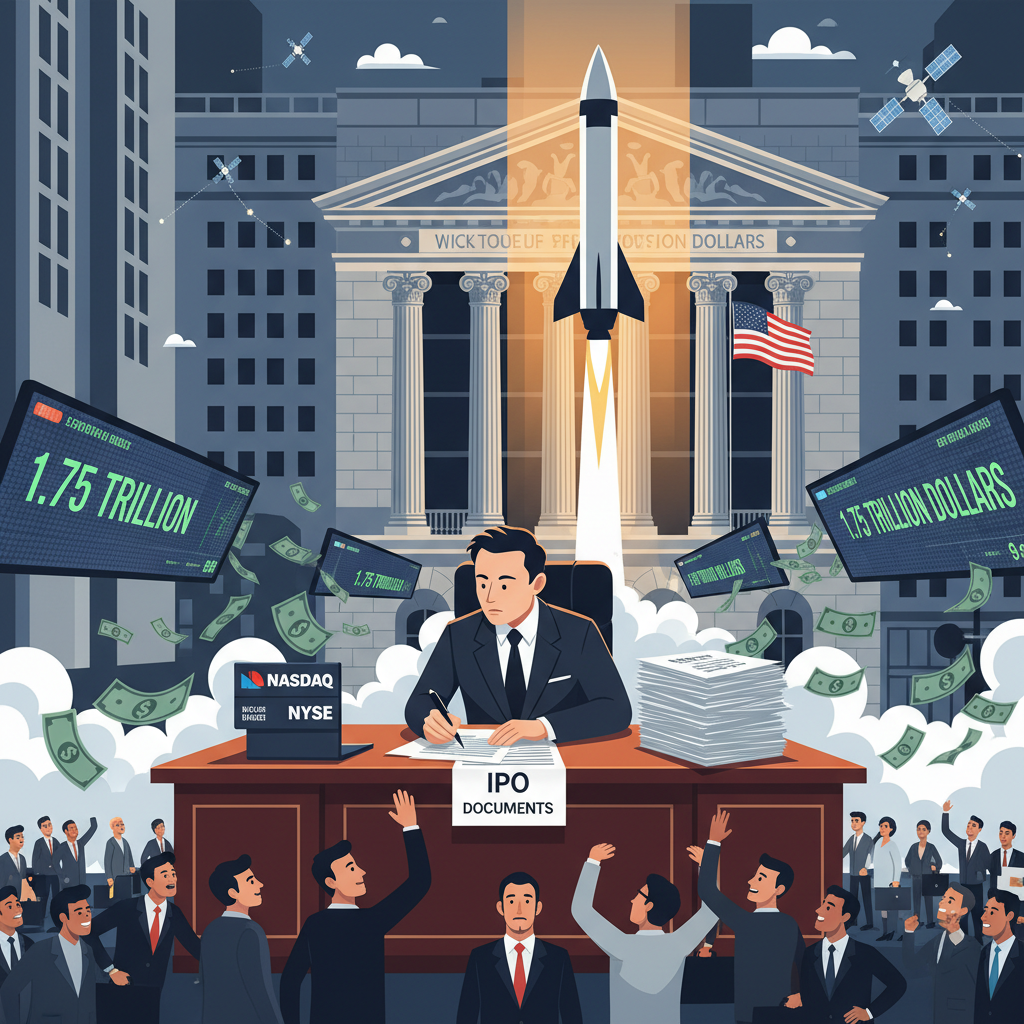
SpaceX's $1.75T IPO is not a rocket company going public — it is the largest funding masterplan ever, designed to bankroll xAI's $1B monthly burn.
Key Points
The $1.75 Trillion Entity — This Is Not a Rocket Company
After absorbing xAI in a $1.25 trillion merger, SpaceX is no longer a pure-play space company. The entity going public is a hybrid beast that bundles rockets, satellite internet, and artificial intelligence under one ticker. A P/S multiple of 60x is flatly impossible to justify through the lens of aerospace peers — Boeing trades at 1.5x sales, Lockheed Martin at roughly 2x. The math only starts to make sense once you factor in the AI infrastructure premium baked into xAI. What investors are actually buying isn't rocket technology but a convergence narrative of 'AI meets space,' and anyone who fails to recognize that distinction will fundamentally misread the valuation. PitchBook's sum-of-parts analysis pegs fair value at $1.1–1.7 trillion, and for the current implied P/S of 110x to compress to a more digestible 12x, SpaceX would need to reach $150 billion in revenue and $95 billion in EBITDA by 2040. Of that, Starlink alone must deliver $120 billion in revenue at a 70% EBITDA margin, with the launch business filling the remaining $30 billion. Strip out xAI and the reasonable valuation for SpaceX's core operations — rockets plus Starlink — sits in the $400–600 billion range. The remaining trillion-plus is pure hope premium riding on xAI's potential.
xAI's $1 Billion Monthly Cash Burn and the Suspiciously Convenient IPO Timing
xAI is torching $1 billion per month — $12 billion annualized — on Grok model training and data center expansion, all while generating negligible revenue. As of Q3 2025, quarterly net losses stood at $1.46 billion; over the preceding nine months, the company burned through $7.8 billion against just $107 million in quarterly revenue. Musk has projected $5.4 billion in revenue by 2027 and expects profitability around that time, but reaching that point requires an additional $3.9 billion in borrowing. Against this backdrop, the fact that SpaceX chose this exact moment to pursue the largest IPO in history — raising $75 billion — is not a coincidence. A substantial share of those proceeds will almost certainly be funneled into plugging xAI's cash hemorrhage, making this effectively an AI funding operation dressed up as a space company listing. If the full $75 billion lands, that buys roughly six years of runway at xAI's current burn rate. This kind of cross-entity capital recycling is a well-worn page from the Musk playbook, previously deployed across Tesla, Twitter, and SpaceX in various configurations.
30% Retail Allocation — The Most Sophisticated Risk Distribution in IPO History
In a typical IPO, retail investors get 10–15% of the allocation. SpaceX is handing them an unprecedented 30%. The company has framed this as 'democratizing investment,' but the reality tells a different story. Morningstar and a growing number of institutional players have expressed skepticism about the $1.75 trillion valuation, leading to a contraction in institutional demand — and retail is being brought in to fill the gap. The distribution strategy itself is a multi-layered operation: Bank of America is handling domestic family offices and high-net-worth individuals; Morgan Stanley is channeling smaller retail investors through its E*Trade platform; UBS covers the global investor base; and Citigroup manages international retail. Whether Musk's personal brand power and the irresistible FOMO of becoming a 'space company shareholder' can fill that 30% tranche will be the single most important variable determining the IPO's success or failure. Institutional investors exit without emotion when the numbers don't add up, but retail investors respond to dreams and brands — which makes them structurally vulnerable to absorbing disproportionate losses in a downturn.
The Starlink 10 Million Subscriber Trap — The Expiration Date on 80% Growth
Starlink has crossed the 10 million subscriber mark and is growing at an impressive 80% annually, holding what amounts to a monopoly in the low-Earth orbit satellite internet market. Its closest competitor, Amazon Kuiper, has yet to launch commercial service. The direct-to-cell offering has already secured 10 million monthly active mobile users, expanding atop a partnership base of 35 global carriers representing 1.7 billion combined subscribers. Once V3 satellites begin deployment in mid-2027, enabling 5G speeds at 150 Mbps, the addressable mobile user base could swell to 170–340 million by 2028. But this growth rate cannot last forever. Once the initial demand pools — unserved rural areas, maritime, aviation — are tapped out, Starlink will hit a growth ceiling. Realistically, growth should decelerate to 50–60% by 2027. Even so, 20 million subscribers and standalone annual revenue exceeding $15 billion by 2028 remain achievable targets. The problem is that justifying a P/S ratio of 60x demands growth far beyond even those impressive figures.
The $75 Billion Liquidity Black Hole and Its Shockwave Through Global Markets
The largest IPO capital raise in history — $75 billion — will exert a non-trivial gravitational pull on global market liquidity. When capital of this magnitude flows into SpaceX, it has to come from somewhere, creating an unavoidable vacuum-cleaner effect that drains neighboring equities. If SpaceX earns S&P 500 inclusion, passive fund rebalancing will automatically buy into the stock while trimming existing holdings, triggering a market-wide portfolio reshuffle. S&P Dow Jones is already reviewing a potential 'Mega-Cap Exception' rule given SpaceX's float ratio of just 5–8%, but if passive fund buying concentrates on such a tiny free float, a forced-buying squeeze could push the price to unsustainable levels. Should both SpaceX and OpenAI secure index inclusion around the same time, the top ten constituents would approach 50% of the entire S&P 500 weighting, effectively transforming the benchmark into a mega-cap tech fund. Korean aerospace stocks surging 16.7% on the mere announcement is a preview of the global ripple effects — and the reverse-direction crowding risk that comes with them. For context, Saudi Aramco's $29.4 billion IPO in 2019 visibly strained Middle Eastern market liquidity, and SpaceX's raise is more than double that size.
Positive & Negative Analysis
Positive Aspects
- Starlink's Overwhelming Market Monopoly
SpaceX is the only large-scale commercial operator in the global low-Earth orbit satellite internet market. With 10 million subscribers locked in and Amazon Kuiper still in pre-commercial limbo, the competitive landscape is effectively a one-player game. OneWeb doesn't even register at comparable scale. This first-mover advantage should hold for at least two to three more years, and with roughly 3 billion people worldwide still lacking internet access, the total addressable market leaves enormous room for continued expansion.
- Reusable Rockets as an Economic Moat
Falcon 9 boosters have now exceeded 20 reuse cycles, driving per-launch costs down to roughly one-third of competitor pricing. Once Starship reaches full commercial operations, payload costs will drop another tier. In the launch market, cost leadership effectively equals monopoly — and any competitor looking to close the gap needs billions of dollars and years of development time. During that window, SpaceX can widen the technological lead further, creating a compounding structural advantage that grows harder to challenge with each passing year.
- Revenue Stability from Government and Defense Contracts
Through the NASA Artemis program, Department of Defense military satellite launches, and U.S. Space Force collaborations, SpaceX has cemented itself as an irreplaceable partner in America's space strategy. These long-term government contracts deliver stable revenue regardless of economic cycles, and SpaceX's geopolitical strategic value has reached a level where substitution is essentially impossible. Government-related revenue is estimated to account for approximately 30% of total revenue as of 2025.
- The Only Player Executing AI + Satellite Convergence
Orbital data centers may sound like science fiction, but the physics is straightforward — the natural cooling of space environments near absolute zero and virtually unlimited solar energy could theoretically slash energy costs far below what terrestrial data centers achieve. SpaceX is the only company on Earth that simultaneously owns the launch vehicle (Starship), the communications backbone (Starlink), and the AI demand engine (xAI). No other entity — not Google, not Amazon, not any government space agency — holds all three pieces of this puzzle at once. If vertical integration of these three capabilities becomes reality, it opens an entirely new market category that no competitor is positioned to contest. The convergence thesis is what separates SpaceX's valuation story from a conventional aerospace play.
- Potential Evolution Into a Space Economy Platform
At full commercial capacity, each Starship launch can deliver over 100 metric tons of payload to low-Earth orbit. This positions SpaceX to become the AWS of space — the infrastructure platform that every other company must use to deploy satellites, conduct space manufacturing, or operate space tourism services. Platform business models generate network effects that deepen the moat over time, making early dominance increasingly difficult to dislodge as the ecosystem matures. The analogy to Amazon Web Services is deliberate: AWS was once a side project that became the profit engine of the entire company, and SpaceX's launch platform could follow the same trajectory as the space economy scales.
Concerns
- xAI's Cash Burn Black Hole
xAI is consuming $1 billion monthly — $12 billion per year — with no clear path to monetization in sight. In an AI market where it competes against OpenAI, Google, and Anthropic, the timeline for recouping this investment remains deeply uncertain. Even if the full $75 billion is raised, at xAI's current burn rate the money runs dry within six years. Should monetization stall, the worst-case scenario involves xAI's losses dragging down SpaceX's core cash flows. Grok, xAI's flagship product, trails significantly behind ChatGPT and Gemini in market share.
- The Near-Impossible Task of Justifying a 60x P/S Ratio
A price-to-sales multiple of 60x is historically unprecedented for a company with significant hardware dependency. To justify it, revenue growth must sustain at least 50% annually for multiple consecutive years — and as the revenue base scales to $50 billion, then $100 billion, maintaining that pace becomes exponentially harder. Even the most aggressive SaaS companies in history rarely maintained 50% growth past the $20 billion revenue mark. The moment growth decelerates, a valuation reset becomes inevitable, and the impact will fall disproportionately on retail investors who bought into the story at peak multiples. History shows that multiple compression in high-growth stocks tends to be sudden rather than gradual, amplifying losses for late entrants.
- Extreme Concentration of Musk Key-Man Risk
Elon Musk is simultaneously running Tesla, SpaceX, xAI, X (formerly Twitter), and DOGE. This represents a textbook extreme case of key-man risk, where a health issue, political controversy, or simple attention dilution affecting Musk could send simultaneous shockwaves through all his companies. Tesla shareholders have already experienced the stock volatility that accompanies Musk's public statements and decisions, and a publicly traded SpaceX would face identical exposure. Ongoing concerns about diminished management focus due to his multi-CEO responsibilities show no signs of abating.
- $75 Billion Liquidity Absorption and Potential Market Crunch
A record $75 billion capital raise could temporarily squeeze global equity market liquidity. If other large IPOs or fundraising events coincide with the same window, a system-wide capital bottleneck becomes a real possibility. When Saudi Aramco raised $29.4 billion in its 2019 IPO, observable liquidity stress appeared across Middle Eastern financial markets — and SpaceX's raise is more than double that magnitude. S&P 500 inclusion would trigger additional capital outflows from existing constituents as passive funds rebalance, adding another layer of market stress.
- Regulatory, Antitrust, and Political Risk Convergence
The SpaceX-xAI merger faces ongoing antitrust scrutiny, FCC spectrum regulation affects Starlink operations, and international frequency disputes add further regulatory complexity. Musk's political activities — including his role heading DOGE — could trigger backlash under a different administration, turning a current political asset into a liability. Several European nations and other countries have begun raising data sovereignty concerns over Starlink, which could act as a brake on global expansion at precisely the moment the growth story needs international scale to deliver. The layering of regulatory, antitrust, and political risks creates a compound exposure where any single trigger could cascade into broader operational constraints.
Outlook
Let me start with what's likely to unfold in the next three to six months. SpaceX's IPO process is currently in the SEC review phase, and the roadshow plus pricing are expected to take place in the second half of 2026. The single hottest question is whether the market will accept a $1.75 trillion target valuation. If institutional appetite proves lukewarm during the roadshow, the valuation could be revised downward — potentially settling into a $1.2–1.5 trillion range. On the flip side, if Starlink's subscriber trajectory accelerates during the roadshow window — say it crosses 12 million by mid-2026 — upward revision remains on the table. The SEC review process could also demand additional disclosures around xAI merger financials and related-party transactions, which may push the listing timeline back by two to three months. The political backdrop matters too — any escalation in trade tensions or a broader market correction during the roadshow window could force the entire process to be shelved temporarily, as we've seen with other mega-IPOs that pulled their filings when conditions deteriorated.
First-week volatility is going to be significant, no question about it. The sheer attention around the largest IPO in history, combined with Musk's celebrity gravitational pull and the FOMO generated by that 30% retail allocation, could easily produce day-one swings of plus or minus 20–30%. For a reference point, ARM Holdings surged 25% on its IPO day in 2024, and SpaceX's offering is more than ten times that size. The knock-on effects in Korean and broader Asian markets deserve attention too. Korean aerospace stocks already jumped 16.7% on the IPO announcement alone; the actual listing day could trigger an even sharper rush. But this is theme-driven speculation without underlying substance, so short-term profit-taking will be brutal. The 180-day lock-up expiration is another event to watch carefully — when insiders become free to sell, a wave of supply could hit the market. Tesla saw roughly a 20% correction following its own lock-up expiration. The interplay between retail enthusiasm and institutional skepticism during the first six months will set the tone for everything that follows — if retail buying sustains the price through the initial volatility, it validates the allocation strategy and builds a positive feedback loop. If it doesn't, expect a sharp repricing that tests investor conviction early.
Moving into the six-month to two-year medium-term window, the picture gets considerably more interesting. Two variables will determine everything: Starlink's growth trajectory and xAI's path to monetization. Starting with Starlink — if the current 80% annual growth rate holds, subscriber counts could reach 18 million by 2027 and cross 30 million by early 2028. But I expect the growth rate to gradually decelerate, and the reasoning is straightforward. Once the initial demand pools — unserved rural populations, maritime operations, aviation connectivity — are absorbed, growth will encounter natural resistance. My base case is 15–18 million subscribers by 2027 with the growth rate settling into the 50–60% range. That still translates to standalone Starlink revenue north of $15 billion annually, which is nothing to dismiss. Layer on the B2B expansion — airline in-flight WiFi, cruise ship connectivity, enterprise satellite backhaul — and average revenue per user could climb from the current $80–120 range to $150–200, unlocking a meaningful revenue uplift without needing net-new subscribers. The aviation vertical alone represents a $6–8 billion addressable market where Starlink's latency and coverage advantages are difficult to replicate.
The xAI side carries far greater uncertainty. Grok model commercialization, enterprise AI services, and orbital data center proof-of-concept work — at least one of these three must begin generating meaningful revenue to sustain the post-IPO valuation. My assessment is that reaching $2–3 billion in annual enterprise API revenue from Grok by mid-2027 represents a realistic scenario. If that milestone is hit, the narrative flips from 'SpaceX saddled itself with a money-burning AI company' to 'SpaceX pioneered a new monetization pathway for AI.' If it's missed, expect the valuation discount to begin in earnest during the second half of 2027. S&P 500 inclusion timing is another pivotal medium-term event. The market cap threshold is comfortably cleared, but the S&P committee also evaluates profitability criteria including four consecutive quarters of positive earnings. If xAI's losses weigh on consolidated results, inclusion could be delayed — meaning the automatic passive fund buying that accompanies index membership would be pushed back. An optimistic timeline puts inclusion in mid-2027; a conservative one says 2028 or later. The 'Mega-Cap Exception' rule currently under review by S&P Dow Jones could accelerate the schedule, but SpaceX's 5–8% float ratio raises a separate concern — passive fund forced-buying concentrated on such a thin float could trigger an unsustainable squeeze. For reference, when Tesla joined the S&P 500 in December 2020, approximately $80 billion in passive capital flowed in, driving the stock up an additional 25% within a month. Given SpaceX's significantly larger market cap, the inclusion effect would be proportionally amplified.
Shifts in the competitive landscape also factor heavily into the medium-term picture. Amazon Kuiper plans to deploy over 1,000 satellites and launch commercial service by mid-2027. If successful, it would represent the first meaningful competitive pressure on Starlink's pricing power. That said, matching SpaceX's launch cost efficiency remains a tall order for Kuiper — Blue Origin's New Glenn rocket has yet to demonstrate Falcon 9-level cost economics. OneWeb has already fallen behind in the LEO race, and China's satellite internet programs trail by an estimated two to three years technologically. The net result is that SpaceX's dominant position should remain largely intact through 2028. That said, Starlink's real medium-term test isn't subscriber count — it's whether the business can demonstrate the kind of margin expansion that turns a high-growth operation into a cash flow machine. Satellite replacement cycles, ground station buildouts, and V3 constellation deployment all require sustained capital expenditure that could keep free cash flow negative longer than the market expects.
Zooming out to the two-to-five-year long-term horizon, this is where we find out whether this IPO was genuinely revolutionary or the most expensive piece of financial packaging in history. In my view, the decisive battleground is orbital data centers. The moment that concept transitions from science fiction to working reality, SpaceX's valuation enters an entirely different dimension. Running AI computations outside Earth's atmosphere — leveraging the near-absolute-zero natural cooling of space and virtually unlimited solar energy — could fundamentally eliminate the two biggest bottlenecks facing terrestrial data centers: power and cooling costs. Global data centers currently consume roughly 2–3% of worldwide electricity, a figure projected to reach 4–5% by 2030. If orbital infrastructure can address that bottleneck, the economic value runs into hundreds of billions of dollars. SpaceX uniquely owns all three required components: the launch vehicle (Starship), the communications network (Starlink), and the AI demand driver (xAI). The convergence of those three capabilities is the real inflection point. Realistically, the first orbital data center proof-of-concept could arrive in 2028–2029, with commercial operations following after 2030. The technical hurdles remain formidable — thermal management in microgravity, latency for round-trip data transmission, and the sheer logistics of maintaining hardware 400 kilometers above Earth's surface. But the economic incentive is clear enough that even partial success would validate an entirely new category of infrastructure investment.
Starship's full commercial readiness is another long-term game-changer. Currently in the test flight phase, regular operational flights by 2028 would enable delivery of over 100 metric tons of payload to LEO per launch. This effectively means SpaceX would monopolize the infrastructure layer of the space economy. Any company looking to deploy satellites, conduct space manufacturing, or operate space tourism would have no choice but to use SpaceX's launch platform. Think of it as SpaceX becoming the AWS of space. If this scenario materializes, SpaceX's annual revenue could reach $80–100 billion by 2030, with a valuation exceeding $3 trillion. The historical parallel here is Amazon's transformation from an e-commerce company into a cloud infrastructure giant during the 2000s. AWS propelled Amazon's market cap from $300 billion to $2 trillion — and SpaceX could replicate that trajectory within the space infrastructure domain. That's the core logic of the bull case. Whether you believe it depends on your assessment of execution risk — the technology is theoretically sound, but scaling space infrastructure has a failure rate that no financial model can fully capture.
Let me lay out the scenarios. The bull case, which I'd assign roughly 25% probability, sees xAI achieving over $10 billion in annual revenue by 2028, Starlink subscribers surpassing 30 million, and a successful orbital data center proof-of-concept. In this scenario, the valuation exceeds $3 trillion by 2029 — making SpaceX the third company after Apple and NVIDIA to reach that milestone. Share price appreciation of 70–100% from the IPO price would be expected. The base case at 50% probability has Starlink maintaining 40–50% annual growth, crossing 20 million subscribers by 2028, while xAI approaches breakeven but doesn't achieve large-scale monetization. The valuation stabilizes in the $1.5–2 trillion range, with stock performance in the negative 10% to positive 15% band relative to the IPO price. This is arguably the most likely path and the one where patient investors who bought at the IPO price eventually get rewarded — not through explosive gains, but through steady compounding as the business matures.
The bear case at 25% probability is the scenario that should give investors pause. In this world, xAI's cash burn accelerates past $15 billion annually while monetization stalls, and Amazon Kuiper launches competitive service that drives Starlink's growth rate below 30%. Add a political risk event around Musk or regulators blocking the SpaceX-xAI merger, and the valuation could compress to $800 billion to $1 trillion — representing 40–50% losses for IPO investors. The early 2000s dot-com collapse offers a cautionary parallel. Cisco peaked at a $550 billion market cap before plunging below $100 billion — an 80% decline — despite having solid underlying business fundamentals. The damage was caused by expectations outrunning reality. SpaceX's core operations are considerably stronger than Cisco's were, but a P/S ratio of 60x carries the same embedded risk. The lesson from every major bubble correction is that the quality of the underlying business doesn't protect you from the pain of multiple compression — it only determines the speed of recovery.
One more ripple effect deserves attention. A successful SpaceX IPO will trigger a domino effect that channels capital into the entire space industry. Valuations for second-generation space companies like Rocket Lab, Relativity Space, and Planet Labs would rise in tandem, and governments worldwide would find fresh justification for expanding their space budgets. In Korea, companies like Hanwha Aerospace, Korea Aerospace Industries, and Satrec Initiative would likely accelerate their efforts to plug into the SpaceX ecosystem. Conversely, a disappointing IPO would throw cold water on the entire sector. Adjacent industry impacts matter too — if orbital data centers become viable, the long-term growth outlook for terrestrial data center operators like Equinix and Digital Realty faces serious questions, and the geographic distribution of AI semiconductor demand could shift in ways that reshape NVIDIA's and AMD's strategic planning. For investors considering participation, the minimum investment horizon should be three to five years. Limiting exposure to 5–10% of your portfolio makes sense, with quarterly monitoring of xAI's monetization milestones to guide position sizing adjustments. And above all, never lose sight of the fundamental reality: this is not a rocket company — it's an AI-plus-space hybrid, and it should be valued and scrutinized accordingly. The companies that defined the last two decades of wealth creation — Amazon, Apple, NVIDIA — all went through periods where the market questioned whether their valuations were justified. SpaceX is entering that same crucible now, and the next three to five years will determine which side of history this IPO falls on. Position sizing, patience, and intellectual honesty about the risks are the only real edges available here.
Sources / References
- Stock Market Next Week Outlook for March 30 – April 3, 2026 — CNBC
- Does SpaceX's Sky-High Valuation Make Sense? — Morningstar
- SpaceX IPO: Musk Plans to Allocate Up to 30% of Shares for Retail Investors — Euronews
- Is SpaceX Worth $1.75 Trillion? Key Questions for Musk's Big IPO — Bloomberg
- SpaceX Starlink Engine: 80% Annual Growth Powers $1.75 Trillion IPO — ainvest
- SpaceX Is About to File for the Biggest IPO in History — Here's What $1.75 Trillion Actually Means — European Business Magazine
- PitchBook Analyst Defends SpaceX Market Valuation of $1.75 Trillion — TechCentral
- Musk's xAI Is Burning Through $1 Billion Per Month — Sherwood News
- The Trillion-Dollar Gravity Well: How SpaceX and OpenAI IPOs Could Reshape the S&P 500 — FinancialContent
- SpaceX Acquires xAI in Bid to Develop Orbital Data Centers — SpaceNews
- SpaceX IPO May Allocate 30% to Retail Investors, 3x the Usual Amount — The Motley Fool
- 10 Million Monthly Active Starlink Mobile Customers and Billions in 2028 — NextBigFuture
- xAI's Cash Burn Hits $1.46 Billion: Musk's AI Ambitions Outpace Revenue Growth — The Startup Mac