
The More Sandbags They Strapped On, the Faster It Ran — The Real Story Behind China's 21.8% Export Explosion in the Face of Tariff Walls
Summary
China's exports surged 21.8% in January-February 2026 while semiconductor exports skyrocketed 73%, pushing the trade surplus to a record $213.6 billion. The paradox is unmistakable: American tariff walls and chip sanctions have inadvertently accelerated China's manufacturing evolution and export diversification, reshaping the global economic order in ways Washington never intended.
Key Points
Exports 21.8%, Semiconductors 73%, Surplus $213.6B — Record-Shattering Numbers Under Tariff Fire
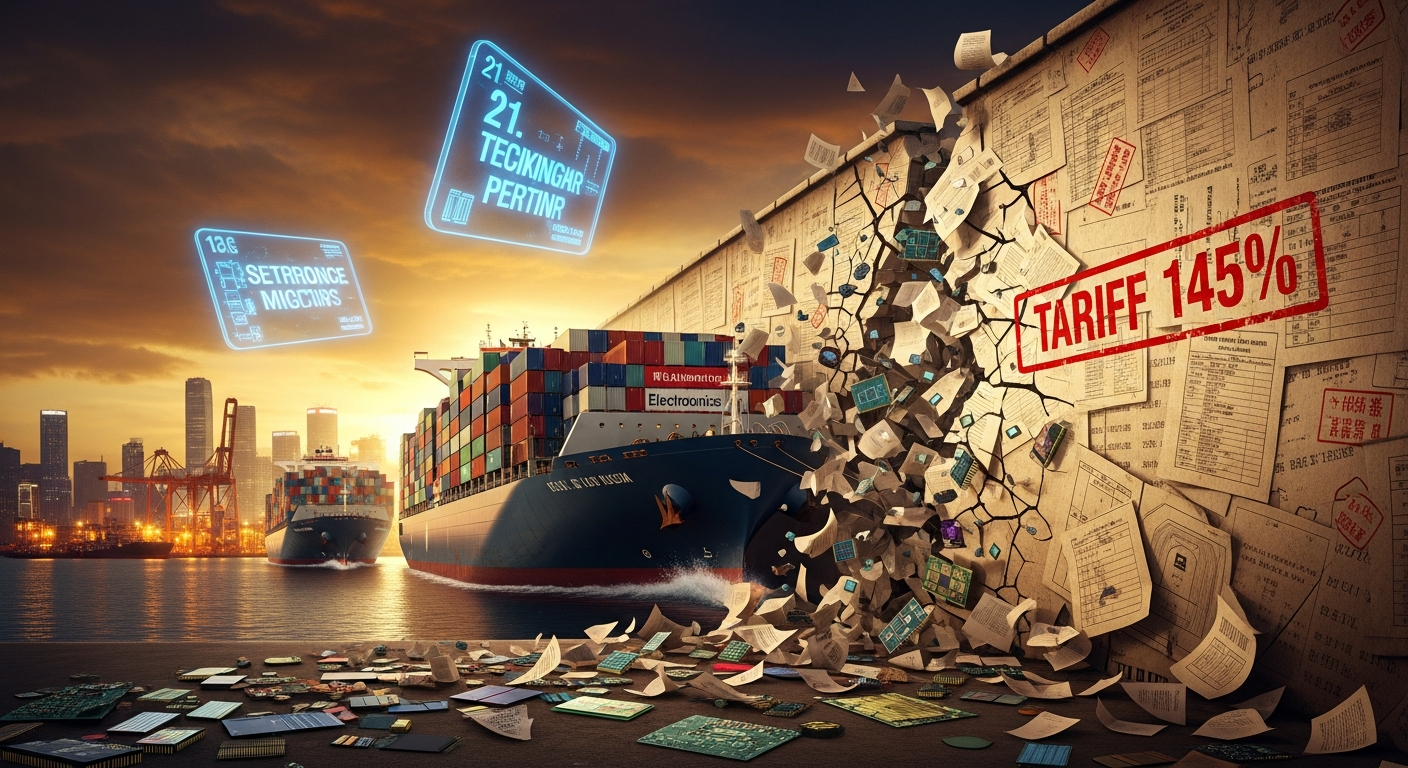
China's exports surged 21.8% year-over-year in January-February 2026, tripling the market consensus of 7.1%. Semiconductor exports skyrocketed 73% to reach $43.3 billion, driven by the convergence of AI demand explosion and global memory chip shortages. The trade surplus hit $213.6 billion in two months, far exceeding the $179.6 billion forecast and setting an all-time record. Following the $1.2 trillion annual surplus in 2025, another record-breaking year appears certain. Notably, high-value-added products — semiconductors, automobiles (up 67.1%), and ships (up 52.8%) — are leading export growth, completely shattering the image of China as merely a low-cost goods exporter.
The Tariff Paradox — How Sanctions Inadvertently Strengthened Chinese Manufacturing
America's tariff war since 2018 and semiconductor export controls since 2022 inflicted genuine short-term pain on China, but the medium-to-long-term effect has paradoxically been to accelerate technological self-sufficiency and export diversification. Huawei's successful 7nm chip design (2023) was symbolic, and YMTC's mass production of 128-layer 3D NAND is projected to lift China's global NAND market share from 5% in 2025 to 8-10% by year-end 2026. Like hormesis in biology — where moderate stress strengthens organisms — external pressure has made the system more resilient. In the mature-node semiconductor market, which represents over 70% of total demand, China has already achieved overwhelming price competitiveness.
The Great Export Map Rewrite — China Thriving Without America
In January-February 2026, China's exports to Africa surged 49.9%, to ASEAN 29.4%, and to the EU 27.8%, while exports to the US declined 11%. ASEAN has risen to become China's largest trading partner. Combined exports to South and Southeast Asia ($759B), Latin America ($264B), and the Middle East ($219B) already exceed those to the US and Western Europe combined. The core premise of America's tariff strategy — that China cannot survive without the US market — is collapsing as China structurally reduces its dependence on American demand. Africa has emerged as the fastest-growing export destination, recording a six-month moving average growth rate of 33% year-over-year.
Section 301 Across 16 Countries — Trump's Plan B After the Supreme Court Defeat
After the Supreme Court's 6-3 ruling struck down IEEPA tariffs on February 20, 2026, the Trump administration deployed a Section 122 emergency tariff (10%, later raised to 15%, limited to 150 days) as a stopgap. On March 11, Section 301 investigations were simultaneously launched into 16 entities including China, the EU, Japan, South Korea, and India, with conclusions and new tariffs targeted for July 24. On March 13, additional Section 301 probes into 60 countries over forced labor practices were announced. Treasury Secretary Bessent has signaled tariff levels will be restored to pre-ruling levels by August, but during this interregnum, China's front-loading has accelerated, paradoxically making the short-term surplus even larger.
The Global South's Double-Edged Dilemma — Opportunity and Dependency Risk
China's export diversification provides developing countries with affordable manufactured goods, but it simultaneously suppresses local manufacturing growth. According to the Rhodium Group, the share of product categories where emerging economies depend on China rose from 15% in 2019 to 20% in 2022, representing a structural transformation of developing countries' industrialization pathways. The boundary between China opening the Global South as a new market and the Global South becoming economically subordinate to China grows thinner by the day — this is not merely a trade issue but a fundamental question about 21st-century development models for the Southern Hemisphere.
Positive & Negative Analysis
Positive Aspects
- Accelerated Technological Self-Sufficiency
American semiconductor sanctions have paradoxically catalyzed improvements in China's chip self-sufficiency rate. Huawei's 7nm chip design, YMTC's 128-layer 3D NAND mass production, and the 73% semiconductor export surge collectively demonstrate this transformation. China's price competitiveness in the mature-node market, which covers over 70% of total semiconductor demand, represents a structural response capability against America's blockade strategy.
- Successful Export Market Diversification
Explosive growth in non-US markets — Africa (49.9%), ASEAN (29.4%), EU (27.8%) — has structurally reduced export dependence on America. The fact that exports to three Global South regions (Southeast/South Asia, Latin America, Middle East) combined now exceed exports to the US and Western Europe means China has secured alternative markets sufficient to offset American market contraction.
- Shift to High-Value-Added Export Structure
Technology-intensive, high-value-added products — semiconductors (73%), automobiles (67.1%), ships (52.8%) — are leading export growth. China's export composition is transitioning from low-cost consumer goods to advanced manufacturing, increasing the value-added per unit of exports. This contributes to qualitative growth of the Chinese economy over the long term.
- Proven Tariff Resilience
Despite seven years of trade war since 2018, China's trade surplus expanded from $1.2 trillion (2025) and continues to grow, demonstrating the Chinese manufacturing sector's capacity to absorb tariff shocks. The result of 11% decline in US exports alongside 21.8% total export growth clearly validates the market diversification strategy's effectiveness.
- Contribution to Global Supply Stability
China's emergence as a critical supplier during the global memory chip shortage caused by the AI demand explosion has helped moderate chip price spikes. Mass supply of mature-node semiconductors contributes to supply chain stability across diverse sectors including automotive, consumer electronics, and industrial equipment.
Concerns
- Erosion of Global South Manufacturing
China's low-cost export offensive is displacing local manufacturing growth in developing countries. The share of product categories where emerging economies depend on China expanded from 15% in 2019 to 20% in 2022, potentially distorting developing countries' industrialization pathways fundamentally. Manufacturing bases in Africa and Southeast Asia are becoming increasingly vulnerable as Chinese products overwhelm local producers.
- Overcapacity and Deepening Global Imbalances
As PIIE has warned, China's trillion-dollar-plus trade surplus is intensifying global economic imbalances. With domestic consumption remaining low relative to GDP, surplus production floods overseas markets in a pattern that is becoming entrenched. This exerts downward pressure on manufacturing and employment in trading partner countries.
- Circumvention Exports and Rules-of-Origin Disputes
The strategy of building Chinese factories in Vietnam, Indonesia, and Mexico to produce Made in Vietnam or Made in Mexico goods that circumvent US tariffs is expanding. The March 13 launch of Section 301 investigations into 60 countries over forced labor practices targets precisely these circumvention strategies, potentially triggering new trade disputes over rules of origin.
- Front-Loading Rebound Risk
If part of the January-February export explosion is attributable to pre-tariff shipping rushes, a cliff effect of sharply declining exports could emerge once tariffs are actually imposed in the second half. This could trigger cascading failures and employment shocks among export-dependent Chinese manufacturers, with Q2-Q3 data serving as the critical indicator.
- Risk of Escalated Technology Blockade
China's semiconductor export surge could paradoxically provide ammunition for intensifying America's technology blockade. Congressional voices already argue that entity-specific export controls are ineffective and demand a shift to country-wide restrictions. Pressure on allies will also mount, potentially further limiting ASML's and Tokyo Electron's exports to China.
Outlook
Let me be blunt. I stared at these numbers for a long time before I could process what they meant. 21.8 percent. While America was slapping tariffs, while the Supreme Court was striking down IEEPA duties as unconstitutional, while the Trump administration was launching Section 301 investigations into 16 countries simultaneously, China's exports exploded to record levels. Semiconductor exports jumped 73 percent. The trade surplus hit $213.6 billion in just two months. This is not in any economics textbook.
Anyone who can read between the lines will immediately ask: "Isn't this just front-loading?" The pre-tariff shipping rush where manufacturers push out as much product as possible before rates go up. Fair point — that element is certainly present. But front-loading alone cannot explain a 73 percent surge in semiconductor exports. Front-loading means shipping existing inventory early, not magically expanding chip production capacity by 73 percent overnight. Something deeper and more structural is at play here.
I call this phenomenon the "tariff paradox." Imagine forcing an athlete to train with sandbags strapped to their legs, then watching them run faster than ever once the sandbags come off. That is essentially what has happened. American tariffs and sanctions inflicted short-term pain on China — no question about it. But over the medium to long term, that pain has functioned as a catalyst that fundamentally transformed China's manufacturing ecosystem. That is my assessment, and the data backs it up.
Let us start with semiconductors. When the United States launched its comprehensive chip export controls in 2022, most analysts predicted China's semiconductor industry would fall behind by at least a decade. Without access to ASML's EUV equipment, advanced process nodes were supposedly impossible. And then what happened? Huawei embedding a domestically designed 7nm chip in its Mate 60 Pro in 2023 was just the opening act. In January-February 2026, China's semiconductor exports reached $43.3 billion — a 73 percent year-over-year increase. This is not merely quantitative expansion. It means China has emerged as a critical supplier amid the global memory chip shortage driven by the AI boom.
It would be premature to declare America's semiconductor blockade a complete failure. TSMC and Samsung maintain overwhelming dominance in cutting-edge 3nm and 2nm processes, and China has not fully closed that gap. But here is what I am watching: the semiconductor industry is not just about leading-edge nodes. In the mature node market — chips for automobiles, appliances, and industrial equipment — China has already achieved devastating price competitiveness. And this market accounts for over 70 percent of total semiconductor demand. While America was busy locking the front door to advanced processes, China was conquering the entire backyard of mature nodes.
Even more fascinating is the transformation of the export map. When the US-China trade war began in 2018, the EU was China's largest trading partner, with the US close behind. By 2026, the map has been completely redrawn. ASEAN now occupies the top position as China's largest trading partner. Exports to Africa surged 49.9 percent, to the EU 27.8 percent, and to ASEAN 29.4 percent. The most stunning number is this: China's combined exports to South and Southeast Asia ($759 billion), Latin America ($264 billion), and the Middle East ($219 billion) have already surpassed its combined exports to the United States and Western Europe. The more the American market shrinks, the more aggressively China creates new demand in the Global South.
Why does this matter? Because the core premise of America's tariff strategy was that "China cannot survive without the US market." That premise is crumbling. The US remains an important market for China, certainly. But what the 2026 data shows is that China has structurally reduced its export dependence on America. Exports to the US fell 11 percent year-over-year, but total exports rose 21.8 percent. Simple arithmetic tells you that the reduction in the US market is being more than offset by growth elsewhere.
Now let us ask the most uncomfortable question: who is actually losing in this scenario? I believe the biggest victims of tariffs are American consumers and American businesses. Tariffs are fundamentally a tax on imported goods, and that tax comes out of American wallets. The Peterson Institute for International Economics has already warned that China's trillion-dollar-plus trade surplus is deepening global imbalances, while simultaneously pointing out that tariffs have not been effective in correcting those imbalances. Until Washington understands the paradoxical structure where raising tariffs only makes China's surplus larger, US trade policy will keep running into the same wall.
The Trump administration's simultaneous launch of Section 301 investigations into 16 countries on March 11, 2026 must be read in this context. After the Supreme Court's 6-3 ruling striking down IEEPA tariffs on February 20, the administration cobbled together a Section 122 emergency tariff — initially 10 percent, later raised to 15 percent — but this is a stopgap measure limited to 150 days. The Section 301 probe aims to conclude by July 24 and impose new duties, with Treasury Secretary Scott Bessent predicting tariff levels will be restored to pre-Supreme Court ruling levels by August. The problem? China is not sitting idle during this window. Over the six months before new tariffs kick in, Chinese manufacturers will accelerate front-loading and more aggressively penetrate Southeast Asian and African markets. The trade war clock is ticking in China's favor.
There is one more dimension that demands attention. China's export explosion is not an unalloyed good for the rest of the world. According to the Rhodium Group, China's overcapacity is suppressing manufacturing growth in emerging economies. Chinese low-cost products are dominating developing country markets, squeezing out space for local manufacturing to grow. The share of product categories where emerging economies depend on China rose from 15 percent in 2019 to 20 percent in 2022. This is not simply a trade issue — it is a structural transformation of developing countries' industrialization pathways. The line between China opening the Global South as a new market and the Global South becoming economically subordinate to China is thinner than most people realize.
Here is my bottom line. Tariffs have not been a tool for suppressing the Chinese economy — they have been pressure that forced the Chinese economy to evolve. This is the economic equivalent of hormesis in biology, where moderate stress makes an organism stronger. The stress of tariffs has accelerated China's technological self-sufficiency and market diversification. Whether this paradox will persist forever is not guaranteed. If the US intensifies its technology blockade and strengthens coordination with allies, the situation could change. But the data to date is unambiguous. The outcome America wanted from the trade war — reduced Chinese exports and a smaller trade surplus — has not materialized. The exact opposite has happened.
$213.6 billion. That number tells the whole story. The higher the tariff walls, the more efficiently China's export engine ran. The more doors were shut on semiconductors, the faster China's chip industry grew. The more the American market narrowed, the wider China's world became. This is the most inconvenient truth the global economy faces in March 2026.
Let me lay out specifically where the tariff paradox heads from here. Not vague predictions about things "going well" or "crisis coming" — but scenario-based analysis grounded in actual data and policy timelines.
Starting with the short-term outlook: the next one to six months, from March through September 2026. Two variables dominate this period. First, the Trump administration's Section 301 investigation conclusion, scheduled for July 24, and the new tariffs that will follow. Second, the impact of $100-plus oil from the Strait of Hormuz blockade on global trade volumes. If the Section 301 probe proceeds on schedule, new tariffs will likely take effect in August. With Treasury Secretary Bessent telegraphing a "restoration to pre-Supreme Court levels by August," the effective tariff rate on China could climb from the current 15 percent back to 25-30 percent. Chinese manufacturers will front-load even more aggressively during this window, and Q2 export data could show higher growth rates than January-February. Simultaneously, elevated oil prices will push up China's import costs, potentially moderating the pace of nominal trade surplus growth. My estimate is that Q2 Chinese export growth will land in the 15-25 percent range — front-loading effects persisting while global demand softening from high oil prices provides partial offset.
Semiconductor exports will remain robust in the short term. The global memory chip shortage is projected to persist through at least late 2026. As long as AI data center expansion continues — and no company has signaled any intention to slow AI investment — demand for HBM and DDR5 will keep climbing. With YMTC scaling up 128-layer 3D NAND production, China's share of the global NAND market could rise from 5 percent in 2025 to 8-10 percent by end of 2026. This creates direct competitive pressure on Samsung and SK Hynix.
Moving to the medium-term: six months to two years, covering late 2026 through early 2028. The defining characteristic of this period will be the structural entrenchment of the US-China trade war. Once Section 301 concludes and new tariffs are imposed, China will respond with retaliatory duties. Bilateral tariff levels could reach historic highs, and supply chain decoupling will advance further. But the critical point is that "complete decoupling will not happen." American companies still generate tens of billions in revenue from the Chinese market, and dependence on Chinese rare earths and battery materials cannot be easily replaced. The medium-term will therefore see "selective decoupling" become the norm — high walls in advanced technology (AI, semiconductors, quantum computing) coexisting with continued interdependence in consumer goods and industrial raw materials.
China's export diversification will deepen further in the medium term. Africa's 49.9 percent export growth demonstrates that the Global South is becoming China's new growth engine. S&P Global's report titled "China Inc. heads to Global South in the age of tariffs" documents how Chinese manufacturers are shifting from direct exports to establishing local production bases. Chinese factories multiplying in Vietnam, Indonesia, and Mexico produce goods labeled "Made in Vietnam" or "Made in Mexico" that are effectively Chinese-manufactured products — circumventing rules of origin. This is already drawing American scrutiny, and the March 13 launch of Section 301 investigations into 60 countries over forced labor practices can be seen as targeting precisely these circumvention strategies.
Now the long-term outlook: two to five years, covering 2028 through 2031. The wild card here is the 2028 US presidential election. Whether the next administration maintains Trump's tariff regime or pivots will dramatically bifurcate the scenarios.
In the bull scenario, China raises its semiconductor self-sufficiency rate from approximately 20 percent currently to 40 percent, producing competitive alternatives to NVIDIA in the AI chip space. Simultaneously, RMB internationalization advances, with the yuan's share of global payments rising from roughly 4 percent to 8-10 percent. China's annual trade surplus exceeds $1.5 trillion, and its economic influence in the Global South overtakes America's in an increasing number of regions. In this scenario, Chinese GDP growth sustains at 4.5-5 percent, and America's tariff strategy is effectively acknowledged as having failed.
The base scenario assumes current trends largely continue. China's semiconductor self-sufficiency reaches 25-30 percent, but dependence on TSMC for cutting-edge processes (sub-3nm) persists. The trade surplus stabilizes at $1.2-1.4 trillion, and the US-China relationship converges toward "competitive coexistence." Both sides recognize that the cost of complete decoupling is too high, and gradually de-escalate tensions outside technology and security domains. Chinese GDP growth settles in the 3.5-4.5 percent range, and the global economy oscillates between "two camps" without fully splitting into bloc economies.
The bear scenario envisions the US successfully strengthening its technology alliance with partners (EU, Japan, South Korea, Taiwan) to effectively exclude China from advanced technology supply chains entirely. Combined with a prolonged property crisis and stagnant domestic consumption, China's export dependence becomes a vulnerability to global slowdowns. In this scenario, China's trade surplus contracts to $800-900 billion, semiconductor self-sufficiency targets are delayed, and GDP growth drops below 3 percent — potentially challenging the Chinese Communist Party's political legitimacy.
My assessment is that the base scenario is most probable, at 60 percent probability. I assign 25 percent to the bull scenario and 15 percent to the bear scenario. The core reasoning: America's technology alliance is not as solid as intended. The Netherlands' ASML and Japan's Tokyo Electron cooperate with US export controls while privately dreading the complete loss of the Chinese market. Samsung and SK Hynix have received equipment import exemptions for their Chinese factories, and tensions between Seoul and Washington rise as those exemptions shrink. A complete technology blockade inflicts pain on American allies too, making it politically unsustainable in my judgment.
The bottom line is that the 2026 tariff paradox is not a temporary anomaly — it is a signal of structural transformation. China's economy is evolving under the external pressure of tariffs along two axes: technological self-sufficiency and market diversification. When this evolution reaches maturity — and I believe substantial completion is achievable within five years — tariffs will cease to function as an effective economic weapon against China. If what America truly wants is to constrain China's economic rise, it needs a strategy far more sophisticated and sustainable than tariffs. The current approach amounts to nothing more than strapping on sandbags.
Sources / References
- China exports sharply beat expectations as trade surplus surges to highest on record — CNBC
- China's chip exports surge 73% as AI demand fuels semiconductor growth — South China Morning Post
- Trump administration launches Section 301 trade probes into Mexico, China, EU, others — CNBC
- How China's Overcapacity Holds Back Emerging Economies — Rhodium Group
- Prospects for global imbalances in 2026 and beyond: Another China shock? — Peterson Institute for International Economics (PIIE)
- China Inc. heads to Global South in the age of tariffs — S&P Global
- China's trade growth starts 2026 strong with biggest gain in four years — ING Think