
TSMC's Real Weapon Isn't the Chip — It's the Package: The Irony Behind Record-Breaking Profits
Summary
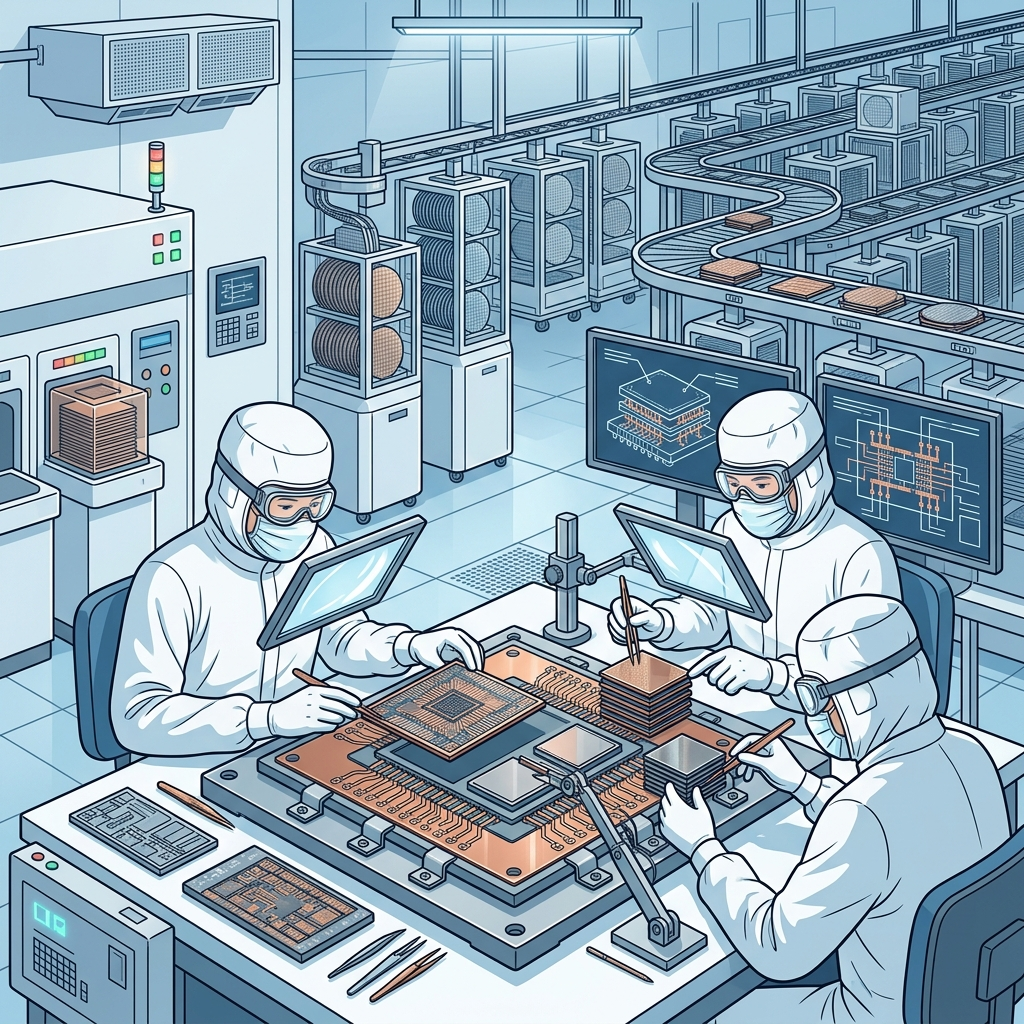
TSMC's Q3 2026 results delivered record-breaking headline figures — NT$1.494 trillion in revenue (+50.9% YoY in NT$ terms, +41.2% in USD) and NT$763.06 billion in net income (+68.7% YoY) — yet shares of 2330.TW fell roughly 2% on the day, with US ADRs off about 1.5% in pre-market trading. The market's focus was not on the headline growth, but on gross margin slipping from 67.7% in Q2 to 66.4% in Q3, with Q4 guidance of 65–67% pointing to further compression. Beneath the margin story lies a structural issue that most analysis overlooks: the genuine supply bottleneck constraining TSMC is not wafer manufacturing capacity, but CoWoS advanced packaging, where new-order lead times now exceed 50 weeks. CEO C.C. Wei's statement that demand remains "far above our capability today to supply" refers not to fab constraints, but to the limited throughput of the packaging infrastructure that assembles high-performance chips and HBM memory into finished AI accelerators. Paradoxically, this shortage is the very mechanism that underwrites TSMC's 66%-tier gross margin — the world's best-capitalized hyperscalers are competing for a finite supply of packaging slots, granting TSMC near-monopoly pricing power that ordinary manufacturing economics cannot explain. The critical question for investors is therefore not how fast revenue grows, but how long the CoWoS packaging monopoly endures — because the moment that supply-demand balance shifts, the premium that makes today's margins possible will begin to erode.
Key Points
The Margin Peak Has Arrived — And the Structural Drivers Are Clear
TSMC's gross margin moved from 67.7% in Q2 to 66.4% in Q3, with Q4 guidance of 65–67% pointing to continued compression. Two structural forces are responsible. First, the 2nm ramp: CFO Wendell Huang described it as a "steep ramp-up," and early-stage production of any new node comes with lower yields and elevated per-wafer unit costs. The revenue contribution jumped from 3% to 8% of wafer mix in a single quarter, confirming real scaling — but that pace generates front-loaded cost pressure before the node's premium ASP fully compensates. Second, overseas fab dilution: Huang stated the dilution from overseas fabs is expected to widen to 3–4pp over the next few years, up from the initial 2–3pp. Arizona-level labor and construction costs are structurally higher than Taiwan, and that gap does not disappear quickly. There is no specific quarter when management projects a margin recovery, meaning the floor is genuinely unknown, which is the core source of investor anxiety. Revenue can compound at impressive rates, but a margin trend consistently pointing downward changes how the business is valued — and TSMC's 2027–2028 window, when overseas fab dilution peaks and A16 ramp begins, could be the period of maximum margin pressure.
CoWoS Advanced Packaging Is the True Supply Ceiling for AI
When CEO C.C. Wei said demand remains "far above our capability today to supply," most listeners interpreted this as a wafer shortage. The reality is different: TSMC has roughly 20 fabs under construction globally, and Arizona Fab 2 is on track for Q3 2027 volume production, running slightly ahead of schedule. The genuine constraint is CoWoS — the packaging technology that stacks multiple compute dies alongside HBM memory into a unified substrate for AI accelerators. New-order CoWoS lead times currently exceed 50 weeks. Wei confirmed that TSMC is in real-world production of 5x reticle-size CoWoS packages, while simultaneously developing 9x and 14x — each generation of AI chips demanding a dramatically larger packaging footprint. According to TrendForce estimates, CoWoS capacity is approximately 130,000 wafers per month at end-2026, with Nvidia holding roughly 60% of that allocation. TSMC VP Kevin Zhang has stated the goal of establishing domestic US CoWoS capacity by 2029, but that is a target, not a confirmed schedule. Until that US capacity materializes, chips made in Arizona still ship to Taiwan for packaging. This packaging bottleneck is the actual ceiling on global AI accelerator supply — the number that most investors aren't watching closely enough.
The Shortage Is the Moat: Supply Scarcity as Structural Pricing Power
TSMC's 66% gross margin is not an efficiency story — it is a monopoly story. When demand structurally exceeds supply, prices hold at a premium without the pressure that competitive markets would otherwise impose. According to Epoch AI data cited by IO Fund, Nvidia, Google, AMD, and Amazon collectively consumed more than 90% of TSMC's CoWoS capacity in 2025 and took 92% of available HBM. The world's most capitalized technology companies are competing for a fixed number of packaging slots. In that environment, premiums stick and lead times extend rather than prices falling. The deepest paradox in the TSMC thesis is that CoWoS supply expanding — which most investors would instinctively read as bullish — actually begins to erode the monopoly that makes 66% margins possible. When supply adequacy returns, customers gain negotiating leverage they currently lack, and Samsung or Intel become more credible alternatives. For TSMC investors, the supply shortage persisting may be the most favorable scenario for near-term margin protection, even as it represents a structural constraint on the broader AI ecosystem. Understanding this paradox is the key to reading TSMC's capital allocation decisions correctly.
US CoWoS by 2029 Is a Goal, Not a Guarantee — And the Gap Matters
TSMC VP Kevin Zhang stated that establishing CoWoS and 3D-IC capacity in the US is a 2029 goal. The gap between that aspiration and the present reality is significant: chips manufactured in Arizona today still cross the Pacific for packaging in Taiwan before shipping back to US customers. Amkor is building an independent packaging facility in Arizona targeting early 2028 production, but as an independent contractor, not TSMC-controlled capacity. This means the entire global AI chip packaging supply chain remains concentrated in Taiwan for at minimum the next three years. US policy objectives under CHIPS Act have focused heavily on fab construction, but a fab without co-located advanced packaging cannot produce finished AI accelerators — it is literally an incomplete supply chain. Any cross-strait disruption, escalation, or natural disaster during this window represents a systemic risk to global AI infrastructure with no current mitigation path. The 2029 target, if met, would be a genuine structural shift. But "goal" and "scheduled milestone" are different categories, and the geopolitical exposure between now and 2029 is the highest-stakes unpriced risk in the TSMC thesis.
AI Accelerator Demand — The CAGR Got Upgraded, Not Downgraded
Wei's comments on the Q3 call included an upward revision to TSMC's AI accelerator growth expectations: the previous guidance of "mid-to-high 50s percent" CAGR for 2024–2029 was revised to "probably higher." This is notable because most companies at this scale guide conservatively and exceed — Wei is saying the previous conservative guidance was already too low. He also stated that demand is "extremely robust" with no signs of slowdown. Dell'Oro Group projects the GPU and custom accelerator market to reach $446 billion by 2029, with custom accelerators comprising approximately half of total shipments. JP Morgan projects TSMC's 2026 USD revenue growth at 30% and sustained above 20% in 2027. These converging data points suggest that for the AI accelerator market, the question is not whether demand will remain strong — it will — but whether supply infrastructure can keep pace. TSMC's structural position as the essential manufacturer and packager of AI accelerators means it is the direct beneficiary of this sustained demand. The risk is that the CoWoS bottleneck resolving too quickly could paradoxically reduce TSMC's pricing power at the same time that revenue volumes are expanding — a dynamic that would look confusing to investors focused only on topline growth.
Positive & Negative Analysis
Positive Aspects
- AI Demand Structural Strength — Upgraded CAGR With No Visible Slowdown
Wei's statement that demand is "extremely robust" with "no sign of slowdown" is backed by a concrete action: TSMC publicly raised its own forward CAGR guidance for AI accelerators from "mid-to-high 50s percent" to "probably higher." That is a company telling the world that its own projections were too conservative. Dell'Oro Group projects the GPU and custom accelerator market to reach $446 billion by 2029, and virtually every chip in that market requires TSMC's manufacturing and packaging capabilities. JP Morgan projects TSMC 2026 USD revenue growth at 30%, sustained above 20% in 2027, suggesting the structural tailwind has multiple years of duration. HPC already accounts for 68% of TSMC's Q3 revenue, meaning the AI infrastructure buildout is already the dominant driver — not an emerging theme but the current operating reality. For investors, demand-side risk appears contained for the next several years, which provides a meaningful buffer against the near-term cost headwinds from the 2nm ramp and overseas fab dilution.
- 2nm Leadership — A One-Quarter Jump From 3% to 8% Wafer Mix
TSMC's 2nm revenue contribution jumped from 3% to 8% of wafer mix in a single quarter — that is not a soft launch, it is a real high-volume manufacturing ramp. Historically, TSMC's new process nodes follow a consistent arc: compressed margins in the early-ramp phase due to lower yields, followed by a premium-pricing phase as the node matures and commands elevated ASPs for customers who need the best performance. 2nm is in the cost-intensive early phase, but the trajectory toward the premium phase is established. Samsung and Intel are both fielding 2nm-class processes, but Intel's external foundry revenue is $293 million per quarter and Samsung Foundry continues to face reported yield and customer acquisition challenges. In practical terms, TSMC remains the only advanced-node foundry that hyperscaler AI accelerator customers actually trust with their most critical production. By the time a credible competitor reaches today's TSMC performance level, TSMC will likely be ramping 1.6nm (A16) volume production — the technology lead continuously resets the clock on competitive convergence.
- CoWoS Technology Gap — Already in 5x Reticle Production, Working on 14x
TSMC is in real-world production of 5x reticle-size CoWoS packages while simultaneously developing 9x and 14x. A competitor reaching 5x production capability today would face a company already producing at a scale they cannot yet match. This technology gap compounds over time because CoWoS know-how is accumulated through production experience — yield optimization, thermal management at extreme package sizes, customer-specific integration challenges — not just capital deployment. The entry barrier is therefore both financial and experiential, making rapid competitive convergence structurally difficult. Wei's statement that "CoWoS is still the number one choice for our customer" is not marketing language — it reflects the reality that no customer has a practical alternative at the leading edge. This technology leadership in packaging, separate from the already-strong leading-edge manufacturing position, creates a two-layer moat that makes TSMC's competitive position substantially more durable than either layer alone.
- Overseas Expansion Strategic Value Extends Well Beyond the Margin Impact
Arizona Fab 2 entering volume production in Q3 2027 makes TSMC the first pure-play foundry producing advanced chips on US soil. The short-term 2–3pp margin dilution is a real cost. But the strategic return — deeper alignment with US government policy priorities, access to CHIPS Act subsidy programs, genuine geopolitical risk diversification — does not appear in the quarterly gross margin line. This expansion directly addresses the legitimate criticism that TSMC's concentration in Taiwan creates systemic supply chain vulnerability for US technology companies. American hyperscaler customers with board-level supply security mandates have a concrete reason to deepen long-term commitments when production is partially on US soil. Wei's note that Fab 2 is tracking "slightly ahead" of schedule signals execution competence and management focus on this strategic milestone. Over a multi-year horizon, reducing the geopolitical discount that investors assign to TSMC may prove more valuable to shareholders than any single quarter's margin performance.
Concerns
- Margin Compression — The Downtrend Is Unambiguous and the Floor Is Unknown
The gross margin path from 67.7% in Q2 to 66.4% in Q3 to a Q4 guidance midpoint of approximately 66% is a clear downtrend. The 2nm ramp continues imposing front-loaded cost pressure, the overseas fab dilution of 3–4pp has not yet fully materialized in the reported numbers, and once 2nm reaches maturity, 1.6nm (A16) will begin its own ramp cycle — resetting the cost-absorption phase. TSMC's advanced foundry business structurally operates in a mode where the newest node's early-stage costs are always partially overlapping with the cost-recovery phase of the preceding node. Management has not identified a specific recovery quarter, which means the structural floor for margins in the 2027–2028 window is genuinely uncertain. A margin trend consistently heading lower, even from a high base of 66%, creates downward pressure on valuation multiples. As the market shifts from pricing TSMC on near-term earnings beats to pricing it on normalized through-cycle margins, this compression story has real multiple-compression implications for the stock.
- CoWoS Monopoly — Durable for Now, But Not Structurally Unassailable
TSMC's current CoWoS dominance is real, but assuming it is permanent introduces significant analytical risk. Samsung is actively developing its own advanced packaging capabilities, Intel continues investing in Foveros 3D packaging, and TSMC's own decision to outsource CoWoS front-end work to OSAT players like Amkor and ASE — while relieving near-term capacity pressure — has a structural side effect: it builds the advanced packaging competency of entities that could become future competitors or enablers of alternative supply chains. As HBM technology advances to HBM4, memory vendors with their own packaging ambitions may push for greater integration control. The packaging ecosystem surrounding AI accelerators could gradually diversify its center of gravity away from TSMC — not through sudden disruption, but through slow erosion of the premium that currently makes 66% margins structurally defensible. Any credible alternative that captures even 10–15% of CoWoS-equivalent demand would have a meaningful impact on TSMC's pricing leverage.
- Geopolitical Concentration — Three More Years of Structural Taiwan Dependency
CoWoS packaging is effectively 100% Taiwan-based today, and US domestic CoWoS capacity is a 2029 goal that is not yet a confirmed milestone. Amkor's Arizona facility targets early 2028 production as an independent operator. For at minimum the next three years, the global AI chip packaging supply chain has a single geographic concentration point in Taiwan. Chips manufactured in Arizona today ship across the Pacific to Taiwan for CoWoS assembly before being shipped back to US customers. This structure means that any significant cross-strait escalation, military incident, or major natural disaster would immediately and severely disrupt the entire global AI accelerator supply chain — with no viable rerouting option at scale. US government policy has invested heavily in fab construction through CHIPS Act, but a fab without co-located advanced packaging capability cannot produce finished AI chips. The structural vulnerability does not resolve until domestic US packaging capacity reaches genuine production scale, and the gap between current reality and that outcome is measured in years.
- Capex Scale — A $60–$64 Billion Annual Commitment That Requires Sustained Demand
TSMC's 2026 capex guidance of $60–$64 billion, with JP Morgan projecting growth to $73–$78 billion in 2027, represents a fixed-cost commitment that must be justified by sustained revenue growth. This capex works cleanly if AI capital expenditure from hyperscalers continues compounding at the rates Wei is implying with his CAGR upgrade. It becomes a materially different problem if the AI investment cycle peaks earlier than consensus assumes and demand growth decelerates. The fixed-cost base embedded in advanced fabs and CoWoS capacity is unavoidable regardless of revenue trajectory, and the margin damage from significant utilization shortfalls would be far more severe than the 1–2pp annual gradual compression currently under discussion. S&P Global Market Intelligence has documented that high capex guidance consistently suppresses investor sentiment even through earnings beats, suggesting the market is already pricing some probability of this adverse scenario. TSMC's 2027–2028 period — when overseas fab dilution peaks, A16 begins ramping, and total capex commitment is at maximum — represents the window of highest simultaneous financial and operational pressure.
Outlook
Looking at the immediate horizon, Q4 guidance numbers are still objectively impressive — $52.3 billion to $54.3 billion in revenue represents roughly 58% YoY growth, and 2nm's share of wafer mix is likely to continue climbing beyond the 8% registered in Q3. The pivotal observation point for the quarter will be exactly where gross margin lands within the guided 65–67% range. If margin comes in at the top of that band, it signals that the market's margin-peak anxiety was overblown, and that TSMC's pricing power is absorbing ramp costs more effectively than feared. If margin lands at the lower end, it reinforces the structural compression narrative. CFO Huang's description of the 2nm scaling as a "steep ramp-up" almost guarantees that early-stage costs will remain elevated through Q4, but the premium average selling price that 2nm commands relative to legacy nodes should provide at least a partial offset. This tension between ramp costs and premium pricing will likely define the Q4 margin outcome.
In the near term — roughly the next six to twelve months — the CoWoS bottleneck is unlikely to meaningfully ease. Silicon Analysts estimates the supply gap narrowing from approximately 20% today to approximately 10% by end-2026, but that forecast already assumes demand growth stays at a conservative pace. Wei's upward revision to AI accelerator CAGR guidance to "probably higher" than mid-to-high 50s percent makes a conservative demand scenario harder to justify. The next generation of AI chips is also pushing toward 9x and then 14x reticle-size CoWoS packages — each generation demanding substantially more packaging capacity per chip than the last. Lead times of 50-plus weeks represent nearly a year of backlog, and there is no visible evidence that backlog is shrinking in any meaningful way. In this environment, TSMC's pricing leverage remains structurally intact.
Another near-term variable worth watching is TSMC's capacity to push CoWoS pricing higher. TSMC has a documented history of raising average selling prices during periods when demand structurally outpaces supply — CoWoS packaging services are not exempt from this pattern. Industry reporting has indicated TSMC implemented pricing adjustments on advanced process nodes and packaging in the second half of 2026. A 50-plus-week lead time is an extraordinarily strong negotiating position: customers who need delivery now are in no position to resist premium pricing. These ASP increases serve as a partial buffer against the margin headwinds from 2nm ramp costs and overseas fab dilution. In the short run, the magnitude of this pricing offset is likely the most significant swing factor determining whether Q4 gross margin lands at 65% or 67%.
Moving into 2027, the headline event is Arizona Fab 2 entering volume production in Q3. Wei confirmed this timeline is running "slightly ahead" of previous schedule, which is notable for a project of this scale and complexity. When Fab 2 begins production, TSMC becomes the first pure-play foundry to manufacture leading-edge chips on American soil — a milestone that carries substantial strategic and political weight well beyond the financial impact. However, a critical point must not be overlooked: the chips produced in Arizona will still require shipment to Taiwan for CoWoS packaging. The fab and the packaging are physically separated by the Pacific Ocean, and that will remain true until domestic CoWoS capacity is established. The early phase of Fab 2 production will also accelerate the overseas fab margin dilution that CFO Huang has guided to widen toward 3–4pp. How quickly Fab 2's yield rates approach Taiwan-level performance becomes a key variable in the 2027 gross margin trajectory.
Through 2027 into 2028, CoWoS capacity expansion accelerates in a meaningful way. TrendForce estimates project TSMC targeting approximately 260,000 CoWoS wafers per month by end-2028, roughly double the end-2026 level of approximately 130,000. Amkor's Arizona packaging facility is also targeting early 2028 production, and while it operates as an independent contractor rather than TSMC-controlled capacity, it represents the first real possibility of co-located chip production and advanced packaging on American soil. Even if total CoWoS capacity doubles by 2028, whether that resolves the supply gap depends entirely on how fast AI chip demand grows. If the AI accelerator CAGR truly runs "probably higher" than the previously guided mid-to-high 50s percent, doubling capacity may only narrow the gap rather than close it — and a narrower but persistent gap still preserves meaningful pricing leverage for TSMC.
The broader chain-reaction effect is also worth modeling through. If CoWoS bottleneck pressure gradually eases over 2027–2028, AI accelerator output increases, the marginal cost of deploying AI infrastructure falls, and more enterprises gain access to AI compute at tolerable economics. That demand democratization could trigger a second wave of AI infrastructure investment beyond the current hyperscaler-dominated cycle — which would in turn sustain or accelerate demand for TSMC's production capacity. In this virtuous cycle scenario, TSMC accepts somewhat lower pricing power in exchange for dramatically higher volumes, and total gross profit expands even as gross margin percentage dips. The risk to this scenario is timing: if the AI investment cycle peaks before the volume ramp materializes, TSMC would be holding dramatically expanded fixed-cost capacity against a softening demand backdrop — a painful combination.
The medium-term margin trajectory depends fundamentally on the tug-of-war between TSMC's pricing power and the relentless expansion of its cost base. JP Morgan projects capex climbing from the current $60–$64 billion range to $73–$78 billion in 2027. This investment commitment is rational if the AI demand CAGR truly sustains at the levels Wei is suggesting — but the margin mathematics only work if pricing holds. As CoWoS supply gradually catches up with demand over 2027–2028, TSMC's pricing leverage softens somewhat, even if it does not collapse. The combination of rising capex, 3–4pp overseas fab dilution materializing, and moderating pricing leverage creates a scenario where gross margins could keep drifting lower from today's 66.4% for a while, before the new cost structure stabilizes. The pace at which overseas fabs hit efficient-scale yields, and the pace at which AI demand grows relative to CoWoS supply expansion, will be the two variables that determine whether margin stabilizes around 65% or continues below.
One often-underappreciated variable in the medium-term outlook is the 1.6nm (A16) process cycle. By the time 2nm reaches production maturity — meaning it contributes strong margins rather than ramp-cost drag — TSMC will need to begin ramping A16. This is the structural inevitability of the advanced foundry business: you are always paying the early-stage costs of the next node while the current node has not yet reached full profitability. 2nm is in the cost-heavy early phase now; A16 will take its turn. Historically, TSMC's new-node cycles have followed a predictable arc — compressed margins on introduction, followed by margin recovery as the node matures and commands a durable ASP premium. If A16 ramp begins in earnest before 2nm fully matures, the recovery window between cycles narrows. Investors who focus on the absolute margin level of any individual quarter should instead track the cycle phase — understanding whether TSMC is in a cost-absorption phase or a margin-recovery phase explains far more than any single data point.
Looking further out to the post-2029 landscape, several structural shifts could significantly alter the competitive dynamics TSMC operates within today. TSMC VP Kevin Zhang's goal of having domestic US CoWoS and 3D-IC capacity operational by 2029 — if realized — would mark a genuine inflection point. For the first time, AI accelerators could be manufactured and packaged entirely within US borders, eliminating the cross-Pacific shipping roundtrip that currently defines the supply chain. Combined with Dell'Oro Group's projection of the GPU and custom accelerator market reaching $446 billion by 2029 and the HBM market exceeding $130 billion, the scale of the AI semiconductor economy in 2029 will be fundamentally different from today. At that scale, unit economics across the supply chain — including packaging — should benefit from genuine economies of scale, potentially providing a natural floor under margins even as competitive dynamics normalize.
The HBM supply chain represents a dimension of the CoWoS bottleneck that is rarely given sufficient weight. CoWoS packaging integrates compute dies with HBM memory — both components must be available simultaneously to produce a finished AI accelerator. SK Hynix holds approximately 53% of the HBM market, Samsung approximately 35%, and Micron approximately 11%, and all major HBM producers have reported 2026 supply as effectively sold out. The CoWoS bottleneck and the HBM allocation constraint reinforce each other: even if TSMC rapidly expanded CoWoS capacity, insufficient HBM supply would prevent finished accelerator output from increasing proportionally. Conversely, expanded HBM supply against a constrained CoWoS ceiling also fails to increase finished output. These two bottlenecks operate as serial constraints in the AI chip supply chain, which means resolving either one in isolation does not solve the broader supply problem. Dell'Oro Group's HBM market forecast of over $130 billion by 2029 implies this constraint remains structurally in place for years, which in turn supports TSMC's pricing power in CoWoS.
The competitive landscape in packaging is most likely to evolve through gradual dilution rather than sudden disruption. TSMC's technology lead — in production at 5x reticle size, developing 9x and 14x — means that even a well-funded competitor reaching 5x would face a company already producing at a scale three to four generations ahead. History from EUV lithography provides a useful analogy: ASML's monopoly has not been "broken" by competitors, but it has been partially flanked by alternative lithography approaches for less demanding applications. TSMC's CoWoS monopoly is likely to follow a similar trajectory — not a sudden collapse, but gradual establishment of alternatives for less demanding packaging configurations, while TSMC retains dominance at the frontier. The practical impact is that TSMC's pricing power in CoWoS gradually normalizes from a scarcity premium toward a technology-leadership premium — still elevated relative to ordinary manufacturing, but less extreme than the current 50-plus-week lead-time environment implies.
Mapping out the scenarios qualitatively: in the optimistic case, AI demand sustains or exceeds Wei's upward-revised CAGR, the CoWoS bottleneck persists through 2028, TSMC's pricing power continues absorbing the cost headwinds from ramp and overseas fabs, and margins stabilize in the 65–67% range even as revenue grows materially. Arizona Fab 2 yields converge toward Taiwan levels faster than expected, moderating the dilution impact. In the base case, CoWoS supply gradually expands and reduces the supply gap, pricing leverage softens somewhat, and margins ease somewhat below today's level over 2027–2028, while sustained revenue growth keeps total gross profit expanding. In the pessimistic case, the AI capex investment cycle peaks earlier than consensus expects, hyperscaler custom chip programs shift a meaningful share of volume away from TSMC, Samsung or an OSAT player establishes credible advanced packaging alternatives, and TSMC faces a simultaneous squeeze of lower utilization, reduced pricing power, and still-elevated capex commitments — compressing margins toward the high-50s percent range while also facing top-line disappointment.
For investors monitoring TSMC, three structural indicators are more informative than any single quarterly margin number. First, CoWoS lead-time trend: if 50-plus weeks holds or extends, the pricing premium is intact; if lead times start falling meaningfully toward 30 weeks or below, the supply-demand balance is shifting and pricing leverage is normalizing. Second, overseas fab yield gap versus Taiwan: this directly determines how much of the guided 3–4pp dilution actually materializes, and whether overseas fabs contribute to profitability on a reasonable timeline. Third, quarterly AI-related capex trends at Nvidia, Google, AMD, and Amazon: these four companies represent 90%-plus of CoWoS capacity demand, so any meaningful deceleration in their AI capex growth rates is an early warning signal for TSMC demand. Watching these three variables across multiple quarters provides far more insight into TSMC's medium-term trajectory than reacting to any individual gross margin print. The underlying thesis — that TSMC's real moat is its CoWoS packaging monopoly, not its leading-edge node capability — stands or falls on whether that structural packaging advantage proves durable or begins eroding. That is the bet at the core of the TSMC investment thesis today.
Sources / References
- TSMC Q3 2026 Official Press Release (SEC EDGAR 6-K EX-99.1) — TSMC, 2026-10-15 — TSMC Q3 2026 Official Press Release (SEC EDGAR 6-K EX-99.1)
- TSMC Q3 2026 Earnings Call Transcript — Motley Fool, 2026-10-15 — TSMC Q3 2026 Earnings Call Transcript
- TSMC CoWoS US Production Plans — Kevin Zhang Remarks — iTiger, 2026 — TSMC CoWoS US Production Plans — Kevin Zhang Remarks
- TSMC Plans to Double CoWoS Capacity by 2028 — Digital Citizen (citing TrendForce), 2026 — TSMC Plans to Double CoWoS Capacity by 2028
- GPU and Custom Accelerator Market to Reach $446B by 2029 — InsideHPC (citing Dell'Oro Group), 2025-08 — GPU and Custom Accelerator Market to Reach $446B by 2029
- TSMC Earnings Beat but Post-Q Selloff Pattern Analysis — S&P Global Market Intelligence, 2026-07 — TSMC Earnings Beat but Post-Q Selloff Pattern Analysis
- TSMC Q3 2026 Earnings Summary and Stock Reaction — KuCoin News, 2026-10-15 — TSMC Q3 2026 Earnings Summary and Stock Reaction