
Long Before Naples Made Pasta, Egypt Was Already There
Summary
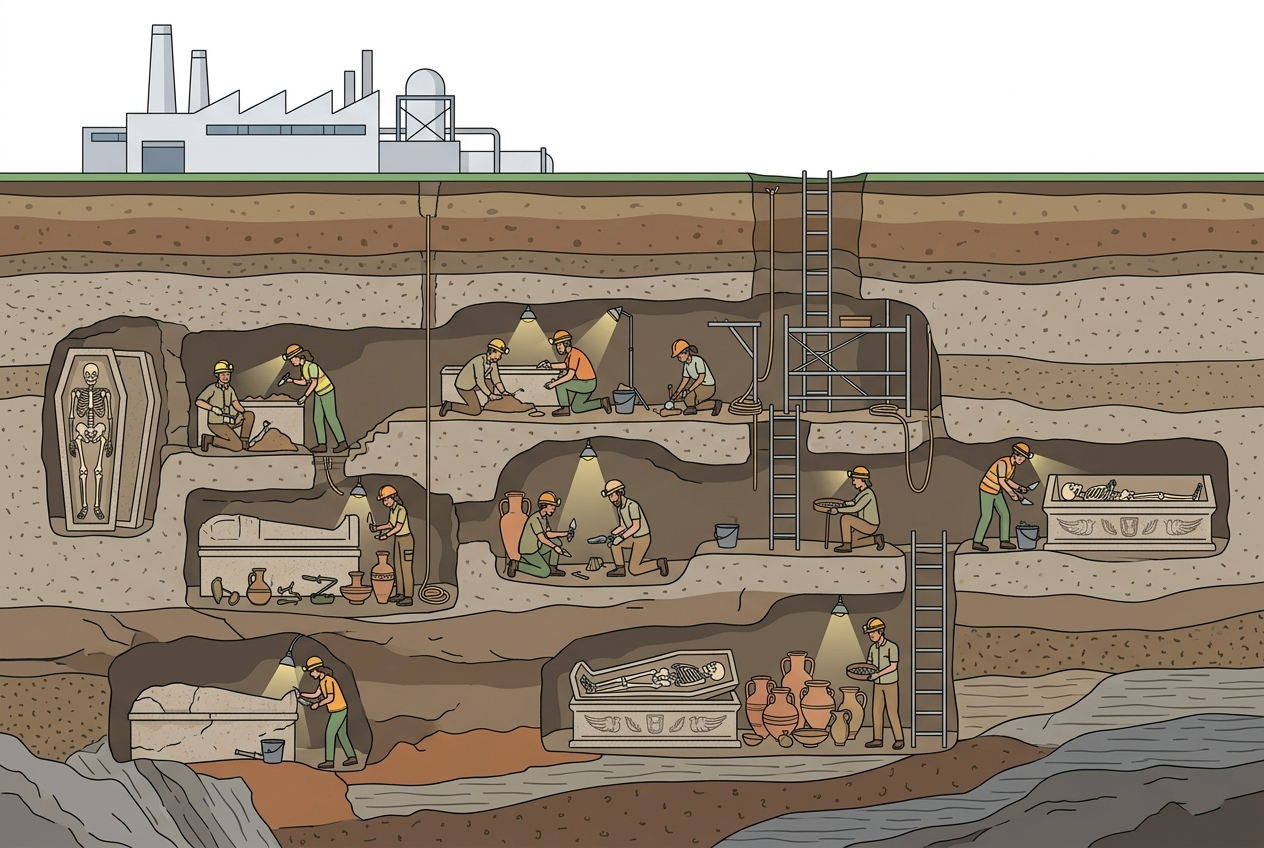
An archaic necropolis dating to the first half of the sixth century BC was discovered at the construction site of a Garofalo pasta factory expansion in Gragnano, near Naples — yielding 85 tombs alongside material evidence of a Mediterranean trade network linking the Egyptian, Greek, and Etruscan worlds, including Egyptian scarabs originating from Naukratis, a Greek colonial trading city in the Nile Delta. Among the grave goods were Etruscan bronze objects, animal-shaped amber carvings, refined silver items, and Greco-Oriental bone pendants, all recovered from the same burial context — demonstrating the multilateral nature of archaic Mediterranean commerce. Sealed tufa sarcophagi created an airtight environment that preserved textiles, wooden objects, and woven baskets dating back approximately 2,600 years, an outcome that is exceptionally rare in the archaeology of this period and provides a direct window into the material culture of pre-Roman Campania. The discovery directly challenges the common assumption that globalization is a modern Western invention, suggesting instead that the sixth-century BC Mediterranean already functioned as a multilateral network weaving together Egyptian religious symbolism, Etruscan metalworking, and Greek trading infrastructure into a coherent system of cross-cultural exchange. Garofalo's voluntary cooperation with the excavation simultaneously demonstrates both the achievements and the limits of Italy's preventive archaeology framework, while the presence of Egyptian funerary symbolism in Campanian tombs sheds new light on how foreign religious traditions permeated the Mediterranean world through mortuary ritual. Announced on July 15, 2026 at an official press conference by Italy's Superintendency for Cultural Heritage, this find is being recognized as a landmark contribution to the study of ancient Mediterranean trade history.
Key Points
Material Proof of Sixth-Century BC Multilateral Mediterranean Trade
The simultaneous recovery of Egyptian scarabs, Etruscan bronze objects, Greek-style amber carvings, and Oriental bone pendants from the same necropolis constitutes decisive material evidence that the sixth-century BC Mediterranean was not connected by isolated bilateral contacts but by a functioning multilateral network. Naukratis, established by Milesian Greeks in the Nile Delta around the mid-seventh century BC, served as the Mediterranean's premier commercial hub, attracting participation from twelve Greek city-states and sustaining a population of roughly 15,000 — exporting Egyptian natron, linen, papyrus, perfume, and scarabs while importing Greek wine, olive oil, and silver coinage in return. The British Museum's Naukratis Project, over seven field seasons, documented more than 18,000 artifacts from the site and identified at least 467 scarabs and scaraboids from the so-called "scarab factory" alone — objects bearing Greco-Egyptian hybrid motifs and distinctive stylistic markers that make their provenance archaeologically traceable wherever they turn up downstream in the trade chain. According to scholarship published in the ASOR journal Ancient Near East Today, these scarabs are concentrated primarily along the central Tyrrhenian coast — in Etruria, Latium, and Campania — a pattern that corroborates the existence of systematic trade routes running from Egypt through Greece into the Italian peninsula during this precise era. Add to this the precedent set by Italian archaeologist Libero D'Orsi, who excavated approximately 300 tombs from the same Ager Stabianus region in the 1950s, and what emerges is not an isolated anomaly but a decades-long accumulation of archaeological evidence pointing toward persistent, structured exchange. I believe the combined weight of these artifacts makes the "systematic trade network" interpretation far more compelling than any alternative explanation based on chance contact or prestige-gift exchange.
The Tufa Sarcophagus as Time Capsule: Exceptional Preservation of Organic Material
The sealed sarcophagi carved from tufa — a volcanic tuff abundant in Campania — created airtight burial chambers that successfully preserved textiles, wooden objects, and woven baskets across approximately 2,600 years, an outcome described by Heritage Daily as an "exceptionally diverse range of everyday objects, technologies, and funerary practices that would normally disappear through natural decay." For most sixth-century BC sites, the archaeological record consists almost entirely of ceramics, metal, and stone — materials robust enough to survive millennia in open soil — which means that inferences about daily life depend heavily on analogy and inference rather than direct evidence. What makes Gragnano different is the survival of the perishables themselves: the actual fabric people wore, the baskets they wove, the wooden implements they fashioned, all readable by modern materials analysts in ways that pottery typologies cannot match. An interdisciplinary team is currently running osteological studies and chemical analyses on the skeletal remains, and textile specialists are expected to extract data on weaving patterns and fiber sources that could illuminate sixth-century southern Italian textile trade networks in unprecedented detail. The tufa sarcophagus also tells us something about how Campanian communities leveraged the region's volcanic geology — using locally quarried volcanic stone not just as a building material but as an accidental refrigerator for their dead. I see this preservation event as one of the most scientifically consequential aspects of the entire find, because it adds an organic dimension to a research field that has long been constrained by the bias of inorganic survival.
Preventive Archaeology's Success — and the Model of Private-Sector Cooperation
This discovery stands as a clear vindication of Italy's preventive archaeology framework: without the systematic pre-construction survey conducted by Geomed S.r.l. beginning in January 2025 across roughly 2,000 square meters of the Via dei Pastai lot, 85 tombs and 2,600 years of preserved cultural heritage would almost certainly have been destroyed by concrete and heavy machinery. Article 28(4) of Italy's Cultural Heritage and Landscape Code (D.Lgs. 42/2004) empowers superintendencies to order preventive archaeological surveys for public works projects at the developer's expense, and the 2023 New Public Procurement Code (D.Lgs. 36/2023) tightened these requirements further by mandating preliminary archaeological impact assessments linked to the National Archaeological Geoportal. What makes the Gragnano case particularly noteworthy is that Garofalo is a private company — legally subject not to the preventive archaeology statute but to Italy's 1939 accidental-discovery law — meaning its cooperation with archaeologists was entirely voluntary and went well beyond what the law required. ABAP Naples Superintendent Paola Ricciardi assessed the necropolis as proof that preventive archaeology delivers on its promise "as a tool for knowledge and protection," while Director-General Luigi La Rocca called it "the result of a successful collaboration between the public and private sectors." Across Europe, preventive archaeology now accounts for more than ninety percent of all archaeological activity, so this case carries weight as a model for extending voluntary cooperation into the private development sector — provided that meaningful financial incentives, such as tax relief or insurance instruments, are put in place to make participation attractive beyond the Garofalo level of corporate civic commitment.
The Internationalization of Funerary Belief: What the Scarab Was Really Doing There
The Egyptian scarab is not decorative: it is a theologically loaded object representing Khepri, the solar deity who rolls the sun across the sky each morning and embodies cosmic regeneration after death — making it, in an Egyptian funerary context, a direct request to the universe for the deceased's resurrection and safe passage through divine judgment. According to the Johns Hopkins Archaeological Museum, heart scarabs placed on a mummy's chest served the specific function of preventing the deceased's own heart from testifying against them during the weighing-of-the-heart ritual in the Hall of Two Truths. Finding such an object — charged with this specific Egyptian theological purpose — interred in the tomb of a sixth-century Campanian who almost certainly did not speak Egyptian raises a question that I find genuinely fascinating: did these communities understand what the scarab meant, or did they treat it as exotic prestige material whose symbolic power they intuited without fully translating? The co-occurrence in the same tombs of terracotta siren-shaped balsam vessels (balsamaria) — figures drawn from Greek mythology and associated with the underworld — suggests that Egyptian and Greek afterlife cosmologies were being blended, layered, or at least juxtaposed in the funerary imagination of this community. Mainstream scholarship has long favored an interpretation centered on social display — foreign exotica as status markers — but more recent revisionist readings argue that deliberate tomb placement in a funerary context is itself evidence of intentional religious adoption rather than passive accumulation. I think the truth is probably more nuanced than either pole: these people likely grasped that the scarab carried power over death, even if their theology was a creative translation rather than a faithful reproduction of Egyptian belief.
Alphabetic Graffiti and Community Profile: Evidence of a Literate, Organized Society
Alphabetic inscriptions scratched onto pottery surfaces — graffiti in the scholarly sense — confirm that this was not a simple agrarian community but a literate society capable of maintaining trade records, asserting ownership, and entering into written agreements, all of which are functional prerequisites for active participation in long-distance commerce. The demographic profile of the necropolis reinforces the image of a full community rather than a warrior elite: skeletal remains identified so far include 16 adults, 4 children, and 15 infants — men, women, and children across age groups, suggesting this was a communal burial ground rather than a restricted aristocratic necropolis. Gendered burial goods add another layer: male tombs included swords, while female tombs were equipped with metal banqueting vessels, tubular fibulae, engraved silver signet rings, and Greco-Oriental bone pendants — a distribution indicating that both men and women were recognized as holding social status and defined roles within this society's hierarchy. Below the archaic necropolis itself, the excavation team identified structural remains from the Copper Age and Bronze Age, pushing the documented occupation of this locality well back of the sixth century BC and suggesting that Gragnano's position in the Ager Stabianus made it a persistent node of human settlement long before it became connected to Mediterranean trade networks. The presence of a terracotta siren-shaped balsamarium dateable to approximately 580–550 BC provides a useful chronological anchor that cross-validates the broader sixth-century BC attribution of the necropolis. Taken together, these interlocking indicators — literacy, demographic breadth, gendered status distinctions, deep occupation history — collectively build a picture of Gragnano as a substantial, organized, and commercially capable community rather than a passive endpoint of trade.
Positive & Negative Analysis
Positive Aspects
- Rare Organic Preservation That Opens a New Dimension of Sixth-Century Life
The fact that tufa sarcophagi preserved 2,600-year-old textiles, wooden objects, and woven baskets makes this discovery genuinely exceptional in the archaeology of the pre-Roman Italian peninsula, where the organic record for this period is almost nonexistent. Most sixth-century BC Campanian sites yield only ceramics, bronze, and stone — materials sturdy enough to survive open-soil burial for millennia — which means that scholars have been reconstructing daily life through analogy and inference rather than physical evidence. This find changes that by providing actual fabrics and wood grain that textile analysts and materials scientists can study directly to determine weaving techniques, fiber provenance, and tool marks, adding a full organic dimension to a research field that has been inorganically constrained for generations. Heritage Daily described the assemblage as representing "an exceptionally diverse range of everyday objects, technologies, and funerary practices that would normally disappear through natural decay," a characterization that captures exactly why this preservation event is so consequential. When the ongoing osteological and chemical analyses are complete, scholars will have data on diet, health, and mobility patterns that simply cannot be obtained from ceramics alone, and the combination of inorganic and organic evidence from a single, well-stratified context will make Gragnano a methodological reference point for future excavations in the region.
- A Critical New Data Point in Naukratis Scarab Distribution Research
The Gragnano find adds a precisely located, well-documented data point to the distribution map of Naukratis-origin scarabs in Italy — a map that has so far been concentrated in Etruria and Latium with only sparse coverage of interior Campania. The ASOR journal's scholarship on pre-Roman Italian scarabs had already established a pattern of concentration along the central Tyrrhenian coast, but specific coordinates within Campania proper were lacking; this necropolis supplies those coordinates in a stratified, professionally excavated context that maximizes comparative value. Because a Naukratis-style scarab found at the Etruscan sanctuary of Gravisca was previously identified by its "unmistakable style" as of Naukratis origin, applying the same stylistic methodology to the Gragnano specimens could yield a firm provenance link that strengthens the case for a direct Egypt-to-Campania trade route running through Greece. Combined with Libero D'Orsi's 300 tombs excavated from the same region in the 1950s, the total corpus now approaches 385 burials from a single locality — a dataset substantial enough to support statistical analysis of artifact distribution patterns and trade connectivity across multiple generations. Cross-referencing the Gragnano assemblage against the British Museum Naukratis Project's database of more than 18,000 artifacts could open entirely new comparative frameworks for understanding how far Naukratis scarab production actually reached during the sixth century BC, when the city's output was at its peak.
- A Concrete Proof of Concept for Preventive Archaeology's Value
Without the preventive survey that began in January 2025, a Garofalo construction crew would have destroyed 85 tombs, their extraordinary organic contents, and more than 2,600 years of preserved cultural heritage without anyone ever knowing what lay beneath the factory floor — making this discovery the clearest possible argument for the value of mandatory pre-construction archaeology. Superintendent Paola Ricciardi explicitly framed the necropolis as proof that preventive archaeology works "as a tool for knowledge and protection," and Director-General Luigi La Rocca cited it as a successful public-private collaboration — both of which are statements that carry institutional weight in ongoing policy debates about whether Italy should extend preventive archaeology obligations to private-sector construction. What makes the Garofalo case particularly useful as a proof of concept is that the company went beyond its legal obligations voluntarily, demonstrating that private developers can choose to treat archaeological discovery as an asset rather than a liability — a reframing that has significant implications for the industry if it can be institutionalized through tax incentives or reputational rewards. Across Europe, preventive archaeology already accounts for more than ninety percent of all archaeological fieldwork, so Italy's ability to demonstrate a successful private-sector cooperation model positions the country as a potential standard-setter for European heritage policy. CEO Massimo Menna's statement that hosting a discovery of this scale "is a great source of pride and a deep sense of responsibility" suggests that corporate cultural identity can be a driver of voluntary compliance even where law does not compel it.
- Adding a New Temporal Dimension to Campanian Cultural Tourism
The Gragnano necropolis gives Campanian cultural tourism something it has long been missing: a credible, well-documented archaic layer that predates Pompeii's Roman-era freeze frame by more than five centuries, creating the potential for an archaeological triangle stretching from Pompeii through Herculaneum to Gragnano that narrates the full depth of human settlement in the Bay of Naples from the Bronze Age to the Imperial era. Pompeii alone drew 4,267,233 visitors in 2024 and generated revenue of approximately 55.29 million euros — a 5 percent increase over the previous year, ranking it third among all Italian heritage sites according to the Italian Ministry of Culture — and the Grande Progetto Pompei, funded with 78 million euros in ERDF investment and 105 million euros total from the European Commission, restored 70 buildings over a decade, demonstrating that large-scale heritage investment in this region can generate proportionate economic returns. The Gragnano mayor's proposal to display artifacts at a local pasta museum or integrate them into a circuit with the Pompeii Archaeological Park represents the kind of creative product bundling — food culture plus archaeology — that appeals to the experiential tourism market increasingly dominant among European and American visitors. Italy holds 61 UNESCO World Heritage Sites — more than any other country — and its cultural and creative industries generate approximately 115 billion euros annually while employing 1.55 million people, which means that developing Gragnano as a heritage attraction feeds directly into a national economic ecosystem that is already proven and scalable. I think the combination of an extraordinary excavation story (the pasta factory angle alone is global press gold) and the depth of the finds makes Gragnano a genuinely viable addition to the Campanian heritage circuit, provided the conservation infrastructure investment follows.
- A High-Potential Platform for Interdisciplinary Research
This excavation functions as a natural laboratory where archaeology, anthropology, chemistry, textile engineering, and paleogenomics can converge on a single, well-stratified dataset — a convergence that is rare precisely because most sites of this period and region offer only the inorganic subset of evidence. The ongoing osteological analysis of skeletal remains can determine diet, disease burden, and physical stress markers; isotope analysis can reveal whether the buried individuals were native to the region or migrants from elsewhere in the Mediterranean, a distinction that would fundamentally reshape the interpretation of the site's role in ancient trade networks. Textile and wood analysis will produce direct data on craft technology and material sourcing that simply cannot be inferred from ceramics; epigraphic analysis of the alphabetic graffiti on pottery surfaces could identify the writing system in use and shed light on the community's linguistic affiliations. The Bronze Age and Copper Age structural remains identified beneath the archaic necropolis open a separate research track on the deep prehistory of this locality, offering the possibility of connecting the sixth-century BC community to a much longer arc of human occupation in the Ager Stabianus. If ancient DNA analysis proves feasible on the skeletal material, Gragnano could contribute genetic data that maps population movements in pre-Roman Campania at a resolution impossible to achieve through artifact typology alone — making this site not just a repository of objects but a generator of biological and cultural historical data for years to come.
Concerns
- The Structural Gap: Preventive Archaeology Does Not Cover Private Construction
Italy's National Research Council (CNR) has explicitly flagged the central weakness in the country's heritage protection framework: preventive archaeology obligations under Article 28(4) of D.Lgs. 42/2004 apply only to public works projects, while private construction remains governed by the accidental-discovery law of 1939, which imposes reporting obligations only after a find is made — meaning there is no mechanism to look before a private developer digs. Garofalo's voluntary cooperation in Gragnano is genuinely praiseworthy, but it is also exceptional, and expecting all Italian private developers to replicate the same level of civic responsibility is not a policy — it is a hope. The full cost of archaeological surveys on private land falls entirely on the developer under Italian law, which creates a structural disincentive that is manageable for a large company like Garofalo but potentially business-ending for a small or medium-sized construction firm facing an unexpected excavation requirement on a tight-margin project. Italy ratified the Council of Europe's Valletta Convention on the protection of the archaeological heritage twenty-four years after signing it, finally doing so on December 31, 2015 — and even that ratification was characterized by scholars writing in Bologna University's legal journal Aedon as "purely formal," producing almost no substantive legislative change. Until a system of meaningful incentives — tax deductions proportional to survey costs, cultural heritage insurance instruments, or reputational certification schemes — is created for private developers who voluntarily commission pre-construction surveys, the Gragnano outcome will remain an outlier rather than a model.
- The Development-vs.-Preservation Tension Is a Real and Growing Burden
Even granting the enormous cultural value of preventive archaeology, Italy's record on infrastructure delivery makes clear that adding mandatory survey requirements to construction timelines carries real economic costs that cannot be dismissed. The OTI 2025 infrastructure report found that of 83 northern Italian infrastructure projects tracked, only 43 percent were on schedule, 36 percent faced delays, and 21 percent were severely delayed — a pattern driven by multiple factors including bureaucratic complexity, permitting procedures, and litigation, but one in which archaeological discovery can be a significant contributor to uncertainty. Italy's National Recovery Plan (PNRR), valued at approximately 225 billion euros, carries the risk of losing roughly 28 billion euros in EU disbursements if project milestones are not met on schedule, which concentrates enormous political pressure on any factor that can slow construction — including, potentially, archaeological surveys on sites adjacent to major infrastructure corridors. Construction industry groups have increasingly characterized preventive archaeology not as a public good but as a regulatory hurdle, and sustained industry opposition has the potential to erode the social coalition that currently supports strong heritage protection mandates. I believe the real challenge is not to choose between development and preservation but to design procedures efficient enough that excavation and construction can proceed in parallel — and Italy has not yet achieved that level of procedural optimization at scale.
- Fundamental Interpretive Uncertainty in the Archaeological Evidence
The presence of a scarab in a tomb does not, by itself, constitute proof that the buried individual understood, adopted, or spiritually subscribed to Egyptian regeneration theology, and this interpretive gap is a genuine epistemological constraint on the most sweeping claims being made about the find. The University of Pennsylvania Museum's research on exotic artifact movement has identified determination of the mechanism of transfer — commercial trade, elite gift exchange, migrant personal property, or war spoils — as one of the hardest methodological challenges in archaeology, and Gragnano is no exception to that challenge. It is entirely possible that the scarab's owner valued it as an exotic, visually striking object whose death-related power they intuited in a general sense, without any specific familiarity with the Khepri mythology or the heart-weighing ritual that gives the scarab its precise Egyptian theological meaning. The co-occurrence of the siren-shaped balsamarium and the scarab could indicate deliberate religious syncretism — a conscious blending of Egyptian and Greek afterlife cosmologies — or it could reflect nothing more than an eclectic accumulation of visually compelling grave goods from multiple cultural sources without any coherent theological architecture underlying the selection. Resolving this ambiguity requires not just more data from Gragnano but systematic comparative evidence from analogous sites across the Mediterranean, and any interpretation that presents the "international funerary belief" thesis as established fact rather than a compelling but contested hypothesis is overstepping what the current evidence can bear.
- Conservation Infrastructure Risks for a Small Municipality
The 85 tombs and their extraordinary contents — especially the 2,600-year-old organic materials — require conservation facilities capable of maintaining precise humidity, temperature, and light conditions that are far beyond the resources typically available to a small Italian municipality like Gragnano. Organic archaeological materials begin to deteriorate the moment they are exposed to ambient atmosphere after millennia in a sealed environment, and the window for effective conservation treatment is narrow, making it essential that appropriate facilities and specialist personnel are in place before excavation of sensitive materials proceeds. The mayor's proposal to display artifacts at a local pasta museum is appealing as a concept but raises serious questions about whether such a venue can meet the international conservation standards — climate control, security, specialized display cases, conservation lab access — that UNESCO and ICOMOS guidelines require for materials of this fragility. Pompeii Archaeological Park has been proposed as an alternative repository, but the park itself has a complex history of management failures, including building collapses under the previous management regime, and its capacity to absorb additional collections without diluting attention and resources from its existing conservation obligations is not self-evident. European Commission funding supported the Grande Progetto Pompei at a total investment of 105 million euros, but whether a similar funding stream can be mobilized for Gragnano — a site that, however significant, lacks Pompeii's global brand recognition and the political weight that comes with it — remains an open question that the Italian government and European partners have not yet answered.
- The Risk of Over-Interpretation From a Single Site
Gragnano's archaic necropolis is a genuinely important discovery, but the leap from eighty-five tombs in one Campanian town to broad conclusions about the structure of sixth-century BC Mediterranean globalization carries methodological risks that deserve honest acknowledgment. Even combining the new finds with D'Orsi's 1950s excavations to assemble a corpus of more than 385 burials from the Ager Stabianus region, the sample remains geographically concentrated in a single locality — making generalizations about Mediterranean-wide trade patterns vulnerable to the charge of regional bias. The dominant "systematic trade network" interpretation competes with alternative explanations — single itinerant trader, heirloom accumulation over generations, indirect redistribution through multiple intermediaries — each of which is consistent with the physical evidence and cannot be ruled out without additional data from sites distributed across the full geographic range of the proposed network. Confirming a "Naukratis-to-Campania direct trade route" thesis requires not just finding the scarabs at the destination but identifying intermediate nodes along the route and demonstrating stylistic continuity across that chain — work that the British Museum Naukratis Project database can support but that has not yet been completed for the Gragnano specimens specifically. I hold the "ancient globalization" framing as the most compelling available interpretation, but I also think intellectual honesty requires flagging that a single spectacular site, however richly documented, cannot by itself overturn a century of scholarship on Mediterranean trade — it can shift probabilities and generate hypotheses, but definitive conclusions will require comparative evidence from sites across North Africa, the Levant, and the Aegean that are still waiting to be excavated or cross-analyzed.
Outlook
In the near term — roughly the next six months — the most significant developments to watch are the initial results from the interdisciplinary scientific analyses currently underway on the Gragnano assemblage. Osteological examination of the skeletal remains, combined with chemical and isotope analysis, will determine the diet, health status, and geographic origins of the individuals buried in the necropolis. If isotope profiling reveals that a meaningful proportion of the interred were migrants from other Mediterranean regions rather than locally born, the implications for understanding Gragnano's role in the ancient trade network are substantial — a migrant-heavy community suggests a commercial node or multicultural settlement, while a locally born population pushes the interpretive emphasis toward long-distance exchange rather than population movement as the vector of cultural mixing. Radiocarbon dating of the organic materials preserved inside the sealed tufa sarcophagi should narrow the current dating attribution of approximately 580–550 BC to a tighter range, which will improve the chronological alignment with the known peak production period of Naukratis scarab workshops. If ancient DNA extraction proves feasible from the skeletal material — a real possibility given the exceptional preservation conditions — genetic data could map population relationships between the Gragnano community and other sixth-century Mediterranean groups at a resolution that artifact typology alone cannot achieve.
The Garofalo factory's construction timeline will also require near-term decisions that carry significant heritage implications. Excavated zones can in principle be handed back for construction once documentation and removal of archaeological material is complete, but adjacent unexplored areas may contain additional burials — and deciding how far to extend the survey footprint before authorizing construction to resume is a judgment call that will test both the Superintendency's capacity and Garofalo's continued goodwill. Mayor Aniello D'Auria's proposals to display artifacts at a local pasta museum or link them to the Pompeii Archaeological Park circuit will also begin to take concrete form during this period, as heritage authorities assess the conservation requirements and visitor infrastructure that would be needed to make either option viable. I believe the near-term story to watch is whether Garofalo's model of voluntary private-sector cooperation begins to attract attention from other Italian companies with major construction projects underway in historically sensitive zones — the company's combination of positive press coverage and demonstrated civic commitment provides a reputational template that could resonate in boardrooms beyond the pasta industry.
In the medium term, spanning roughly six months to two years, this discovery is likely to begin reshaping the scholarly landscape for ancient Mediterranean trade research in ways that will take a generation to fully articulate. Existing scholarship on Naukratis scarab distribution in Italy has been concentrated in Etruria and Latium; the systematic documentation of Campanian interior sites has been significantly thinner, meaning that the Gragnano find adds a well-stratified, professionally excavated data point to a map that was previously sketchier in this region. Cross-referencing the Gragnano scarabs against the British Museum Naukratis Project's database of more than 18,000 artifacts through stylistic and compositional analysis could establish or rule out a direct Naukratis-to-Campania provenance link that would either confirm or complicate the trade route hypothesis with actual evidence rather than inference. Stylistic comparisons between the Gragnano specimens and the Naukratis-style scarabs previously identified at the Etruscan sanctuary of Gravisca — where origination was established by "unmistakable style" — offer a particularly promising methodological pathway for reconstructing the specific itinerary these objects followed from Egypt to southern Italy. The discovery is also likely to catalyze renewed survey interest in sixth-century BC sites across Campania, including locations that received only surface documentation in previous decades; comparative analysis between Gragnano and these re-examined sites could substantially densify the regional archaeological map and reveal whether Gragnano's connectivity was exceptional or representative of a broader Campanian pattern.
On the policy side, Italy's preventive archaeology framework can be expected to enter a new phase of debate during this medium-term window. The 2023 New Public Procurement Code already strengthened requirements for public-sector projects, but the gap covering private construction has not been addressed in legislation, and the Gragnano case provides the most compelling argument in years for extending some form of mandatory or incentivized pre-construction survey to private developments. I expect the Italian Ministry of Culture to explore whether a tax relief mechanism — structured as a percentage offset against survey costs, modeled on existing cultural heritage donation incentives — could be proposed through a delegated regulatory instrument without requiring primary legislation. In parallel, Italy's implementation of its National Recovery Plan across approximately 225 billion euros in infrastructure investment will dramatically increase the volume of public-works-triggered preventive archaeology surveys, creating pressure on the system's capacity and accelerating interest in digital survey tools — GIS-linked geoportal risk assessment, ground-penetrating radar, LiDAR — that can reduce excavation time and cost while maintaining heritage protection standards. Across Europe, preventive archaeology already constitutes more than ninety percent of all archaeological fieldwork, and Italy's institutional response to the Gragnano precedent will be watched as a potential benchmark for the continent.
Looking further ahead, at a horizon of two to five years, the most consequential long-term outcome may be a gradual paradigm shift in how ancient Mediterranean trade history is narrated and taught. The dominant scholarly framework currently centers its story on the great Greek poleis — Athens, Corinth, Miletus — as the primary agents and beneficiaries of Mediterranean exchange, with peripheral communities like Gragnano appearing only as passive recipients at the end of trade chains. If evidence continues to accumulate that small Campanian communities were actively integrated into multilateral networks connecting Egypt, Etruria, and the Greek world simultaneously, the research focus will eventually shift from hub-centric to periphery-inclusive models of ancient connectivity. This shift resonates with a broader reorientation already underway in modern globalization studies, where scholars have been challenging the "Global North" default by recovering the agency of peripheral actors in economic networks — a theoretical parallel that ancient Mediterranean historians are increasingly drawing on to reframe their own material. I think the "ancient globalization" thesis, as Gragnano contributes to it, has the potential to migrate beyond archaeology into the general educated reader's understanding of world history, particularly if it is communicated through popular venues alongside scholarly publications.
From a cultural tourism perspective, the long-term scenario I find most compelling is the emergence of a coherent Campanian archaeological triangle connecting Pompeii, Herculaneum, and Gragnano — a circuit offering visitors a temporal journey from the Bronze Age roots of the region through the archaic sixth-century BC Mediterranean network at Gragnano, all the way to the Roman Imperial city frozen in AD 79 at Pompeii. Pompeii draws more than four million visitors annually and generates revenues exceeding 55 million euros per year, so adding a well-presented archaic site to the same regional circuit adds temporal depth without competing for the same visitor demographic. The European Commission's willingness to invest 105 million euros through the ERDF in the Grande Progetto Pompei over a decade demonstrates that large-scale heritage investment in this region has been both politically viable and economically productive.
The governance challenge — aligning the Italian central government, the Campania regional government, the municipal administration of Gragnano, and a private industrial partner in Garofalo — is real and not trivial, and the lessons of Pompeii's historic management failures must inform whatever institutional architecture is designed for this new site. A similarly structured European funding instrument for Gragnano, perhaps linked to the broader PNRR cultural heritage component, is a realistic medium-to-long-term objective if credible conservation and visitor management plans are presented to Brussels. If those governance conditions are met, I believe Gragnano could become one of the most distinctive archaeological tourism experiences in the Mediterranean — not despite its pasta-factory origin story, but partly because of it, since the sheer improbability of the discovery is itself a story the world wants to hear.
Sources / References
- Dagli scavi di un pastificio di Gragnano una necropoli arcaica di 2500 anni fa — ANSA — Italian National News Agency
- An exceptional discovery: an archaic necropolis found in Gragnano beneath the Garofalo pasta factory — Finestre sull'Arte
- Rare Archaic Necropolis Unearthed in Southern Italy Reveals Exceptional Ancient Treasures — Heritage Daily
- Archaic Necropolis Unearthed Beneath Italian Pasta Factory Preserves Rare Textiles, Baskets, and Egyptian Scarabs — Arkeonews
- Naukratis: Greeks in Egypt — Research Project — The British Museum
- Naukratis — History and Trade Networks — World History Encyclopedia
- Pompeii 2024 Visitor Statistics — Official Ministry Report — Italian Ministry of Culture (MiC)
- Pompeii restored thanks to a EUR78 million investment in cohesion policy funds — European Commission — Regional Policy