
Same Day, Same Excommunication — Why the Vatican Can't Win Against the SSPX
Summary
The July 1, 2026 unauthorized consecration of four bishops by the Society of Saint Pius X (SSPX) at its seminary in Écône, Switzerland, followed by the Vatican's sweeping excommunication of six bishops and all SSPX priests on July 2, represents the largest formal rupture within the Catholic Church in 156 years. The event is historically distinctive not only for its scale but for its date — an almost exact repetition of July 1, 1988, when SSPX founder Archbishop Marcel Lefebvre performed the same unauthorized consecrations on the same calendar date, exactly 38 years prior. The dispute's core is emphatically not a liturgical argument over the traditional Latin Mass but a fundamental doctrinal conflict over the Second Vatican Council's declarations on religious liberty and interfaith dialogue, which the SSPX continues to reject as incompatible with authentic Catholic teaching. The SSPX's growth from approximately 60,000 adherents at the 1988 excommunication to a claimed 600,000 today — achieved entirely while under canonical separation from Rome — presents compelling historical evidence that excommunication as a disciplinary tool may paradoxically reinforce rather than suppress traditionalist movements by generating a martyrdom narrative. Pope Leo XIV's immediate and uncompromising response, contrasting sharply with his predecessors' strategy of sustained dialogue and accommodation, marks a turning point whose long-term consequences for both the Church's institutional authority and the future of the Catholic traditionalist movement remain deeply uncertain.
Key Points
38-Year Déjà Vu — An Exact Historical Repeat on the Same Date
The July 1, 2026 SSPX bishop consecrations carry exceptional historical weight precisely because they are not merely a reprise of the 1988 break in spirit — they fell on the exact same calendar date, July 1, 38 years later to the day. In 1988, Archbishop Lefebvre consecrated four bishops without papal approval; in 2026, the SSPX again consecrated four bishops without papal approval, with an attendance of roughly 16,500 people including 1,300 priests and religious. The Vatican's response followed the same sequence: immediate excommunication, this time expanded from the 1988 pattern to cover six bishops total — the four newly consecrated and the two officiating senior bishops, de Galarreta and Fellay — plus all SSPX priests worldwide. The 2009 lifting of the 1988 excommunications and the 2012 collapse of normalization talks over the doctrinal preamble refusal are bookends demonstrating that every attempt at reconciliation in the intervening 38 years ultimately failed to close the structural gap. The label of the Catholic Church's largest schism in 156 years is accurate but arguably undersells the real story, which is the institutional déjà vu: the same confrontation, the same playbook, the same outcome, separated by almost exactly four decades of unchanged structural antagonism.
The Real Battleground Is Doctrine, Not the Latin Mass
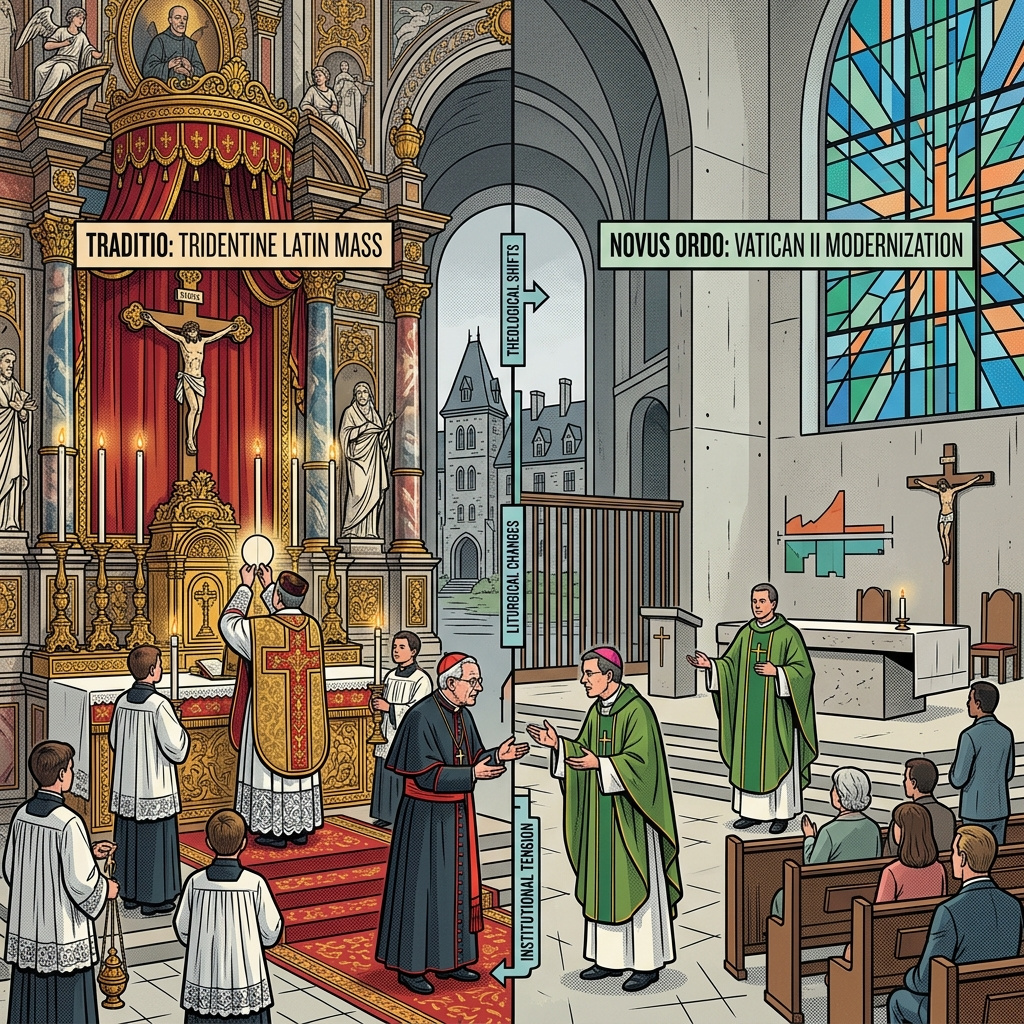
The widespread popular framing of this conflict as a liturgical dispute — the old Latin Mass versus the new Novus Ordo Mass — fundamentally misrepresents the nature of the disagreement and why resolution is so structurally difficult. Cardinal Parolin, the Vatican Secretary of State, stated it plainly: the fundamental issue is the council. Sociologist Massimo Introvigne provided independent scholarly confirmation: Archbishop Lefebvre's actual concern was religious liberty and the Church's relationship with other religions, not the form of the Mass. What the SSPX categorically refuses to accept are the Second Vatican Council's core doctrinal declarations — Dignitatis Humanae on religious freedom, and Nostra Aetate on the Church's relationship to other faith traditions. The clearest evidence that liturgical form is not the real barrier is the existence of the Priestly Fraternity of Saint Peter, operating with 368 priests celebrating the traditional Latin Mass in full canonical communion with Rome — demonstrating that the old rite and Vatican II acceptance are not mutually exclusive. Liturgical preferences are inherently negotiable; doctrinal truth claims about the Church's definitive teaching authority are not — which is why every accommodation attempted over 38 years failed to produce SSPX reconciliation.
The Paradox: Excommunication as Organizational Fuel
The empirical record on what the 1988 excommunication actually produced should give serious pause to anyone confident the 2026 measure will succeed where the first did not. At the time of the 1988 rupture, the SSPX counted roughly 60,000 adherents; by 2026, it claims 600,000 — a tenfold increase accomplished entirely under formal canonical separation, with no Vatican recognition and active Church discouragement of SSPX participation. SSPX Superior General Pagliarani's characterization of the consecrations as an extreme measure to save souls, amid the doctrinal and moral confusion in the Church, constructs exactly the martyrdom narrative that religious sociology identifies as a primary driver of separatist community cohesion. The framing of institutional persecution as evidence of prophetic correctness is historically among the most powerful organizational adhesives available to a religious movement. The Old Catholic Church, separated in 1870, has 4.9 million members today; the pattern of excommunicated communities growing rather than dissolving is consistent enough across history that expecting a different result this time requires a positive theory of what structural variable has changed.
America's First Pope Draws a Hard Line
Pope Leo XIV — Robert Francis Prevost, born in Chicago in 1955, undergraduate mathematics at Villanova University, elected May 8, 2025 — is not only the first American-born pope in history but the first to have taken decisive action against the SSPX rather than pursuing dialogue. His predecessor Francis, shaped by Argentine pastoral theology, spent decades attempting to keep the SSPX within a conversational relationship with Rome, culminating in the 2016 grant of special confessional authority to SSPX priests — an extraordinary accommodation that effectively legitimized SSPX sacramental practice on a limited basis. Leo XIV's approach could not be more different: a formal written appeal on June 29, a 48-hour window, and then immediate execution of the excommunication decree when the SSPX consecrations proceeded, with language explicitly warning of a sin of extreme gravity and an act of tearing Christ's seamless garment. Whether this represents a principled institutional stance or a pragmatic calculation that 38 years of dialogue has exhausted its potential, the cultural contrast with the Francis era is unmistakable and historically significant. American decision-making culture tends to set clear parameters, make one final offer, and act when it is refused — and that is precisely the sequence that played out here.
The Vatican's Surgical Strategy — Separating Clergy from Laity
One of the more strategically sophisticated elements of the Vatican's 2026 response, compared to the more blunt 1988 excommunication, is the explicit differentiation between clerical leadership and lay faithful. The Dicastery for the Doctrine of the Faith clarified that SSPX faithful attending Mass for liturgical or spiritual reasons are not automatically subject to excommunication — the imputability standard requires individual assessment of intent, and most laypeople attending SSPX Masses do not meet the threshold of deliberate schismatic intent. This approach isolates the SSPX's institutional hierarchy as the target while avoiding the politically and pastorally damaging outcome of alienating tens or hundreds of thousands of ordinary Catholics. The simultaneously announced five-step reconciliation process for individual priests provides a concrete institutional mechanism for clergy who want to exit the SSPX without leaving traditional Catholic practice altogether. Archbishop Hebda's immediate offer of six alternative traditional Mass venues in the Twin Cities demonstrates how dioceses can operationalize this strategy at the local level — providing SSPX-affiliated faithful with an accessible, valid, fully recognized alternative within the official Church structure.
Positive & Negative Analysis
Positive Aspects
- Doctrinal Boundaries Sharply and Unambiguously Redrawn
The excommunication accomplishes something that decades of ambiguous dialogue failed to achieve: it publicly clarifies, with canonical finality, that Vatican II acceptance is the non-negotiable minimum threshold for communion with Rome. For years, the Vatican's posture of ongoing engagement with the SSPX — including the 2016 confessional authorization — sent a mixed institutional signal that arguably contributed to internal Catholic confusion about where the boundaries actually lay. Pope Leo XIV's willingness to state plainly that SSPX clergy refuse to accept certain fundamental elements of the church, beginning with various points of the Second Vatican Council, makes explicit what had been diplomatically obscured. The formal decree through the Dicastery for the Doctrine of the Faith also creates a documented institutional precedent for how the Vatican handles large-scale doctrinal separatist movements. Canonical clarity, even when painful, serves the long-term institutional health of any organization — a clearly stated boundary, however contested, is more governable than a permanent gray zone where the SSPX could simultaneously claim and deny communion depending on the context.
- A Formal Reconciliation Path Published Simultaneously
The Vatican's decision to announce the five-step reconciliation process for individual priests on the same day as the excommunication decree demonstrates a degree of strategic maturity that the 1988 response notably lacked. By providing a formal, institutionally recognized pathway for clergy who want to return to communion — with the explicit condition that traditional Latin Mass celebration is permitted for those who comply — the Vatican has separated the question of doctrinal loyalty from the question of liturgical preference in a way that creates a genuinely viable option for moderate SSPX clergy. Cardinal Parolin's public statement that dialogue can resume and a solution can truly be found functions as more than diplomatic formality; it signals to SSPX clergy that the institutional door is not welded shut. The 1988 precedent shows that this kind of off-ramp can be used: twelve priests left immediately to found the FSSP, which now counts 368 priests. Even if the 2026 scale of departure is smaller, the existence of a formal process rather than an informal understanding makes individual decisions considerably more legible and institutionally sustainable.
- Lay Faithful Protected from Blanket Canonical Punishment
The explicit clarification that SSPX laypeople attending Mass for liturgical or spiritual reasons are not automatically subject to excommunication represents a genuine pastoral improvement over a less discriminating approach. The overwhelming majority of SSPX faithful are not schism-minded separatists — they are Catholics who prefer the traditional Latin Mass and have found in SSPX communities a spiritual home that mainstream parishes have not provided. Holding them collectively liable for the institutional decisions of the SSPX's clerical hierarchy would be both pastorally damaging and legally imprecise; Catholic canon law has long recognized that the imputability of serious ecclesiastical offenses requires assessment of individual intent. Dioceses are now being actively encouraged to provide alternative traditional Mass venues as a constructive response — Archbishop Hebda's immediate offer of six locations in the Twin Cities is an early example. The net effect of this differentiated approach, if implemented consistently, could be a gradual reabsorption of SSPX lay faithful into the official Church's traditional worship structures without requiring them to abandon the liturgical practice they value.
- Legitimate Channels for Traditionalist Demand May Expand
One underappreciated indirect effect of the excommunication is the increased pressure it creates on the official Church to provide robust, accessible alternatives for traditional liturgy, if the Vatican genuinely wants to compete for the constituency the SSPX has cultivated. Traditional Latin Mass attendance in the United States grew 71 percent between 2019 and 2021 — structural demand for traditional worship is real, broad, and demonstrably not confined to the SSPX. The FSSP, which grew from 12 priests at its 1988 founding to 368 priests today — approximately a 30-fold increase — demonstrates that when legitimate traditional worship channels exist within the official Church, they attract substantial and sustained participation. If the Vatican responds to the SSPX excommunication by actively expanding support for the FSSP, the Institute of Christ the King, and similar Vatican-recognized traditional communities, the paradoxical outcome might be that excommunicating the SSPX catalyzes a healthier and more institutionally sustainable traditional worship ecosystem within official Catholicism.
Concerns
- Sacramental Invalidity Creates Concrete Harm for Ordinary Faithful
The Vatican's declaration that SSPX sacraments of penance and marriage are invalid — not merely illicit — carries consequences that extend well beyond the clerical hierarchy and land directly on ordinary laypeople who had no institutional decision-making role in the schism. Invalid is a legally categorical term in canon law: it means the sacrament, in the Church's legal framework, did not occur. SSPX faithful who confessed through SSPX priests or married in SSPX ceremonies now find those acts legally nonexistent within the Catholic system. The 2016 special confessional authorization that Francis granted — which had, in effect, regularized SSPX confessions as spiritually valid — is also now rescinded, eliminating an accommodation that had provided meaningful pastoral relief. The moral logic of penalizing ordinary faithful for institutional decisions made by clergy above their level of authority is not self-evident, and it raises legitimate questions about the pastoral proportionality of the measure.
- The Martyrdom Narrative Will Cement SSPX Cohesion
History is not on the Vatican's side when it comes to the use of excommunication to suppress theologically motivated separatist movements. The 1988 excommunication produced a tenfold increase in claimed SSPX membership over the following 38 years, from 60,000 to 600,000 — accomplished entirely during formal canonical exclusion from Rome. Pagliarani's official response — framing the consecrations as an act of fidelity in a time of doctrinal and moral confusion in the Church — constructs exactly the narrative architecture of a persecuted remnant community, a framing that religious sociology identifies as among the most powerful drivers of organizational solidarity and retention. When an institution singles out a community for maximum censure, it inadvertently signals to members that their affiliation carries moral weight and requires courage — both powerful motivators for deepened commitment rather than departure. The Vatican has already tested this mechanism once in 1988, and the result over 38 years was expansion rather than dissolution.
- Demographic Trends Undercut the Excommunication's Long-Term Logic
Perhaps the most structurally uncomfortable data point for the Vatican's long-term strategy is what the generational numbers show about the direction Catholic culture is moving among younger clergy and converts. Harvard University's Cooperative Election Study found that American Gen Z Catholic identity jumped from 15 percent in 2022 to 21 percent in 2023, with some dioceses reporting adult conversion growth rates of 50 to 70 percent annually. The Catholic University of America's 2025 priest survey found that 80 percent of priests ordained since 2020 describe themselves as conservative or orthodox, compared to dramatically lower proportions among older ordination cohorts. Among priests ordained since 2000, 39 percent listed traditional Latin Mass access as a top institutional priority. This generational shift means that the SSPX's core doctrinal instincts are not becoming more isolated within Catholicism — they are becoming more mainstream. Excommunicating the SSPX leadership does not suppress demand for the tradition it represents; it may simply redirect that demand into official channels, leaving the underlying generational dynamic entirely unaddressed.
- History Offers No Evidence That Excommunication Resolves Doctrinal Schisms
The deepest strategic concern is the historical record on how excommunication as a disciplinary tool performs when deployed against movements rooted in genuine doctrinal disagreement rather than simple disciplinary infractions. The 1054 East-West Schism — triggered by mutual excommunications — remains unresolved nearly a thousand years later, despite the 1965 symbolic mutual lifting of those excommunications and decades of subsequent ecumenical dialogue. The Old Catholic Church, formed after the 1870 papal infallibility definition, has existed independently for 155 years and now claims 4.9 million members. In not one of these cases did excommunication produce the reintegration it was intended to achieve. Father Murray's warning that the longer the SSPX operates in defiance of the Holy See, the deeper the separatist spirit will become embedded among the clerics is historically well-grounded — but the corollary is that excommunication is the instrument most likely to extend that period of defiance by removing incentives for voluntary accommodation.
Outlook
The most immediately visible changes in the next one to three months will come from within the SSPX itself, in the form of individual departures. The 1988 precedent is instructive: twelve priests immediately left the SSPX following that excommunication and founded the Priestly Fraternity of Saint Peter (FSSP), which now operates with 368 priests across 146 dioceses worldwide. A comparable pattern of individual departures is plausible here, driven by moderate clergy who find the Vatican's simultaneously announced five-step reconciliation process an acceptable path forward. That process permits continued traditional Latin Mass celebration in exchange for signing doctrinal acceptance of Vatican II and recognition of the Novus Ordo Mass's validity — terms that some priests in the SSPX's moderate wing might view as survivable. However, I expect the scale of departures to be meaningfully smaller than in 1988. Thirty-eight years of separation have already filtered out most of the clergy inclined toward reconciliation, and those who remain today are far more doctrinally committed than the 1988 cohort. The priests who stayed through the 2009 partial olive branch and the 2012 doctrinal preamble refusal are confirmed believers, not undecided observers waiting for an exit ramp.
Between three and six months out, the more probable dynamic is institutional hardening rather than organizational fracture. Superior General Pagliarani's declaration that the excommunication is "objectively unjust and invalid" is not rhetorical posturing — it is the SSPX's official doctrinal position, communicated in a formal letter to the Pope himself. The SSPX currently enrolls 264 seminarians across five seminaries, with entering class sizes of 65 in 2024 and 68 in 2025, a sustained upward trend. Rather than discouraging vocations, the "persecuted for fidelity" narrative is structurally more likely to increase seminary applications among young traditionalist Catholics who interpret the Vatican's hard line as confirming the SSPX's prophetic correctness about institutional corruption. In the United States, where the SSPX counts approximately 25,000 affiliated faithful and the Saint Thomas Aquinas Seminary in Virginia anchors institutional life, the excommunication will function as a rallying point rather than a dispersal mechanism. Archbishop Hebda's offer of six alternative venues for traditional Mass may attract a fraction of lay faithful on the margins, but without doctrinal resolution, the practical appeal of those alternatives is limited to those who were already reconsidering their affiliation.
At the six-month to one-year mark, the first empirical data on the excommunication's real effect will become available. Three metrics matter most: SSPX Mass center count (currently 760), seminary enrollment, and the number of priests completing the Vatican's formal reconciliation process. Based on historical precedent from comparable religious separations, I project Mass center numbers remaining within a five-percent band of current levels — roughly 720 to 800 — with no dramatic organizational collapse. The Old Catholic Church provides a useful historical parallel: founded in 1870 with minimal institutional infrastructure, it has sustained independent existence for over 150 years and now claims 4.9 million members globally. The SSPX enters this second excommunication period with substantially more robust independent infrastructure than the Old Catholics possessed at founding. One counterintuitive dynamic also deserves close attention: traditional Latin Mass attendance in the United States grew 71 percent between 2019 and 2021, during a period when overall Catholic weekly Mass attendance had declined from approximately 50 percent in 1972 to roughly 25 percent today. The Vatican's excommunication does not eliminate demand for traditional liturgy; it primarily redirects that demand toward alternative channels such as the FSSP and other Vatican-approved traditional communities. The net effect may be a reallocation of the traditionalist constituency rather than its suppression.
Looking one to two years out, the most consequential variable is generational and demographic rather than institutional or canonical. Harvard University's Cooperative Election Study documented a jump in American Gen Z Catholic identity from 15 percent in 2022 to 21 percent in 2023, with some dioceses reporting adult conversion growth of 50 to 70 percent annually. The Catholic University of America's 2025 survey of priests found that among those ordained since 2000, 39 percent listed traditional Latin Mass access as a top priority — compared to 20 percent of priests ordained in the 1980s and 1990s, and only 11 percent of those ordained before 1980. Most significantly, 80 percent of priests ordained since 2020 describe themselves as "conservative or orthodox." This generational shift within official Catholicism means the SSPX's doctrinal instincts are becoming increasingly mainstream inside the institution that just expelled them. The Vatican has removed the SSPX's clerical leadership from canonical standing — but the spiritual sensibility the SSPX represents continues to grow within the institution. That is arguably the deepest structural irony of this entire confrontation, and the most uncomfortable long-term truth for Vatican strategists.
For the two-to-five-year window, three distinct scenarios are worth walking through in detail. The Bull scenario — partial reconciliation through internal SSPX fracture — carries roughly 20 percent probability. In this outcome, following the FSSP precedent, between 50 and 100 moderate SSPX priests separate from the main organization, individually complete the Vatican's five-step process, and form a new fraternity in full canonical communion while maintaining traditional Mass practice. The remaining SSPX core continues in reduced but stable form. The low probability reflects hard historical evidence: Pagliarani's leadership has taken a harder doctrinal line than any SSPX administration since Lefebvre himself, the 2012 preamble refusal demonstrates the organization's non-negotiable floor, and the terms of reconciliation — explicit acceptance of Vatican II — are precisely what the SSPX was founded to resist. Five-year cumulative defections at the individual level might total 30 to 60 clergy and 5,000 to 15,000 laypeople, but leadership-level direction change is unlikely without a generational turnover at the very top of the SSPX hierarchy.
The Base scenario — sustained parallel existence at roughly current institutional scale — is the outcome I consider most probable, at approximately 55 percent likelihood. The 1988-to-2009 period provides the template: 21 years of formal excommunication during which the SSPX grew rather than contracted. The Vatican's differentiated approach — penalizing clerical leadership while keeping lay faithful accessible — effectively allows SSPX communities to continue operating most of their day-to-day functions without serious disruption. With 760 Mass centers, five seminaries, and networks spanning 77 countries, the SSPX has built the infrastructure of a self-sustaining parallel institution. Vatican outreach efforts will likely continue on a periodic basis, but the 2009 and 2012 failure sequence — maximum institutional goodwill followed by doctrinal deadlock — is structurally positioned to repeat. Introvigne's assessment that the SSPX has "reached its high-water mark" of growth suggests the active weekly core of 30,000 to 40,000 participants may stabilize rather than expand dramatically. But that core, with 18-to-39-year-old traditional Mass attendees reporting 98 percent weekly Mass attendance rates, represents one of the most committed religious communities in contemporary Western Catholicism by any standard sociological measure.
The Bear scenario — complete institutional separation and the emergence of the SSPX as a formally independent denomination — carries approximately 25 percent probability. It's worth noting that "bear" here reflects a Vatican-perspective framing; from the SSPX's standpoint, this outcome might reasonably be described as liberation and institutional clarity. In this scenario, the SSPX gradually formalizes its independent canonical structures, normalizes non-acknowledgment of papal authority in practice while maintaining its formal theological position of not intending to "replace the Church," and operates as a fully self-contained Catholic institution existing in permanent parallel to Rome. The historical precedents are well-established and sobering for the Vatican: the Old Catholic Church has maintained independent existence since 1870 and grown to 4.9 million members worldwide; the East-West Schism of 1054 remains unresolved after nearly a thousand years of periodic dialogue; the Anglican communion, separated in the sixteenth century, has never returned to Rome despite recurring ecumenical engagement. Canon lawyer Father Murray captures the operative mechanism precisely: "The longer the SSPX operates in defiance of the Holy See, the deeper the separatist spirit will become embedded among the clerics." Every year of normalized separation makes institutional independence feel more natural — and return feel more unnecessary — to a new generation of SSPX seminarians who have never known the pre-schism reality and for whom independence is simply the world they were formed in.
There are wildcards that could alter any of these trajectories, and intellectual honesty requires acknowledging them plainly. If Pope Leo XIV were to issue a significant liberalization of traditional Latin Mass access — something comparable in scope to Benedict XVI's Summorum Pontificum of 2007, which broadly permitted the old rite before being substantially restricted by Francis's Traditionis Custodes in 2021 — some SSPX faithful might find sufficiently accommodating alternatives within official channels and transfer their affiliation. A generational leadership transition within the SSPX could also surface more conciliatory voices than the current Pagliarani administration. Both scenarios receive below 10 percent probability in my assessment, because Leo XIV has publicly stated that Vatican II acceptance is a non-negotiable condition of reconciliation, and no amount of liturgical accommodation bridges a gap that is fundamentally doctrinal in nature. The structural reality is this: the SSPX's foundational objection is to what the Catholic Church officially teaches, not to how it worships. This conflict will almost certainly outlast not just the current pontificate, but several. The appropriate frame for understanding this event is not a news cycle about institutional discipline — it is a chapter in the multi-century history of how religious institutions manage the tension between doctrinal continuity and institutional adaptation, a tension that belongs to no single tradition and has never once been permanently resolved in any of them.
Sources / References
- Vatican Declares SSPX Bishops, Priests Excommunicated — America Magazine
- What Is the Society of Saint Pius X? Why Pope Leo Excommunicated Its Bishops — Al Jazeera
- Why the SSPX Dispute Was Never Really About the Latin Mass — Catholic Standard
- After the Vatican Declares SSPX in Formal Schism, What's Next for the Church? — OSV News
- SSPX Rejects Vatican's Excommunication, Calls It Objectively Unjust and Invalid — National Catholic Register
- Catholic Church Says 6 Bishops From SSPX Excommunicated — CBS News
- Letter on Remission of SSPX Excommunications (2009) — Vatican Official