
A Secret Sleeping 1,800 Years Beneath a Mosque Pillar: The Teenage Emperor's Sun Temple Was Really There
Summary
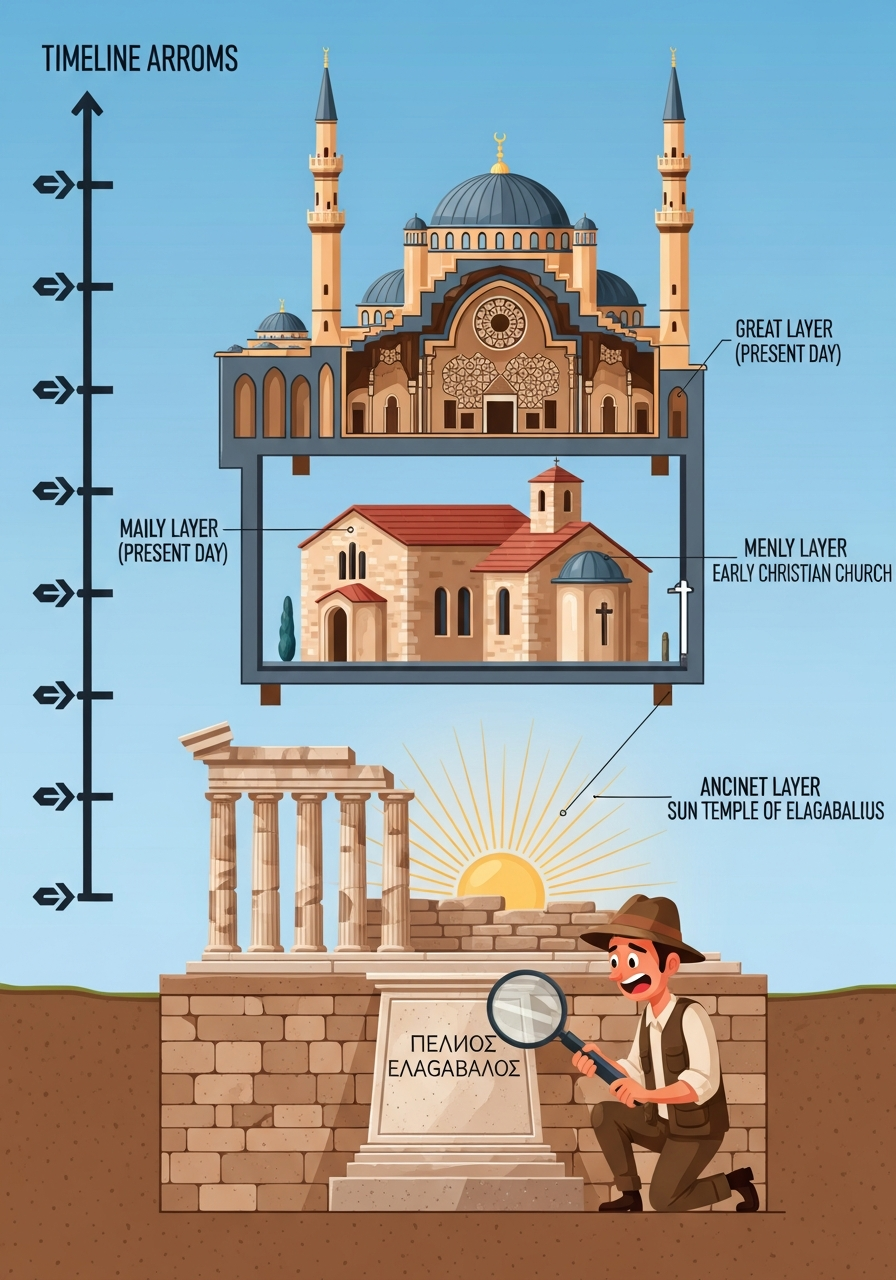
A Greek inscription discovered at the base of a column inside Syria's Great Mosque of Homs (al-Nuri Mosque) is providing a decisive clue in a decades-long scholarly debate over the location of the 3rd-century Roman Emperor Elagabalus's Temple of the Sun. Published in the archaeology journal Shedet by Professor Maamoun Abdulkarim of the University of Sharjah, the study analyzes the inscription's formal dedicatory style and heroic content—comparing a warrior-king to wind, storm, and leopard—to present compelling evidence that the current mosque stands atop the ancient Emesa sun temple. The discovery vividly illustrates the cultural palimpsest of religious architecture transitioning from pagan temple to Christian church to Islamic mosque, while underscoring the urgent need for heritage preservation and scholarly research in conflict zones.
Key Points
Discovery and Content of the Greek Inscription
During restoration work at the Great Mosque of Homs in 2016, a Greek inscription was discovered on a granite column pedestal buried beneath the floor. The pedestal measures approximately one meter on each side, with the inscribed plaque occupying about 75 centimeters of the front surface and the remaining 25 centimeters consisting of a decorative frame. The inscription is arranged in horizontal rows with symmetrical, formal lettering—a style commonly found in official Roman-era dedicatory or commemorative texts. The content carries a heroic, militaristic tone, comparing a warrior-king to wind, storm, and leopard while describing the defeat of enemies and imposition of tribute.
Therese Riyoun, head of the Homs excavation department, was responsible for documentation, and in May 2016, historian Abdulhadi al-Nazar published the first translation via Facebook. However, full scholarly analysis was significantly delayed due to the Syrian civil war.
Historical Context of Elagabalus and the Emesa Sun Temple
Ancient Emesa (modern-day Homs) was a religious center during the Roman Empire, built around the worship of the sun god Elagabal (meaning 'God of the Mountain' in Arabic). The sun temple served as the core of civic life, hosting seasonal festivals and reinforcing the political power of the priestly elite. Sextus Varius Avitus Bassianus, born around 203/204 CE in Emesa, belonged to the Severan dynasty bloodline and served as hereditary high priest of the sun god.
Ascending to the Roman throne at just 14 years of age in 218 CE, he attempted to elevate the Emesa sun god to the supreme deity of the Roman pantheon. He transported the temple's sacred black stone (a baetyl, presumably a meteorite) to Rome and constructed a massive temple called the Elagabalium on the Palatine Hill. Each summer solstice, he would parade the black stone through Rome on a chariot adorned with gold and jewels, performing elaborate rituals.
Decisive Contribution to the Scholarly Debate
The exact location of the Emesa sun temple had been an unresolved question in archaeology for decades. Some scholars pointed to the Great Mosque of Homs site as the most likely candidate, while others proposed locations on the city outskirts or nearby hills, with no consensus reached. Professor Maamoun Abdulkarim's study, published in the Shedet journal, created a substantive turning point in this debate through precise analysis of the inscription's formal dedicatory style.
The symmetrical arrangement and official Greek lettering used in the inscription are styles found only at major Roman-era temples or public buildings. The heroic praise and militaristic rhetoric directed at a warrior-king strongly suggest this was not a simple personal monument but a dedication belonging to a state-scale religious facility. However, Professor Abdulkarim himself specifies that the inscription does not 'confirm' but rather 'strongly suggests' the temple's location, indicating that further excavation and cross-verification are needed. Nevertheless, it is regarded as the strongest physical evidence discovered to date, substantially raising the possibility that ancient temple ruins exist beneath the Great Mosque of Homs.
Cultural Palimpsest of Religious Architecture
The case of the Great Mosque of Homs is a classic example of the 'architectural palimpsest' phenomenon—where a sacred site is repeatedly repurposed across different eras and religions. The transition from a pagan-era sun temple to a Christian-era church and then to a mosque following the Islamic conquest is a universal pattern observed throughout the Middle East and Mediterranean. The Umayyad Mosque of Damascus, built atop a Temple of Jupiter and a Church of St. John the Baptist, is a prominent comparative case.
This layering was not simply a matter of building recycling. Conquerors deliberately appropriated the sacred sites of the conquered to assert religious and political authority, while also seeking to absorb the 'sacred energy' of existing holy places. The intentional reuse of structural elements like columns, foundation stones, and bases was a way to physically embody this continuity of authority. The discovery of the Homs inscription within a structural element—a column pedestal—is precisely a product of this mechanism. This finding demonstrates that the cultural layering of religious architecture is not merely historical inference but an archaeologically verifiable reality, reinforcing the need for interdisciplinary research on similar sacred sites.
Challenges and Significance of Cultural Heritage Research in Conflict Zones
The discovery and research process of this inscription starkly reveals the practical barriers facing cultural heritage research in conflict zones. At the time of discovery in 2016, Syria was in the midst of civil war, and Homs itself had suffered severe destruction from intense fighting. The fact that nearly 10 years elapsed between discovery and full scholarly analysis is a stark example of how war can freeze the clock of academic research.
According to UNITAR-UNOSAT satellite analysis, a total of 104 severe damages and 85 moderate damages were confirmed across Syria's six World Heritage cities. AAAS satellite imagery analysis reports that more than 25% of archaeological sites have suffered from looting. The Wilson Center emphasizes that Syrian cultural heritage preservation faces the dual challenge of navigating both war and transition, and evaluates this inscription study as a hopeful case proving that scholarly achievement is possible even after conflict ends. Professor Abdulkarim's research goes beyond single inscription analysis to compellingly demonstrate why cultural heritage in conflict zones should be subject to international protection and emergency documentation.
Positive & Negative Analysis
Positive Aspects
- Providing Material Evidence for Decades of Scholarly Debate
In the long-standing academic debate over the location of the Emesa sun temple, this inscription represents the first direct material evidence that goes beyond literary records and indirect inference. The combination of formal dedicatory style and heroic rhetoric strongly suggests the inscription belonged to a major state religious facility, significantly strengthening the scholarly justification for subsurface excavation beneath the Great Mosque of Homs. Should non-destructive subsurface surveys (such as GPR) be approved in the future, this inscription is likely to serve as their starting point. The archaeological significance is considerable in that a single artifact can reset an entire research direction.
- Empirical Confirmation of Religious Architectural Layering Theory
The phenomenon of religious architectural layering—transitioning from pagan temple to church to mosque—has been widely accepted theoretically in academia, but confirming it with physical evidence in individual cases has proven difficult. The Homs inscription, as a Roman-era artifact physically sealed within a mosque column, has become a representative case empirically validating the layering theory. This could stimulate comparative research on similar cases such as the Umayyad Mosque of Damascus, the Mezquita of Cordoba, and Hagia Sophia in Istanbul. The ability to trace a site's religious transitions through material culture contributes to both architectural and religious history research.
- Demonstrating the Possibility of Heritage Research in Conflict Zones
This case has proven that documentation and scholarly analysis of cultural heritage remain possible even under the extreme circumstances of the Syrian civil war. Although 10 years elapsed from the 2016 discovery to the 2026 academic publication, the fact that scholarly results can still be produced after conflict ends serves as a practical reference case for cultural heritage researchers in similar situations in Yemen, Libya, Ukraine, and elsewhere. The fact that the University of Sharjah, a Gulf-region academic institution, conducted this Syrian heritage research demonstrates the importance of regional academic networks in conflict-zone research.
- Public Engagement with Multi-Layered Historical Narratives
Elements such as a fourteen-year-old emperor, a sacred black meteorite stone, sun worship, and a secret inscription hidden inside a mosque column possess narrative power that stimulates public imagination beyond the confines of academic papers. The coverage of this discovery by major outlets including Phys.org, Newsweek, and Archaeology Magazine demonstrates archaeology's potential to capture public interest. Public attention plays a decisive role in generating international support for heritage preservation in conflict zones and contributes to securing public funding for scholarly research.
Concerns
- Limitations of Conclusions Based on a Single Inscription
The claims to date fundamentally depend on a single inscription. While the formal style and heroic content strongly suggest a connection to the sun temple, they do not definitively confirm that the site was necessarily the sun temple. The possibility that the inscription was produced elsewhere and reused as building material (spolia), or that it belonged to a different public building rather than the sun temple, cannot be entirely ruled out. Without further excavation, the original context of this inscription cannot be established, and the researcher himself acknowledges this point.
- Practical Impossibility of Site Access and Further Excavation
The Great Mosque of Homs is currently an actively used Islamic place of worship, and full-scale archaeological excavation of the column bases or underground areas is virtually impossible for religious, political, and structural reasons. As long as Syria's political instability continues, the pursuit of international collaborative excavation projects remains distant. Non-destructive survey technologies (GPR, LiDAR) could serve as alternatives, but these also require authorization from local authorities and international cooperation. Consequently, the scholarly questions raised by this inscription will inevitably remain in abeyance for a considerable period.
- Irreversible Loss of Contextual Information Due to Conflict
The Syrian civil war inflicted massive physical damage on major heritage sites including Homs. UNITAR-UNOSAT confirmed 104 instances of severe damage and 85 of moderate damage across Syria's six World Heritage cities, while AAAS reports that more than 25% of archaeological sites have suffered from looting. Other artifacts or structural evidence that may have existed in the same archaeological stratum as this inscription have likely been destroyed by war and looting. While the inscription itself was preserved, the archaeological context in which it was originally situated may have been partially or completely lost.
- Documentation Gaps Due to 10-Year Delay in Scholarly Analysis
There is a possibility that primary data that could only be recorded at the time of excavation—such as the field conditions immediately following the 2016 discovery, the exact original position of the column pedestal, and the composition of surrounding strata—was not sufficiently secured. Initial documentation was handled by Therese Riyoun, head of the Homs excavation department, and an informal translation was first published via Facebook, but systematic scholarly documentation was delayed for years due to the civil war. The physical condition of the site may have changed during this period, potentially affecting the accuracy of future re-verification work.
- Risk of Political Instrumentalization
The discovery of ancient ruins always carries the risk of being co-opted in modern politics for nationalist narratives or territorial legitimacy claims. Various political forces within Syria could exploit this discovery to bolster their own claims to legitimacy, or selectively interpret it to highlight particular religious identities. The fact that a Roman-era pagan temple lies beneath an Islamic mosque could become a sensitive topic in a region with high inter-religious tensions, and caution is needed to prevent scholarly discoveries from inadvertently becoming sparks of conflict.
Outlook
To properly understand the significance of this discovery, one must first retrace the journey of Homs as a city. Known as Emesa during the Roman Empire, this city sat at the crossroads of east-west trade routes and served as a center of sun worship. During the 3rd-century Severan dynasty, it influenced the religious landscape of the entire empire as the hometown of the imperial family. Later, a Christian episcopal see was established during the Byzantine era, and a mosque was built following the Islamic conquest, making it a site of religious transformation spanning millennia. The fact that physical traces of all this history are layered within a single structure constitutes the core significance of this inscription discovery.
The academic attention that concentrated on Professor Abdulkarim's study following its publication in the Shedet journal was not simply because a single inscription had been found. This inscription functions as the most direct material evidence in the decades-long scholarly debate over the location of the Emesa sun temple, elevating the level of discussion that had previously relied solely on literary sources and indirect inference. The formal dedicatory style used in the inscription is a feature observed only in major Roman-era public buildings or temples, and the heroic rhetoric comparing a warrior-king to wind, storm, and leopard is interpreted as pointing to a state-scale religious facility rather than a personal monument.
Of course, this interpretation requires cautious qualification. Professor Abdulkarim himself makes clear that the inscription does not 'confirm' but rather 'strongly suggests' the location of the sun temple. The possibility that the inscription was spolia—reused as building material from another location—cannot be entirely excluded, and the possibility that it belonged to a different public building rather than the sun temple also remains open. However, the scale of the column pedestal (one meter on each side), the sophisticated composition of the plaque (75 centimeters of inscription and 25 centimeters of decorative frame), and the symmetrical arrangement demonstrate that this was not a temporary structure but belonged to a substantial architectural program. Synthesizing the evidence to date, the hypothesis that the Great Mosque of Homs site is the leading candidate for the ancient sun temple has secured stronger grounds than ever before.
Another dimension of this discovery is its empirical contribution to the cultural layering of religious architecture—the architectural palimpsest phenomenon. The phenomenon of a single sacred site being repeatedly converted into worship spaces of different religions across different eras is observed throughout the Middle East and Mediterranean, but clearly confirming the physical traces of each transition is not easy. The Umayyad Mosque of Damascus, built atop a Temple of Jupiter and a Church of St. John the Baptist, and Istanbul's Hagia Sophia, transformed from church to mosque to museum and back to mosque, are famous comparative cases. The Homs inscription directly reveals that material traces from the deepest layer of this palimpsest—the pagan era—were physically sealed within an Islamic-era structure.
This layering was not simply a matter of building recycling. Erecting one's own worship space atop the sacred site of the conquered was an act of visibly declaring religious and political authority, while simultaneously seeking to absorb the 'sacred energy' of existing holy places. The deliberate reuse of structural elements from previous buildings—columns, foundation stones, bases—was a way to physically embody this continuity of authority. The discovery of the Homs inscription within a structural element, a column pedestal, is precisely a product of this mechanism.
Yet despite all this scholarly significance, the prospects for future research are far from smooth. The Great Mosque of Homs is currently an actively used Islamic place of worship. Full-scale archaeological excavation of the column bases or underground areas is blocked by three layers of barriers: religious sensitivity, structural safety, and Syria's political situation. Non-destructive subsurface survey technologies such as GPR (Ground Penetrating Radar) and LiDAR have been proposed as alternatives, but these too require approval from local religious authorities and the government, with practical challenges of assembling international research teams and securing funding remaining.
The broader context facing Syrian cultural heritage cannot be ignored either. The civil war that began in 2011 dealt a devastating blow to the nation's cultural heritage infrastructure. UNITAR-UNOSAT satellite analysis recorded 104 instances of severe damage and 85 of moderate damage across Syria's six UNESCO World Heritage cities. AAAS satellite imagery analysis reports that more than 25% of archaeological sites have suffered from looting, and illegal excavation and antiquities trafficking have become a major source of conflict funding. The destruction of Palmyra's Temple of Bel and Arch of Triumph, the souk fire in Aleppo's Old City, and the shelling damage to Krak des Chevaliers are merely the dramatic cases reported in international news; the ruins that have disappeared without even being recorded are far more numerous.
The Wilson Center analyzes that Syrian cultural heritage preservation simultaneously faces the dual challenges of emergency protection during wartime and systematic recovery during transition. Even if the civil war officially ends, long-term challenges of rebuilding institutional capacity, securing trained personnel, and sustaining international funding support remain. The case of the Homs inscription carries dual significance in this context. On one hand, it is a case of hope showing that important scholarly discoveries are possible even amid the ruins of war; on the other, it simultaneously demonstrates the limits of reality where no full-scale follow-up investigation has been conducted even 10 years after the discovery.
From an international perspective, this discovery could serve as an occasion to rekindle international attention to cultural heritage protection in conflict zones. UNESCO's emergency cultural heritage protection mechanisms, ALIPH (International Alliance for the Protection of Heritage in Conflict Areas) activities, and remote research projects by academic institutions in various countries are contributing to Syrian cultural heritage preservation, but their roles face structural limitations in situations where field access is restricted. The fact that the University of Sharjah, a Gulf-region academic institution, conducted this research is also a case demonstrating the comparative advantage that regional academic networks hold in conflict-zone research.
Synthesizing the outlook, this inscription's discovery sets future research directions on three dimensions. First, the scholarly justification for non-destructive surveys of the Great Mosque of Homs site has been significantly strengthened. GPR surveys will likely be the first follow-up research pursued once Syria's political stability is restored and cooperation with local authorities becomes possible. Second, comparative research on similar religious architectural layering cases across the Middle East is likely to be activated. The Homs case will stimulate the search for as-yet-undiscovered material traces at sacred sites in Damascus, Jerusalem, Istanbul, and elsewhere. Third, discussions on emergency documentation systems for cultural heritage in conflict zones will be strengthened. The lesson of this case, where primary data at the time of discovery was not sufficiently secured, highlights the need for protocols that enable at least minimal systematic documentation even in conflict situations.
Ultimately, the Greek inscription discovered beneath a mosque column is not simply an archaeological artifact. It is physical evidence of religious transformation spanning 1,800 years, a living case study of war's impact on scholarly research, and a reminder of the depth of history that a single sacred site can hold. Whether the sun god's temple that the teenage emperor served truly stood beneath that mosque—that final answer has not yet been given. But it is clear that the most important step toward that answer has been taken, and the fact that this step crossed 10 years of wartime lends this discovery a weight that transcends its scholarly significance.
Sources / References
- Mysterious Greek inscription reignites debate over lost Temple of the Sun — Phys.org
- Greek Inscription Found in Great Mosque of Homs Reveals Lost Temple of the Sun — Arkeonews
- Greek inscription in Syrian mosque reignites debate over Roman emperor's lost sun temple — ScienceDaily
- The Greek Inscription in the Great Mosque of Homs (Shedet Journal) — ResearchGate
- Great Mosque of al-Nuri, Homs — Wikipedia
- Elagabalus — Wikipedia
- Preserving Cultural Heritage in Syria Through War and Transition — Wilson Center
- Archaeology: Inscription Debate Over Roman Emperor's Lost Temple — Newsweek
- Greek Inscription Found in Syria's Great Mosque — Archaeology Magazine