
Games Are Not Netflix — The One-Line Lesson Xbox Paid $69 Billion to Learn
Summary
Xbox's "Reset" restructuring marks the moment Microsoft formally acknowledged that its seven-year gaming strategy was broken at a fundamental level. After deploying $69 billion to acquire Activision Blizzard and assembling a portfolio spanning dozens of studios, the company announced 3,200 layoffs and the divestiture of four beloved studios — Double Fine, Ninja Theory, Compulsion Games, and Undead Labs — in a single restructuring sweep. Game Pass subscribers sit at approximately 30 million, barely 40 percent of the 77 million target Microsoft cited in its own merger review filings, while the business continues to lose 64 cents on every dollar invested. The core failure reveals a categorical mistake: Microsoft applied Big Tech's portfolio-management logic to a creative industry governed by entirely different rules, assuming the subscription model that reshaped streaming video could be transplanted into a medium where a single great game commands hundreds of hours of a player's devotion. With nearly 50,000 cumulative gaming-industry layoffs since 2022 and developer unionization accelerating, Xbox Reset stands as the definitive case study in how the world's largest technology companies systematically misread creative industries — and its consequences will reshape the business of making games for years to come.
Key Points
Game Pass's Structural Collapse — A Subscription Model That Never Scaled to Its Own Targets
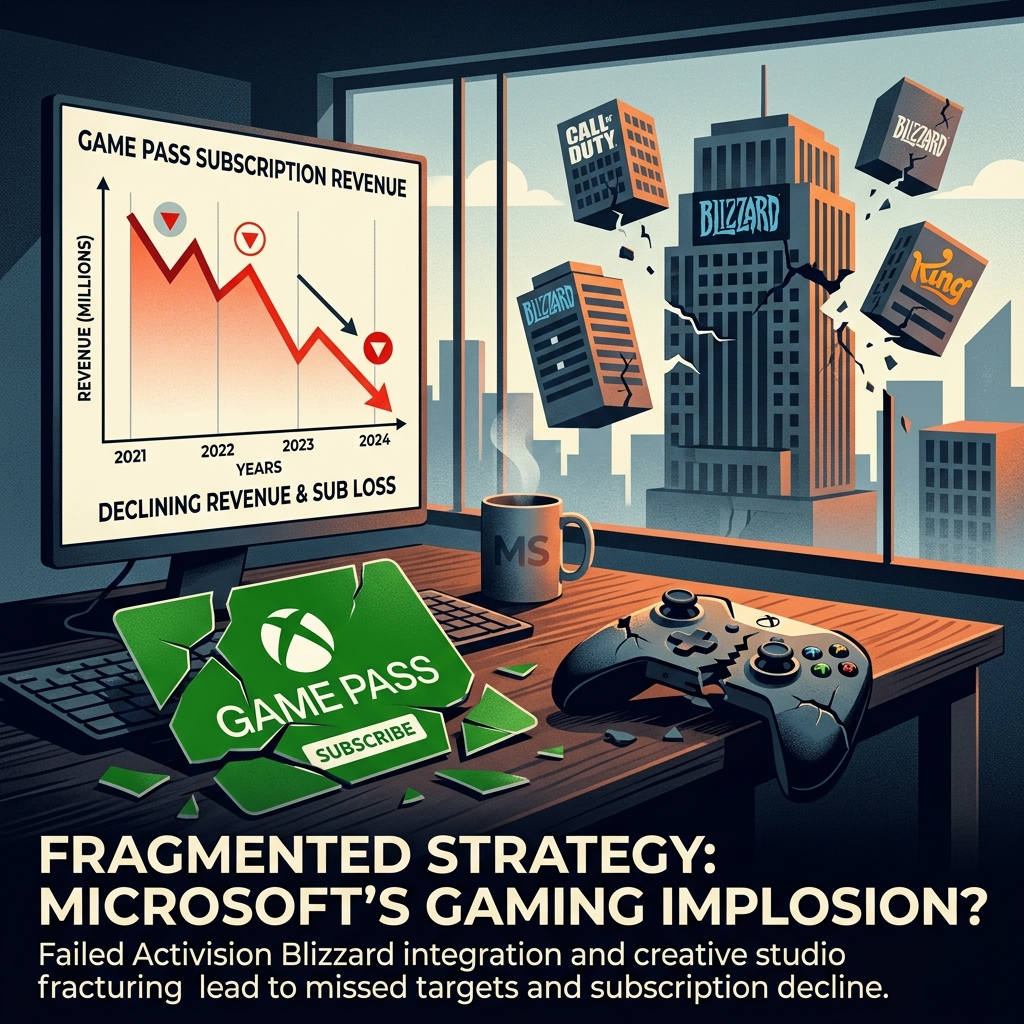
Microsoft launched Game Pass in 2017 and spent seven years and tens of billions of dollars attempting to make it the Netflix of gaming. Its own Activision Blizzard merger review filings set an explicit target of 77 million subscribers by 2026 — the company delivered 30 million, or roughly 40 percent of that projection. The platform peaked at 34 million subscribers in February 2024 and has been declining since, a downward trajectory that persisted despite multiple price increases that should have filtered out casual subscribers while retaining the committed core. CEO Asha Sharma's disclosure in her all-hands memo that the business was losing 64 cents on every dollar invested confirmed what the subscriber numbers already suggested: the revenue model is structurally broken, not merely underperforming in a cyclical way. Even with an annual revenue run rate of approximately $5 billion, the platform's margins run three to ten times lower than comparable platform and publishing businesses, meaning the company purchased volume at the direct expense of profitability for seven consecutive years. Game Pass did not quietly dominate a market — it subsidized itself progressively deeper into a structural hole.
The $69 Billion Activision Paradox — History's Largest Gaming Acquisition Unwound in Two Years
The 2023 Activision Blizzard acquisition at $69 billion — a figure roughly comparable to the annual GDP of a mid-sized country — was intended to cement Xbox's gaming dominance for an entire console generation. Microsoft gained Call of Duty, Diablo, World of Warcraft, Overwatch, and Candy Crush, assembling an IP portfolio with no historical precedent in the gaming industry. The result two years later stands in sharp contrast to those expectations. Layoffs following the acquisition total more than 5,750 people across waves in January 2024, September 2024, and July 2026. Of the five studios Xbox acquired with such fanfare at the E3 2018 showcase, only Playground Games remains inside Microsoft as of 2026. The $69 billion investment produced a business where, by the CEO's own explicit words, the company is "not healthy" — making this the most expensive lesson in creative-industry M&A history, and a cautionary data point for any Big Tech firm that believes scale of capital investment can substitute for understanding of creative culture.
The Broken Incentive Model — Why Game Subscriptions Misfire Where Streaming Succeeds
The Netflix analogy that Microsoft built its entire gaming strategy around contains a fundamental flaw that was observable from the beginning, yet was systematically overlooked for nearly a decade. On a video streaming platform, content volume drives subscriber retention — a member is unlikely to cancel because there are always more shows and films to discover, and the consumption pattern is additive rather than exclusive. Gamers operate on a categorically different model: a dedicated player invests hundreds of hours into a single title and does not meaningfully benefit from a library of 100 games if none of those games engages them deeply enough to justify the subscription. Under Game Pass's structure, a studio that spends three years creating an ambitious original IP effectively surrenders the individual sales revenue that title would have generated in a traditional retail context, and in exchange receives a subscription-formula payout that rewards volume of content over depth of engagement. This creates a structurally broken incentive that pushes studios toward franchise sequels and safer commercial bets rather than the bold original titles that would genuinely expand the subscriber base. Gaming subscription revenue is projected to grow from $13.1 billion in 2026 to $21.3 billion by 2030, but Xbox's incentive-structure problem must be addressed before it can meaningfully benefit from that market expansion.
3,200 Layoffs and the Industry's Four-Year Reckoning
This round of Xbox layoffs is the largest in the company's history and, by Tencent's Amir Satvat's assessment, the single worst layoff event in the history of the gaming industry as a whole. The human scale is staggering in a way that raw numbers struggle to convey: 1,600 people departed immediately, while the remaining 1,600 are exiting through a rolling 12-month process that extends to June 2027, meaning hundreds of employees are spending up to a year in an organization where their departure has already been announced. GDC 2026 survey data shows that 33 percent of game developers in the United States have experienced a layoff within the past two years, and 48 percent of those displaced remain unemployed — a figure that reflects a job market saturated by years of consecutive industry-wide cuts. Adding Xbox's tally to the cumulative total brings gaming-industry layoffs since 2022 to approximately 50,000 displaced workers, representing a measurable depletion of the industry's development capacity at exactly the senior and mid-career levels where institutional knowledge and specialized experience are hardest to rebuild. The GDC finding that 82 percent of game developers now support unionization signals that the industry's labor relations are undergoing a permanent structural shift.
"Liberation vs. Abandonment" — The Two Faces of Studio Independence
Tim Schafer's public statement welcoming the return of Double Fine's creative independence read as a genuinely positive outcome for studio leadership, and on one level it is: walking away from Microsoft with full IP ownership, back-catalog revenue, and the freedom to make games entirely on their own terms represents meaningful autonomy after seven years of operating inside a corporate reporting structure. But the liberation narrative applies narrowly to the executive decision-makers at the top of a relatively small group of studios, and does not extend to the vast majority of the 3,200 people who lost their employment. Quality assurance testers, junior developers, production coordinators, and support staff across the impacted studios don't receive IP catalogs in lieu of jobs — they receive termination notices and have to navigate a saturated employment market. Ninja Theory and Undead Labs face external acquisition processes where the character and priorities of the incoming buyer will determine everything about their creative trajectories going forward. Arkane Lyon faces the most protracted uncertainty, operating under French labor law that mandates formal Works Council consultation before any closure or structural reorganization, a process that typically extends three to six months and leaves an entire studio suspended between potential outcomes.
Positive & Negative Analysis
Positive Aspects
- Creative Freedom Restored for Divested Studios
The most tangible upside of Xbox Reset, for a specific group of beneficiaries, is the creative liberation that Double Fine and Compulsion Games gain by recovering their full IP catalogs and operational independence. Both studios operated for years under Microsoft's reporting hierarchies, KPI frameworks, and Game Pass day-one release mandates — constraints that creative directors have privately noted as limiting their ability to take the kinds of risks that produce memorable games. Tim Schafer demonstrated with Broken Age's $3.3 million Kickstarter campaign that he can raise development funds directly from a passionate and committed audience, and the subsequent success of Psychonauts 2 shows the team can execute on ambitious creative visions even under meaningful corporate constraints. Freed from a parent company's quarterly performance expectations, both studios can now set their own development timelines, take on speculative projects, and make the creative bets that produce genuinely differentiated output. Over a long enough horizon, that autonomy produces the kind of distinctive, conversation-starting games that subscription platforms desperately need to drive new subscriber acquisition.
- Management Efficiency Gains and Faster Decision-Making
The compression of Xbox's management hierarchy from 14 reporting layers to 5 addresses a structural problem that analysts and industry observers had identified for years as a root cause of the company's strategic and execution failures. GameFile News reported extensively on how Xbox's ponderous approval hierarchy slowed decision-making to the point where competitive opportunities were lost, project timelines consistently slipped, and strategic responses to competitor moves arrived too late to matter. Helen Chiang's appointment as COO, alongside the consolidation of Minecraft, Call of Duty, Elder Scrolls, and Candy Crush under direct CEO oversight, removes layers of bureaucratic friction from the properties that generate the most commercial value. Wedbush Securities analyst Michael Pachter assessed this restructuring as "the best possible outcome under the circumstances," reflecting a view shared by multiple industry observers that structural efficiency was a necessary prerequisite for any real recovery trajectory. A meaningfully flatter organization should be able to respond faster to competitive moves from PlayStation and Nintendo — a capability Xbox demonstrably lacked in recent cycles.
- Core IP Concentration Opens a Path to Margin Recovery
The decision to concentrate organizational resources on four blockbuster franchises — Minecraft, Call of Duty, Candy Crush, and Elder Scrolls — represents a strategically defensible response to the margin problem that Asha Sharma identified as the platform's existential crisis. Each of these franchises independently generates hundreds of millions of dollars in annual revenue, and removing the overhead of managing dozens of smaller studios materially improves the financial return on that revenue base. Call of Duty's multiplatform expansion to PlayStation is already generating revenue from Sony's user base, meaning Xbox is now monetizing premium IP across all platforms rather than treating exclusivity as a strategic weapon — a shift that Vorhaus Advisors' Mike Vorhaus described as the correct long-term call. Microsoft's Azure cloud infrastructure provides additional strategic leverage: pairing premium IP with cloud gaming delivery creates a pathway toward a platform-agnostic subscription model where hardware unit sales become a secondary metric. The math isn't guaranteed to close, but this direction at least points toward a scenario where profitability is theoretically achievable.
- A $5 Billion Revenue Base Provides a Survivable Foundation
Despite the severity of the structural problems Microsoft has now officially acknowledged, Game Pass's approximately $5 billion annual revenue run rate represents a survivable business foundation from which meaningful improvement remains mathematically possible. The 30 million active subscribers paying an average of roughly $14 per month generate a revenue line that, with disciplined cost management concentrated on high-margin franchises, can support continued operation and investment in the platform's core capabilities. The gaming subscription market's projected growth from $13.1 billion to $21.3 billion between 2026 and 2030 means the broader sector tailwind is real and unlikely to reverse. A leaner cost structure anchored on four established franchises could lift platform margins toward the levels of comparable publishing and platform businesses, potentially moving the economics from the current 64-cents-lost-per-dollar position toward something closer to breakeven. This is a stabilization thesis, not a growth thesis — but stabilization is the prerequisite for any eventual recovery, and $5 billion in annual revenue is a credible base from which that stabilization can be attempted.
Concerns
- The Human Cost — 3,200 Careers Disrupted
Behind the headline number of 3,200 layoffs are individuals — each with rent payments, mortgages, family obligations, healthcare needs, and career trajectories that have been abruptly interrupted by a corporate strategy failure they played no role in creating. The two-track departure structure — 1,600 leaving immediately and 1,600 exiting through a rolling 12-month process ending June 2027 — creates an extended period of organizational paralysis where the employees who remain cannot reasonably be expected to produce their best creative work under conditions of known imminent departure. GDC 2026 survey data showing that 48 percent of previously laid-off game developers remain unemployed tells a specific and painful story about how saturated the gaming employment market has become after years of consecutive industry-wide cuts. Adding Xbox's 3,200 to the cumulative total brings gaming-industry layoffs since 2022 to approximately 50,000, a number that represents a genuine degradation of the industry's human capital — particularly at the senior developer level, where replacing institutional knowledge and specialized experience takes years, not quarters. The long-term cost to the industry's development capacity is likely to outlast the current restructuring cycle by a significant margin.
- Exclusive Content Pipeline Severely Weakened
The loss of four studios deals a concrete and lasting blow to Xbox's ability to generate the kind of exclusive content that historically drives console platform adoption and subscription growth. Of the five studios acquired with such visible enthusiasm at E3 2018, only Playground Games remains inside Microsoft in 2026 — meaning eight years of creative studio acquisition strategy has been essentially unwound in a single restructuring announcement. The Hellblade franchise evolution that Ninja Theory was positioned to lead, the State of Decay development arc that Undead Labs was building toward, the Psychonauts universe that Double Fine was continuing to expand — none of these creative trajectories will produce their next chapters as Xbox exclusives. Enders Analysis' Gareth Sutcliffe offered perhaps the most pointed external assessment: the restructuring provides no indication of what the growth path actually looks like after the cost cuts are completed. PlayStation continues to leverage Spider-Man, God of War, and The Last of Us as market-defining exclusive franchises; by divesting four studios simultaneously, Xbox has voluntarily weakened its position in the one competitive dimension where differentiated, high-quality exclusive content is genuinely irreplaceable.
- Hardware Business Shows Signs of Structural Decline
Xbox Series X/S unit sales declined from 9.8 million in 2023 to 4.79 million in 2024, effectively halving in a single year, and the decision to raise the console's price from $499 to $599 is estimated to have produced an additional 58 percent decline in 2025. That trajectory — a hardware business that has more than halved its annual sales volume over two years — does not have an obvious or near-term reversal mechanism. Project Helix represents the platform's medium-term hardware hope, but leaked pricing estimates of approximately $1,200 raise serious questions about whether a mass-market gaming audience that retreated from a $599 Xbox will embrace a hybrid device at double that price point. If Xbox's hardware market share continues declining from its current 23 percent floor, third-party developers will progressively deprioritize Xbox versions of multiplatform titles, generating comparatively worse game selection for Xbox owners, which then drives further console abandonment — a downward spiral without a natural stopping point. A weakening hardware base also directly compresses the addressable Game Pass subscriber pool, meaning the service-side and hardware-side problems are not independent challenges but compounding ones that accelerate each other.
- No Credible Growth Strategy for the Post-Restructuring Era
The most fundamental strategic question surrounding Xbox Reset is one that Microsoft has not yet answered: after cutting four studios and 3,200 people, what specifically drives subscriber and revenue growth from here? Asha Sharma's pledge of a return to growth in FY2027 requires meaningful positive momentum within approximately twelve months, a timeline that strikes most independent analysts as severely compressed given the scale and depth of the organizational disruption currently underway. Bethesda Games Studios Union's observation that prior Xbox cost-reduction cycles "were insufficient to solve the underlying problem" indicates that cost reduction alone does not constitute a coherent recovery strategy for a business with structural unit-economics problems. The margin challenge Xbox identified — three to ten times lower than comparable platform and publishing businesses — stems not only from content production costs but from the hardware-subsidy model Xbox has used for two decades to compete on price with PlayStation. Divesting four studios reduces one cost category in isolation while leaving the structural driver of the margin gap largely untouched. Until Microsoft presents a specific, credible answer to what new subscribers or revenue it expects to generate and by what mechanism, the restructuring reads as crisis management rather than strategic transformation with a defined destination.
Outlook
In the immediate term — the next six months — the most consequential story coming out of Xbox Reset will be what actually happens to the studios being divested. Double Fine and Compulsion Games are headed toward management buyout structures, where studio leadership acquires control from Microsoft with full IP catalogs and back-catalog revenues intact. The financing question is significant: in a development environment where a single AAA title costs upward of $100 million to produce, maintaining independence requires securing a publisher deal or substantial investor backing within a compressed window. Tim Schafer's name and the Psychonauts IP give Double Fine real leverage, and there's a meaningful probability the studio returns to its crowdfunding roots — Broken Age raised $3.3 million on Kickstarter in 2012 and essentially invented the modern gaming crowdfunding playbook. Compulsion has fewer marquee assets but a devoted community following its previous work, which gives it a workable indie reputation to build on. The studios' first independent decisions will reveal whether this "liberation" is genuine creative freedom or a more palatable framing for being cut loose.
The situations facing Ninja Theory and Undead Labs are structurally more complex. Both studios are being sold to external buyers rather than undergoing management buyouts, and the identity of those acquirers will determine everything about how they operate creatively and commercially going forward. Potential buyers include Tencent, whose gaming acquisition portfolio spans dozens of studios globally; Saudi Arabia's PIF-backed Savvy Gaming Group, which has been aggressive in gaming M&A; or portfolio aggregators like Embracer Group, which has a mixed record with the studios it has absorbed. Each scenario implies a fundamentally different strategic context for the studios involved. Arkane Lyon faces an additional complication: French labor law requires formal Works Council consultation before any closure, sale, or structural reorganization, a process that typically runs a minimum of three to six months. The Arkane situation will likely remain unresolved until early 2027, with genuine uncertainty about whether the Lyon studio continues as a going concern, relocates its operations, or closes entirely.
Xbox's own near-term strategic posture now concentrates on four franchise pillars: Minecraft, Call of Duty, Candy Crush, and Elder Scrolls. Reorganizing these properties under direct CEO oversight — alongside Helen Chiang's appointment as COO — should, in theory, accelerate decision cycles for the platform's most commercially significant titles. The structural problem is what exists outside those four franchises. Halo Studios, the rechristened 343 Industries, has not announced its next flagship entry. Fable remains in development at Playground Games with no confirmed release window. Over the twelve-month period in which 3,200 employees are cycling out of the organization, maintaining execution quality on the projects that remain will be extremely difficult. Asha Sharma's commitment to return to growth in FY2027 — meaning within approximately the next twelve months — is a timeline that I believe severely underestimates how much organizational disruption the company has just imposed on itself. Cutting 3,200 people and divesting four studios is a survival posture, not a setup for rapid growth acceleration.
Looking further out into 2027 and 2028, the pivotal variable in Xbox's medium-term trajectory is Project Helix. Officially announced in March 2026, Helix is designed as a hybrid gaming device that maintains compatibility with PC storefronts including Steam and GOG, effectively blurring the boundary between console and PC gaming in a way no major manufacturer has successfully attempted at consumer scale. Developer alpha kits are expected to ship in 2027, with a consumer launch targeting 2028. The bull scenario here is compelling in theory: if Helix creates a genuine new product category that absorbs a portion of the existing PC gaming market, it could introduce millions of players who have never subscribed to Game Pass into the Xbox ecosystem, potentially pushing subscriber counts from 30 million toward 40 to 50 million over a two-to-three-year period. The gaming subscription market itself is projected to grow from $13.1 billion in 2026 to $21.3 billion by 2030 at a compounded annual growth rate of 11.3 percent, meaning the underlying market is expanding regardless of Xbox's internal difficulties. The serious obstacle is the leaked price estimate of approximately $1,200. Xbox's Series X price increase from $499 to $599 produced a roughly 58 percent sales decline — asking consumers to pay double the current console price for an unproven hybrid format carries adoption risk that cannot be dismissed.
My base scenario for the 2026-to-2028 period is a gradual but deliberate shift from a hardware-led business to a software and services platform, with Xbox conceding its console-wars position while maximizing revenue extraction across all platforms and devices. Call of Duty's expansion to PlayStation is already operational, and it signals that Microsoft has effectively accepted the loss of the console competition in exchange for monetizing its IP regardless of which device the player uses. This is, in my view, the strategically sound long-term direction for a company with Microsoft's actual competitive advantages. Azure's cloud infrastructure and its accumulated AI research capabilities are genuine moats — first-party gaming hardware is not. If Game Pass can evolve into a platform-agnostic cloud gaming standard, hardware unit sales become a secondary health metric rather than the primary one. The transition requires a minimum of two to three years to execute credibly, and subscription attrition could accelerate meaningfully during the transition period. Sustaining the approximately $5 billion annual Game Pass revenue line requires two to three system-seller exclusives per year — and with four studios removed from the pipeline, that content cadence is now genuinely strained in a way that will be difficult to conceal from subscribers.
The bear scenario for the longer-term horizon — 2028 through 2031 — is one Microsoft's communications team won't articulate but that the market math increasingly implies. If Project Helix fails to achieve mainstream adoption at its reported price point, if Game Pass subscribers continue declining below the 30 million level, and if the core franchise pipeline loses forward momentum without new exclusive content investments to replace the divested studios, Microsoft may ultimately exit the console hardware business entirely. Under this scenario, "Xbox" becomes a brand name attached to a software and services platform — a publisher and subscription service that operates across PlayStation, Nintendo, PC, and mobile, without a proprietary device of its own. This is the path Sega followed after the Dreamcast's commercial failure in 2001, and Sega has operated as a profitable multiplatform publisher in the decades since. The critical distinction is that Microsoft possesses Azure, which gives it cloud-gaming infrastructure that Sega never had access to. Whether that infrastructure functions as a long-term competitive moat — enabling a genuinely differentiated cloud gaming experience — or as an ongoing cost center with diminishing strategic returns is the central question the next three to five years will answer.
The ripple effects of Xbox Reset extend well beyond Microsoft's balance sheet and will reshape the industry's labor landscape in ways that are only beginning to become visible. The cumulative gaming-industry layoff count from 2022 through mid-2026 now approaches 50,000 workers — a figure that represents a tangible depletion of the industry's senior and mid-career development talent pool over a compressed four-year period. GDC 2026 data showing that 82 percent of game developers in the United States now support unionization represents a fundamental shift in labor sentiment from even five years ago, when union organization was largely a fringe conversation in an industry that had always relied on creative passion and equity upside to offset labor market leverage. Bethesda Games Studios Union's critique of the Xbox restructuring as insufficient to address the underlying business problems is evidence that organized labor is already an active participant in the industry's political economy, not a future possibility. I expect meaningful union formation in United States and European game development within two to three years, and as union presence progressively raises the effective cost of mass layoffs, it will gradually constrain the "acquire and restructure" cycle that Big Tech has normalized. The parallel to the early-2000s dot-com bust is instructive: that wave of mass tech layoffs ultimately produced labor protections and cultural shifts that reshaped how the entire technology sector operated for the following decade. The gaming industry is likely to follow a similar path.
There are conditions, of course, under which my reading of this situation proves wrong, and intellectual honesty requires naming them directly. If Project Helix launches at a price point in the $500 to $700 range rather than the leaked $1,200 estimate, and successfully draws the existing PC gaming audience into the Xbox and Game Pass ecosystem, the entire trajectory changes in ways that are difficult to model from here. If Microsoft's AI tools genuinely enable smaller development teams to produce output comparable to large studios — a scenario the company has been suggesting in developer communications — the loss of four studios might be partially offset by per-developer productivity gains that we don't yet have real-world data to validate. And if Asha Sharma's FY2027 growth pledge actually materializes, meaning subscribers and margins trend meaningfully upward within twelve months of the restructuring announcement, then this will be assessed in retrospect as a painful but ultimately effective correction. I remain skeptical of that timeline, given that the organizational disruption from 3,200 departures typically takes twelve to eighteen months simply to stabilize. What I'm confident about is the larger lesson: Xbox Reset is not simply one company's restructuring. It is a defining data point in the ongoing question of whether technology companies can successfully acquire and steward creative industries at scale — and the evidence accumulated since 2018 says, emphatically, that the answer is no.
Sources / References
- "Resetting Xbox" — CEO Asha Sharma All-Hands Memo (Full Text) — Xbox Wire (Microsoft)
- Asha Sharma: "Our Business Is Not Healthy" — 64-Cent Loss Disclosure and Margin Details — HotHardware
- Xbox Announces 3,200 Layoffs and Divestiture of Four Studios — Variety
- Microsoft Cuts 4,800 Employees Across the Company; Xbox Division Accounts for 1,600 Immediately — CNBC
- Game Pass at 30 Million Subscribers — Far Short of 77 Million Goal, per WSJ — Notebookcheck / The Wall Street Journal
- Independence Day — Tim Schafer's Official Statement on Double Fine's Independence — Double Fine Productions
- GDC 2026 State of the Game Industry: Layoffs, Generative AI, and Developer Survey Data — Game Developers Conference
- Industry Reacts to Xbox's Biggest Course Correction in Gaming — Pachter, Sutcliffe, Satvat — GamesBeat