
AI's Gastric Bypass Surgery — The Lap Band Google TurboQuant Strapped onto Bloated AI Models
Summary
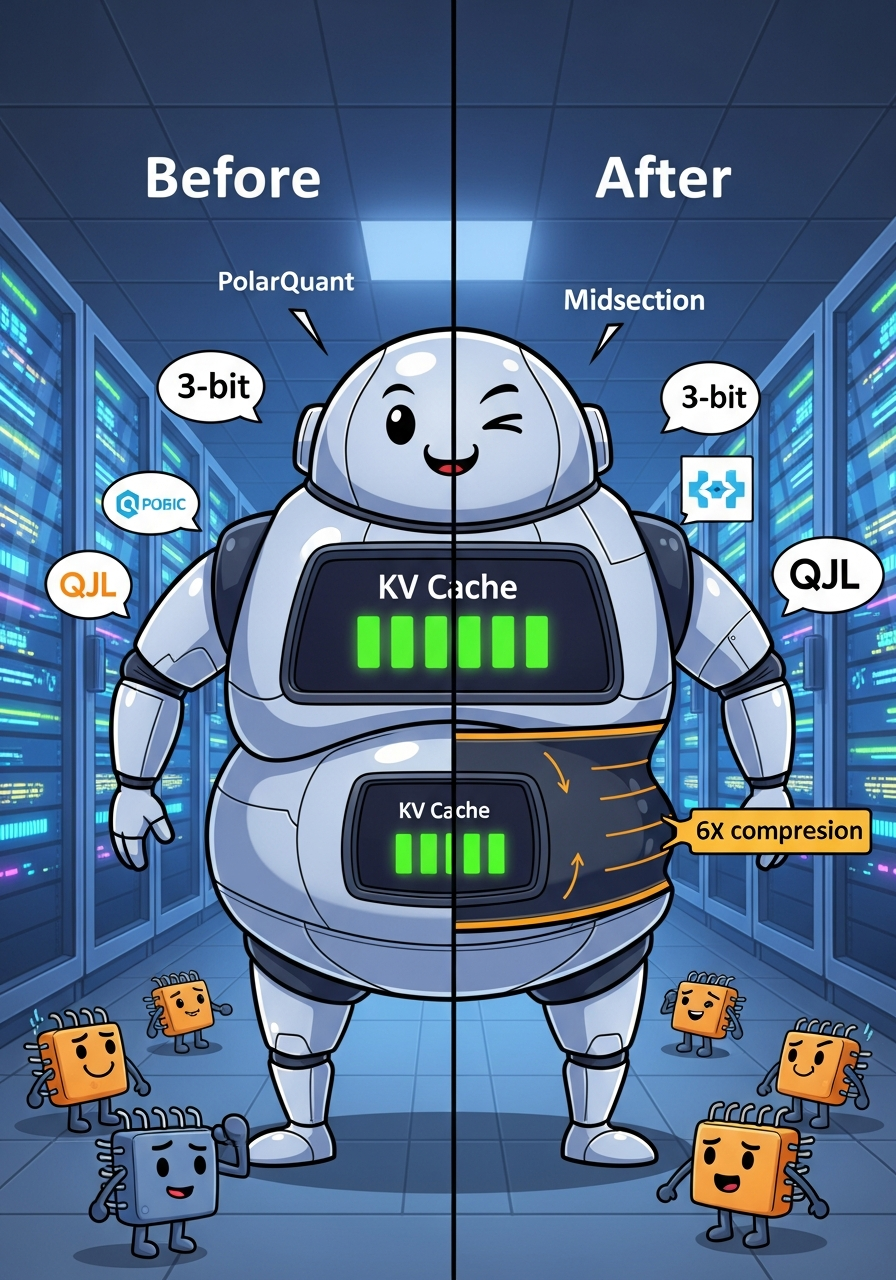
Google Research unveiled TurboQuant at ICLR 2026, a technique that quantizes the KV cache to 3 bits and compresses AI memory consumption by 6x while claiming minimal performance degradation. The technology has the potential to fundamentally disrupt the core cost structure of AI infrastructure, where GPU memory bottlenecks have long been the binding constraint on inference economics. However, the gap between laboratory benchmarks and production deployment, the cumulative effect of quantization-induced quality degradation, and the existence of bottlenecks beyond memory all suggest that calling TurboQuant a universal key to AI democratization is premature. Whether this becomes the starting gun for an AI cost revolution or joins the graveyard of impressive lab results depends entirely on production validation over the next one to two years.
Key Points
The PolarQuant-QJL Dual Strategy and What 6x Compression Actually Means
TurboQuant is not a single trick but a two-pronged approach combining PolarQuant and QJL — Quantized Johnson-Lindenstrauss random projections — to squeeze the KV cache down to just 3 bits per element. PolarQuant handles the key cache by decomposing vectors into magnitude and angle components, quantizing each separately to preserve directional information that attention mechanisms depend on. QJL tackles the value cache through random projection, a dimensionality reduction technique borrowed from theoretical computer science that compresses high-dimensional data while maintaining approximate distances between vectors. The result is a 6x reduction in KV cache memory with an 8x speedup in attention logits computation and negligible degradation on standard language modeling benchmarks.
GPU Memory Bottlenecks and the Real Cost Structure of AI Inference
Running a large language model in production is fundamentally a memory problem, not a compute problem. The KV cache grows linearly with sequence length and becomes the dominant consumer of GPU memory during long-context inference. A 128-GPU inference cluster costs approximately $1 million or more to set up, and the memory bandwidth of the GPUs is typically the binding constraint on how many requests per second the system can handle. Every technique that reduces memory consumption per request translates directly into either cost savings or increased throughput on existing hardware.
The Canyon Between Lab Benchmarks and Production Reality
TurboQuant's results are impressive on paper, but they were demonstrated on academic benchmarks under controlled conditions. Production inference environments are chaotic — they handle heterogeneous request lengths, unpredictable traffic patterns, mixed workloads, and latency constraints that no benchmark suite fully captures. The history of AI optimization research is littered with techniques that showed spectacular results on WikiText-2 and MMLU but fell apart when deployed at scale.
The AI Democratization Promise Meets Hard Economic Reality
The narrative around TurboQuant quickly inflated to this could democratize AI by slashing costs. Memory compression is necessary but not sufficient for AI democratization. Even if TurboQuant delivers its full 6x compression in production, the overall inference cost reduction would be meaningful but bounded — memory is one bottleneck among many.
The Big Tech Efficiency Arms Race and What It Means for the Industry
TurboQuant does not exist in a vacuum. It is one salvo in an escalating efficiency war among the major AI labs. DeepSeek-V3 demonstrated that aggressive optimization could dramatically reduce training costs. Meta's work on grouped query attention, NVIDIA's TensorRT optimizations, and a host of academic contributions to efficient inference are all converging on the same target — making AI cheaper to run.
Positive & Negative Analysis
Positive Aspects
- Dramatic Inference Cost Reduction Within Reach
If TurboQuant's 6x KV cache compression translates to production environments even partially — say, a conservative 3-4x effective compression — the inference cost savings would be substantial. GPU memory is the most expensive resource in AI inference pipelines, and reducing its consumption directly translates to serving more users per GPU or using fewer GPUs for the same workload.
- Long-Context AI Finally Becomes Practical
The KV cache problem is at its worst with long-context inference. Current models with 128K or 1M context windows are technically capable but practically constrained by the enormous memory footprint of their KV caches. A 6x compression would transform long-context inference from a luxury feature into a standard capability.
- Edge AI Deployment Gets a Serious Boost
Running AI models on edge devices — phones, laptops, IoT sensors, autonomous vehicles — is fundamentally constrained by available memory. TurboQuant's compression could make it feasible to run meaningful AI workloads on devices with limited memory, opening up entirely new deployment scenarios.
- A New Paradigm for AI Research and Development
TurboQuant represents a broader shift in how the AI community thinks about efficiency. The PolarQuant-QJL combination is methodologically interesting because it draws on techniques from random projection theory that have been well-studied in other fields but underutilized in deep learning.
- Cloud Competition Gets Fiercer — and Consumers Win
When Google publishes a technique that could reduce inference costs by half, Amazon and Microsoft cannot ignore it. The competitive pressure to adopt, improve upon, or develop alternatives to TurboQuant will intensify the AI efficiency race among cloud providers. This competition is unambiguously good for consumers and developers who purchase inference as a service.
Concerns
- The Lab Fantasy Problem — Benchmarks Are Not Reality
Every AI optimization paper looks good on benchmarks. TurboQuant's reported performance on WikiText-2 perplexity and standard NLP benchmarks tells us something, but it does not tell us what happens when the technique is deployed in a production system handling 50,000 concurrent requests with heterogeneous prompt lengths.
- Quantization Error Accumulation Is a Ticking Time Bomb
Quantizing the KV cache to 3 bits introduces rounding errors on every single cached value. For a single inference pass, these errors may be genuinely negligible. But AI systems in production do not operate in isolation — they are embedded in pipelines where one model's output feeds into another's input.
- Technical Moat Erosion — When Everyone Gets the Same Advantage, Nobody Has an Advantage
TurboQuant is published research. It will be implemented in PyTorch, integrated into vLLM and TensorRT, and available to every AI company within months of publication. If Google, OpenAI, Anthropic, and every other AI provider all implement the same memory compression technique, the efficiency gains cancel out competitively.
- The Risk of Enabling AI Misuse at Reduced Cost
Making AI inference cheaper and more memory-efficient does not only benefit legitimate applications. Every reduction in the cost of running AI models also reduces the cost of running AI models for spam generation, deepfake production, automated social media manipulation, and other adversarial uses.
- Google Lock-In and the Platform Dependency Trap
While TurboQuant is published openly, the practical implementation and optimization of the technique will inevitably be most mature on Google's own cloud platform. Google has a long history of publishing research that is technically open but practically advantaged on Google Cloud.
Outlook
The weeks immediately following TurboQuant's presentation at ICLR 2026 are going to be a masterclass in hype cycle dynamics. The first wave of reaction will focus on the headline numbers: 6x compression, 8x speedup in attention logits computation, minimal quality degradation. These numbers are real and legitimate, but they describe performance under controlled laboratory conditions.
What I expect to see within the first three to six months is a flurry of open-source implementations and independent reproductions. The vLLM community will be among the first to integrate TurboQuant-style quantization into their serving framework. My prediction is that the results will be good but not as spectacular as the paper suggests.
NVIDIA's response will be particularly telling. The company has massive financial incentive to either embrace TurboQuant-style quantization or to downplay it in favor of their own TensorRT quantization pipeline. Watch for TensorRT updates in the Q3-Q4 2026 timeframe.
The cloud provider response will unfold on a slightly longer timeline. Google Cloud will almost certainly offer TurboQuant-optimized inference endpoints by Q4 2026. AWS and Azure will follow within six to nine months.
Moving into the medium-term window of 2027 through 2028, the story shifts from does this technique work to how does it reshape the competitive landscape. The edge AI implications deserve particular attention in this timeframe. Gartner projects that by 2027, small task-specific AI models will be used 3x more than general-purpose LLMs.
In the bull case scenario, TurboQuant proves production-ready within twelve months, and the combination of KV cache compression, improved hardware utilization, and competitive pressure drives inference costs down by 60-70% within two years. I assign this scenario approximately 15-20% probability.
The base case is more measured. TurboQuant proves partially effective in production. Inference costs decline by 25-40% for workloads that can tolerate quantization. I put this scenario at approximately 50-55% probability.
The bear case envisions TurboQuant as another addition to the pile of promising research that never achieves production maturity. This scenario carries approximately 25-30% probability.
The uncomfortable conclusion is that TurboQuant is probably genuinely important, but not for the reasons the hype cycle will emphasize. Its significance is that it demonstrates a viable path to 3-bit quantization of a major inference bottleneck, which opens the door to a research agenda that could eventually push KV cache compression to 2 bits or even 1 bit.
Sources / References
- TurboQuant — 3-Bit KV Cache Quantization with PolarQuant and QJL — Google Research (ICLR 2026)
- Google's TurboQuant Achieves 6x AI Memory Compression with Minimal Performance Loss — TechCrunch
- How TurboQuant Could Reshape AI Inference Economics — VentureBeat
- TurboQuant — Google Claims 6x Memory Reduction for LLM Inference — The Register
- Understanding KV Cache Quantization — From INT8 to 3-Bit Compression — Towards AI