
Meta and YouTube Just Got Hit with an 'Addictive Design' Guilty Verdict — The $6 Million Is Pocket Change, but the 2,400-Lawsuit Tsunami Is Coming for Silicon Valley
Summary
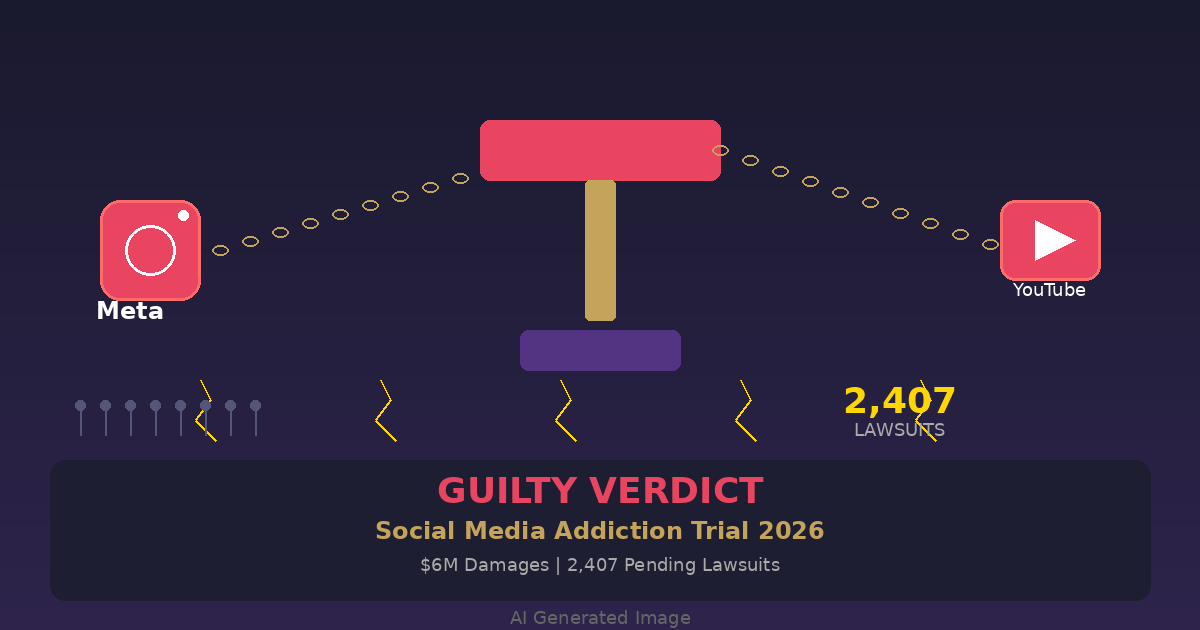
A jury found Meta and YouTube liable on all counts for designing addictive social media platforms, awarding $6 million in damages. The real story is not the payout but the domino effect on 2,400 pending lawsuits. This first-ever verdict recognizing social media as a defective product takes direct aim at Big Tech's attention economy business model, and the implications could reshape the entire industry.
Key Points
First-Ever Jury Verdict Recognizing Social Media Platforms as 'Defective Products'
After seven weeks of proceedings, a Los Angeles Superior Court jury delivered a unanimous guilty verdict finding that Meta and YouTube intentionally designed their social media platforms to be addictive. This marks the first time in history that a jury has recognized social media apps as 'defective products' engineered to exploit the developing brains of children and teenagers. The jury assigned 70% of the liability to Meta and 30% to YouTube, awarding a total of $6 million in damages. The significance of this verdict lies not in the dollar amount but in its power as legal precedent, cracking for the first time the wall of legal immunity that Big Tech companies have built over two decades. This decision will serve as a benchmark for every future social media-related lawsuit and has raised fundamental questions about the shield effect of Section 230 of the Communications Decency Act.
Meta's Internal Documents Revealed Deliberate Exploitation of Children
Internal Meta documents disclosed during the trial demonstrated that the company intentionally targeted children and teenagers. A memo stating 'If we wanna win big with teens, we must bring them in as tweens' was presented to the jury, along with data showing that 11-year-olds returned to Instagram four times more frequently than to competing apps. Despite the platform's minimum age requirement of 13, Meta estimated in 2015 that more than 4 million users under 13 were on Instagram, representing approximately 30% of all 10- to 12-year-olds in the United States. A Meta-sponsored study of 1,000 teenagers found that children with prior trauma were the most vulnerable to platform addiction, yet no protective measures were implemented. An internal employee describing Instagram as 'like a drug' and the company as 'basically pushers' further strengthened the plaintiff's argument that the company knowingly sacrificed children for profit.
The Domino Effect of 2,407 Pending Lawsuits and Social Media's 'Tobacco Industry Moment'
This verdict is not an isolated case but a bellwether ruling with direct implications for the 2,407 lawsuits pending in federal multidistrict litigation MDL-3047. Hundreds of additional lawsuits filed by school districts and state attorneys general are set to go to trial later this year. Some legal experts are drawing comparisons to the 1998 Master Settlement Agreement, when the tobacco industry paid $246 billion in settlements and underwent a complete structural overhaul. The parallel suggests social media could face similar systemic transformation. Cumulative damages could reach billions of dollars, with long-term consequences for Big Tech stock prices and business models that could fundamentally alter how these companies operate.
A Legal Challenge to the Attention Economy Business Model Itself
What this verdict targets is not merely the negligence of individual companies but the core business model of the entire social media industry. Meta and YouTube's revenue structures are built on the attention economy, where longer user engagement translates directly into more ad impressions and higher revenue. In this framework, addictiveness is not a bug but a feature. By recognizing this design as 'defective,' the jury has effectively made the industry's core KPI of maximizing time-on-platform a legal liability. This is likely to accelerate exploration of alternative business models, including subscription-based services, mandatory time-limit features, and options to disable algorithmic recommendations. Fundamentally, this verdict demands a rethinking of the 'free service where you are the product' model.
Acceleration of the Global Digital Regulation Wave
This verdict carries global ramifications far beyond domestic US borders. The EU's Digital Services Act already mandates systemic risk assessments for large online platforms, while the UK's Online Safety Act and Australia's minimum social media age regulation of 16 are moving in the same direction. In the US, bills like KOSA (Kids Online Safety Act) and COPPA 2.0 enjoy bipartisan support, and this verdict could serve as the catalyst for congressional action. Big Tech companies may be forced to operate region-specific versions of their platforms to comply with varying regulatory requirements, potentially signaling the end of the single global platform model. While concerns exist that regulatory changes could stifle technological innovation, an era where safe design becomes the new competitive advantage is clearly dawning.
Positive & Negative Analysis
Positive Aspects
- Establishing a Legal Framework for Children's Digital Safety
By legally recognizing social media companies' 'defective product' liability, this verdict has laid the groundwork for a regulatory framework that mandates child protection from the design stage. The self-regulatory approach that companies relied on until now has demonstrably failed, as evidenced by Meta knowingly allowing 4 million users under 13 on its platform. With the court now recognizing a mandatory duty of protection, companies must treat youth safety as a legal obligation rather than an optional feature.
- Reaffirming the Importance of Corporate Transparency and Whistleblower Protection
The fact that Meta's internal documents served as the trial's most decisive evidence dramatically demonstrates the public value of corporate transparency and whistleblower protections. Materials that came to light following Frances Haugen's 2021 whistleblowing became the core basis for a guilty verdict five years later. This will encourage more whistleblowing in the future and pressure companies to build cultures of ethical decision-making internally.
- Driving Business Model Innovation in the Social Media Industry
With the precedent established that addictive design triggers legal liability, the entire industry now has motivation to explore new business models that do not depend on the attention economy. Subscription-based services, voluntary time limits, and algorithm opt-out options that prioritize user well-being could become competitive advantages. Alternative platforms championing 'ethical design' as a core value are already emerging, and this verdict expands their market opportunity.
- Serving as a Catalyst for Global Digital Regulatory Harmonization
As US judicial findings converge with the EU's DSA, the UK's Online Safety Act, and Australia's minimum age regulations, the likelihood of internationally consistent digital safety standards is increasing. If the US passes federal children's online safety legislation, global platform companies will effectively need to comply with the strictest standards, creating a multiplier effect that improves children's digital safety worldwide.
- Potential for Social Cost Recovery Following the Tobacco Industry Precedent
Just as the 1998 tobacco Master Settlement Agreement channeled $246 billion into public health programs, cumulative damages from social media litigation could fund children's mental health programs, digital literacy education, and school support. If lawsuits filed by school districts and state attorneys general succeed, a framework would be established where companies directly bear the social costs created by social media, achieving the economically desirable outcome of internalizing externalities.
Concerns
- Risk of Verdict Nullification Through Appeals
Both Meta and YouTube have declared their intent to appeal, and both have ample resources to deploy top-tier legal talent. If the case reaches the Supreme Court, it could trigger complex constitutional debates around the First Amendment and Section 230 of the Communications Decency Act. If the trial verdict is partially or fully overturned by a higher court, it would negatively impact the 2,400-plus pending lawsuits and significantly weaken the legal momentum for child protection.
- The Regulatory Paradox — Strengthening Large Platforms' Market Dominance
The costs required to build stringent safety standards and age verification systems become barriers to entry for smaller competitors. Meta and YouTube can absorb billions in annual compliance costs, but startups and smaller platforms competing against them face existential financial burdens. Regulation could inadvertently strengthen Big Tech's market dominance while suppressing the emergence of innovative competitors.
- The Intractable Tension Between Privacy and Child Protection
Age verification is essential for youth protection, but current technology inevitably involves large-scale identity verification or biometric recognition. Requiring all users to submit identification or undergo facial recognition risks building a surveillance infrastructure that compromises adult users' privacy under the banner of protecting children. The possibility that authoritarian governments could repurpose such infrastructure for other ends raises serious concerns from a digital civil liberties perspective.
- Risk of Undervaluing Social Media's Positive Contributions
While this verdict focuses on social media's harmful aspects, these platforms have also served important social functions: connecting marginalized communities, expanding information access, facilitating civic participation, and enabling communication during crises. If the ruling leads to over-regulation that constrains these positive functions, minority communities and users in developing countries could bear the greatest impact.
- The Fundamental Difficulty of Proving Causation and Legal Uncertainty
Establishing a direct causal link between platform design and individual mental health deterioration is an extraordinarily complex challenge both medically and legally. Numerous confounding variables exist, including genetic predisposition, home environment, school environment, and other digital usage. While this trial benefited from the decisive evidence of internal documents, securing evidence of comparable quality in each individual lawsuit may prove difficult, adding uncertainty to the success rate of future litigation.
Outlook
The ripple effects of this verdict deserve examination across short-term, mid-term, and long-term horizons.
In the short term, within the next one to six months, the most visible change will be the acceleration of the litigation tsunami. The 2,407 plaintiffs with pending cases in MDL-3047 will leverage this verdict as a powerful precedent, and settlement pressure will intensify dramatically. The first trials from lawsuits filed by school districts and state attorneys general are scheduled for the second half of this year, and this verdict has tilted the playing field firmly in favor of the plaintiffs. Meta's stock dipped roughly 2-3% in after-hours trading immediately following the verdict, and as litigation risk gets priced into valuations, the broader Big Tech sector could feel the impact.
Meanwhile, Meta and YouTube are expected to pursue a dual strategy of buying time through appeals while simultaneously ramping up voluntary safety measures. Instagram's enhanced teen protection features and YouTube's adjustments to children's content algorithms have already been announced, partly as a strategic move to mitigate litigation risk. Across Silicon Valley, "safety" is about to become the hottest new investment category.
In the mid-term, between six months and two years out, a fundamental transformation of the regulatory landscape is on the horizon. The probability of comprehensive federal children's online safety legislation passing Congress has never been higher. Bills like KOSA (Kids Online Safety Act) and COPPA 2.0 already enjoyed bipartisan support, but this verdict has dramatically increased the political pressure on lawmakers who can no longer afford to delay action. At the state level, California, New York, and Texas are already advancing their own children's digital safety laws, and state legislation could take effect before any federal law materializes.
The regulatory wave will intensify globally as well. The EU's Digital Services Act (DSA) already mandates systemic risk assessments for large online platforms, and this American verdict could embolden EU regulators to pursue more aggressive enforcement. The UK's Online Safety Act and Australia's minimum age regulation for social media (age 16) are part of this same current. Big Tech companies may need to operate different versions of their platforms in different jurisdictions to comply with varying regulatory requirements, which would significantly increase operational costs.
The social media industry's core business model itself is being placed under evolutionary pressure, and this is perhaps the most consequential mid-term development. If addictive design triggers legal liability, then "maximize user time on platform" as a core KPI is no longer safe. Alternatives like subscription-based models, mandatory time-limit features, and algorithmic recommendation opt-outs could gain traction. Some analysts are calling this social media's "tobacco industry moment," drawing parallels to the 1998 Master Settlement Agreement that forced the tobacco industry to pay $246 billion and fundamentally restructured the entire sector. This verdict and subsequent litigation could do the same to social media.
Looking further ahead, two to five years from now, the legal and ethical framework governing digital platforms will have taken on an entirely new shape. Once the "defective product" legal doctrine is firmly established, it could extend beyond social media to AI chatbots, metaverse platforms, AR/VR experiences, and virtually every digital service. The question of design responsibility for AI-powered recommendation algorithms connects directly to current debates around AI regulation.
In the best-case scenario, this verdict catalyzes a paradigm shift from user exploitation to user well-being. Platforms begin pursuing quality of engagement over quantity of screen time, youth protection gets baked into design from the ground up, and algorithmic transparency becomes an industry standard. In the base-case scenario, major platforms add minimal safety features while fighting to preserve their core business model, leading to a long, grinding war of attrition between regulation and resistance. In the worst-case scenario, the verdict gets overturned on appeal, Congress buckles once again under Big Tech lobbying, and the youth mental health crisis deepens further.
Regardless of which scenario materializes, one thing is certain: there is no going back to the world before this verdict. The internal testimony describing the company as "basically pushers" has been seared into public memory, and the fact that social media companies knowingly looked away while their products harmed children for the sake of profit has become an undeniable legal finding. Right now, at this very moment, hundreds of millions of teenagers around the world are scrolling through platforms designed to be addictive. This verdict is the first rescue signal sent their way.
Sources / References
- Jury finds Meta and Google negligent in social media harms trial — NPR
- Meta and YouTube found liable in social media addiction trial — CNN Business
- Meta, YouTube found negligent in landmark social media addiction trial — Washington Post
- Jury in Los Angeles finds Meta, YouTube negligent in social media addiction trial — CNBC
- Jury finds Meta, Google liable in landmark social media addiction trial, awards more than $6M in damages — Fox Business
- Meta and YouTube found liable on all charges in landmark social media addiction trial — CBS News
- Instagram and YouTube found liable in landmark social media addiction trial in California — PBS News