
The Tour de France Will Die in July — Before Pogačar Can Win His Sixth
Summary
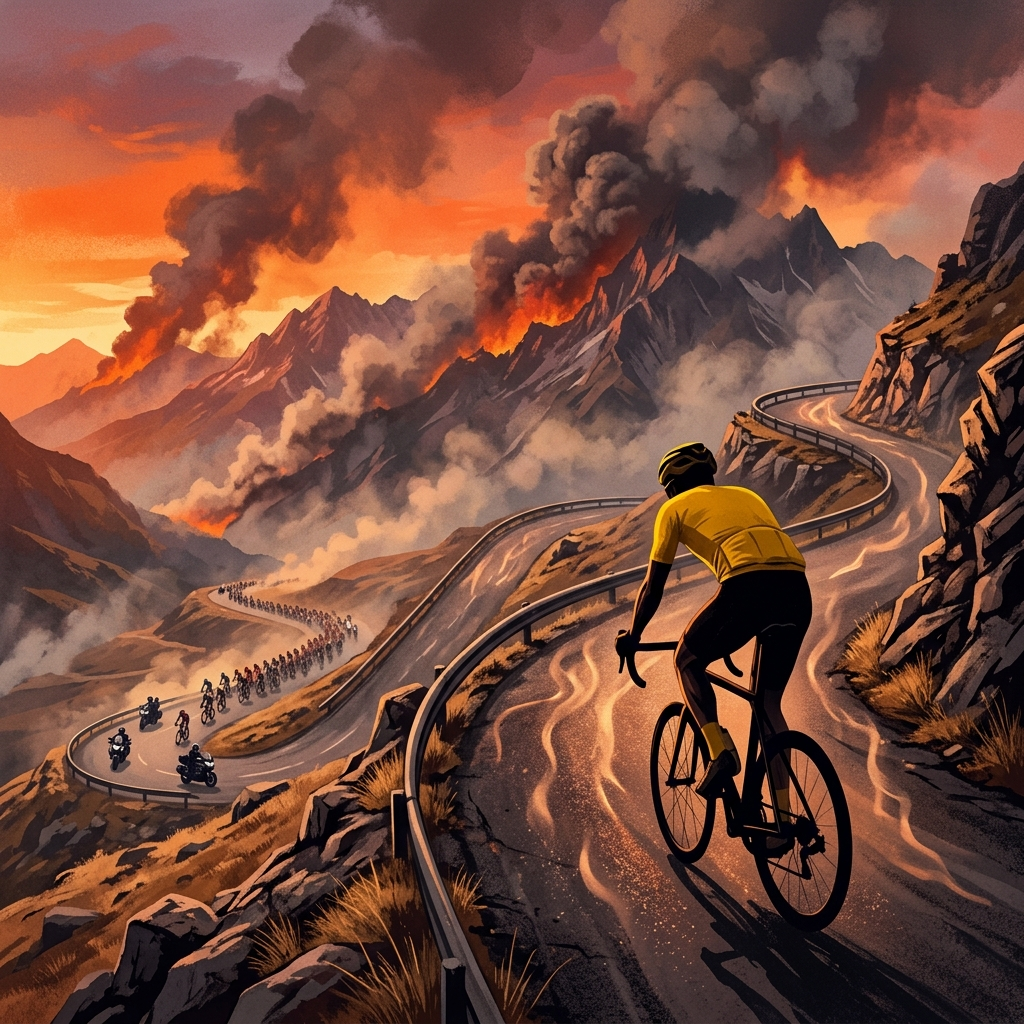
The 2026 Tour de France drew to a close under conditions no edition in its history had ever faced: two stages truncated by wildfire and record-shattering heat, even as Tadej Pogačar secured his fifth overall title at just 27 years old, joining Anquetil, Merckx, Hinault, and Indurain as the only five-time champions in cycling history. His margin of victory — 6 minutes and 26 seconds over runner-up Remco Evenepoel — was so commanding that calling it a close race would be almost embarrassing; Pogačar wore the yellow jersey from Stage 6 to the final Stage 21 without a single day of genuine threat. The tournament's average temperature of 87.4°F obliterated the previous record of 78.6°F set in 2022, while more than 197,000 people were evacuated from wildfire zones in France alone and organizers were forced to slash the final stage from 133km to 89km. These two storylines — cycling's greatest-ever champion reaching a new peak, and the accelerating climate crisis threatening to end the race as we know it — collide into the defining paradox of this edition: the greatest racer in history is dominating the greatest race in history at the precise moment that race faces an existential threat. This article makes the case that the stage truncations of 2026 are not isolated bad luck, but the opening chapters of a story about how climate change is rewriting the terms under which outdoor sport can exist at all.
Key Points
The Historical Weight of the Youngest Five-Time Champion
Tadej Pogačar's fifth Tour de France victory at age 27 is an achievement so rare that context is required to properly absorb it. In over a century of Tour history, only four riders had ever reached five wins: Jacques Anquetil in the 1950s and '60s, Eddy Merckx in the '60s and '70s, Bernard Hinault in the '70s and '80s, and Miguel Indurain in the '90s — and in virtually every case, these victories came during the mature, fully developed phase of a long career, when riders were in their early-to-mid thirties. Pogačar joined this club a full decade younger than most of its members, setting the all-time record for youngest five-time champion in the process. What that age gap means in practical terms is enormously significant: assuming a typical professional career arc, Pogačar has at minimum five peak years still ahead of him, which places additional records not in the realm of fan speculation but of reasonable projection. Eddy Merckx — 81 years old and widely considered the greatest cyclist in history — publicly predicted Pogačar's sixth title in an interview with The National, which is about the strongest possible endorsement from the most credible possible source. Pogačar's current statistics illustrate how rapidly he is approaching the record books: 26 Tour stage wins places him third all-time, behind only Merckx's 34 and Mark Cavendish's 35, and well ahead of every other rider in the sport's history. His 71 days in yellow is closing on Hinault's 79 and has Merckx's all-time record of 111 days within realistic range given the years remaining. His 13 Monument victories are second only to Merckx's 19, demonstrating a versatility across all race formats that sets him apart from any Tour specialist of the modern era. At 27, with the form he has shown and the competitive depth still available to him, the remaining chapters of this career have the potential to be more significant than anything we have seen so far.
What 6:26 Actually Means — The Scale of Riding a Different Race
The margin of 6 minutes and 26 seconds that Pogačar put into runner-up Remco Evenepoel represents something that statistics alone struggle to communicate with full impact. In a three-week, multi-thousand-kilometer event with 21 stages spanning completely different terrain and physiological demands, that gap is not merely "winning big" — it is demonstrating an absolute physical superiority that makes the term "race" feel semantically strained when applied to the field as a whole. Pogačar held the yellow jersey from Stage 6 through the final Stage 21 without a single day of genuine threat; at his peak in the third week, the gap to Evenepoel stretched beyond seven minutes before settling back to 6:26 on the final podium. This is particularly meaningful because Evenepoel is not a weak field filler — he is a world-class champion at his prime, a rider who would have been the dominant figure of the Tour in any era not featuring Pogačar. Putting six-plus minutes into a world-class rival over three weeks of varied terrain and maximum competitive pressure suggests a physiological reality, not merely a tactical or strategic advantage. Jonas Vingegaard's crash on Stage 15 and subsequent collarbone fracture added a footnote to the final margin, but Pogačar had already built a decisive lead before Vingegaard hit the ground — his dominance was established in the race's first half, before the dynamic changed. Third place del Toro was equally powerless throughout, suggesting that this was not merely about the absence of a single rival but about Pogačar operating at a level unavailable to the entire competitive field simultaneously. The kind of consistency required to sustain this gap across three weeks of Alpine climbs, Pyrenean stages, time trials, and maximum tactical pressure from 176 other professional athletes is what the 2026 Tour's numbers are actually measuring. In 2026, Pogačar was the closest living embodiment of grand tour perfection.
Why the GOAT Debate Frames the Wrong Question
The instinct to compare Pogačar with Eddy Merckx and declare one of them the greatest cyclist in history is understandable, but it rests on a premise that does not hold up to careful examination. The Tour de France that Merckx won five times in the late 1960s and early 1970s and the Tour de France that Pogačar won his fifth time in 2026 share a name, a country, and a trophy. Beyond those three things, they are essentially different sports conducted under different conditions using different technology and supported by different science. Merckx had no GPS-based real-time data analysis feeding into his race decisions during competition. He had no power meters calibrated to optimize his exact sustainable output on each specific climb. He had no aerodynamically engineered time trial equipment developed through wind tunnel testing, no team of physiologists managing his nutrition and recovery down to the gram across three weeks. Every strategic decision Merckx made in a grand tour came from his own accumulated experience and intuitive reading of the race — a fundamentally different cognitive task from the one today's riders face. Comparing their raw statistics and asking "who was greater?" is the same category error as asking whether Charles Lindbergh or a modern commercial airline pilot was a better aviator: the question misframes the comparison entirely, and it does a disservice to both men's actual achievements across their respective eras. The more intellectually honest GOAT framework asks not "who had more stage wins?" but "who dominated their competitive era most completely?" — and by that measure, Pogačar's 6:26 over a world-class Evenepoel in 2026 is as compelling an argument for greatness as anything Merckx posted against his own contemporaries. The debate is genuinely interesting dinner table conversation. But as a framework for evaluating greatness, it is the wrong question.
The Climate Crisis That Simultaneously Rewrote Heat Records and Race Routes
The 2026 Tour de France's average race temperature of 87.4°F didn't merely break the previous record of 78.6°F set in 2022 — it annihilated it by nearly nine degrees Fahrenheit, indicating that this race was conducted in a fundamentally different climate environment from any previous edition in its history. Stage 9 was shortened by 30 kilometers due to the extreme heat. The final Stage 21 was cut from 133km to 89km because wildfire had made the original course operationally impossible: firefighters and security personnel who would normally support the race route had to be redirected to wildfire evacuation operations, and the planned course simply could not be maintained. More than 197,000 people were evacuated from wildfire zones in France alone, with approximately 80,000 more displaced in neighboring Spain. European wildfire burn area has increased 57% over the past four years, a trend line that does not suggest moderation. A study published in Scientific Reports covering 50 years of Tour data from 1974 to 2023 found that WBGT in southern and eastern France has been rising at 0.5°C per decade, and that Bordeaux has already recorded a WBGT of 28.7°C, exceeding the UCI's 28°C threshold for potential race cancellation consideration; the researchers concluded that a forced schedule change is "only a question of time." Against this backdrop, Pogačar's own statement on July 13 — "If I had the power I would change all the calendar and not race in July and August in hot places" — and Tour director Prudhomme's "categoric no" five days later, softened only by "Perhaps one day, but it is not on the agenda," define the central institutional conflict of the Tour's near future. The science and the sport's greatest champion point in the same direction. The institution has not yet followed.
A Warning Signal That Every Outdoor Sport on the Planet Should Hear
The climate disruption that shortened two stages of the 2026 Tour de France is not a cycling-specific problem — it is a leading indicator of a structural crisis facing every major outdoor summer sport simultaneously. FIFA now mandates hydration breaks when WBGT exceeds 32°C and applied them to all 104 matches at the 2026 World Cup regardless of actual match-day temperature. Formula 1 introduced a Heat Hazard protocol in 2025 that triggers when ambient temperatures exceed 31°C, and deployed it at the 2026 Austrian Grand Prix. The Australian Open has operated an extreme heat policy since 1998, with the authority to suspend play when WBGT reaches 32.5°C. The Tokyo 2020 Olympics relocated the marathon from Tokyo to Sapporo to reduce athlete heat exposure; the 2022 Qatar World Cup was moved from June-July to November-December because Qatar's summer temperatures reach 35–45°C. These are not isolated adaptations — they are the early stages of a systematic renegotiation between organized sport and the climate in which it operates. Professional road cycling may be the most structurally exposed of all major outdoor sports: you cannot move a mountain pass indoors, you cannot air-condition 200 kilometers of open road, and the sport's most iconic moments require sustained outdoor exertion in exactly the conditions that are becoming increasingly dangerous. The 197,000 evacuees in France and 80,000 in Spain were not background noise during the 2026 Tour; they were the most direct evidence available that the sport's operating environment is changing in ways that no governing body can simply wait out. For fans of any outdoor sport, tracking temperature data and course modification announcements has become as meaningful a measure of the sport's health as anything on the results sheet.
Positive & Negative Analysis
Positive Aspects
- A Historic Achievement That Enriches Cycling's Cultural Legacy
Pogačar's fifth Tour de France victory at 27 is more than a personal milestone — it is a genuine contribution to the cultural canon of sport, a chapter in cycling's history that will be referenced for generations. The five-time champion club is one of sport's most exclusive societies: four riders in over a hundred years, and now a fifth who is younger than all of his predecessors were when they entered it. This kind of historic rarity doesn't just satisfy existing fans — it has the potential to draw in people who have never followed cycling before, because greatness at this scale tends to transcend the sport that contains it. Merckx's public prediction of a sixth title adds an intergenerational dimension that enriches the narrative further: one legend explicitly anointing another across a fifty-year gulf in cycling history is the kind of moment that sports exist to create, and it gives non-cycling fans a reason to pay attention beyond the race itself. For a sport that has historically struggled to achieve the global mainstream recognition of football, basketball, or tennis, a champion of Pogačar's magnitude is an invaluable asset — a figure compelling enough to make casual observers stop scrolling. The sustained quality of his performance across multiple disciplines — mountains, time trials, one-day classics — also gives his record a completeness that pure grand tour specialists lack, making the case for his historical significance broadly persuasive rather than narrowly technical.
- The Dominant Champion Effect That Actually Grows Viewership
The popular intuition that one dominant champion makes a sport boring has been tested repeatedly by history, and history keeps producing the opposite result. Michael Jordan's Bulls ownership of the 1990s didn't suppress NBA viewership; Game 6 of the 1998 Finals drew 35.89 million viewers — the most-watched basketball game ever broadcast. Tiger Woods' dominance didn't thin PGA Tour galleries; his absence for five years dropped ratings 18% and attendance 11%, and his return spiked the 2018 Open by 38% and the PGA Championship by 69%. The 2026 Tour de France confirms this pattern with its own record-setting numbers: France Télévisions reported 45.6 million cumulative viewers — 72% of the French population aged 4 and above — the highest in the race's history. The Alpe d'Huez stage drew 5.4 million viewers at 50.5% audience share; the final stage peaked at 8.3 million; France.tv posted 43 million video views, up 80% versus 2024. Dominant champions create a specific spectator experience — the opportunity to witness something that seems to exceed what human capability should allow — that competitive uncertainty alone cannot replicate. Every other team in the peloton designing its entire strategy around "how do we crack Pogačar?" generates daily subplots that sustain three weeks of viewer investment at a level that a closer race might paradoxically not.
- Making the Climate Crisis Viscerally Real for Sports Audiences
The 2026 Tour de France accomplished something that no UN climate report or scientific paper could easily achieve: it made climate change immediately, personally real for tens of millions of sports fans who watched their favorite race lose two stages to conditions that previously would have seemed impossible. Sports audiences — notoriously resistant to abstract political and scientific communication — respond viscerally when the sport they love is directly affected, and the data points that moved through cycling media in 2026 reached audiences that traditional climate communication rarely penetrates. The numbers — 87.4°F average temperature, 197,000 French evacuees, final stage cut by 44km, European wildfire area up 57% — gained traction and emotional weight specifically because they arrived inside a beloved cultural institution. Sam Hampton's warning that "this is the coolest summer that's going to be in our lifetimes" gained far wider circulation through cycling coverage than it would have through academic channels alone. Pogačar's own statement about wanting to move the race away from July heat gave the climate argument an emotionally credible human face that environmental campaigns typically struggle to find. The 2026 Tour functioned — unintentionally but effectively — as one of the most powerful climate communication events of the year, and that may ultimately be among its most lasting legacies.
- The Living Demonstration of Sports Science at the Frontier of Human Performance
Pogačar's performance across three weeks of historic heat is also compelling evidence of how sophisticated modern sports science has become in its ability to optimize elite human performance at scale. GPS-based real-time load management, power-meter-calibrated pacing on every individual climb, aerodynamic equipment developed through wind tunnel testing, individualized nutrition programs calibrated to his specific physiology across three weeks of racing, and heat acclimatization protocols designed specifically for 2026 conditions all contributed to the kind of sustained, consistent performance that previous generations of champions simply could not have sustained at this level. That Pogačar held the yellow jersey from Stage 6 to Stage 21 — through historic heat, maximum tactical pressure from 176 rivals, and the psychological weight of being every team's primary target — reflects not just extraordinary physical gifts but a level of scientific management that represents the current frontier of what elite sport preparation can achieve. The lessons learned in planning and executing his preparation flow back into applied sports science literature and eventually into training frameworks for endurance athletes across multiple disciplines. Watching the output of that research in competition, in real time, is part of what makes sport at this level genuinely fascinating beyond the simple question of who finishes first.
- Forcing Tactical Innovation Across the Entire Competitive Field
There is an underappreciated benefit to having a dominant champion: it forces the rest of the competitive ecosystem to evolve in ways it otherwise wouldn't. When a single tactical approach — deploying your best climber against Pogačar and hoping for the best — fails decisively enough often enough, other teams are compelled to think fundamentally differently about race design and roster construction. In the editions ahead, the ongoing search for an answer to Pogačar is going to produce creative race strategies that push the boundaries of what has been tried in professional cycling, from multi-leader team compositions to synchronized cross-stage attacks to pre-race coalition strategies between normally competing squads. Michael Jordan's Bulls forced the development of zone defenses and tactical responses that permanently changed professional basketball's strategic landscape long after Jordan himself retired. Pogačar's dominance is already reshaping how teams build rosters, design race plans, and select which stages to contest resources on. That ongoing tactical evolution is one of the things that makes cycling genuinely interesting to follow across seasons rather than just within a single race, and the sport becomes more complex and strategically rich when one competitor's apparent invincibility forces everyone else into deeper creativity.
Concerns
- The Collapse of Competitive Suspense When the Result Feels Settled
A margin of 6:26 is remarkable in its athletic significance, but it also does something damaging to the fundamental structure of the race: it removes the suspense that makes three-week competition compelling in its most basic sense. From Stage 6 forward, the yellow jersey was functionally settled, and the remaining fifteen stages served primarily as a competition for second place with Pogačar as an uncontested participant in his own coronation. Vingegaard's collarbone fracture on Stage 15 eliminated the only rider who had previously demonstrated the ability to seriously challenge Pogačar at this level, leaving the field without a credible protagonist for the race's central dramatic narrative. Former F1 commercial chief Bernie Ecclestone publicly acknowledged during Sebastian Vettel's four consecutive championships from 2010 to 2013 that dominant seasons were actively hurting Formula 1's viewing figures — and Vettel was far less dominant by time margins than Pogačar has been. Not every dominant champion drives the Jordan or Tiger Woods viewership effect; the outcome depends heavily on the sport's nature and the specific form of engagement the dominant figure generates. If Pogačar's advantage grows rather than narrows in coming editions, the risk of "the result is known before Stage 6 even starts" becoming the default audience assumption is real, and that assumption tends to erode casual viewership even when core fans remain loyal and engaged.
- The Climate Threat to Sporting Integrity and Athlete Safety
The shortening of Stage 21 from 133km to 89km and Stage 9 by 30km represents a direct challenge to the Tour's sporting integrity — the fundamental premise that every rider in every edition completes the same distance under comparable conditions. When the course is cut by a third in the final stage, records and comparative statistics across editions carry asterisks by definition, and the already difficult task of comparing performances across different years becomes even less reliable. Racing at 87.4°F average temperature for multiple hours at maximum competitive intensity creates serious documented medical risks: heat stroke, severe dehydration, and cognitive impairment are not hypothetical concerns but physiological realities that occur on a gradient as temperatures rise. The moral dimension of continuing to race while 197,000 people within the same country are evacuating from active wildfire also deserves acknowledgment — there is something genuinely uncomfortable about the spectacle of professional sport proceeding at full commercial scale alongside that level of civilian emergency. Pogačar's five-title achievement carries the permanent notation that it occurred in an edition where two stages were shortened by extraordinary circumstances, which — while not diminishing what he accomplished — complicates the historical comparison in ways that future commentators will need to address honestly. The integrity of competitive sport rests on consistent and complete conditions; climate change is making that consistency harder to guarantee with each passing year.
- The Risk of Demoralization Spreading Through the Competitive Ecosystem
When one competitor's dominance is sufficiently absolute, the effect on motivation throughout the layers of the sport below the very top can be quietly corrosive in ways that don't show up in viewership figures until well after the damage is done. For smaller teams with limited budgets and roster depth, "we have no realistic path to winning this race" is a difficult message to take to potential sponsors and to young riders being recruited into the program. The competitive argument for why a talented climber should choose a resource-constrained team over a better-resourced alternative becomes harder to make when the answer to "could we win the Tour?" is visibly no, and clearly so. Promising young riders who might have oriented their entire development toward grand tour competition may instead choose one-day races or other Grand Tours where the outcome feels less predetermined — a rational individual response that gradually thins the Tour's competitive depth below the podium. The Merckx era produced similar concerns: his dominance was so complete that some top competitors reportedly reduced their Tour de France investment, knowing that racing against Merckx at his peak was a losing proposition regardless of preparation. The sport's long-term health depends on a diverse ecosystem of teams investing in Tour ambitions with realistic hope attached to that investment; sustained dominance that makes those ambitions feel unrealistic is a structural risk that competes with the short-term spectacle benefits.
- The Existential Threat to the July Tradition Itself
More than a century of "the Tour happens in July, in France" is not just a scheduling convention — it is the bedrock of the race's identity, commercial value, cultural resonance, and place in the French national calendar. The prospect of that tradition ending or being fundamentally altered is not an abstraction; it is a scenario the race director has already acknowledged as a future possibility, even while currently dismissing it. If European wildfire burn area continues growing and WBGT in southern France continues rising at 0.5°C per decade, the window in which the July race remains operationally viable is not permanent, and treating it as permanent is an institutional choice with real consequences. Moving to September creates a direct calendar conflict with the Vuelta a España, meaning either the Vuelta would need to shift or the races would overlap, creating impossible demands on riders, teams, and broadcast partners. A June shift introduces its own weather unpredictability in high mountain stages. Either adjustment triggers cascading effects through broadcasting contracts, hospitality commitments, tourism planning, and the economic calendars of hundreds of French towns that have built significant commercial infrastructure around the July race date. The cost of changing is genuinely high. But the cost of not changing — if the climate projections that researchers describe as "only a question of time" prove accurate — may ultimately be higher, and deferring the decision doesn't make it disappear.
- The Economic Cost of Climate Adaptation Falling on the Sport's Infrastructure
Every safety enhancement and emergency contingency plan that the 2026 Tour's conditions required carries real financial cost, and those costs are ultimately distributed through the sport's commercial ecosystem in ways that affect everyone from top-level organizers to roadside fans. Pre-race route safety assessments now need to account for wildfire risk in ways that require dedicated staffing, satellite monitoring, and contingency planning that simply didn't exist as operational requirements in previous decades. Having a backup 89km course ready in case the 133km original becomes unsafe requires significant organizational investment and coordination with local governments, emergency services, and security forces across multiple jurisdictions simultaneously. Enhanced medical protocols for heat-related events, expanded cooling infrastructure at stage finishes, more sophisticated real-time weather monitoring, and additional medical personnel at high-risk segments all add operating costs to what is already a complex and expensive logistical undertaking. For the professional teams, the parallel requirement to upgrade heat management protocols, acclimatization training infrastructure, and medical staff capabilities adds budget pressure that smaller outfits absorb with particular difficulty. The Tour's free roadside viewing tradition — one of its most distinctive and democratizing features, and a major part of what makes it culturally unique among major sporting events — may face pressure if safety management requirements for high-risk segments require crowd management restrictions that limit access. Climate adaptation in sport is not free, and the 2026 Tour has clarified that the question of who pays for it is one the sport's economic structure will need to actively address.
Outlook
Let me start with what happens in the coming weeks and months. The immediate aftermath of the 2026 Tour will generate two parallel streams of conversation in the cycling world. The first is about Pogačar's second-half season plans: will he target the Vuelta a España, or bank on a focused recovery heading into 2027? UAE Team Emirates' management of their flagship asset will be scrutinized heavily, and given the physical toll of three weeks at this intensity in historically brutal heat, the case for a strategic rest period is genuinely compelling. The second stream — and arguably the more consequential one — is about how ASO responds to the climate conditions that disrupted two stages and forced over 197,000 evacuations in the host country. Two stage truncations in a single edition demand more than a press conference. I expect ASO to announce a dedicated climate risk working group before the end of 2026. Whether that group produces real operational change or serves primarily as institutional optics will be the story to watch. Additionally, the professional teams — beginning with UAE Team Emirates — will substantially upgrade their heat management protocols and athlete monitoring systems based on this edition's experience, which could itself shift how grand tours are raced in the years ahead.
The most visible near-term conflict is already clearly drawn. Pogačar's public statement — "If I had the power I would change all the calendar and not race in July and August in hot places" — stands in direct opposition to Prudhomme's "categoric no" delivered five days later. This is not a minor disagreement between a rider and a race director. It's a structural collision between the interests of athlete safety and the commercial and cultural weight of a century-old tradition. What makes it politically explosive is the credibility gap: Pogačar is the greatest active cyclist on the planet, and 197,000 people were evacuated from the race's host country in the same edition that prompted his remarks. When the world's greatest active athlete demands structural change with those conditions as backdrop, the "categoric no" has a measurable shelf life. Prudhomme's own addendum — "Perhaps one day" — was a rhetorical admission that the current state is not permanent. I think the conversation will shift, within six to eighteen months, from "should this even be discussed?" to "when and how do we actually make the change?" The pressure accumulates faster when the photographic evidence includes burning hillsides and civilian evacuation orders running alongside the race.
Vingegaard's recovery trajectory and competitive return will shape the 2027 narrative as much as any climate development. A collarbone fracture in a professional cyclist typically permits full training within a few months, meaning he could realistically be back to complete fitness well before next summer. If Vingegaard returns healthy for 2027, the three-way contest between him, Evenepoel, and Pogačar becomes arguably cycling's most compelling active rivalry. Evenepoel will not accept a 6:26 defeat as the expected outcome — he is too analytically driven and too competitive to approach 2027 without a complete strategic overhaul. Whether that gap is genuinely bridgeable through tactical evolution alone is a separate question, and one worth being honest about: if Pogačar's advantage comes from a fundamental physiological difference rather than superior strategy, tactical refinement alone has an obvious ceiling. But combine a motivated Evenepoel, a revenge-narrative Vingegaard emerging from injury, and Pogačar chasing his sixth title, and 2027 has the potential to be one of the most-watched Tours in the race's history — assuming, of course, that conditions permit a full and undisrupted edition.
The medium-term outlook for the Tour's operating environment is where the genuinely difficult questions live. The 57% increase in European wildfire burn area over four years is not a trend that reverses without deliberate intervention. The 87.4°F average race temperature that shattered the 2022 record by nearly nine degrees is not a statistical aberration in isolation — it's a data point on an upward curve. The Scientific Reports study projecting 0.5°C WBGT increase per decade in the Tour's key regions provides the scientific framework within which all future planning must occur. If that trajectory continues — and current climate models project that it will — the window in which July cycling in France remains safely operable is measurably narrowing, not expanding. A calendar shift to June or September emerges as the most credible structural solution, but it creates its own cascade of problems: September conflicts directly with the Vuelta a España, disrupting the entire Grand Tour calendar. Broadcasting contracts, sponsor commitments, and riders' seasonal planning are deeply interconnected in ways that make any date change operationally and commercially expensive. What FIFA demonstrated in 2022 — overriding a century-old tradition because Qatar's summer heat reaches 35–45°C — is that structural impossibility yields to sufficient climate pressure. That precedent makes the unthinkable considerably more thinkable than it was even five years ago.
The UCI's protocol system requires structural reform, and 2026 has made that harder to ignore. The high-temperature protocol introduced in 2024 depends on consensus among organizers, team representatives, rider delegates, and UCI commissaires before activation — a design that privileges stakeholder negotiation over automatic protection thresholds. In the 2026 Tour, the stage truncations that did occur happened through ad hoc decisions rather than formal protocol engagement. Meanwhile, FIFPRO has been pushing FIFA to lower its WBGT intervention threshold from 32°C to 28°C, and scientists have demonstrated that a three-minute hydration break cannot meaningfully reduce athletes' core body temperature under extreme conditions. The gap between what peer-reviewed science recommends and what governing frameworks can actually enforce is widening across every major sport. For road cycling specifically — where races span six hours of continuous outdoor exertion at maximum intensity, where mountain passes cannot be cooled, and where tactical attacking in extreme heat is among the sport's defining moments — the need for pre-agreed, automatically triggered intervention thresholds is more urgent than in almost any other discipline. UCI's 2027 governance review will be closely watched by everyone invested in the long-term viability of professional road racing.
Looking further out, I see three plausible trajectories, and I want to be honest that I'm not assigning numerical odds to any of them — doing so would require fabricating numbers I don't actually have. The most optimistic path involves ASO moving proactively: a window shift to late May or early June, systematic redesign of mountain stages away from the highest wildfire-risk zones, and enhanced athlete health monitoring that makes remaining heat exposure manageable. In this scenario, the Tour retains its essential identity — French mountains, three weeks of suffering, a yellow jersey — while modernizing its calendar and safety infrastructure in ways that could deepen fan engagement by making each edition feel less precarious.
The most realistic middle path is gradual, reactive adaptation: stages get truncated when conditions demand it, the calendar shifts incrementally rather than by formal decision, and the race continues but in a form that feels progressively less complete to longtime fans. Records from truncated editions carry asterisks, cross-era comparisons become murkier, and the grand spectacle erodes quietly at its edges without ever formally ending. The darkest scenario — which I genuinely hope to be wrong about — is that the pace of climate change outstrips the pace of institutional response, and by the early 2030s the July Tour becomes untenable not occasionally but consistently, forcing either abandonment of the July tradition or a fundamental reinvention of what the Tour de France even is as a sporting event. Oxford's Sam Hampton said it plainly: "This is the coolest summer that's going to be in our lifetimes." Each edition from here happens in conditions a bit worse than the last. That trajectory does not bend without active intervention from multiple directions simultaneously.
I want to be fair to the counter-argument, because I could genuinely be wrong. The conditions under which my pessimism fails to materialize do exist. Climate adaptation technology may advance faster than current projections suggest. EU carbon reduction commitments could deliver measurable regional temperature deceleration within the relevant timeframe. ASO may prove more operationally agile than its institutional history implies, and Prudhomme's "categoric no" may quietly become a new September plan faster than anyone currently expects. Pogačar's dominance will eventually give way to a new competitive landscape — his reign is extraordinary but not permanent — and the natural narrative shift of a closer race may bring renewed sporting uncertainty regardless of climate conditions. The teams and riders will continue pushing the frontiers of heat adaptation through improved protocols, better acclimatization, and smarter pacing. None of this is impossible, and I want to be clear that I am not predicting catastrophe as a certainty.
But the honest assessment, based on the trajectory the data shows and that the 2026 edition demonstrated with brutal clarity, is that the comfortable assumption of continuity — that the Tour will keep happening the same way because it always has — is no longer warranted by the evidence. One more thing worth watching alongside all of this: the pace of international climate policy, and whether EU commitments translate to measurable effects on southern European summer temperatures within the decade. Sport and climate are no longer parallel stories. The shape of Pogačar's next trophy ceremony depends, in part, on decisions being made far outside of cycling.
Sources / References
- Tadej Pogacar wins 2026 Tour de France for record-tying fifth time — NBC Sports
- Tadej Pogacar wins 2026 Tour de France amid wildfires — NPR
- Wildfire disruptions to the Tour de France show how climate change is shaping sports — TIME
- Final stage of 2026 Tour de France shortened due to wildfires — CyclingNews
- Pogacar 2026 Tour de France records analysis — BikeRadar
- Eddy Merckx predicts Pogacar sixth Tour de France title — The National
- After 5th Tour victory, Pogacar cycling supremacy unchallenged — Anchorage Daily News
- Tour de France 2026 viewership on France Télévisions — Puremédias
- Prudhomme gives categoric no to moving Tour from July — Cycling Up To Date
- Tour de France is a July race, director rejects Pogacar wish — Cycling Weekly
- Pogacar calls for calendar overhaul after heatwave stage shortening — BikeRadar
- Scientific Reports study on Tour de France heat stress 1974-2023 — EurekAlert
- New High Temperature Protocol to protect riders health — UCI
- FIFA moves 2022 World Cup to November-December due to Qatar heat — CBS News
- Most watched NBA Finals (Jordan 1998 record) — Front Office Sports
- How Tiger Woods changed the face of golf TV ratings and purses — Irish Times