
Yamal vs. Messi in the World Cup Final — Why the 'Generational Shift' Narrative Gets It Completely Wrong
Summary
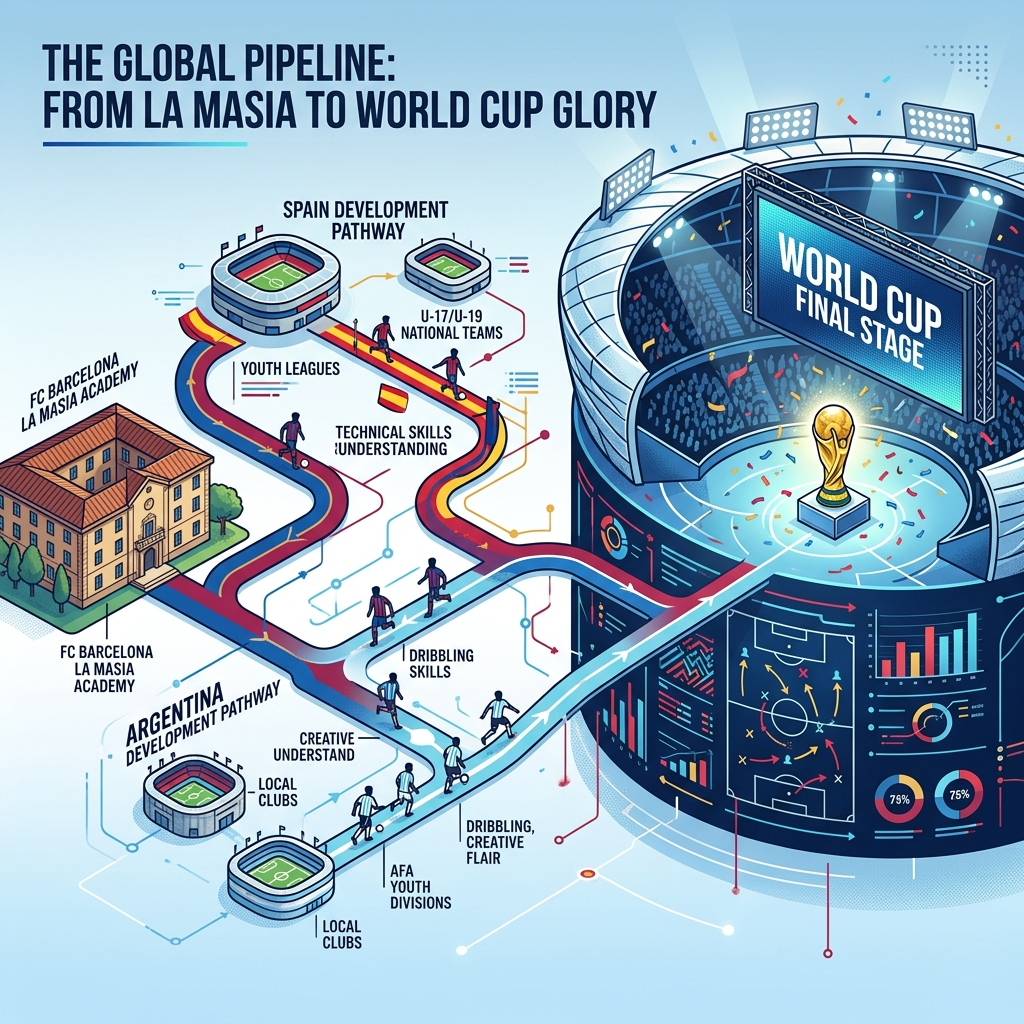
The 2026 FIFA World Cup Final, set for July 19 at MetLife Stadium in New Jersey, has been framed by global media as a symbolic generational-shift showdown between 19-year-old Lamine Yamal and 39-year-old Lionel Messi, but this narrative contains a fundamental structural flaw. Messi is unambiguously a present-tense player: he has scored 21 World Cup goals across 31 appearances, breaking Miroslav Klose's long-standing record of 16, and netted 8 goals in this tournament alone. Yamal is not "the future" either — he made his professional debut at 15 as Barcelona's youngest-ever player, became Euro 2024's youngest scorer at 16 years and 362 days, and has been Spain's undisputed ace throughout this tournament. Most critically, both men are products of the same institution: FC Barcelona's La Masia academy, meaning July 19 is less a clash of nations than a simultaneous showcase of a single footballing philosophy's two greatest outputs. In the largest World Cup in history — expanded to 48 teams in the name of democratizing football — the fact that both finalists share the same academy DNA exposes a structural inequality that bracket expansion alone cannot resolve.
Key Points
Not Generational Replacement — Simultaneous Dual-Peak Performance
Messi is 39 years old and has just set an all-time World Cup record of 21 goals across 31 appearances, surpassing Miroslav Klose's mark of 16 that had stood unchallenged for twelve years following the 2014 Brazil World Cup. Yamal is 19, made his professional debut at 15 as Barcelona's youngest-ever player, became Euro 2024's youngest scorer at 16 years and 362 days old, and has served as Spain's primary attacking force through every knockout match in this tournament. The media's instinct to frame this as "the past meeting the future" collapses on contact with those facts. ESPN's data shows Messi's touches inside the box per 90 minutes jumping from 4.42 at the 2014 World Cup to 6.28 at this one, and under coach Scaloni he has scored 15 World Cup goals in just two tournaments after managing only 6 in the previous four combined. These are not the numbers of someone operating in the past tense — they are the numbers of a player at the peak of a specifically engineered tactical deployment. Two completely different kinds of individual peak have converged in the same stadium: a 19-year-old ascending toward his full ceiling, and a 39-year-old holding an all-time career record. The closest historical parallel in sport is the Federer-Nadal-Djokovic era in tennis — simultaneous co-existence of greatness, not handover — and this final operates by exactly the same structural logic.
La Masia Community Identity Runs Deeper Than National Allegiance
When Yamal told Fox Sports after Spain's semifinal win that he "wants Messi's shirt after the final," every major outlet reported it as a heartwarming cross-generational respect story — but the real significance of that statement operates at a much deeper structural level. A player on the eve of the World Cup Final, the biggest match of his career, publicly announces he wants the jersey of the opposing team's most dangerous player. That statement is psychologically implausible under a standard nation-versus-nation competitive frame, where the opponent is experienced as fundamentally "other." The only context in which it is entirely natural is one where both players recognize each other as members of the same footballing household — which is precisely what La Masia creates and sustains across generations. Spain's golden generation of Xavi, Iniesta, Busquets, and Pedro consistently described their international success as "bringing Barcelona's football to the national team," signaling that club identity was the deeper organizing principle even when competing for the nation. La Masia's rondo-centered training system and positional play philosophy produce graduates who share the same footballing language regardless of national affiliation, and this final is, in its structural reality, a civil war within that shared language — the living present confronting the founding legacy across a national border.
The 48-Team Expansion's Structural Paradox — More Participants, Same Power Map
FIFA justified the expansion of the World Cup to 48 nations as a democratizing step — a mechanism for bringing more of the world into meaningful competition at the sport's highest level and generating new audiences in underserved markets. The bracket's progression has told a different story. Morocco, ranked sixth in the world by FIFA, was eliminated in the quarterfinals. Japan was the only Asian team to advance from the group stage, and not a single Asian nation reached the final four. The United States, Canada, and dozens of first-time participants were all eliminated before the final stages. Among the eight quarterfinalists, six were European, one South American, one African — a distribution statistically indistinguishable from a 32-team edition. The cumulative record of World Cup Final appearances by teams from Africa and Asia remains at zero across all 22 editions of the tournament, and this expanded edition has not changed that figure by a single instance. Participation access was widened. Competitive access at the summit was not. The fact that both finalists share La Masia DNA is not incidental to this structural reality — it is its most concentrated symbolic expression, and it demands honest reckoning with what democratizing football actually requires beyond printing more participation certificates.
Resource Concentration and the Geographic Lottery of Footballing Development
La Masia's estimated annual operating budget exceeds 10 million euros — a figure roughly equivalent to the total annual football infrastructure funding of multiple African national federations combined, according to available data on continental football federation budgets. That budget sustains more than 50 specialist coaches, a dedicated medical team, a sports science unit, a nutrition management program, and a data analytics department — institutional infrastructure that exceeds what most small-to-midsize national football programs possess in their entirety. Messi's path to Barcelona at 13 was made possible specifically by the club's willingness to fund his growth hormone therapy when Argentine clubs declined; Yamal's path was made possible by the geographic accident of being born approximately fifteen minutes from the academy. Footballing raw talent is not concentrated in Europe — research consistently suggests it is distributed broadly across the global population. What is geographically concentrated is the infrastructure to identify, systematically develop, and elevate that talent to world-class level over a sustained period. A child born in Lagos or Dhaka with Messi's raw ability faces a probability approaching zero of ever accessing La Masia-equivalent training. The spectacle of this final is genuine and extraordinary — but the structural inequality that made it possible deserves to be named directly alongside the brilliance, not obscured by the commercial glow.
Sports Science Is Rewriting the Definition of Elite Athletic Longevity
Messi competing as a decisive force in a World Cup at 39 was considered essentially impossible by sports medicine consensus a decade ago, and the fact that he is not only competing but setting all-time records demands explanation beyond individual exceptionalism. What has changed is the science surrounding elite athletes at every level. Personalized nutrition protocols calibrated at the individual metabolic level, cryotherapy and hyperbaric oxygen therapy for accelerated post-match recovery, GPS-based training load management systems that flag injury risk thresholds in real time, and individualized biomechanical monitoring have collectively extended the competitive lifespan of top-tier athletes in ways the previous generation of coaches and physicians would not have predicted. The additional contextual factor in Messi's specific case is that competing in MLS — relative to the demands of La Liga or the Champions League — has provided a lower-intensity base environment that makes energy conservation for international tournaments substantially more manageable. Tom Brady won a Super Bowl at 43, Serena Williams competed at Grand Slam level deep into her late thirties, and now Messi is setting all-time World Cup scoring records at 39. These are not isolated biographical anomalies — they are systematic data points in a fundamental redefinition of what peak athletic performance across a full career can and should look like, and every professional sport will be renegotiating its assumptions about aging, contract length, and retirement timelines in the years ahead.
Positive & Negative Analysis
Positive Aspects
- Explosive Global Inspiration for Young Footballers Everywhere
Yamal standing on a World Cup Final pitch at 19 delivers an argument to young footballers around the world that no coaching manual or motivational speech could replicate with comparable force. The proposition that talent and sustained effort can overcome the barrier of age — that a teenager can reach the absolute summit of the world's most-watched sport — is now backed by living, televised, verifiable proof visible to billions of people simultaneously. Academies in every country on the planet will have millions of young players watching this match, and some of them will carry this moment as a defining reference point in how they understand what is achievable in their own careers. Yamal's trajectory also provides the most persuasive case study in existence for the value of long-term youth development investment over short-term results pressure, demonstrating that a coaching philosophy prioritizing player understanding over winning at youth level generates outcomes that no amount of expensive transfer activity in the short term can replicate. Beyond the individual inspiration, Messi's parallel achievement at 39 compounds the message: the ceiling for what dedicated athletes can accomplish at any career stage is higher than previously understood, and the convergence of both examples in a single match reshapes how young athletes across all sports conceptualize long-term development.
- Empirical Validation of the Sports Science Revolution at the Highest Level
Messi's sustained performance as a 39-year-old at the World Cup is the single most high-profile validation that modern sports science has genuinely changed what is achievable across an elite athletic career — not in a lab study or a testimonial, but on the largest stage in world sport. Personalized nutrition, cryotherapy, GPS load monitoring, hyperbaric recovery therapy, and individualized injury prevention protocols have been advancing rapidly for a decade, but their combined impact has rarely been visible at this scale in one individual performance. The implications extend far beyond football: every professional sport is now evaluating what these technologies mean for player longevity, roster construction, contract structuring, and the age at which athletes are prematurely written off as past their peak. The long-held assumption that elite athletes enter irreversible decline in their mid-thirties is being dismantled in real time, and Messi's World Cup at 39 — alongside Tom Brady's Super Bowl at 43 — represents the leading edge of a systematic renegotiation of professional sport's relationship with aging. These are not isolated biographical anomalies — they are converging data points that demand a fundamental revision of how sports medicine, clubs, and athletes themselves plan careers across the full arc from debut to retirement.
- Record Viewership and a Commercial Inflection Point for Global Football
The combination of Spain's and Argentina's enormous global fan bases with the individual followings of Yamal and Messi produces a viewership scenario that credibly threatens the all-time sports broadcasting record. The projected global audience exceeding 1.6 billion for this final, if realized, would surpass the approximately 1.5 billion who watched the Qatar 2022 Final and represent the largest live audience for any single event in recorded human history. That commercial magnitude translates directly into elevated revenues across broadcasting rights, sponsorships, and advertising for the entire football ecosystem. The American hosting context adds a further layer of significance: this final at MetLife Stadium in the world's largest sports market, featuring a player who competes in MLS, has genuine potential to deliver the kind of mainstream cultural penetration for football that the sport has been attempting to build in the United States for three decades — particularly through the deeply engaged Hispanic community, for whom Argentina versus Spain carries resonance operating at a frequency far beyond the scoreline. That intersection of commercial scale, cultural depth, and narrative power — all converging in one match — represents the kind of inflection point that can genuinely shift a sport's long-term trajectory in a market where it has historically competed from a disadvantaged position relative to domestic leagues.
- Global Spotlight on Youth Development as the Definitive Competitive Moat
This final reframes long-term youth development investment — not as a community relations program or a soft branding exercise, but as the single most effective competitive strategy available to a football institution with the discipline to pursue it. The fact that La Masia has produced World Cup Final-level players separated by nineteen years demonstrates that its model generates reproducible, philosophy-grounded outputs rather than one-generation luck. The curriculum's consistency across the Xavi era, the Messi era, and now the Yamal era — the same rondo, the same positional play principles, the same emphasis on game understanding over individual technique — has maintained its effectiveness across two completely different global football eras. For clubs and national associations worldwide, this final functions as the most credibly validated case study in existence for restructuring youth investment toward long-duration, philosophy-led development, and its timing in the world's most commercially prominent tournament means the argument reaches decision-makers who would ignore any academic paper on the subject. The pedagogical discipline of refusing to abandon the rondo even as tactical trends in senior football shift demonstrates that methodological consistency, not trend-chasing, is the true source of La Masia's multigenerational competitive advantage.
Concerns
- Risk of This Final Being Weaponized to Justify Structural Inequality
The most dangerous downstream effect of this final's commercial and sporting success is the near-certainty that FIFA will deploy it as rhetorical evidence for the 48-team expansion's vindication. The "record audience, dream final, unprecedented commercial returns" argument will be used as a firewall against any structural critique of the expanded format's actual competitive equity outcomes. But the commercial success of a single showpiece match and the structural fairness of the competition that produced it are entirely separate questions — and conflating them is a logical sleight of hand that will be used deliberately and repeatedly. Forty-eight teams participated in this World Cup, and the finalist profile is statistically identical to what the 32-team era consistently produced. More countries got to play. No new country got to win. The fact that a brilliant final emerged from this format does not tell us anything about whether the format created genuine competitive opportunity for the 32 additional nations it included, and allowing the spectacle to foreclose that conversation is precisely the kind of complacency that will ensure the structural gap never meaningfully narrows.
- Messi's Record as a Potentially Impossible Benchmark for Future Athletes
The cultural impact of Messi scoring 21 World Cup goals at 39 carries a genuine and underappreciated risk of establishing an unreasonable standard against which future generations of players will be measured by clubs, fans, and media. If the narrative that peak-level competition remains possible at 39 spreads without adequate contextualization of the specific factors that make Messi's case exceptional, it will generate irrational social and contractual pressure on players in their mid-thirties who are making entirely rational retirement decisions based on their individual physical realities. Messi is an outlier produced by a highly specific convergence: extraordinary genetic capacity, world-class care and nutrition beginning at 13, and the relatively reduced physical demands of MLS competition that has preserved his body's energy reserves for international tournaments. These conditions are not generalizable across the professional player population. The foreseeable market dynamic — clubs invoking "Messi did it" to pressure aging players beyond their genuine physical limits, or to justify refusing contract extensions to players who responsibly retire at 34 or 35 — is not a hypothetical concern but a predictable consequence of how football's commercial ecosystem responds to exceptional individual cases.
- The Psychological Weight of Extraordinary Early Achievement
The experience of playing in a World Cup Final at 19 is simultaneously the greatest possible validation and potentially the heaviest possible long-term burden that football can place on a young player's developing identity and psychological foundations. From this moment forward, every match Yamal plays for the next decade will be measured — by media, by fans, by commercial partners — against the standard of "the player who reached the World Cup Final at 19," and that comparison framework is one no athlete can sustain across a full career without psychological cost. Historical precedent provides sober reference points: the documented mental burden Ronaldo Nazário carried following the circumstances surrounding the 1998 World Cup Final and the years of questions that followed, the prolonged cycle of injury and expectation that Michael Owen navigated after becoming a global star at a similarly young age in 1998. Yamal's mental fortitude appears formidable, and Barcelona's support infrastructure is among the best available. But the global media's appetite for his narrative — already operating at an intensity disproportionate to a 19-year-old's lived experience — is a structural pressure that warrants serious, proactive attention from those responsible for his development, not merely celebration.
- Club Identity Progressively Eroding the Meaning of International Football
Yamal publicly wanting Messi's jersey before a World Cup Final in which they compete on opposite sides is charming at the surface level, but it points toward a dynamic with genuinely uncomfortable long-term implications for what international football means and why fans emotionally invest in it. The World Cup is structurally premised on the proposition that national identity creates authentic competitive stakes — that the result carries meaning because each team represents something genuinely distinct from the other. When the most prominent players in a final experience their opponent primarily as a member of the same club community rather than a national adversary, that foundational premise begins to erode in ways that are difficult to arrest once they become normalized. Spain's Euro 2008-2012 dominance was already critically described in football journalism as a de facto extension of Barcelona under a national badge — a criticism that carried genuine weight at the time. This final takes that dynamic across an international border entirely, and if the pattern becomes the norm rather than the exception, the depth of emotional investment that fans bring to international football — the investment that drives the commercial value the entire structure depends on — will gradually hollow out, creating a long-run paradox in which the very success of elite club academies progressively undermines the international competition that serves as their most valuable showcase.
Outlook
Regardless of who holds the trophy at the end of July 19, the transfer market over the next one to three months will move in two clear and predictable directions. Yamal's market value is going to surge substantially. CIES Football Observatory already valued him at 358 million euros in June 2026 — the highest transfer valuation ever assigned to any player in football history, more than 130 million euros ahead of Erling Haaland in second place — and a strong final performance could push that figure well past 400 million euros within weeks. Barcelona's reported release clause of at least 1 billion euros makes any actual transfer essentially theoretical, but the valuation itself tells a structural story: based on La Masia's estimated annual operating budget of around 10 million euros, Yamal alone has generated a return that exceeds the academy's total operating investment over approximately 35 years. Simultaneously, Europe's elite clubs are about to accelerate their benchmarking of the La Masia model. Manchester City, Real Madrid, and Bayern Munich — all operating sophisticated youth systems already — will study La Masia's positional play curriculum at a depth the sport has not seen before. This final has become the most expensive and most credible advertisement for long-term youth development philosophy in the history of football, and the industry response will be proportional.
The commercial scale of the final itself demands its own accounting. According to Sportico, the total economic value generated by this match — advertising, broadcasting rights, ticketing, and merchandising combined — is projected to reach several billion dollars. MetLife Stadium's 82,000 seats sold out immediately, and premium inventory in the secondary market has been trading at tens of thousands of dollars per seat. FIFA's total commercial revenue target for the 2023-2026 cycle stands at 13 billion dollars — the highest for any single sports event organization in history — with broadcast rights revenue from this tournament alone projected at 3.92 billion dollars. Expected global viewership for the final exceeds 1.6 billion people; if that number materializes, it eclipses the approximately 1.5 billion who watched the Qatar 2022 Final and rewrites the record for the largest live audience in recorded human history. The winning team's prize money rises from 42 million dollars in Qatar to 50 million dollars, with the total prize pool up 52 percent to 671 million dollars across all participating nations. These numbers represent a generational commercial leap for the sport, and the downstream pressure they create on FIFA's reform agenda will be enormous — and potentially counterproductive.
Three to six months out, the sharpest outstanding question is Messi's international retirement. After setting an all-time World Cup scoring record of 21 goals at 39 years old, the probability that this tournament marks his final chapter with Argentina's national team is, in my assessment, high. Win or lose, there is no cleaner exit point available — this is a perfect punctuation mark on an international career of unprecedented scope. Whatever Messi chooses to say in the immediate aftermath of the final will ripple through the entire football calendar for months afterward. An international retirement announcement would trigger cascading effects on Inter Miami's commercial strategy, MLS's overall marketing architecture, and every downstream structure within Argentinian football. On Yamal's side of the ledger, the 2026-27 La Liga and Champions League season at Barcelona becomes his decisive step-up campaign. A 19-year-old carrying the lived experience of a World Cup Final into the club season — tracking that development curve over the next six months will be one of the most compelling storylines in the sport. Within that window, Yamal's personal sponsorship portfolio is likely to surpass 20 million euros annually, with Nike and Adidas engaged in direct competition for his long-term signature. His individual brand trajectory at this age is genuinely unprecedented in the modern commercialization era of football.
Looking at the medium-term horizon — one to two years — I expect this final to generate measurable and lasting change in global football academy investment patterns. The fact that La Masia has produced World Cup Final-level players separated by nineteen years is, in the language of capital allocation, proof that long-duration youth investment delivers the highest achievable return on footballing capital. English Premier League clubs already spend tens of millions of pounds annually on youth academies, and that figure will climb another tier in the next investment cycle. But here is the critical paradox worth sitting with carefully: La Masia's authentic competitive advantage is not its budget size. It is the maintenance of a consistent philosophical framework across multiple decades without deviation. Through the Xavi era, the Messi era, and now the Yamal era, the core curriculum — rondo, positional play, and understanding the game over winning individual moments — has never wavered. That continuity is not something capital alone can purchase or replicate. China's Super League experiment in the mid-2010s is the cautionary counterexample: China injected enormous sums into foreign star acquisitions and academy construction programs, but without a coherent underlying philosophy organizing the investment, it produced no sustainable talent pipeline. Infrastructure funded without guiding ideology consistently fails. La Masia internalized this principle long before it became a widely discussed lesson in football administration.
Over a one-to-two-year horizon, FIFA's 48-team format debate will reignite with renewed urgency and better data than it has ever had before. The fact that this final features two teams sharing the same academy DNA is an uncomfortable empirical answer to the founding question of whether the expanded format created meaningful competitive equity across global football. Advocates of the larger tournament will point to record global revenues and fan engagement metrics as proof of success — and those numbers are genuine. Critics will point, with equal force, to the unchanged finalist profile relative to the 32-team era, and they will be equally correct. My projection is that between 2027 and 2028, a concrete internal debate will crystallize within FIFA between two competing positions: one faction pushing for further expansion to 64 teams as a revenue maximization strategy, and another arguing for maintaining 48 teams while redirecting meaningful resources toward developing-nation youth infrastructure investment as the actual path to competitive democratization. The second argument is going to arrive backed by data for the first time, with this final as its anchor exhibit. For football's democratization to be genuine rather than rhetorical, the investment priority needs to shift from access to the tournament to access to the infrastructure that makes competing in it viably possible — and that conversation, long suppressed by the commercial logic of bracket expansion, is finally becoming unavoidable.
Looking three to five years out, I can map three distinct trajectories for where football's global power structure lands. In the optimistic scenario, this final functions as the trigger for a sustained, coordinated wave of global youth investment — driven by FIFA, club networks, and national federations together — that produces, within eight to twelve years, the first African or Asian team to reach a World Cup semifinal. La Masia's openly visible success paradoxically generates qualified imitators at meaningful scale, the academy oligopoly gradually weakens, and competitive diversity at the final stages of the tournament begins to genuinely increase. In the baseline scenario — which I assign approximately 60 percent probability — academy investment increases modestly across the sport but structural outcomes change slowly, and the 2030 and 2034 World Cups still feature European and South American dominance in the final stages. In the pessimistic scenario, FIFA becomes commercially satisfied by this final's performance and treats bracket expansion as a substitute for structural reform: more countries participate, competitive inequity deepens, and "democratizing football" remains a marketing phrase on a press release.
Saudi Arabia's confirmation as the 2034 World Cup host introduces a meaningful long-run variable. If Saudi Pro League clubs begin serious long-horizon academy investment now, a Saudi-developed player could plausibly be competing at international elite level by 2034 — but replicating decades of accumulated philosophical infrastructure through accelerated capital deployment remains genuinely difficult. African football's chronic shortage of development infrastructure remains the single largest structural bottleneck in the global game, and that gap will not close until direct, sustained, philosophy-guided investment is prioritized at the federation and governance level — not just tournament participation rights parceled out to make the bracket look more globally representative.
Sources / References
- Argentina stun England in 2-1 comeback win to reach 2026 World Cup final — Al Jazeera
- Lamine Yamal: What to know about Spain's World Cup final star — Al Jazeera
- FIFA World Cup 2026 semifinal results — Yahoo Sports
- Lamine Yamal wants Argentina in World Cup final as Spain hero has eye on Lionel Messi's jersey — Fox Sports
- Argentina vs Spain: Messi vs Yamal World Cup Final business analysis — Sportico
- 2026 FIFA World Cup bracket, results, and matchups — CBS Sports
- 2026 FIFA World Cup final — Wikipedia
- More glory on the cards for birthday-boy Lionel Messi? — FIFA Official
- How Argentina coach Scaloni unlocked Messi's goal-scoring prowess at the World Cup — ESPN