
A Drone Hovered Over a Pension Protester's Head — In a Democracy
Summary
Argentina's Milei government spent at least $1.2 million on AI surveillance technology between 2024 and 2025, assembling an integrated infrastructure of social media intelligence tools, facial recognition software, thermal-equipped drones, and real-time tracking systems — all documented in Amnesty International's "Sensing the Surveillance State" report published on August 19, 2026. Rather than targeting criminals, this surveillance apparatus has been systematically directed at protesters, journalists, retired pensioners demonstrating against pension cuts, migrants, and human rights defenders — populations defined by political opposition to government policy, not by any criminal conduct. Through 21 in-depth interviews, Amnesty empirically established that this program produces a measurable chilling effect: self-censorship, reduced protest participation, and withdrawal from public civic life, all without requiring a single arrest. The purchase of Clearview AI's facial recognition technology for $33,500 in October 2025 — a company that has received over €70 million in European fines for illegally scraping more than 70 billion facial images from the internet — illustrates a structural paradox: a democracy using public funds to deploy surveillance tools that its peer democracies have formally criminalized. Most unsettling of all is the argument that democratic legitimacy itself, far from constraining surveillance, may function as its most effective political shield — making this model of control more durable, more normalized, and ultimately harder to dismantle than surveillance in any authoritarian system.
Key Points
\$1.2 Million Surveillance Shopping List
The Argentine security ministry's procurement of at least $1.2 million in surveillance technology between 2024 and 2025 reads less like a routine acquisition and more like a blueprint for comprehensive population monitoring. The catalog documented by Amnesty International includes Maltego, an open-source intelligence platform that aggregates and cross-references data from social media, websites, the dark web, personal records, and technical infrastructure simultaneously. It includes Clearview AI, a facial recognition system operating on a database of more than 70 billion facial images scraped without consent from across the internet. It includes thermal-imaging drones capable of identifying individuals by body heat signature, and ground-based real-time video transmission systems that relay footage instantly to monitoring centers. The combination is what makes the total capability alarming beyond any single component: physical surveillance on the street and digital surveillance online, both operating simultaneously and cross-referencing against each other, for a government investment of $1.2 million.
The Clearview AI component is perhaps the most symbolically devastating element of the procurement. The Argentine government purchased the license in October 2025 for $33,500 — a remarkably accessible price point for a technology that the Netherlands fined €30.5 million, France fined €20 million, and Greece fined €20 million, with the UK adding approximately £7.5 million, for a total European sanction exceeding €70 million. Amnesty International noted that Clearview AI "has a widely known track record of mass exploitation of biometric data without sufficient legal grounds" — yet the Argentine government's position was that this track record presented no obstacle to a government contract. The $1.2 million total budget delivers a surveillance capability whose social impact far exceeds what that figure would suggest, targeting not criminals but political opponents, all documented across 21 in-depth interviews conducted for Amnesty's report. What this purchasing pattern reveals is a structural shift in the economics of governance: the barrier to entry for deploying this level of citizen monitoring capability has dropped low enough that virtually any government can now afford to participate in this market.
An AI Surveillance System Built on Legal Voids
The legal architecture surrounding Argentina's surveillance expansion reflects a systematic and deliberate approach rather than a series of ad hoc decisions. In May 2024, the government established rules allowing federal police to monitor social media without any judicial approval — no warrant, no judge, no independent review required at any stage. In July 2024, Resolution 710/2024 formally created UIAAS, the AI Security Applications Unit within the Security Ministry's cybercrime division, with a mandate explicitly described as "open patrol of social media, apps, websites, and the dark web." As JURIST's legal analysis confirmed, the foundational resolution contains no specified data retention limits, no access restrictions, and no independent oversight mechanisms — meaning the unit operates with expansive authority and essentially no accountability structure. This absence of safeguards is not an administrative oversight. It is the design.
The most consequential legal change came on December 31, 2025, with DNU 941/2025. This presidential decree reorganized the national intelligence service SIDE under direct control of the presidential secretariat headed by Karina Milei, the president's sister, and granted intelligence officers the authority to arrest citizens under three specified circumstances. This single decree eliminated the institutional separation between intelligence functions and police powers — a separation that had been a foundational principle of Argentine democracy since the country's return to civilian rule following the 1976–1983 military dictatorship. CELS characterized DNU 941/2025 as establishing "a legal framework for the surveillance of the entire population under conditions of extreme secrecy" and declared it unconstitutional. The pattern of building legal authorization incrementally — first permitting warrantless monitoring, then creating a dedicated AI unit, then granting arrest powers — represents a textbook escalation ladder for institutional surveillance expansion that other governments can and will replicate.
The Chilling Effect: How Surveillance Works Without a Single Arrest
The most significant empirical contribution of Amnesty's "Sensing the Surveillance State" report is its systematic documentation that the chilling effect is actually working. Through 21 in-depth interviews with journalists, activists, pensioners, youth, human rights defenders, migrants, and marginalized community members, Amnesty established a consistent pattern: self-censorship on social media, reduced participation in public demonstrations, and withdrawal from visible civic activity — all driven not by arrests or prosecutions but simply by the awareness of being watched. One journalist described abandoning political commentary entirely, now using social media only for entertainment. Paula Cejas, Latin American director of the International Federation of Journalists, stated that "social media and the streets are no longer a safe space for journalists." An activist who documents police abuses described feeling intensely surveilled and controlled. Academic research published in the Journal of Human Rights Practice at Oxford corroborates this mechanism, confirming that the mere awareness of surveillance — not its actual deployment in enforcement — is sufficient to produce self-censorship and avoidance of collective action.
The logic of this mechanism is straightforward but its implications are profound. When appearing publicly at a demonstration means having your face permanently added to a government facial recognition database, and when posting a political opinion means having that content archived by an intelligence unit operating without data retention limits, the act of exercising democratic rights carries a new and ongoing risk calculation. People rationally respond by exercising those rights less. The surveillance never needs to be activated against any specific individual to suppress dissent — its documented existence alone does the work. This is why the chilling effect represents a form of social control far more efficient and far more difficult to challenge legally than direct repression: it leaves no arrested bodies, no prosecutions, no obvious constitutional violations to litigate. The constitutional rights remain technically intact while their practical exercise becomes systemically more expensive and more risky.
The Paradox of a Democracy Purchasing Banned Technology
Clearview AI has been fined more than €70 million across Europe for its practice of scraping billions of facial images from the internet without consent to build what has become the world's largest facial recognition database, exceeding 70 billion images. The Netherlands imposed a penalty of €30.5 million. France and Greece each imposed €20 million fines. The UK added approximately £7.5 million in additional penalties. The EU AI Act, which entered full effect on February 2, 2025, explicitly prohibits the kind of real-time remote biometric surveillance Clearview enables in public spaces, with violation penalties reaching €35 million or 7% of global annual revenue. Amnesty International's own assessment notes that Clearview AI "has a widely known track record of mass exploitation of biometric data without sufficient legal grounds." By any measure of European legal standards, this company is operating an illegal surveillance business model.
Yet the Argentine government purchased its license in October 2025 for $33,500, using public funds. This paradox reveals something fundamental about the global surveillance technology market that goes beyond simple hypocrisy. When the EU bans or heavily penalizes a surveillance company, that company does not close down — it redirects its commercial energy toward markets where regulation is absent or unenforced. Clearview AI is now operating in at least five Latin American countries, and conducted joint operational training with participants from ten countries as recently as March 2026. Regulation does not eliminate surveillance technology; it redistributes it geographically. Each fine the EU imposes on Clearview simultaneously makes its Latin American market development more urgent, more commercially valuable, and more aggressively pursued. The global surveillance economy does not have an off switch — it has only a map of where regulations exist and where they do not, and the commercial pressure to fill the unregulated spaces is constant and substantial.
Intelligence Arrest Powers: The Escalation from Technology to Authority
DNU 941/2025, signed on December 31, 2025 and entering effect on January 2, 2026, represents the most significant structural shift in Argentina's surveillance expansion: the conversion from technological monitoring capability into legal detention authority. The decree granted SIDE intelligence officers the power to arrest citizens under three specified conditions — during intelligence activities, when providing judicial assistance, and in cases of flagrante delicto. For understanding why this matters so deeply, Argentine history is essential context: the 1976–1983 military dictatorship used intelligence agencies to conduct clandestine arrests, torture, and enforced disappearances, leaving Argentina with some of the deepest institutional trauma of any country in the region regarding state intelligence overreach. The absolute separation of intelligence functions from police and detention powers was not an arbitrary bureaucratic choice — it was a direct response to catastrophe, a safeguard built precisely because the consequences of its absence had been devastating and lived.
The decree also reorganized SIDE under direct control of the presidential secretariat, placing the national intelligence apparatus under the supervision of Milei's own sister, Karina Milei. CELS characterized this arrangement as granting "powers characteristic of a secret police force" and establishing a framework for population-wide surveillance "under conditions of extreme secrecy." Viewing the timeline in sequence — May 2024's warrantless social media monitoring authorization, July 2024's UIAAS creation, October 2024's Clearview AI contract, and December 2025's intelligence arrest authority — reveals not a series of independent policy decisions but a deliberate escalation ladder. Within 18 months, the Argentine government moved from digital monitoring capability to the power of detention, crossing a line that Argentine democracy had treated as inviolable since the return of civilian rule.
Positive & Negative Analysis
Positive Aspects
- Measurable Reduction in Crime Rates
Argentina's 2025 homicide rate of 3.6 per 100,000 inhabitants represents a 7.3% decline from 2024 and an approximately 19% reduction since Milei took office — placing Argentina at the lowest homicide rate in Latin America and the Caribbean, a genuinely significant achievement in one of the world's most consistently violent regions. Simple and aggravated robbery fell 21.6%, and theft dropped 17.4%, suggesting improvement across multiple categories of crime rather than merely the headline homicide figure. The government's "90/10 Plan" — concentrating police and security resources in the 193 municipalities responsible for 90% of all homicides — provides a strategic framework that, if effective, represents a thoughtful approach to prioritizing limited law enforcement capacity. For ordinary Argentine citizens who have lived with violent crime as a daily reality, who have suffered direct victimization or lived in neighborhoods where street crime was endemic, these statistics represent a genuine improvement in quality of life, not merely a political talking point. The government has a real statistical case when it argues that something in its security approach has delivered results, and the causal relationship between the "90/10 Plan" strategy and these improvements, while not definitively established, cannot be dismissed on the available evidence. The crime reduction numbers are real, they are significant in regional context, and they provide the political insulation that makes the surveillance debate so much more complicated than a simple binary between rights and repression.
- Functioning Judicial Checks Against Surveillance Overreach
The 2023 Buenos Aires Court of Appeals ruling on the SRFP facial recognition system stands as concrete evidence that Argentina's judiciary retains the capacity and willingness to act as a meaningful check on executive surveillance expansion. The court found that the city government's facial recognition system had been applied illegally against more than 15,000 civilians well beyond any authorized watchlist scope, and prohibited the system from reactivating until an independent oversight body was established, discriminatory impact investigations were completed, and operational data was made publicly accessible. This ruling was not a narrow technical decision but a broad constitutional judgment about what conditions are required for any facial recognition system to be legally operated by a government body. It provides CELS and allied legal organizations with both the precedent and the strategic template for mounting similar constitutional challenges to DNU 941/2025 and the UIAAS framework. Argentina's constitutional system, including an independent court structure, remains institutionally capable of imposing meaningful limits on government surveillance programs, which distinguishes the Argentine situation from countries where judicial independence has been more thoroughly compromised. The persistence of civil society organizations — CELS, FOPEA, and others — as active documentation and advocacy entities represents democratic accountability infrastructure that is still operational, still publishing, and still litigating.
- International Scrutiny and Civil Society Documentation
Amnesty International's "Sensing the Surveillance State" report, published on August 19, 2026, represents a high-profile form of international accountability that constrains Argentina's government in ways that domestic political dynamics alone cannot. The report's methodology — 21 in-depth interviews generating empirical documentation of the chilling effect — provides the kind of systematic evidence base that courts, international bodies, and foreign governments can cite when considering how to respond to Argentina's surveillance expansion. Freedom House's tracking of Argentina's press freedom score decline from 63.13 to 56.14 between 2024 and 2025 constitutes ongoing quantitative monitoring visible to international investors, diplomatic partners, and multilateral institutions. Civil society organizations inside Argentina, including CELS and FOPEA, documented 110 attacks on journalists between January and October 2024, with approximately one-third attributed directly to verbal attacks by President Milei — a level of sustained documentation that creates accumulating accountability pressure. The fact that all of this documentation and publication is occurring in real time, while surveillance expansion continues, demonstrates that Argentina's civil society operating space has not been fully foreclosed and that the international community is paying active attention. Every credible international report, every documented press freedom decline, and every civil society legal challenge raises the diplomatic and reputational cost of the government's surveillance trajectory.
- Emerging Regulatory Norms in Latin America
The regulatory landscape within Latin America itself is not uniformly favorable to unconstrained AI surveillance, and this matters for understanding the regional trajectory. Uruguay became the first Latin American country to sign the Council of Europe's Framework Convention on Artificial Intelligence, Human Rights, Democracy and the Rule of Law in 2025, signaling that at least one country in the region has chosen to align its AI governance framework with the strongest available international human rights standards. Brazil is preparing legislation modeled on the EU AI Act that would introduce civil liability frameworks and tiered risk classifications covering facial recognition technology and automated decision systems. Chile has developed a regulatory draft centered on transparency requirements, human oversight mechanisms, and accountability structures for AI systems. These developments collectively suggest that the regional regulatory vacuum that Clearview AI and similar companies are currently exploiting may begin to close incrementally over the coming years. As regional norms solidify and the contrast between Argentina's regulatory approach and that of its neighbors sharpens, the diplomatic and commercial costs of Argentina's outlier position will gradually increase. The EU's extension of AI Act enforcement attention beyond its own borders — including warnings issued to Italy in 2026 over facial recognition expansion plans — also indicates that the global regulatory environment is moving in a direction that will eventually impose costs on governments operating surveillance infrastructure that would be illegal under European standards.
Concerns
- The Rising Price of Protest: The Real Damage of the Chilling Effect
Amnesty International's empirical documentation establishes that surveillance is already doing what it was designed to do: reducing democratic participation without requiring any direct enforcement action. The 21 interviews reveal a consistent pattern of self-censorship, reduced attendance at public demonstrations, and withdrawal from visible political activity — not because anyone was arrested, but because the awareness of being watched has made the cost of dissent feel prohibitively high for ordinary people. Freedom House recorded Argentina's press freedom score dropping seven full points between 2024 and 2025, and FOPEA documented 110 attacks on journalists in just the first ten months of 2024, but the subtler and harder-to-count damage is the journalists, activists, and ordinary citizens who simply stopped speaking, stopped marching, and stopped engaging with political life altogether. The recursive trap embedded in this dynamic is particularly insidious: the very people most harmed by surveillance — marginalized communities, migrants, those already most socially vulnerable — are also the people least able to mobilize politically against it, because the chilling effect hits them hardest and first. What makes this especially damaging in the context of a democracy is that the formal rights remain intact on paper: the Argentine constitution still guarantees freedom of assembly and expression, courts can still rule against surveillance programs, but a democracy where rights formally exist and are functionally inaccessible to an increasing proportion of the population is a democracy whose self-correcting capacity is failing.
- The Water Balloon Effect in the Surveillance Tech Supply Chain
The core structural problem with national or regional AI surveillance regulation is that it redistributes surveillance capacity geographically rather than reducing it globally — a dynamic visible in real time through Clearview AI's Latin American expansion. The EU fined Clearview AI more than €70 million and the company cannot legally operate within Europe. The immediate consequence was not that Clearview closed down or abandoned its surveillance business model — it was that Clearview redirected its commercial attention toward markets where regulation is absent or unenforced, and the company is now operating in at least five Latin American countries with demonstrable momentum toward further expansion. In March 2026, it provided operational system access to participants from ten countries at a training exercise in Ecuador, suggesting that the regional expansion model has become a sophisticated commercial playbook. The EU AI Act's prohibitions on biometric mass surveillance protect European citizens, but have not reduced the total amount of this technology deployed against human beings globally. Without coordinated international governance that closes the jurisdictional gap, each successful national or regional regulation effort effectively subsidizes the expansion of the same technology into less-regulated markets, meaning that the most vigorous European enforcement automatically increases commercial pressure to sell the prohibited technology to the most vulnerable populations elsewhere.
- Democratic Legitimacy Normalizes Surveillance
The reason democratic AI surveillance is structurally more dangerous than authoritarian surveillance is not that democratic governments are more powerful — it is that democracy provides an almost uniquely effective political shield for surveillance normalization. When an authoritarian state surveils dissidents, the act is immediately recognizable as oppression, sanctionable under international human rights frameworks, and subject to diplomatic and economic pressure. When an elected democratic government deploys identical technology under the banner of crime reduction, the same act becomes "policing policy," is evaluated through the lens of democratic political preference rather than rights violation, and becomes effectively immune to the same sanction mechanisms. The Argentine government's ability to point to a 19% reduction in homicides as political justification for its surveillance apparatus is not a coincidence — it is precisely the kind of democratic legitimation that insulates authoritarian-adjacent behavior from the scrutiny it would receive under an authoritarian regime. Beyond the immediate political dynamic, normalization has long-term structural consequences: once surveillance infrastructure becomes established as a routine component of government security operations, it tends to persist across administrations regardless of which party holds power. The next Argentine government — of whatever political orientation — will inherit the Clearview AI license, the UIAAS division, and the DNU 941/2025 framework, and the political incentives to dismantle functioning security infrastructure are close to zero.
- Structural Bias in Facial Recognition and Disproportionate Harm to Marginalized Groups
NIST's 2019 demographic effects research established that some facial recognition algorithms produce false positive rates for Black and Asian faces that are 10 to 100 times higher than for white faces — a finding that represents not a minor calibration error but a systemic bias embedded in the technology's foundational training data and architecture. In the United States, the consequences of this bias have been documented in more than 14 officially confirmed cases of wrongful arrest attributable to facial recognition misidentification, with the overwhelming majority of victims being Black. European city-level pilots of facial recognition technology confirmed similar patterns of low effectiveness, high false positive rates, and discriminatory outcomes across demographic groups. The implications for Argentina are direct and predictable: the populations explicitly identified as surveillance targets in the Amnesty report — migrants, indigenous communities, marginalized groups — are precisely those at elevated statistical risk of algorithmic misidentification. The surveillance net that expands to catch political dissidents simultaneously expands the wrongful identification net, and the weight of that net falls most heavily on those already carrying the greatest social vulnerability. This is not a flaw that can be corrected through software updates alone — it reflects the absence of diverse representative training data, a problem built into systems already deployed. Deploying technology with documented discriminatory performance characteristics against populations already subject to structural disadvantage is not an incidental side effect of surveillance expansion: it is the amplification and institutional reinforcement of existing social inequalities through technological means.
Outlook
The six months following Amnesty International's report will likely represent the first genuine test of whether Argentina's surveillance expansion can be meaningfully constrained. CELS and allied organizations are expected to file constitutional challenges to DNU 941/2025, and the 2023 Buenos Aires Court of Appeals ruling on the SRFP facial recognition system provides established legal precedent for such challenges to succeed at the appellate level. But I do not expect the Milei government to yield readily to legal pressure. The crime reduction statistics — a 19% decline in homicides since Milei took office, a 21.6% drop in robbery — supply the government with potent political insulation that makes any court-ordered restriction politically costless to circumvent. Even if courts place restrictions on a specific technology or program, the most probable pattern is that the government reroutes around those constraints by adopting alternative technologies or alternative legal frameworks. This dynamic has already been demonstrated: the Buenos Aires city government's facial recognition system was ruled unconstitutional in 2023, and the federal government proceeded to contract with Clearview AI through a separate channel in 2025 without interruption. Legal checks deflect rather than terminate surveillance ambition.
In the near term, Clearview AI's continued expansion across Latin America will serve as the most useful leading indicator for the regional trajectory. The company is already operating in at least five countries in the region — Brazil, Colombia, Chile, the Dominican Republic, and Trinidad and Tobago — and its March 2026 five-day operational training exercise in Ecuador, providing access to participants from ten countries, suggests that regional expansion is accelerating rather than plateauing. Within the next six months, it is realistic to anticipate additional contracts in two or three more Latin American countries. Argentina's role in this process is increasingly that of a proof-of-concept: a demonstration that a government can quickly assemble a surveillance infrastructure using existing security mandates, insulate it politically through crime statistics, and sustain it against legal and international pressure. The global AI security and surveillance market is projected to grow from $30.3 billion in 2025 to $152.7 billion by 2033 at a compound annual growth rate of 22%, with government public safety and security comprising 40% of the total AI government market. As technology costs continue to fall, the $1.2 million package Argentina assembled becomes financially accessible to governments operating with far smaller budgets.
Over the medium term, I anticipate a sharpening "regulatory race" dynamic within Latin America itself. Uruguay signed the Council of Europe's AI and Human Rights framework in 2025, becoming the first Latin American signatory. Brazil is preparing AI legislation modeled on the EU AI Act that would introduce civil liability frameworks and tiered risk classifications. Chile has a regulatory draft centered on transparency and human oversight. These developments place Argentina in an increasingly isolated position as a regional regulatory outlier. When jurisdictions within the same geographic region maintain sharply different legal frameworks for AI surveillance, diplomatic and trade friction tends to follow. The EU AI Act issued warnings to Italy over its facial recognition expansion plans since the regulation entered full effect in February 2025, and if the EU moves toward applying indirect extraterritorial pressure — such as trade restrictions targeting governments that maintain contracts with EU-sanctioned surveillance companies — Argentina would face a concrete diplomatic cost calculation. However, I do not expect such pressure to produce substantive policy change in the near term, because the Milei government's political foundation rests far more heavily on domestic security performance than on its standing in European diplomatic circles.
The medium-term picture also depends substantially on Argentina's electoral dynamics. Surveillance could theoretically emerge as a meaningful campaign issue, but I assess this as unlikely for two mutually reinforcing reasons. First, the crime reduction narrative works powerfully in Milei's favor with the median voter — "our security approach made Argentina safer" is a far more intuitive message than "the causal relationship between AI surveillance deployment and crime reduction has not been rigorously established." Second, the populations most directly harmed by surveillance — migrants, activists, marginalized community members — are consistently underrepresented in electoral processes. This creates what I call a chilling effect on democratic accountability: those most suppressed by surveillance find it most difficult to organize politically against it. If Palantir's predictive policing systems enter the Argentine security architecture following Peter Thiel's April 2026 Casa Rosada meeting — where Thiel met directly with Milei and senior officials — this dynamic deepens significantly. Predictive policing that algorithmically flags "potential risk areas and individuals" applied to the political sphere does not merely monitor dissent. It maps dissent preemptively, enabling authorities to position resources before any protest forms.
Looking further ahead, I believe Argentina is demonstrating the emergence of a genuinely new political category: the democratic surveillance state. This is meaningfully distinct from what political scientists typically call "illiberal democracy" — regimes that hold elections but erode press freedom or judicial independence. The democratic surveillance state maintains all of those formal institutions in functioning form — contested elections, independent courts, free media — while using technological infrastructure to systematically reduce the practical value of exercising civil liberties. Milei's Argentina still earns a "Free" rating from Freedom House. Courts can still issue constitutional rulings. Amnesty International can still publish and distribute this report without legal suppression. And yet surveillance expands. This coexistence of democratic institutions and systematic surveillance escalation is not a temporary phase I expect to resolve in democracy's favor on its own. When the global AI surveillance market reaches $152.7 billion by 2033, a democratic government that has not deployed at least some of these capabilities will be the anomaly. And once surveillance infrastructure is assembled, the political incentives for any subsequent administration to voluntarily dismantle it are close to zero.
The long-term domino sequence reveals a three-stage progression worth mapping explicitly. The first-order effect is direct suppression of protest — already underway and empirically documented through Amnesty's 21 interviews. The second-order effect is the normalization of self-censorship at scale: citizens progressively stop expressing political opinions publicly, stop appearing at demonstrations with their faces visible, and begin treating political non-engagement as a rational risk-management strategy rather than a genuine preference. The third-order effect is the most structurally consequential: the gradual hollowing of democracy's self-correcting mechanism. When protest and press freedom formally exist but carry costs so elevated that only an increasingly small and unusually courageous minority will bear them, the feedback loop between citizen grievance and policy response weakens progressively. Elections still occur, but the signal quality of democratic accountability deteriorates. NIST's finding that facial recognition false positive rates for Black and Asian faces run 10 to 100 times higher than for white faces means this erosion begins at society's most marginalized edges and works inward, dismantling democratic participation at its most structurally fragile points first.
Against three scenarios — bull, base, and bear — here is how I assess the probabilities. The bull scenario, surveillance consolidation and regional export of the Argentine model, strikes me as the most probable near-to-medium-term trajectory. The political insulation provided by crime statistics is durable, Clearview AI's Latin American expansion is commercially self-sustaining, and a potential Palantir contract would elevate the analytical sophistication of the system by an order of magnitude. The base scenario — continued technology adoption with increasing legal and diplomatic friction, but no structural reversal — represents the most likely medium-to-long-term equilibrium absent a forcing event: CELS achieves partial legal victories, EU pressure raises the cost of some contracts, but the surveillance architecture itself persists across administrations regardless of which party governs. The bear scenario — meaningful rollback — requires a confluence of forcing events including a high-profile domestic false positive arrest generating the kind of sustained public attention that shifted surveillance narratives in other countries, accelerated EU extraterritorial enforcement mechanisms, and a domestic political realignment away from the current security-first framework. None of these is impossible; their simultaneous occurrence is what makes the bear scenario the least probable of the three.
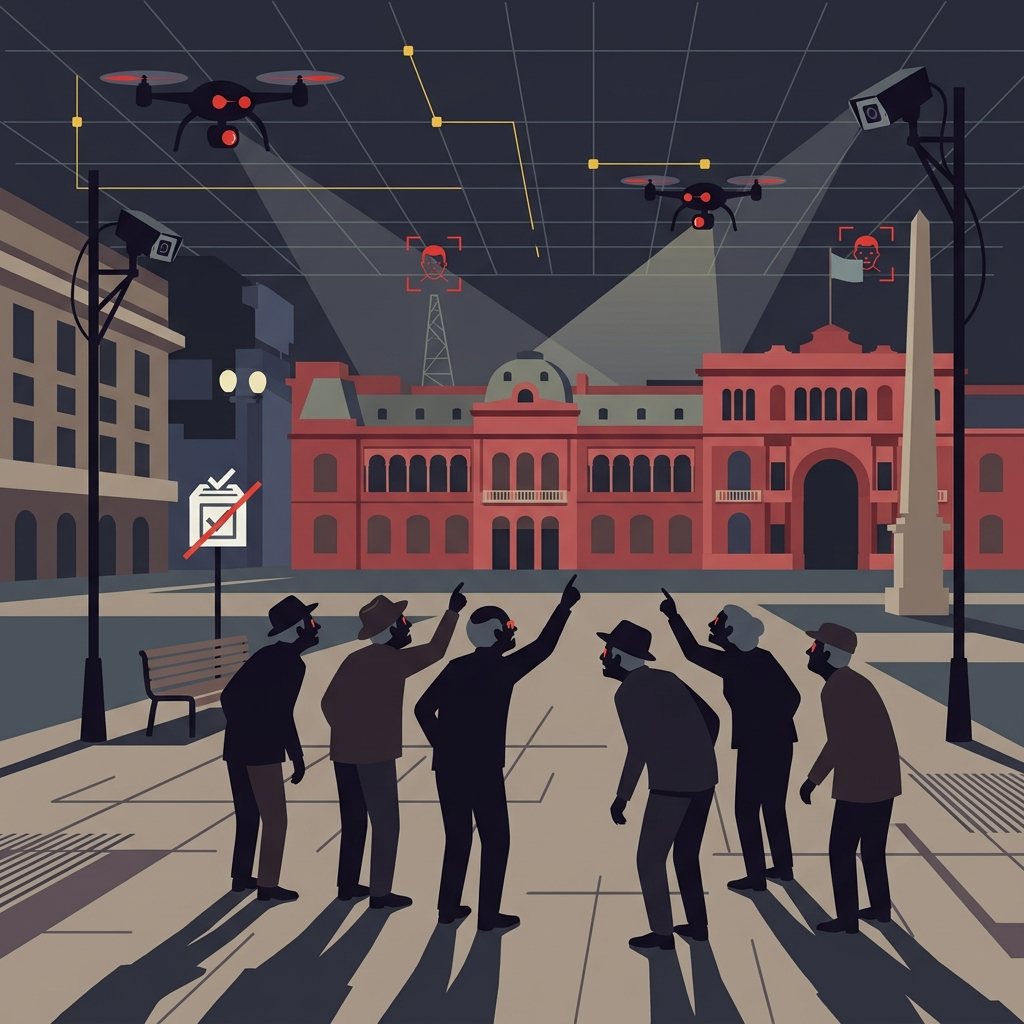
The message for readers beyond Argentina is this: watch this situation not because of Milei specifically, but because the cameras will still be running after Milei is gone. The drones do not carry political affiliations. What Argentina is building is not a historical peculiarity confined to one ideologically extreme administration — it is a template actively marketed to other governments by the same commercial actors who sold it to Buenos Aires. The EU AI Act threatens fines of up to €35 million or 7% of global annual revenue for violations of its biometric surveillance prohibitions, but its jurisdiction ends at the EU's external borders. Beyond those borders, in the absence of coordinated international governance, surveillance expands quietly and incrementally, one procurement contract at a time. The drone that hovered within six feet of an elderly pension protester in Buenos Aires is not an aberration. It is the first draft of what surveillance in democracies will look like everywhere.
Sources / References
- "Sensing the Surveillance State": Argentina's Unchecked AI-Driven Surveillance and Techno-Authoritarian Infrastructure of Social Control — Amnesty International
- Amnesty International Decries Argentina's Expanding AI Surveillance as Tool of Social Control, Resolution 710/2024 and UIAAS Legal Framework Analysis — JURIST
- Amnesty International Exposes Argentina's Growing Surveillance State: Maltego, Journalist Testimonies, Peter Thiel Connection — Common Dreams
- Argentina: Freedom in the World 2025 — Press Freedom Score Decline and Democratic Indicators — Freedom House
- Argentina Recorded Lowest Homicide Rate on Record in 2025: Crime Statistics and the 90/10 Plan — Buenos Aires Times
- SIDE: The State Repurposed for Domestic Surveillance — DNU 941/2025 Analysis and Constitutional Challenge — CELS
- How Clearview AI Expanded Across Latin America: Five Countries and Growing — Time