
Politicians Who Couldn't Touch Big Tech Went After the Kids Instead
Summary
Social media bans targeting teenagers under 16 have spread to more than 16 countries simultaneously — beginning with Australia's landmark December 2025 legislation — despite a complete absence of peer-reviewed experiments demonstrating their effectiveness for this age group. A study published in Frontiers in Developmental Psychology in May 2026 found not a single controlled trial examining social media restrictions for users under 16, and 40 percent of existing adult-focused studies reported harmful outcomes, including increased loneliness and reduced life satisfaction, from platform restrictions. Australia's six-month enforcement record is strikingly bleak: 78 percent of banned teenagers continue accessing Instagram and TikTok via VPNs, borrowed parental Face IDs, and freshly created accounts. Rather than regulating the addictive platform design — infinite scroll, autoplay, algorithmic dopamine loops — engineered by Big Tech, these bans expel the very victims of that design from the platforms while leaving the machinery completely intact. This article argues that the synchronized global wave of teen social media legislation is the cheapest form of political self-congratulation available to lawmakers unwilling to confront the trillion-dollar industry actually responsible for the harm.
Key Points
Zero Experiments — 16 Countries Passed Bans Without a Single Controlled Trial
The May 2026 Frontiers in Developmental Psychology study delivered a finding that should have halted this legislative wave before it gained momentum: after a systematic review of global scientific literature, researchers confirmed there is not a single peer-reviewed controlled experiment examining the effects of social media restriction on users under 16. Not sparse evidence — zero evidence, anywhere in the academic record. What makes this more damaging is the picture from existing adult-focused studies: 40 percent found that social media restrictions produced harmful outcomes, including increased loneliness, diminished social connectedness, and reduced life satisfaction among participants. Despite this evidentiary void, bans have swept from Australia to France, Indonesia, Brazil, Greece, Norway, Denmark, Austria, the United Kingdom, and beyond, affecting hundreds of millions of teenagers across wildly different cultural contexts. This represents one of the most significant collapses of evidence-based policymaking in modern democratic history — a case where collective moral anxiety moved faster than the scientific method by a wide margin. The pattern echoes the 1950s comic book panic, where a single unverified book drove congressional hearings and mass censorship; the difference now is that not even a contested book exists to provide the justification for what 16 governments have done.
Australia's Six-Month Report Card — The Brutal Reality of 78% Circumvention
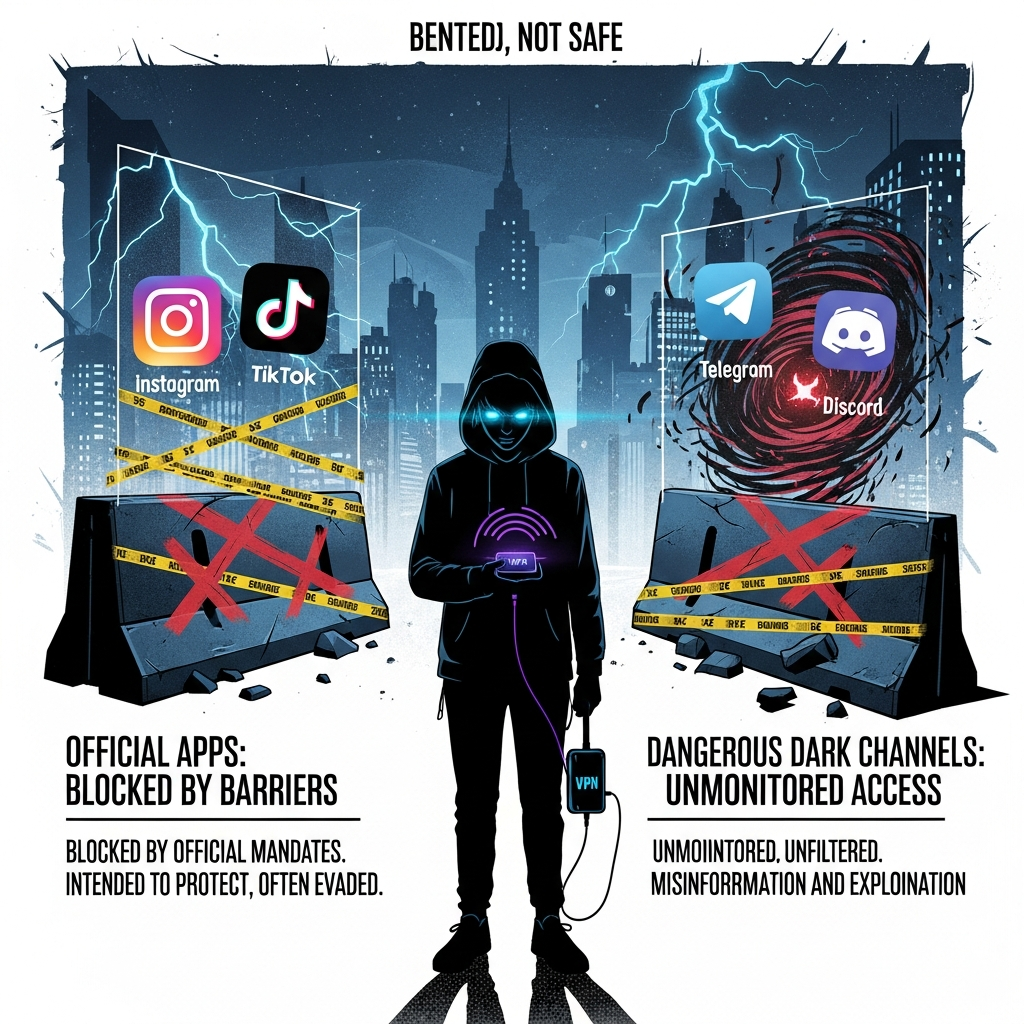
Australia's enforcement results, six months after the world's first under-16 social media ban took effect, constitute the strongest available empirical argument against this entire policy approach. According to Mi-3 Media's June 2026 reporting, 78 percent of the targeted teenagers are still accessing Instagram and TikTok — through VPNs, parental biometric borrowing, commercially purchased face masks designed to defeat age verification technology, and the straightforward creation of new accounts. Meta deleted more than 4.7 million Australian teen accounts, a figure that looks decisive until you understand those teens were back online with fresh profiles in under five minutes. Fortune's analysis concluded that blocking digital natives from the internet is structurally comparable to trying to hold back a tide — the effort is real but the outcome is predetermined by physics. The 78 percent figure isn't merely a statistic; it's evidence that technical enforcement of a blanket ban on a generation that has never known life without the internet is not achievable through the tools any democratic government currently possesses. More troubling still is the question of what happens in the 22 percent of apparent "successes" — those teens aren't necessarily going offline; they're finding their way into unregulated spaces where no one is monitoring what happens to them.
Wrong Target — The Law Punishes Kids for What the Platforms Built
UN High Commissioner for Human Rights Volker Türk stated plainly in May 2026 that the root cause of social media harm is platform design, not the users themselves. Infinite scroll, autoplay video, algorithmic engagement maximization, push notification saturation — these features are deliberately engineered to override users' intention to stop, and they produce compulsive usage patterns in adults and children alike regardless of age. Yet the legislation in 15 of the 16 countries targeting teens doesn't regulate any of these design choices; the machines are left running exactly as their engineers intended them to run. Instead of confronting the design, these laws remove the most vulnerable users from the platform while leaving the addiction-generating mechanisms fully operational. Brazil stands as the meaningful exception, having included a ban on infinite scroll for minors alongside its age restriction — making it the only country so far to actually regulate the machine rather than expel its victims. This is the structural flaw at the core of the entire legislative wave: it addresses the symptom while leaving the cause untouched. Big Tech's lobbying apparatus spent years ensuring algorithmic regulation would stay off the table, and age-restriction bans emerged as the politically convenient alternative that requires no confrontation with trillion-dollar companies.
The Global Transmission of a Moral Panic — What 16 Countries Responding Identically Tells Us
The truly remarkable and troubling feature of this legislative wave is how simultaneous it is: countries with radically different political systems, cultural norms, and governance philosophies all produced the same regulatory response within roughly six months of each other. Conservative Australian government, centrist French administration, Islamic-democratic Indonesia, left-wing Brazil — identical prescription emerging from each of them. When actors this fundamentally different respond identically to the same stimulus, the most plausible explanation is not that overwhelming independent evidence produced independent convergence. It's that a contagious fear response spread globally, amplified by the very social media platforms whose perceived harms prompted the response in the first place. TechCrunch's tracker shows the spread from Australia's passage to 16-plus-country adoption took just six months — faster than any scientific consensus has ever formed on a complex social phenomenon. Historically, moral panics about new media follow a consistent arc: acute public alarm, sweeping legislation passed without adequate deliberation, subsequent recognition of overreach, and gradual policy reversal. The 1950s comic book panic and 1990s video game violence scare both ended with science dismissing the alarm — social media may genuinely present new challenges, but the political response looks disturbingly similar to those earlier overreactions.
The Unintended Worst Outcome — Bans Push Kids Into Completely Unprotected Spaces
The most dangerous unintended consequence of these bans is hiding in plain sight within the bypass statistics: the teens who circumvent restrictions don't stay where they were — they migrate to platforms and spaces with far weaker safeguards than the mainstream platforms they left. Instagram and TikTok have real and serious problems, but they also have content reporting systems, parental supervision tools, cyberbullying detection algorithms, and age-appropriate content filters — imperfect protections, but protections that function at global scale nonetheless. When a ban drives teenagers toward private Telegram channels, anonymous Discord servers, or dark web forums, none of those protections follow them into those environments. Early Australian data shows Tor browser and ProtonVPN downloads among under-15 users increased 340 percent year-over-year after the ban took effect, suggesting the migration is already underway at meaningful scale. The 371 privacy and security experts who signed the March 2026 open letter flagged an additional dimension: facial recognition age-verification systems show error rates up to 35 percent higher for non-white teenagers, meaning the displacement effect falls disproportionately on already-marginalized youth. These bans haven't protected children from the internet — they've pushed children into the parts of the internet where protection is entirely absent.
Positive & Negative Analysis
Positive Aspects
- Child Online Safety Is Now a Top-Tier Global Policy Issue
The legislation's most valuable achievement — independent of whether the bans themselves function as intended — is that it transformed child online safety from a private family concern into a front-rank global governance priority. Two years ago, policymakers across most of the world treated teen social media use as an individual parenting matter handled at home. Today, the UN High Commissioner for Human Rights is issuing formal statements, the WHO is reviewing guidelines, and the OECD is revising its child digital environment framework in direct response to the pressure this debate has created. This escalation of institutional attention creates the political conditions for more targeted, evidence-based interventions that would never have gained traction in the previous low-salience environment. The OECD is expected to publish a revised child digital environment guideline in the second half of 2026 specifically because of momentum from this debate. If the resulting attention gets channeled toward design regulation and education — the approaches that evidence actually supports — the current wave of flawed bans will have served as a costly but necessary catalyst for something genuinely better.
- Big Tech Moved Faster on Teen Protections Under Coordinated Regulatory Pressure
While the bans didn't directly regulate platform algorithms, the unprecedented spectacle of 16 governments simultaneously reaching for legislation appears to have meaningfully accelerated self-regulatory actions from Big Tech companies. Meta expanded Instagram's teen protection mode to 36 countries immediately after Australia's law came into effect, shifted teen accounts to private by default, and added notification suppression after 10 p.m. TikTok introduced a default 60-minute daily usage cap for users under 18 and blocked direct messaging for users under 16. Snapchat removed algorithmic content recommendations from accounts under 13. Big Tech insists these changes were already in development regardless, but the timing — 16 nations pulling out legal tools simultaneously — is genuinely difficult to dismiss as coincidence. The broader lesson here is significant: even a poorly designed regulation can produce real behavioral change from industry when the threat is credible and sufficiently coordinated. Direct regulation may have failed to reach the platforms' core mechanics, but the credible threat of regulation created indirect pressure that produced real-world value for teen users.
- Family Conversations About Digital Life Increased Substantially
An underappreciated positive side effect of the legislative debate is the surge in parent-child conversations about social media that it appears to have triggered across multiple countries. Australia's Institute of Family Studies found in April 2026 that 67 percent of parents reported talking with their children about social media more frequently since the ban took effect. This matters because research consistently finds that open parental dialogue about digital habits is one of the most reliable predictors of healthy adolescent online behavior — more effective, in many studies, than any technical restriction government or platform can impose. Finland's experience makes this concrete: without any platform ban, Finland achieves EU-leading youth online safety metrics primarily through family dialogue programs and school media literacy education. If the ban's greatest lasting legacy proves to be that it normalized and amplified conversations between parents and children about digital life, that's a genuine achievement even if the ban itself ultimately fails as an enforcement mechanism. Technology can be circumvented in minutes; a parent-child relationship built on open communication about digital habits is considerably harder to route around.
- Brazil's Design Regulation Model Offers a Superior Blueprint
One undervalued positive outcome of the legislative wave is that it has elevated a genuinely better policy model into global policy discussions: regulating addictive platform design rather than controlling user access. Brazil's law, implemented in March 2026, included not just an age restriction but an outright ban on infinite scroll for minors — making it the first country in the world to directly target a feature specifically engineered to override users' intent to stop using a platform. This distinction is now being discussed in policy circles internationally as a potential global benchmark worth replicating. The EU's Digital Services Act framework is developing detailed prohibitions on manipulative design practices for users under 18, with completion expected by 2027. Without the political pressure created by this ban wave, it's doubtful these more sophisticated regulatory approaches would have reached their current level of urgency and institutional attention. Sometimes a flawed intervention is most valuable precisely because its failure forces a more rigorous search for better alternatives — and that dynamic appears clearly in motion here.
- Digital Literacy Education Has Received a Significant Global Policy Push
Perhaps the most durable positive consequence of the ban wave is the attention and political resources now being directed toward digital literacy education in school systems worldwide. Australia is simultaneously advancing a school curriculum enhancement bill alongside its access restriction law. Norway announced plans to make media literacy mandatory from the third grade starting in 2027. The United Kingdom is considering significant expansion of digital safety content within its PSHE curriculum framework. These educational investments are categorically more effective as long-term protective mechanisms than access restrictions, a conclusion backed by Finland's and Estonia's consistently superior youth safety outcomes. Estonia's results are particularly compelling: teaching digital citizenship from the first grade has produced Europe's lowest adolescent cyberbullying rates, achieved entirely without platform bans or age-restriction legislation. The critical question is whether this educational push will outlast the political moment that generated it — but if it does, it will prove to be the most meaningful and lasting contribution the ban wave makes to children's actual safety online.
Concerns
- Bans Drive Teens Into Unmonitored, Completely Unprotected Digital Spaces
The gravest unintended consequence of these bans is the documented migration of teenagers from imperfect-but-monitored platforms to genuinely unprotected and unregulated spaces. Instagram and TikTok maintain content reporting mechanisms, parental control tools, cyberbullying detection systems, and age-appropriate algorithmic filters — imperfect safeguards, but real protections that operate at global scale across billions of daily users. When bans push teenagers toward private Telegram channels, anonymous Discord servers, and dark web forums, every one of those protections vanishes entirely. Early Australian data is deeply concerning: Tor browser and ProtonVPN downloads among under-15 users rose 340 percent year-over-year after the ban took effect, indicating the displacement is already happening at a significant and measurable scale. The risk of grooming, exploitation, and exposure to genuinely harmful content in unregulated digital environments is categorically — not marginally — higher than on mainstream platforms that, whatever their flaws, have compliance teams and reporting infrastructure. These bans have not removed children from digital danger; they've relocated the danger to somewhere parents and platforms can no longer observe it, which is worse by every meaningful measure of child safety.
- Age Verification Systems Are Constructing a Biometric Surveillance Infrastructure
The enforcement mechanisms required to make these bans operationally effective represent an independent and compounding privacy crisis that deserves separate attention. As 371 privacy and security experts warned in their March 2026 open letter, facial recognition age verification shows error rates up to 35 percent higher for non-white teenagers, embedding structural racial discrimination into the architecture of systems nominally designed to protect children. Beyond the discrimination problem, requiring every internet user to submit to biometric scanning or government document verification before accessing platforms is functionally equivalent to constructing a global surveillance infrastructure under the rhetorical cover of child protection. In countries with weak press freedom records — Turkey, Egypt, and Indonesia, all of which are implementing these bans — that infrastructure could readily be repurposed for monitoring political dissidents, journalists, and civil society actors. The data security implications of collecting facial biometrics at global internet scale are severe in ways qualitatively different from a password breach: a leaked face scan cannot be changed, revoked, or reset. The risks being created by age-verification mandates may well exceed in magnitude and permanence the risks they were designed to prevent.
- The Bans Divert Critical Attention Away From Actual Platform Regulation
The most strategically damaging consequence of the age-restriction approach is the political attention and capital it consumes that could otherwise be directed at the actual root cause of harm. Regulating platform design — prohibiting infinite scroll, requiring algorithmic transparency audits, banning engagement-maximizing features for minors — is genuinely difficult work that requires confronting Big Tech's lobbying apparatus and building technically sophisticated oversight frameworks. Banning teenagers, by contrast, is quick, fast to implement, and politically rewarding in the short term, which makes it the default choice when political will is available but limited. While lawmakers announce victories in child protection and pivot to the next political issue, algorithm regulation bills continue to stall in committee across most of the 16 countries that have enacted access restrictions. With the partial exception of the EU's Digital Services Act, meaningful root-cause regulatory work has been deprioritized in every nation that chose the access-restriction route. Every year spent defending an unenforceable ban is a year not spent constructing the regulatory infrastructure that could actually change how these platforms design their products and target their most vulnerable users.
- The Bans Deepen Digital Inequality Along Class and Racial Lines
These laws appear on paper to treat all teenagers equally, but their real-world effects are deeply and predictably stratified by socioeconomic status and race. Teenagers from middle- and upper-income households with high digital literacy can circumvent these bans with minimal friction: commercial VPNs, parental biometric access, and new account creation are all trivially accessible to anyone with adequate resources and knowledge. Teenagers from lower-income households with limited digital access and literacy are meaningfully more likely to actually be denied platform access — precisely the teenagers for whom social media often functions as a critical conduit for educational content, peer support networks, and mental health help-seeking during crises. Additionally, the documented error-rate disparities in facial recognition age-verification technology mean non-white teenagers systematically encounter more false rejections, making the discrimination structural rather than incidental to implementation. Blocking access for the most vulnerable teens amplifies their existing disadvantages rather than equalizing protections across socioeconomic lines. These bans, framed as universal child protections, function in practice as instruments that concentrate digital disadvantage on those already facing the most significant barriers to opportunity.
- Science-Free Lawmaking Sets a Dangerous Precedent for Democratic Governance
The deepest long-term risk posed by these bans may be the democratic precedent they establish in policy: that sufficient public fear justifies restricting fundamental rights — digital access, free expression, privacy — without scientific evidence that the restriction will be effective or proportionate. Sixteen nations have enacted sweeping restrictions on minors' digital lives with less empirical support than regulatory agencies require to approve a new antihistamine formulation for the market. As the Frontiers research team noted explicitly, governments are implementing bans without even designing studies to measure the bans' effects — a fundamental inversion of the scientific method's appropriate role in public policy under conditions of uncertainty. If this precedent holds and proves politically rewarding, the template becomes available for any future technology that generates comparable public anxiety: AI-generated content, gene-editing applications, autonomous vehicles, neural interface technologies. The pattern of "fear constitutes sufficient justification for restriction" could prove far more damaging over time than any of the specific harms these bans were designed to address. Democratic societies have built hard-won institutional norms around evidence-based governance over decades; this wave of legislation applies serious, sustained strain to those norms at precisely the moment they face pressure from multiple directions simultaneously.
Outlook
Within the next six months, I expect more than half of the pending legislation across the 16-plus countries to pass in some form. Greece has already announced a January 2027 implementation date. Norway is preparing its bill for submission before year's end. Austria is targeting a June draft completion. The United Kingdom is actively considering an Australian-style blanket ban, and a formal bill could emerge before 2026 closes. What concerns me more than the passage rates is the widening gap between how quickly these laws pass and how slowly they demonstrate any measurable effect. The 78 percent bypass rate in Australia isn't an Australian peculiarity — Indonesia has higher baseline VPN usage than Australia, and French teenagers are no less digitally capable. My prediction: by the end of 2026, four or five more countries will have active bans in place, while comparative data accumulates to show unmistakably that "a net full of holes" is the accurate description of every single one of them.
The scientific community's counteroffensive will intensify in the near term, and this is where the politics get genuinely interesting. The Frontiers study was an opening salvo, not a final judgment. I expect at least three or four major meta-analyses to be published in the second half of 2026, drawing on ongoing work at the Oxford Internet Institute, MIT Media Lab, and Stanford's Human-Centered AI group. If these studies reinforce the finding that restrictions produce null or harmful results, they will land at precisely the moment Australia releases its official one-year performance assessment in December 2026. How the Australian government frames the 78 percent number — "early implementation challenges" versus "fundamental design failure" — will shape the international conversation for years. Either framing concedes the law's limitations. I expect formal review or amendment discussions to begin in at least two or three countries by mid-2027, and the political cover for that will come directly from the accumulating scientific literature.
Looking at 2027 to 2028, I believe the fundamental shift will move from blanket age bans toward platform design regulation. Brazil has already demonstrated what the distinction looks like in practice: banning infinite scroll for minors is categorically different from banning minors from platforms. This is what I'd call regulatory evolution — "Ban 2.0" — and I think it will become the dominant framework within two years. The EU's Digital Services Act is already developing detailed prohibitions on manipulative design practices for users under 18, with completion expected by 2027. If DSA provisions achieve de facto global standard status — as EU digital regulations often do — this transition could accelerate considerably. My forecast: by 2028, at least 60 percent of the countries currently operating age-restriction bans will either supplement them with design regulations or replace the bans entirely. Politicians aren't irrational actors. Defending a law with a 78 percent bypass rate is politically untenable. Upgrading to "smarter regulation" gives governments an exit ramp without requiring an explicit admission of failure, and most will take it.
The age-verification privacy battle will become the fiercest medium-term policy contest, and I'm confident it will produce at least one landmark legal ruling. Most current laws sidestep the implementation question entirely — they require platforms to verify user ages without specifying how, leaving platforms to choose between facial recognition, document verification, and parental consent, each of which has documented severe problems. Facial recognition shows error rates up to 35 percent higher for non-white teenagers, embedding structural discrimination. Document verification requires collecting minors' government IDs at scale, creating data security exposure of a different magnitude. Parental consent is trivially bypassable, as the 78 percent figure already proves. No currently available method resolves these contradictions, as the 371 experts' letter made explicit. I expect at least one major constitutional or human rights ruling — from the European Court of Human Rights or Australia's Federal Court — to directly address age-verification legality before the end of 2027. Big Tech will exploit the resulting ambiguity by positioning proprietary verification solutions as the only viable privacy-preserving option, and that move will generate its own antitrust controversy.
Looking further out, to 2028 through 2030, I believe the decisive contest will be between two competing paradigms: digital prohibition versus digital literacy. The evidence for the literacy approach already exists and is genuinely compelling. Finland, Estonia, and Singapore — none of which have social media bans — consistently rank among the world's leaders on youth online safety metrics. Estonia teaches digital citizenship from the first grade and has Europe's lowest adolescent cyberbullying rates. Finland achieves top-tier outcomes primarily through media literacy programs and family dialogue, with no platform ban required. As this comparative data accumulates, the case for education over restriction will become increasingly difficult to argue against. My prediction: by 2030, at least 75 percent of OECD nations will have incorporated digital literacy into primary school curricula as mandatory coursework. In retrospect, the current wave of bans will most likely be categorized as the "mid-2020s moral panic" — filed alongside the 1950s comic book scare and the 1990s video game violence panic, both of which are now understood as dramatic overreactions that produced regrettable legislation.
The longer-term transformation I find most intriguing is the structural change these pressures will force on the platforms themselves. Current social media architecture is essentially single-tier: every age group exposed to the same algorithm, the same interface, the same advertising logic. As minor-protection requirements intensify globally, platforms will face mounting legal pressure to develop genuinely distinct experiences for different age cohorts. Meta has reportedly been considering separate Instagram environments for 10-to-12-year-olds and 13-to-17-year-olds. YouTube Kids already partially implements this model. My forecast: by 2028 to 2030, major platforms will face legal requirements to maintain separate minor ecosystems with fundamentally different algorithmic logic and advertising rules. The financial implications are enormous — if targeted advertising to minors is prohibited, which follows logically from most current legislative trajectories, platforms will need to shift those users to subscription or parent-payment models. The global social media advertising market is worth roughly $250 billion; eliminating minors from the targeted-ad pool would force a restructuring of 15 to 20 percent of that market. This may be the unintended but most consequential long-term consequence of the entire legislative wave.
Let me lay out the scenario analysis explicitly. In the optimistic case — which I put at roughly 25 percent probability — Australia's December 2026 official data, combined with a wave of scientific meta-analyses, triggers a rapid global paradigm shift toward design regulation and digital education. Accelerated by DSA enforcement, more than half of G20 countries adopt algorithmic transparency requirements by 2028, and age-restriction bans are effectively abandoned as outdated policy. In the base case — which I give 50 percent odds — bans and design regulation coexist uncomfortably for two to three years. Age restrictions are gradually relaxed as design regulations layer on top, with design regulation emerging as the dominant framework around 2029 or 2030. In the pessimistic case — 25 percent probability — a wave of high-profile child harm incidents hardens public opinion further, driving bans upward to age 18 and triggering real-name registration mandates. In this scenario, internet freedom and privacy suffer serious, durable setbacks, and authoritarian-style internet control finds unexpected political legitimacy in democratic countries.
I want to be honest about where I could be wrong. If a large-scale randomized controlled trial in the next two years finds that social media bans produce meaningful, sustained improvements in adolescent mental health, the scientific ground shifts and my analysis needs fundamental revision. Alternatively, if privacy-preserving age verification technology achieves near-perfect accuracy and reduces bypass rates below 10 percent, the enforcement-failure argument loses much of its force. For parents reading this: don't wait for the law to protect your kids. Start the conversation now — not "what are you watching?" but "why do you love this content?" That question opens a relationship no regulation can substitute for. For policymakers: study Brazil's design regulation model and Finland's education model seriously before defaulting to the Australian playbook that the data is already calling into question. For Big Tech: the window for voluntary, meaningful minor-protection redesign is narrowing fast. Genuine reform now will be far less costly than the mandatory restructuring that's coming if you wait for governments to force the issue — and they will.
Sources / References
- Frontiers in Developmental Psychology — "We Cannot Ban Our Way Out of a Youth Mental Health Crisis: Social Media Bans for Teenagers Lack Evidence and Pose Risks, Scientists Say" — Frontiers, May 29
- UN News — "UN Rights Chief Calls for Effective Regulation of Online Platforms to Protect Children" — UN News, May
- Mi-3 Media — "Australia's Social Media Ban Under 16s Faces Enforcement Challenges: 78% Still Access" — Mi-3 Media, June 4
- Fortune — "Australia's Social Media Ban Isn't Working: Teens Sidestepping Restrictions" — Fortune, April 25
- TechCrunch — "Social Media Bans for Children: A Country-by-Country List" — TechCrunch, April 23
- Jurist — "Indonesia Bans Social Media for Children Under 16" — Jurist, March
- Tech Policy Press — "Early Lessons From Australia's Teen Social Media Ban for the Rest of the World" — Tech Policy Press