
Finland Has Been the Happiest Country for Nine Straight Years — So Why Are American Teen Girls Living Through Their Most Miserable Era Ever?
Summary
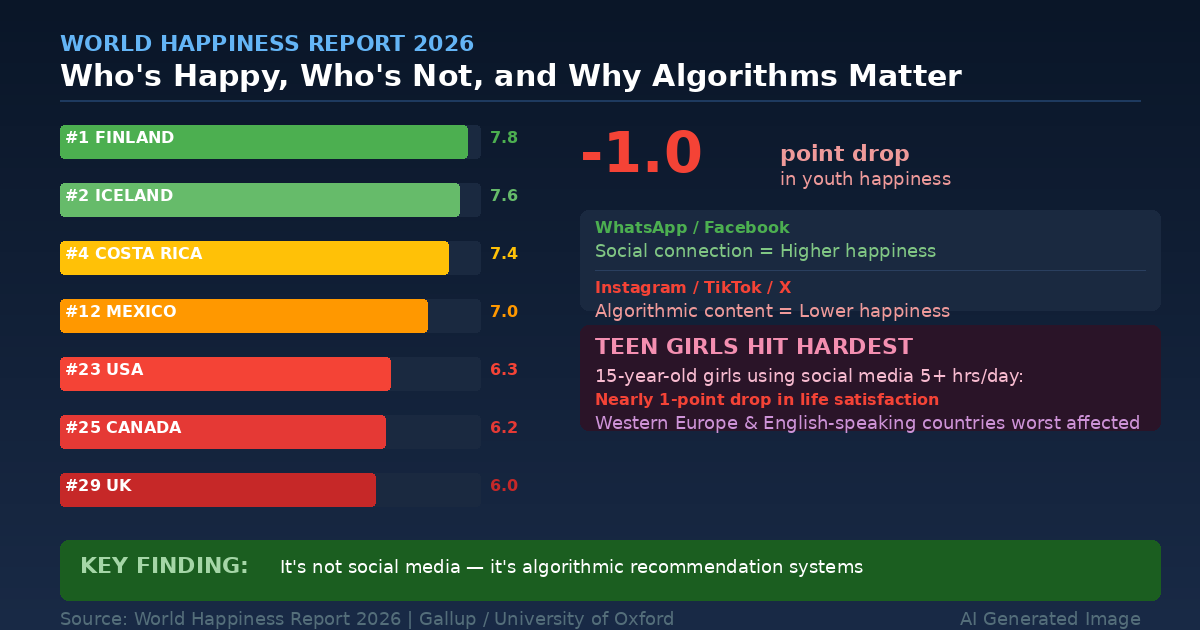
The 2026 World Happiness Report analyzed 147 countries and reached a startling conclusion: teenagers in wealthy nations are unhappier than those in poorer ones, and algorithms are widening the gap. Costa Rica made a historic entry into the top 5, while every English-speaking country dropped out of the top 10 for the second consecutive year.
Key Points
English-Speaking Youth Happiness Plummeted by 1 Point in a Decade
Life evaluations among people under 25 in the United States, Canada, Australia, and New Zealand have dropped by nearly a full point on a 0-to-10 scale over the past decade. This is a seismic statistical shift. During the same period, youth happiness in the rest of the world actually rose, creating a reversal where teenagers in the most prosperous societies are becoming unhappier than those in developing nations. The data shows material abundance does not guarantee happiness and that the digital environment may be a new source of misery.
Algorithmic Platforms Are Destroying Happiness
Analysis of 15-year-olds across 47 countries reveals that Instagram, TikTok, and X — platforms driven by algorithmically curated visual content — show significant correlations with declining happiness and rising mental health problems. In contrast, WhatsApp and Facebook, designed to facilitate social connections, show a clear positive correlation with life satisfaction. The three traits shared by the most harmful platforms are algorithmic feeds, influencer-centric ecosystems, and visual content dominance — a toxic cocktail that maximizes social comparison.
Teen Girls Bear the Deepest Scars
Across every region, 15-year-old girls report significantly lower life satisfaction than boys. When a 15-year-old girl in Western Europe uses social media for five or more hours a day, her life satisfaction drops by nearly a full point out of ten — almost twice the drop observed among girls in other regions. English-speaking countries are the birthplace of social media, and algorithms optimize addiction most efficiently in the language where they have the most data, making English-speaking teens the first test subjects of the most finely tuned algorithms on earth.
Costa Rica Historic Top 5 Entry — A Victory of Relationships Over GDP
Costa Rica climbed to 4th place, becoming the first Latin American country ever to enter the top 5. Mexico rocketed from 36th in 2022 to 12th. Costa Rica, whose per capita GDP is less than a quarter of America, outranks the US at 23rd, proving that strong family ties and social bonds exert a more powerful influence on happiness than economic prosperity. Costa Rica abolished its military in 1948 and redirected the budget to education and healthcare, a model now being re-examined worldwide.
Regulating Algorithm Design Matters More Than Blanket Bans
Australia banned social media for under-16s, France passed a ban for under-15s, Germany is pushing under-14 restrictions, and the US is advancing the Kids Off Social Media Act. However, the report data shows the problem is not social media itself but specific platform design choices. The real solution is forcing changes in platform design: deactivating algorithmic recommendations for minors, mandating usage-time warnings, and restricting features that encourage visual comparison such as public like counts.
Positive & Negative Analysis
Positive Aspects
- A Turning Point for Digital Wellbeing Research
The 2026 report introduces the digital environment as a new variable in happiness measurement, traditionally dominated by GDP and life expectancy. By proving differential impacts across platform types using data from 47 countries, it opens the possibility of adding Digital Environment Quality indicators to future happiness research and policy design. This goes beyond an academic finding to provide practical evidence for designing wellbeing policy in the digital age.
- Rise of Relationship-Centered Development Models
Costa Rica and Mexico's surge demonstrates that Silicon Valley-style technology-centered development is not the only path. The Costa Rica model — preserving social capital while adopting technology — offers an alternative development pathway for developing nations. The proposition that relationship quality rather than GDP determines happiness has been reconfirmed by data from 147 countries, enabling constructive criticism of growth-obsessed development paradigms.
- Scientific Basis for Platform-Specific Regulation
Regulating all social media uniformly is neither efficient nor fair. The report proves differential impacts between WhatsApp/Facebook versus Instagram/TikTok/X through data, providing a scientific foundation for precision regulation targeting the specific mechanism of algorithmic recommendation systems. This serves as a roadmap for tech companies to identify which features of their platforms are harmful.
- Early Warning System for Generational Happiness Gaps
The data on declining teen happiness provides a basis for predicting long-term impacts on labor productivity, birth rates, and social trust. This secures time for preemptive policy intervention and offers the opportunity to prepare for potential generational crises that could hit the 2030s.
Concerns
- Risk of Confusing Correlation with Causation
What the report shows is correlation, not causation. Depressed teenagers may use more social media rather than social media causing depression. Structural factors like economic inequality, housing crises, and student debt in English-speaking countries could be the real culprits. There is a risk of using social media as a convenient scapegoat while ignoring more fundamental socioeconomic problems.
- Potential Cultural Bias in Data
The report data may be primarily collected from OECD and Western-centric countries. Whether the different effects of social media in non-English-speaking countries reflect cultural differences or data gaps remains unclear. Explaining Finland happiness through saunas and forest walks is romantic but overlooks its high suicide rates and seasonal depression.
- Questionable Effectiveness of Age-Based Bans
Australia-style blanket bans and European age restrictions may not practically work against digital native generations who know how to use VPNs. As seen in alcohol and tobacco regulation, prohibition does not necessarily reduce consumption and can create underground economies. Without complementary digital literacy education, regulation alone has clear limits.
- Risk of Stifling Technology Innovation
Excessive regulation of algorithmic recommendation systems could chill technology innovation itself. Algorithmic recommendations are not purely harmful — they also serve positive functions like educational content discovery, exposure for minority creators, and interest-based community formation. Deactivating algorithms for minors could simultaneously reduce their access to valuable information opportunities.
Outlook
In the short term (the next 6 to 12 months), the 2026 World Happiness Report's social media data will serve as a decisive catalyst for youth social media regulation debates worldwide. Australia's under-16 ban is approaching its third month of enforcement, and the first efficacy analysis is due soon. Depending on those results, the legislative pace in the EU, Japan, South Korea, and other nations will either accelerate dramatically or stall. Meta has already begun pilot-testing the deactivation of algorithmic recommendations for teens in Europe, putting intense pressure on rival platforms. Google (YouTube), ByteDance (TikTok), and Elon Musk's X will all face heightened regulatory scrutiny if they fail to adopt similar measures.
In the United States, the federal Kids Off Social Media Act (KOSMA) has gained bipartisan support, and if Virginia's one-hour daily limit for minors begins to show positive results, other states will rapidly follow suit. In the UK, the detailed social media provisions of the Online Safety Act are set for enforcement in the second half of 2026. In the bull case scenario, a G7-level Algorithm Transparency Accord could enter negotiations by late 2026. In the base case, the EU's Digital Services Act enforcement intensifies, leading to the first major sanctions against Meta and TikTok. In the bear case, fragmented national regulations hand platforms regulatory arbitrage opportunities, and Australia's ban is rendered ineffective by widespread VPN usage among teens, fueling a narrative that regulation is futile.
Meanwhile, the market capitalization of social media companies will inevitably be affected. Meta's stock has already dropped over 3% following EU regulatory tightening news, and an accelerated exodus of teen users from Instagram and TikTok may be observed in the immediate aftermath of the report's release. Alternative platforms like BeReal and Discord — which are not driven by algorithmic feeds — could see significant growth as users seek non-algorithmic social experiences.
Over the medium term (1 to 2 years), the paradigm of happiness research itself could undergo a fundamental transformation. Until now, the field has focused primarily on macro-level national indicators such as GDP, life expectancy, and social support. But the 2026 report demonstrates that the digital environment, a new variable, can exert a more direct influence on individual happiness than national welfare levels. By the 2027 or 2028 report, we may see the introduction of a Digital Environment Quality Index that comprehensively measures daily screen time, algorithmic exposure hours, social comparison frequency, and the quality of digital connections.
The rise of Costa Rica and Mexico will strengthen the hypothesis that relationship-centered societies may have an inherent advantage over technology-centered societies in producing happiness. Costa Rica's case, in particular, could ignite new debates in international development. The fundamental question will be whether the digital transformation programs pushed by the World Bank and IMF truly contribute to the happiness of developing nations' citizens, or whether they actually erode social capital. Rather than blindly pursuing Silicon Valley-style digital transformation, a Costa Rica model that preserves social capital while adopting technology may emerge as a viable alternative.
Significant changes are also expected in education. There is a real possibility that the OECD's PISA assessments will add digital wellbeing literacy as a new measurement domain, and Finland and the Nordic countries' media literacy education models will be benchmarked worldwide. Finland already teaches critical media thinking from elementary school, and research may soon establish a connection between this educational approach and Finnish youth's comparatively higher happiness scores. Asian education leaders like South Korea, Japan, and Singapore will likely begin introducing digital wellbeing curricula as well.
Over the long term (2 to 5 years), the most fascinating and concerning question is this: when today's teenagers become adults, how will the algorithm-induced misery of their adolescence shape their lifetime happiness trajectories? Developmental psychology research shows that adolescent mental health has lasting, measurable effects on adult job satisfaction, relationship stability, and overall life satisfaction. As the Harvard Study of Adult Development has demonstrated over 85 years, the social relationship patterns and emotional health formed during adolescence are the single most powerful predictors of happiness at ages 50 and 60.
If current trends are not corrected, the English-speaking world could face its most unhappy generation of young adults by the early 2030s. This would send cascading shocks through labor productivity, birth rates, and social trust — metrics at the core of national competitiveness. According to McKinsey Global Institute estimates, the global economic cost of mental health problems already exceeds $5 trillion annually, and social media-driven mental health deterioration could push this figure beyond $7 trillion by 2030.
In the base case, regulation and platform self-improvement combine to slow the decline but not fully reverse it. Algorithmic recommendation restrictions for minors become law in most developed nations, and social media companies voluntarily introduce age-appropriate safety features. However, already-formed algorithmic addiction patterns do not dissolve easily, and social comparison habits persist even as today's teens become twenty-somethings.
In the bull case, technology becomes part of the solution rather than solely the problem. Happiness-optimizing algorithms emerge that block content recommendations harmful to users' mental health, and social media platforms introduce systems that monitor users' wellbeing indicators in real-time and automatically intervene when negative patterns are detected. Device manufacturers like Apple and Samsung strengthen digital wellbeing features at the operating system level, providing users with tools to control algorithmic feeds themselves.
In the bear case, next-generation social media combining AR/VR with generative AI amplifies algorithmic addictiveness tenfold. Meta's virtual reality social platforms and Apple Vision Pro's spatial computing create immersive social experiences with addiction mechanisms far more powerful than today's 2D scrolling. When AI-generated perfect virtual influencers become more appealing than real people, the object of social comparison shifts from other humans to idealized AI creations. In this scenario, the decline in youth happiness spreads from the English-speaking world to every corner of the globe, and even Latin America's relationship-centered societies lose their defensive advantage against digital penetration.
From a broader perspective, this report reveals a fundamental dilemma of 21st-century civilization. Humanity is living through its most connected era in history, yet the quality of those connections has not kept pace with their quantity. The connections created by social media are quantitatively explosive but qualitatively superficial and comparison-driven. What Finland's sauna culture and Costa Rica's family dining culture demonstrate is that a few deep relationships exert a far more powerful influence on happiness than thousands of shallow followers.
The two metrics to watch most closely over the next five years are: first, whether the happiness decline among under-25s in English-speaking countries can be reversed — if the downward trend continues through the 2028 report, it signals that algorithmic regulation alone cannot solve the problem and that structural social changes are needed; and second, whether the happiness gains in Costa Rica and Mexico can be sustained — if these countries also see declining happiness as social media penetration increases, it will serve as a warning that algorithms' destructive power can breach even cultural defenses. How these two indicators move will determine how humanity must redesign the relationship between technology and happiness.
Sources / References
- World Happiness Report 2026 — Gallup / University of Oxford
- World Happiness Report highlights social media's negative impact, ranks Finland as happiest country — NBC News
- Social media is harming adolescents at a scale large enough to cause changes at the population level — World Happiness Report Chapter 3
- World Happiness Report 2026 shows a complex global picture of social media and happiness — University of Oxford
- Canada slips further down in World Happiness rankings, due in part to social media use — CBC News
- Costa Rica ranked fourth happiest country — Semafor
- Countries are barring teens from social media — could the U.S. be next? — CNBC