
Society

Australia Kicked Everyone Under 16 Off Instagram — But Are Kids Actually Safer Now?
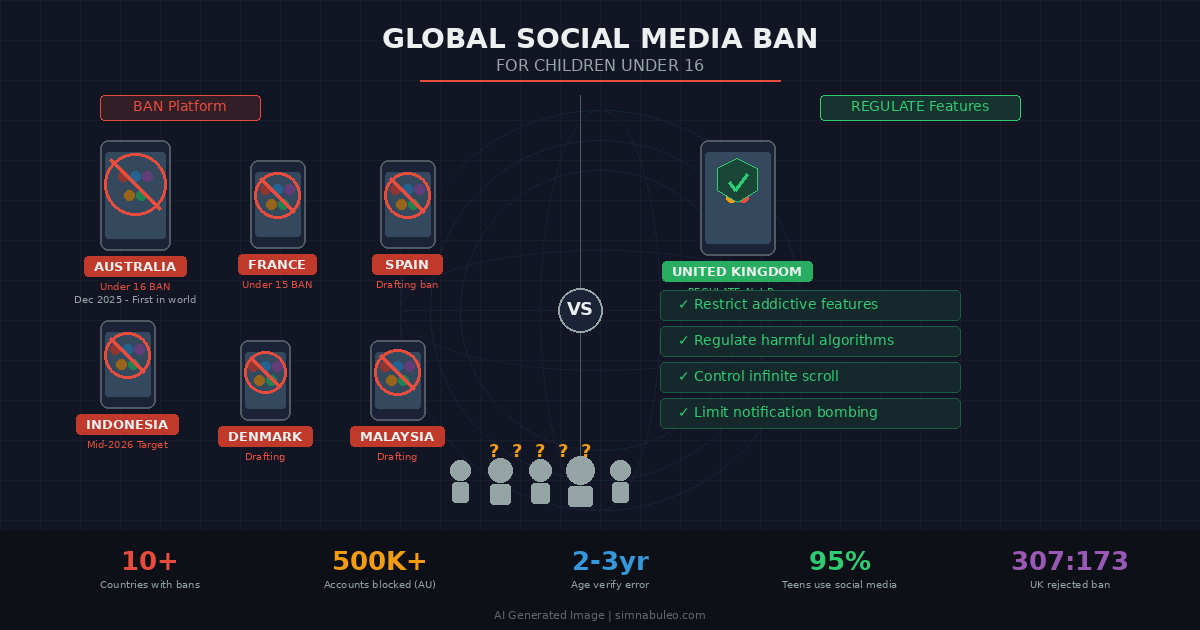
AI Generated Image - Global social media ban for children infographic showing BAN vs REGULATE approaches across countries
AI Generated Image - Global social media ban for children: BAN vs REGULATE approaches across countries

Summary

From Australia to the world, governments are banning children from social media — but the UK chose the opposite path

Key Points

1

Australia became the first country to ban social media for children under 16 in December 2025, with France, Indonesia, Spain, and 10+ countries following suit

2

The UK House of Commons rejected the ban 307-to-173, opting instead to regulate specific addictive platform features

3

Meta's facial age estimation technology shows a 2-3 year margin of error, identifying 11-year-olds as 30 and blocking legitimate users

4

Meta blocked over 500,000 underage accounts in Australia in the first month, but many teens have already found workarounds

5

Bans may create a water balloon effect, pushing children to unregulated platforms and dark-web-adjacent services with zero safety features

6

Biometric data collection for age verification poses new privacy threats, with Reddit filing a constitutional challenge in Australia

7

By 2027, over 70% of major developed nations are predicted to adopt selective harmful feature regulation rather than blanket bans

8

Age verification infrastructure built for social media bans could spread to gaming, streaming, and e-commerce, leading to an age-stratified internet

Positive & Negative Analysis

Positive Aspects

  • Elevated Big Tech Accountability

    After Australia's ban, Meta blocked 500K+ underage accounts and invested in age verification systems previously considered unthinkable. For the first time, companies are treating child protection as a top priority rather than just preaching self-regulation.

  • Practical Tool for Parents

    The legal ban provides parents with a clear starting point for discussing digital device usage with children. Australian schools report decreased smartphone-related conflicts since the ban took effect, showing the educational value of setting social baselines.

  • International Standards Formation

    Multiple countries testing different approaches simultaneously enables evidence-based policy development for children's digital rights. Combined with the EU AI Act, a comprehensive global framework for child online protection is taking shape.

  • Youth Mental Health Improvement Potential

    If bans and feature regulations work together effectively, meaningful improvements in youth mental health indicators could emerge by 2029. Child safety certification could become a new marketing tool for companies rebuilding parental trust.

Concerns

  • Water Balloon Effect and Circumvention

    Within two months of Australia's ban, many teens found workarounds. Children kicked off regulated platforms may migrate to small messenger services or dark-web-adjacent platforms with zero safety features, making the situation worse.

  • Privacy Invasion Risk

    Selfie-based facial recognition, government ID linkage, and biometric data collection are building surveillance infrastructure under the banner of child protection. A hack could leak identity information for tens of millions of children.

  • Deepening Digital Inequality

    Tech-savvy families easily circumvent bans via VPNs while less privileged children are excluded from the digital world. As social media serves as a channel for education and information access, bans could widen the digital divide.

  • Marginalized Youth Isolation

    For LGBTQ+ youth and marginalized teenagers, online communities may be their only lifeline for safe information and connection. Bans shut down these positive functions along with everything harmful.

  • Technical Limitations Exposed

    Meta's age estimation identifies 11-year-olds as 30 and blocks legitimate 16-year-old users. With a 2-3 year error margin, the technological feasibility of enforcement faces serious questions.

Outlook

In the immediate months ahead, this battlefield is going to get much hotter. France has committed to implementing its under-15 ban before the September school year, making summer 2026 a period of intense debate over implementation specifics across Europe. Indonesia is also targeting mid-2026 for legislation, potentially becoming the first large-scale Asian implementation. The key thing to watch is Australia's early data — the Australian eSafety Commissioner's six-month report, due in June 2026, will be a critical inflection point.

I predict this report will reach substantially skeptical conclusions about the ban's effectiveness. Given the technical limitations already exposed — facial recognition's two-to-three-year margin of error, widespread circumvention, migration to unregulated platforms — there's a strong probability the finding will be the ban was implemented, but the results are unclear. Reddit's constitutional challenge in Australia's High Court should also reach a decision in the second half of 2026, and if the court rules against the law, it would send a chilling signal to every country pursuing similar bans.

Looking one to two years out, the industry landscape will undergo major restructuring. The most likely scenario is a shift from total bans to feature-specific regulation. The UK has already chosen this path, and the EU is also moving toward individually regulating addictive platform design features — infinite scroll, autoplay, notification bombardment — in conjunction with its August 2026 AI Act implementation. My prediction is that by 2027, more than 70% of major developed nations will adopt a selective harmful feature regulation model rather than age-based blanket prohibition.

As this transition unfolds, Big Tech companies will inevitably adjust their strategies. Meta has already introduced youth-specific protected accounts on Instagram, and TikTok has made its 60-minute usage limit a default setting. By around 2027, we will likely see the emergence of an entirely new market category: children's social media. Just as Netflix separated kids profiles, social media will probably evolve into a dual structure with adult and children's versions.

Looking three to five years out, this debate expands into much more fundamental questions. What should the digital age of majority be? Currently, different countries use 15, 16, and 18, but by 2028-2029, discussions around an internationally unified digital age standard will likely emerge. The UN Committee on the Rights of the Child has already issued General Comment No. 25 on children's rights in the digital environment.

In the bull case scenario, Australia and France's experiments produce positive data and tech companies actively cooperate, leading to significant improvements in youth mental health indicators by 2029. The base case sees most ban laws implemented with limited effectiveness, countries converging on the UK model of feature-specific regulation. By 2028, major nations pass Harmful Algorithm Prohibition Act legislation, and the social media industry experiences approximately 15-20% revenue decline.

The bear case is genuinely worrying. Bans proliferate but technical enforcement fails, children migrate to far more dangerous platforms, and a biometric database gets hacked leaking identity information for tens of millions of children. The cause of child protection itself loses public credibility.

There are cascading effects being overlooked. Once age verification infrastructure is in place, it will likely spread to online gaming, streaming, and e-commerce, creating an age-stratified internet that clashes with foundational principles of openness and anonymity. Education systems will also need fundamental redesign, shifting from how to safely use social media to how to navigate the digital world without it. Finland has already made media literacy mandatory since 2025, and education may ultimately beat prohibition — though these effects take a generation to materialize.

Sources / References

Related Perspectives

Society

They've Been Handing Amazon the Bill for Six Years. The Response? A Record $77.7 Billion in Profit.

The Make Amazon Pay campaign has pressed Amazon for fair wages, tax justice, and environmental accountability at every Black Friday since 2020, with its seventh annual coordinated action scheduled from November 27 through Cyber Monday, November 30, 2026. A major milestone arrived in July 2026 when Italy became the first country anywhere to see Amazon sign a nationwide collective bargaining agreement — covering 57 facilities and including specific protections against disciplinary use of surveillance footage — as reported by the European Transport Workers' Federation (ETF). Yet in the same period, Amazon's FY2025 net income hit a record $77.7 billion, up 31 percent from the prior year per its SEC-filed 10-K, while CEO Andy Jassy publicly flagged approximately $200 billion in capital expenditure for 2026, the majority directed at AI and data centers. The tax battle is equally contentious: the Institute on Taxation and Economic Policy (ITEP) calculated Amazon's federal effective tax rate at just 1.4 percent for FY2025 and noted the real figure could be "closer to zero than the 1 percent tax rate we tabulate," while Amazon's own GAAP filings show a 19.6 percent effective rate — a methodological gap that makes the tax argument genuinely difficult to communicate to general audiences. An internal Amazon robotics document, obtained by the New York Times and re-reported by Computerworld, targeted the ability to "avoid hiring" more than 600,000 U.S. workers by 2033, though Amazon disputed the document as representing one team's view rather than company-wide strategy. The fundamental asymmetry between campaign momentum and Amazon's accelerating growth sets the defining paradox of this movement: Black Friday strikes build the narrative infrastructure needed for structural reform, but the levers most capable of fundamentally reshaping Amazon's behavior — global minimum tax enforcement and unified regulatory implementation — lie not on picket lines but at OECD negotiating tables and in national legislatures.

Society

Spain's First General Strike in 14 Years Puts Housing on the Labor Agenda

Spain's two largest unions, UGT and CCOO, are set to launch a 24-hour general strike on November 11, 2026 — the country's first nationwide work stoppage in 14 years — demanding housing rights and a wage that can actually cover rent. The forced eviction of an 87-year-old pensioner in Madrid sparked nationwide outrage, and Parliament then rejected two emergency housing decrees the Sánchez government submitted, with a snap election set for November 29 as the immediate political fallout. Eurostat's 2024 data places Spain's average age of leaving the parental home at 30.0 years, nearly four years above the EU average of 26.2, while Fotocasa surveys indicate renters are spending an average of 50% of their income on rent. Portugal, taking the opposite regulatory approach by easing rent rules, has still seen house prices more than double since 2017, exposing the regulation-versus-market binary as a false choice that misses the structural roots of the crisis. With Banco de España estimating a shortfall of 750,000 homes and an annual structural deficit of 40,000 households, no incoming government can close that gap within a single electoral cycle. Housing costs are functioning as a structural pipeline transferring income across generations, locking younger households out of asset formation entirely — and the question of how to dismantle that mechanism is one no election result can answer on its own.

Society

Why COP31's Climate Pledges Don't Come With Receipts

COP31 opens in Antalya, Türkiye on November 9, 2026, but the selection criteria and sponsorship amount for Koç Holding, one of its top sponsors, remain completely undisclosed — and both the UNFCCC Secretariat and the COP presidency declined to answer questions about the sponsorship arrangement. According to Transparency International, UNFCCC has no formal conflict-of-interest policy whatsoever, meaning there is no official procedure to scrutinize how corporate sponsor interests might influence negotiation outcomes. The UNEP Adaptation Gap Report 2025 estimates that developing nations need $310 billion to $365 billion annually for climate adaptation by 2035, against a 2023 actual flow of just $26 billion — needs that run 12 to 14 times current flows — while no binding implementation mechanism has been put in place to close it. The developed-country $100 billion annual climate finance pledge was delivered two years late per OECD data, and the "triple adaptation finance by 2035" commitment from COP30 lacks any defined baseline, making verification of compliance structurally impossible. This analysis argues that the COP system's most fundamental problem is not indifference to the climate crisis but its chronic inability to impose costs on the commitments it so efficiently generates — and that demanding receipts for climate pledges is not pessimism but the minimum condition for this system's long-term credibility.

Society

All Bans, No Evidence — The Global Paradox of Youth Social Media Prohibition

Youth social media bans are spreading from Australia to the UK, France, and Norway, yet mounting evidence suggests they may be delivering far less than promised. Australia, the first country to legally prohibit under-16s from social media, has seen a parental survey by the eSafety Commissioner — covering 898 parents of children aged 8 to 15 — find that around seven in ten parents whose child had an account before the ban still reported active accounts on Facebook, Instagram, Snapchat, and TikTok months later. Zero fines have been issued against the current maximum of AUD 49.5 million, and Prime Minister Albanese's announcement in June 2026 of a doubling to AUD 99 million has not changed that enforcement record. France passed a ban for under-15s only to have the Conseil constitutionnel strike down the core provision through Decision n° 2026-911 DC, ruling a blanket prohibition unconstitutional for violating freedom of expression and communication without proportionality. A May 2026 Frontiers in Developmental Psychology meta-analysis found that not a single social media restriction experiment has ever included anyone under sixteen, meaning every such ban is being enacted without direct experimental evidence for the specific age group targeted. The UK (targeting spring 2027) and Norway (planning to table its bill by the end of 2026) are pressing ahead regardless, while this analysis argues the global ban wave represents political narrative overriding scientific evidence, and that platform design reform — rather than outright access prohibition — is the more defensible and durable path to protecting young people online.

Society

The Nobel Peace Prize Can't Arrest Anyone — That's Exactly Why Navi Pillay's Win Hits Different

The 2026 Nobel Peace Prize has been awarded to South African international law scholar Navanethem "Navi" Pillay, recognized "for her efforts to promote peace and international law" — a decision that signals a deliberate redefinition of what peace itself means. The Norwegian Nobel Committee's choice frames peace not as the product of diplomatic compromise alone but as something that inherently requires legal accountability for those who commit atrocities. Pillay's career spans more than three decades, from defending anti-apartheid activists in apartheid South Africa to serving as a judge at the ICTR and the ICC, to currently sitting on the ICJ bench in the case where Myanmar stands accused of genocide. Her contribution to the landmark 1998 Akayesu judgment — the first genocide conviction by an international court — helped establish that rape and sexual violence can constitute crimes against humanity and genocide, permanently reshaping international criminal justice. The award was announced on the very same day that U.S. Secretary of State Marco Rubio unveiled sweeping new sanctions targeting the ICC as an institution, producing a historic collision between two fundamentally incompatible visions of global order. The convergence of that Nobel announcement and those sanctions on October 9, 2026 makes this one of the most politically consequential peace prizes in recent memory, and poses a foundational question: can international law hold the world's most powerful actors accountable, or does it ultimately yield to the logic of force?

SimNabuleo AI

AI Riffs on the World — AI perspectives at your fingertips

simcreatio [email protected]

Content on this site is based on AI analysis and is reviewed and processed by people, though some inaccuracies may occur.

© 2026 simcreatio(심크리티오), JAEKYEONG SIM(심재경)

enko