
59 Days That Rewrote Decades of Physics
Summary
Deep beneath the hills of Guangdong Province, China, a massive spherical detector has just pulled off one of the most stunning upsets in the history of particle physics. JUNO — the Jiangmen Underground Neutrino Observatory — collected just 59 days of data before surpassing the combined precision of decades of global neutrino experiments, publishing its results as the cover story of Nature in June 2026. The experiment achieved world-record precision on two critical neutrino oscillation parameters: sin²θ₁₂ uncertainty reduced by a factor of 1.6, and Δm²₂₁ reduced by 1.8-fold compared to all previous experiments combined. Built at a cost of approximately $300–350 million and involving more than 700 scientists from 75 institutions across 17 countries, JUNO signals both a paradigm shift in particle physics and a geopolitical realignment in who leads basic science. The ghost particles streaming through your body at this very moment may carry the answer to why anything exists at all, and for the first time in decades, the ground is genuinely shifting under the Standard Model's feet.
Key Points
59 Days of Data That Beat Decades of Global Experimentation
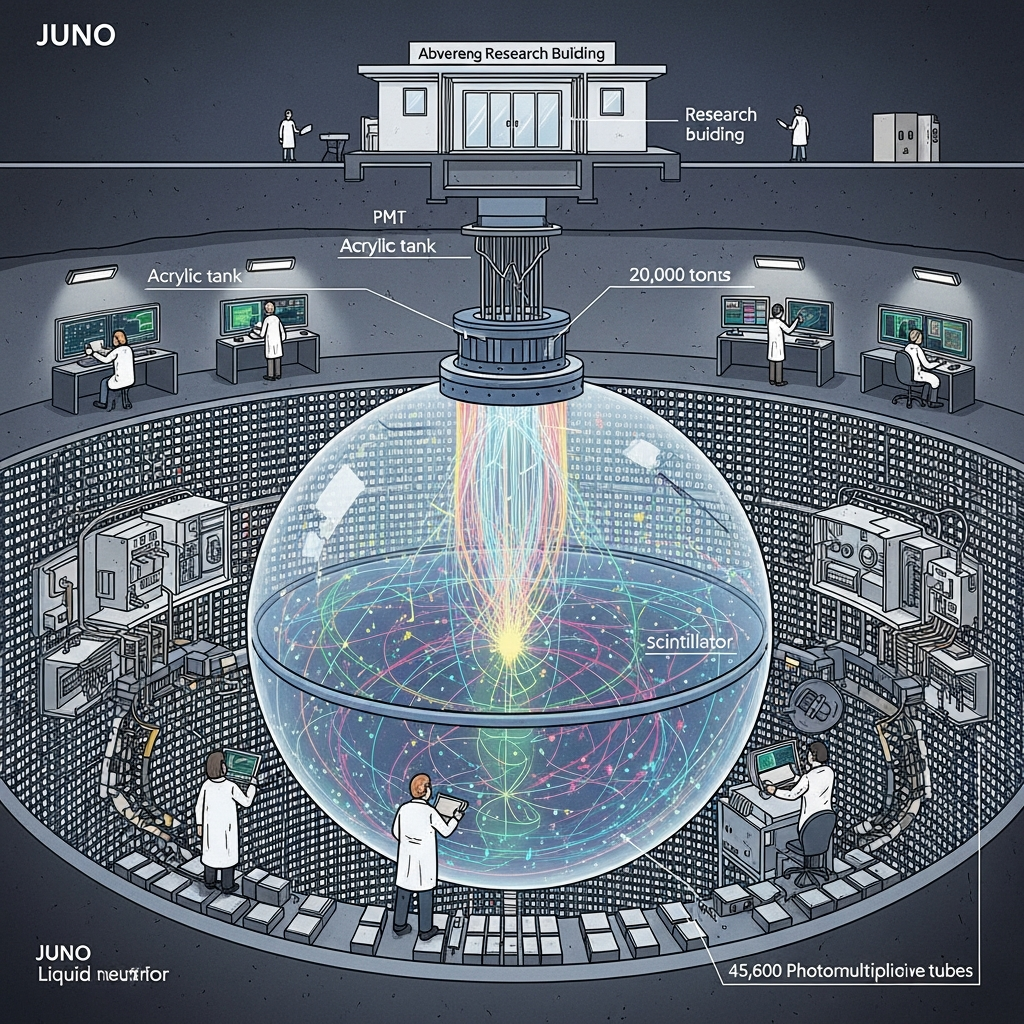
JUNO collected data for just 59 days — from August 26 to November 2, 2025 — and emerged from that short window with world-record precision on two of the most important parameters in neutrino physics. The experiment measured sin²θ₁₂ with an uncertainty 1.6 times smaller than the entire pre-existing global dataset combined, and Δm²₂₁ with an uncertainty 1.8 times smaller, surpassing the accumulated result of multiple experiments over many years of operation. UCI physicist Juan Pedro Ochoa-Ricoux confirmed this directly: "They have already achieved the world's best precision on both parameters." This result was published as the cover article of Nature's June 2026 issue, receiving the field's most prominent formal recognition. JUNO's detector design explains how this was possible: a 20,000-ton liquid scintillator sphere that is 20 times larger by mass than KamLAND and twice as efficient at photon detection as Super-Kamiokande, representing not an incremental upgrade but a generational redesign of what neutrino detection means at scale. As JUNO's event count continues to compound, the precision lead over prior experiments will grow substantially rather than plateau, and the "JUNO era" of neutrino physics is only just beginning.
The Crack in the Standard Model — What Neutrino Mass Actually Means
The Standard Model of particle physics is the most tested and successful physical theory in human history, predicting experimental outcomes across decades with extraordinary accuracy. But it predicted one thing that turned out to be fundamentally wrong: it assigned neutrinos a mass of exactly zero. When Takaaki Kajita and Arthur McDonald proved — in work honored by the 2015 Nobel Prize — that neutrinos oscillate between their three flavor types, they established that neutrinos must have nonzero mass, directly contradicting Standard Model predictions and exposing an incompleteness in the theory's foundations. JUNO was built specifically to probe the nature of that incompleteness, measuring the oscillation parameters that describe how neutrinos mix between their mass and flavor eigenstates with the highest precision ever achieved. The experiment has also surfaced a roughly 1.5-sigma tension between solar and reactor neutrino datasets, which — if it grows with additional data — could represent the first direct experimental signal of physics beyond the Standard Model, such as sterile neutrinos or non-standard interactions with other particles or fields. An arXiv study from 2025 explicitly frames neutrino mass as "the clearest evidence that the Standard Model is incomplete," and JUNO is the most sensitive instrument ever constructed to quantify exactly how and where that incompleteness manifests.
China's Basic Science Ascendancy: A Structural Turning Point
JUNO is managed by the Institute of High Energy Physics, part of the Chinese Academy of Sciences, with a construction cost of approximately $300–350 million — a substantial but strategically focused investment in fundamental science infrastructure. China's National Natural Science Foundation budget for 2026 reached 41.86 billion yuan (approximately $6.15 billion USD), a 6.09% year-on-year increase, with 81.71% of that budget specifically allocated to basic research rather than applied development. China's 15th Five-Year Plan (2026–2030) places science and technology self-sufficiency as a central national strategic objective, and JUNO is one of the clearest demonstrations of that strategy yielding internationally competitive results. Particle physics has historically been dominated by Europe's CERN and Japan's Super-Kamiokande and KamLAND — JUNO's first-result performance against both those benchmarks simultaneously is the output of deliberate, sustained investment, not a coincidence. That said, framing JUNO purely as a Chinese achievement misses its genuinely international character: 17 countries and 700-plus scientists contributed essential expertise. Science has no passport; scientific infrastructure does, and right now China holds the deed to the most precise neutrino detector on Earth, in the same way CERN held that position for Europe through the second half of the twentieth century.
The Cosmic Mystery That Neutrino Mass Hierarchy Could Unlock
Neutrinos exist in three types — electron, muon, and tau — and each has a different mass, but physicists still don't know which is heaviest. This is the "mass hierarchy" problem: Normal Ordering places the electron neutrino type as the lightest, while Inverted Ordering places it as the heaviest, and JUNO's primary long-term mission is to determine which picture is correct. The reason this determination matters so profoundly is its tight connection to the question of CP violation: why the Big Bang produced slightly more matter than antimatter, allowing everything in the universe — including us — to exist rather than annihilating back to pure energy. Independent analyses of JUNO's early data already show Normal Ordering preferred at 2.2–2.3 sigma, with Inverted Ordering's p-value falling below 2.57%, suggesting the early data is beginning to favor one answer. If JUNO confirms Normal Ordering, it constrains the parameter space for leptogenesis models that explain the baryon asymmetry of the universe, one of the most profound unsolved problems in cosmology. The mass hierarchy question is not an obscure technical detail — it is the experimental version of asking why there is something rather than nothing, approached with the most sensitive instrument in the history of neutrino physics.
The JUNO-DUNE-Hyper-K Triangle and the Architecture of Scientific Verification
The global neutrino physics landscape is defined by three major next-generation experiments that form an interlocking triangular verification structure. JUNO in China uses liquid scintillator technology and reactor antineutrinos; Hyper-Kamiokande in Japan, scheduled to begin operations in 2027, uses water Cherenkov technology and atmospheric and accelerator neutrinos; and DUNE in the United States, targeting a 2031 start, uses liquid argon technology and long-baseline accelerator neutrinos. Nature News & Views has explicitly noted that these three experiments "each bring different perspectives because they use different technologies and neutrino sources," which is the key point — completely different detector technologies mean completely different systematic uncertainties. This architectural diversity is not scientific competition but the most rigorous path to a 5-sigma discovery: independent experiments using fundamentally different physical mechanisms arriving at the same answer is the strongest form of verification particle physics can produce. JUNO holds the temporal advantage of being first, allowing it to establish initial constraints that DUNE and Hyper-K will independently confirm. Despite DUNE's budget exceeding $3 billion — roughly ten times JUNO's — JUNO's earlier start date gives it a multi-year head start in data accumulation that translates directly to scientific priority.
Positive & Negative Analysis
Positive Aspects
- Unprecedented Detector Engineering and World-Record Precision
JUNO's detector represents the most sophisticated liquid scintillator neutrino instrument ever built, combining massive scale with unprecedented precision in a configuration that has no direct precedent. The 20,000-ton liquid scintillator sphere is wrapped by 45,600 photomultiplier tubes, achieving roughly twice the photon detection efficiency of Super-Kamiokande while operating at 20 times the detector mass of KamLAND. The energy resolution target of 3%/√E has never been achieved at this scale before, and Nobel laureate Arthur McDonald specifically praised JUNO's "remarkable radioactive purity, energy resolution, and long-term detector stability" — praise that carries weight because McDonald helped define what precision neutrino detection could achieve. The fact that world-record parameter precision was validated within just 59 days of first operation demonstrates that the pre-deployment calibration and commissioning work was itself executed with extraordinary care and rigor. As data continues to accumulate, the precision advantages embedded in this detector design will compound, meaning JUNO's lead over prior experiments is likely to widen substantially rather than plateau at current levels.
- Living Proof That Science Can Still Cross Borders
In an era of intensifying US-China strategic competition and geopolitical fragmentation across multiple sectors, JUNO's international collaboration model stands out as something genuinely meaningful and worth preserving. Scientists from 17 nations — including countries with deeply complex and often adversarial diplomatic relationships — are jointly operating a detector 700 meters underground and publishing their results together in the world's premier scientific journals. INFN's Gioacchino Ranucci described the result as reflecting "the experience and expertise of researchers worldwide," which is accurate: technical contributions from Italian detector expertise, multinational calibration teams, and internationally distributed software development were essential to achieving the result, not cosmetic additions. This is what physics has historically been able to accomplish that almost nothing else can: create shared scientific purpose that transcends the political tensions of the moment, in the same way CERN served as a model of European scientific cooperation throughout the Cold War. The collaborative structure also produces better science through diverse theoretical frameworks, complementary experimental expertise, and the kind of distributed peer review that is built into the collaboration's architecture from the ground up.
- A Historic Payoff for Long-Term Investment in Basic Science
JUNO's $300–350 million price tag and 30-year scientific lifespan represent one of the clearest illustrations currently available of why sustained investment in basic research pays off in ways that applied research programs cannot replicate. The payoff follows a pattern familiar from physics history: Maxwell's discovery of electromagnetic waves was not designed to produce mobile communications, and the founders of quantum mechanics were not aiming at the semiconductor revolution. Basic science discoveries have an extraordinary and unreliable habit of enabling applications that were completely impossible to anticipate at the time of the original discovery. JUNO's 30-year lifespan means an entire generation of scientists can build their careers around a single instrument, creating deep institutional knowledge, mentorship chains, and compounding expertise that multiplies the human capital value of the construction investment. The detector also carries significant scientific multi-use potential — supernova neutrino detection, geo-neutrino studies of Earth's deep interior heat sources, and searches for neutrinoless double beta decay — that dramatically increases its scientific value per dollar invested.
- A Multipurpose Observatory With Far More Than One Job
JUNO was designed primarily to determine the neutrino mass hierarchy, but its physics program extends well beyond that single objective and makes it arguably the most scientifically versatile neutrino instrument ever built. When a nearby massive star explodes in a Type II supernova, JUNO could capture thousands of neutrinos simultaneously, providing a real-time window into the core collapse dynamics that no optical or radio telescope can match because neutrinos escape the stellar core before the shock wave does. Geo-neutrinos, emitted by radioactive decays deep within Earth's mantle and core, are detectable by JUNO and offer a probe of the planet's interior heat distribution that no drilling program or seismic survey can replicate. A future upgrade involving isotope loading of the liquid scintillator could enable a search for neutrinoless double beta decay, which would determine whether the neutrino is its own antiparticle and has direct implications for understanding the matter-antimatter asymmetry of the universe. This multipurpose character means JUNO delivers physics value across particle physics, astrophysics, and geophysics from a single construction investment, making it among the most cost-effective scientific facilities currently in operation anywhere in the world.
- A Gateway to Physics Beyond the Standard Model
Live Science described JUNO as a "portal to beyond-Standard-Model physics," and that framing captures something real about the experiment's scientific position. The Standard Model has been the dominant framework in particle physics since the 1970s, successfully predicting the W and Z bosons, the Higgs boson, and the behavior of quarks and leptons across decades of increasingly precise experiments. But since the Higgs discovery at CERN in 2012 confirmed the last major Standard Model prediction, particle physics has been searching for a new direction without finding one. JUNO's precision measurements directly constrain which theoretical extensions of the Standard Model remain viable, functioning as a real-time filter on the theoretical landscape. The solar-reactor tension in JUNO's early data may already be pointing toward one of those extensions, and if that tension is confirmed as a physical signal rather than a systematic effect, JUNO will have delivered the first confirmed evidence of physics beyond the Standard Model in the neutrino sector — a result that would fundamentally alter the theoretical landscape of particle physics and open the next era of fundamental science.
Concerns
- The Technical Uncertainty of Sustaining Long-Term Energy Resolution
JUNO's most demanding challenge is not building the detector to spec — it's sustaining that performance for decades across conditions that cannot be fully simulated in advance. The 3%/√E energy resolution target is already unprecedented at this scale, and MIT physicist Kate Scholberg has explicitly identified radioactive backgrounds and low-energy systematics as the major ongoing challenges to the experiment's long-term scientific program. Maintaining the required radioactive purity — keeping uranium, thorium, and carbon-14 contamination at the lowest levels ever achieved in a large-scale physics experiment — across 20,000 tons of liquid scintillator over 30 years has no real historical precedent to draw from. If detector performance degrades through photomultiplier tube aging, slow contamination diffusion into the scintillator, or systematic effects that emerge only on multi-year timescales, the mass hierarchy determination timeline could stretch from the projected six years to ten or fifteen years. This uncertainty doesn't invalidate the current world-record results, but it creates real and quantifiable risk for the long-term scientific program that the entire construction cost was predicated on delivering.
- US-China Geopolitical Tensions and the Risk to Scientific Collaboration
The triangular verification architecture of JUNO-DUNE-Hyper-K relies on international data-sharing and institutional cooperation that is not guaranteed under the current geopolitical climate, and this risk deserves direct acknowledgment rather than diplomatic minimization. US-China scientific collaboration has already come under political pressure across multiple domains, and if that pressure extends to JUNO-affiliated exchanges between American and Chinese research institutions, the independent cross-verification that the 5-sigma discovery standard requires becomes harder to deliver credibly. The history of CERN demonstrates that physics facilities can survive political tensions — Soviet and American scientists collaborated at Geneva throughout the Cold War — but the current decoupling pressures involve more systematic institutional mechanisms than episodic political crises. Western researchers' participation in JUNO could be chilled not by explicit prohibition but by funding restrictions, visa complications, data-sharing agreements blocked at the institutional level, or simple organizational risk-aversion. In particle physics, results that cannot be independently verified by external teams using different instruments carry measurably less evidentiary weight, regardless of the intrinsic quality of the data.
- The Legitimate Critique: Refinement, Not Revolution — Yet
There is a reasonable criticism of JUNO's current results that deserves honest engagement rather than dismissal: the experiment is measuring something already confirmed to exist with greater precision, not discovering something new. Neutrino oscillation was established a quarter-century ago, the Nobel Prize recognizing it was awarded in 2015, and JUNO is measuring the oscillation parameters more accurately — which is scientifically important work, but it is not in the same discovery category as the original observation of the phenomenon. Critics who describe JUNO's current results as "precision refinement rather than fundamental discovery" are applying a fair epistemic standard, and their argument deserves acknowledgment. The solar-reactor tension could change this narrative if it grows into a confirmed signal of new physics, but at 1.5 sigma it remains solidly speculative. The question of whether $300–350 million in construction cost is justified by parameter precision improvements alone — before any genuinely new phenomena have been discovered — is legitimate and cannot be answered by appealing to the experiment's future potential.
- Questions About Long-Term Sustainability of China's Basic Science Budget
China's science funding figures are impressive in absolute terms: 3.92 trillion yuan in total R&D investment, with the National Natural Science Foundation budget at 41.86 billion yuan and growing at 6.09% annually. However, basic research intensity — basic science spending as a fraction of GDP — stands at approximately 0.19%, compared to roughly 0.5% in the United States, meaning China's basic science spending, while large in absolute scale, has not yet reached the proportional commitment level of the most research-intensive economies. JUNO's 30-year scientific lifespan requires 30 years of stable, uninterrupted funding at the operational level, and basic research budgets are historically among the first to face pressure when economies slow or domestic political priorities shift toward applied outcomes. As China navigates a period of moderating economic growth and intensifying debates about resource allocation between basic research and technology application, the assumption that JUNO will receive full uninterrupted operational support through the 2050s may be more optimistic than a cautious long-range forecast warrants. Institutional guarantees, not just political commitments, are what 30-year science programs ultimately require.
- The Fundamental Limitation: Mass Differences, Not Absolute Masses
JUNO measures neutrino mass-squared differences — specifically sin²θ₁₂ and Δm²₂₁ — not the absolute mass values of the individual neutrino mass eigenstates, and this is a fundamental constraint built into how neutrino oscillation physics works rather than a limitation of detector design. The oscillation patterns that JUNO observes depend on the differences between mass-squared values, not on the mass scale itself, meaning that even perfect oscillation parameter measurements leave the absolute neutrino mass entirely unconstrained. The KATRIN experiment has set an upper limit on the effective electron antineutrino mass at approximately 0.8 eV, while cosmological data from the CMB and large-scale structure surveys constrain the sum of all three neutrino masses to below about 0.1 eV — and the tension between these two independent constraints remains unresolved and could indicate systematic issues in one or both measurements. This means that even after JUNO achieves its mass hierarchy determination, significant uncertainties about the absolute neutrino mass scale will remain, and the question of whether neutrinos are Majorana or Dirac fermions cannot be answered by JUNO's current configuration without the isotope-loading upgrade. Multiple experimental generations with fundamentally different measurement approaches will be needed to construct the complete picture of neutrino mass that the field ultimately requires.
Outlook
The most immediate and measurable near-term development to watch is JUNO's data accumulation rate and how quickly it compounds the precision advantage established in the first 59 days. At roughly 45 electron antineutrino detection events per day, six months of operation adds approximately 8,100 events to the dataset, and a full year of running brings the total above 16,000. Statistical precision in oscillation parameter measurements scales with the square root of the event count, meaning JUNO's uncertainties on sin²θ₁₂ and Δm²₂₁ should shrink by an additional 40–60% relative to the 59-day baseline within the next twelve months. I expect a second major JUNO paper in late 2026 or early 2027 that will push the experiment's precision lead over the accumulated global dataset from impressive to something that redefines the field's reference point. The single most important technical indicator to watch during this period is whether JUNO's energy resolution stabilizes at or near the 3%/√E design target over multiple months of sustained operation. The first 59 days suggest it will — but sustained performance across a full operational cycle, including seasonal temperature changes and detector aging effects, is the real test. If it holds, the long-term science program is fully on track. If it drifts, the timeline for the mass hierarchy determination extends.
The near-term scientific development I find most compelling is the emerging combination of JUNO's reactor antineutrino data with accelerator-based neutrino datasets from NOvA and T2K. A peer-reviewed Scientific Reports analysis showed that joint analysis of all three experiments could push the mass hierarchy preference to 3 sigma before the end of this decade. Independent analyses of JUNO's first results already show Normal Ordering preferred at 2.2–2.3 sigma, with Inverted Ordering's p-value falling to 1.96–2.57%. Three sigma is not the 5-sigma discovery threshold in particle physics, but it is what the field's own taxonomy calls "strong evidence," and strong evidence reshapes funding priorities, experimental design decisions, and theoretical program emphases across the entire global community. If the combined JUNO+NOvA+T2K analysis delivers 3-sigma preference within the next two years, it sends a clear signal to physics program offices worldwide that resources should be concentrating on the confirmation phase. This is also the point at which the physics community's informal expectations will crystallize around Normal Ordering — making an Inverted Ordering result, if that's what eventually emerges, dramatically more disruptive to the field.
Moving to the medium-term window of six months to two years, 2027 is shaping up as the most consequential year for neutrino physics in at least a generation. Hyper-Kamiokande in Japan is scheduled to begin operations then, deploying a water Cherenkov detector more than ten times larger than its predecessor Super-Kamiokande, drawing on atmospheric neutrinos and a J-PARC accelerator beam. The crucial point is not Hyper-K's size — it's that Hyper-K uses a fundamentally different detection technology than JUNO. Water Cherenkov versus liquid scintillator means completely different systematic uncertainties, different backgrounds, different sensitivity profiles. When two independent experiments using completely different physical mechanisms converge on the same mass hierarchy answer, the conclusion carries the evidentiary weight that no single experiment can provide alone. Nature News & Views has explicitly stated that JUNO, DUNE, and Hyper-K "each bring different perspectives because they use different technologies and neutrino sources." What I'm describing is not scientific competition — it is the community's self-correcting verification mechanism working exactly as designed. The formation of this triangular architecture is the single most important structural development in the near-to-medium-term outlook for the field.
The medium-term wildcard that I think receives the least proportional media attention is the fate of the solar-reactor tension in JUNO's data. The experiment's solar neutrino and reactor antineutrino datasets currently show a roughly 1.5-sigma inconsistency in how they constrain oscillation parameters. Right now, that is firmly within the noise range, and no responsible physicist would claim a discovery signal. But if continued data collection compounds rather than resolves this tension — if it grows from 1.5 to 3 sigma over the next year or two — the implications are extraordinary. We would be looking at the first serious experimental pointer toward physics beyond the Standard Model in the neutrino sector: possibly sterile neutrinos mediating the mixing, possibly non-standard interactions of a type not currently in the theoretical toolkit, possibly something without a clear theoretical home in the existing literature.
I estimate the probability of this being a genuine new-physics signal at around 30–40%. If it is real, JUNO transforms from the most precise neutrino oscillation measurement instrument ever built into the experiment that opened the door to the next layer of fundamental physics, and the JUNO collaboration team immediately enters Nobel Prize consideration. The KATRIN experiment has set an upper limit on the effective electron antineutrino mass at approximately 0.8 eV, while cosmological constraints from CMB and large-scale structure data prefer a sum of all neutrino masses below about 0.1 eV — and the tension between those two constraints adds yet another reason to watch JUNO's precision measurements carefully over the next eighteen months.
On the two-to-five-year horizon, the defining event is JUNO's mass hierarchy determination. Chief Scientist Wang Yifang has projected a 3-sigma level determination within six years of operation, placing this milestone around 2031. The downstream consequences of that result are enormous, regardless of which way it falls. If Normal Ordering is confirmed — the currently favored scenario based on early data — the theoretical roadmap for explaining the matter-antimatter asymmetry through leptogenesis becomes substantially more focused and testable. Theorists will know which regions of parameter space CP violation must inhabit, and the long-baseline experiments DUNE and Hyper-K will have a precisely defined target for their CP violation measurements. If Inverted Ordering is the answer, a substantial fraction of currently favored theoretical frameworks — many of which were built assuming Normal Ordering — will be disconfirmed, and particle physics will face a significant period of theoretical disruption and rebuilding. Either outcome advances the field decisively, but the Inverted Ordering scenario is the more disruptive one: textbook chapters will need fundamental revision, theoretical research programs will need reorientation, and the community will have to grapple with having collectively expected the wrong answer. It is worth noting that DUNE's budget exceeds $3 billion — roughly ten times JUNO's construction cost — but its operational target is 2031, placing it six years behind JUNO's start date. On cost-effectiveness grounds, JUNO is almost certainly the most efficient major neutrino experiment in history.
By the 2030s, with JUNO, DUNE, and Hyper-Kamiokande all operating simultaneously and accumulating years of data, a 5-sigma confirmed mass hierarchy determination should be achievable through combined analysis. This milestone would mark a genuine paradigm transition: neutrino physics moves from what I call its "discovery era" — establishing that oscillation happens and mapping the parameters — into its "precision era," where high-accuracy measurements become tools for probing the theoretical landscape of beyond-Standard-Model physics. The analogy I find most apt is CERN's LEP collider program in the 1990s, when precision electroweak measurements at the Z-boson pole became the defining instrument for testing the Standard Model's electroweak sector with extraordinary rigor. JUNO also has a viable upgrade pathway — isotope loading of the liquid scintillator — that could enable a search for neutrinoless double beta decay. If that decay is observed, it proves neutrinos are Majorana particles, their own antiparticles, which is one of the two leading theoretical mechanisms for explaining why the Big Bang's matter-antimatter imbalance came out the way it did. That discovery would connect directly to the deepest open question in cosmology.
Let me frame three explicit scenarios for how the next decade plays out. In the optimistic scenario, the JUNO-NOvA-T2K combined analysis pushes mass hierarchy preference to 3 sigma before 2028, and the solar-reactor tension simultaneously grows to 3 sigma, pointing toward a confirmed beyond-Standard-Model signal. Particle physics gets its first confirmed new-physics discovery since the Higgs boson, JUNO's collaboration enters Nobel Prize consideration in real time, and the next theoretical framework for fundamental physics begins crystallizing around data from 700 meters underground in Guangdong Province. I assign this scenario roughly 25% probability. The base scenario — which I estimate at 55% probability — sees JUNO following its announced roadmap: 3–4 sigma on mass hierarchy around 2031, followed by 5-sigma confirmation from the JUNO-DUNE-Hyper-K combination in the mid-2030s, the solar-reactor tension resolving as a systematic effect rather than a physics signal, and the field transitioning smoothly to its precision era. The pessimistic scenario, which I put at 20%, involves energy resolution degrading below design specification on a multi-year timescale due to detector aging or radioactive contamination, stretching the mass hierarchy timeline to ten to fifteen years rather than six, while US-China science cooperation restrictions progressively weaken the international verification architecture that makes results credible globally. Even in this worst-case scenario, the 59-day result is a permanent scientific achievement that cannot be undone — it's the long-term program, not the first result, that bears the risk.
I want to close with one honest admission: the biggest risk to optimistic projections isn't detector physics — it's geopolitics. Science has no borders; science infrastructure does. The building, the data servers, and the institutional authority over JUNO's findings are Chinese, and if US-China decoupling extends aggressively into basic research exchange, the triangular cross-verification framework that makes results fully credible across the global scientific community could weaken at exactly the moment when the most important results are coming in. That said, the neutrinos don't care about export controls. They will keep streaming through that detector at 45 events per day regardless of diplomatic conditions, and the answers they carry will eventually find their way into the global scientific literature.
What I want readers to take away is this: the next five to ten years of neutrino physics are likely to deliver more fundamental discoveries than the previous fifty combined, and JUNO is the instrument that opens that era. When SNO and Super-Kamiokande first confirmed neutrino oscillation in the late 1990s, the initial reaction outside physics was a collective shrug — and then fifteen years later it was a Nobel Prize and a rewrite of every physics textbook on Earth. JUNO is on the same trajectory, with a more powerful instrument and a more specific target. Anyone who cares about what the universe is made of and why it exists at all should have JUNO, DUNE, and Hyper-Kamiokande on their radar. We may be watching the opening of the most consequential experimental physics program of the 21st century.
Sources / References
- "JUNO First Physics Results: World-Record Precision on Neutrino Oscillation Parameters from 59 Days of Data" — Nature (June 10, 2026 cover story; primary source for sin²θ₁₂ 1.6× and Δm²₂₁ 1.8× precision improvements) — Nature Primary Paper
- "Statistical Implications of JUNO's First Results: Normal Ordering Preferred at 2.2–2.3 Sigma" — arXiv / Journal of High Energy Physics (independent statistical analysis confirming Normal Ordering preference and Inverted Ordering p-value reduction) — JHEP Independent Analysis
- "Neutrinos: JUNO Experiment Debuts with Extremely High Precision" — Italian National Institute for Nuclear Physics (INFN) (technical specifications, international collaboration scope, and Gioacchino Ranucci quote) — INFN Official Statement
- "JUNO Neutrino Observatory Releases First Results" — Scientific American (includes Juan Pedro Ochoa-Ricoux interview and independent expert commentary) — Scientific American
- "Next-Generation Underground Neutrino Detector in China Is Up and Running" — Physics Today / American Institute of Physics (total cost estimate $350 million, six-year mass hierarchy timeline, Kate Scholberg commentary on detector challenges) — Physics Today
- "China Boosts 2026 Science Funding, Focusing on Basic Research" — CGTN (National Natural Science Foundation 41.86 billion yuan, 6.09% increase, 81.71% basic research allocation) — CGTN China Science Budget
- "Combined JUNO+NOvA+T2K Analysis: Projected Timeline for 3-Sigma Neutrino Mass Hierarchy Determination" — Scientific Reports / Nature Portfolio (JUNO-NOvA-T2K synergy analysis projecting 3-sigma determination feasibility within 2026–2028 window) — Scientific Reports Mass Hierarchy Timeline