
The High-Speed Train That Stopped at a 2,500-Year-Old City — The Silk Road Is Changing
Summary
The Jaloliddin Manguberdi high-speed train, built by South Korea's Hyundai Rotem, entered commercial service on the Tashkent–Khiva route in May 2026, cutting travel time from roughly 14 hours to 7 hours 30 minutes and linking Samarkand and Bukhara along the way. According to IntelliNews, this marks the first time a Korean-built high-speed train has gone into commercial service overseas, under a contract worth 270 billion won covering six trainsets and maintenance packages. Uzbekistan's Tourism Committee reported 9.1 million foreign visits in January–August 2026, up 21.1% year-on-year, but stat.uz Q1 data shows 76.7% of "tourism-purpose" arrivals came from three neighboring countries, and the 2025 purpose breakdown puts travel-purpose visits at roughly 15% of total — a material gap between the headline and the underlying reality. At six runs per week with 389 seats, the train's annual capacity works out to about 121,000 seats by my math — roughly 1.3% of the 9.1 million figure — which undercuts both the "tourism boom" narrative and the "next Kyoto" overcrowding fear simultaneously. With National Geographic naming Khiva one of its Best of the World picks for 2026, and a $242 million Urgench Airport expansion projected for late 2028, the real variables shaping this city's future are the additional trainset deliveries scheduled through September 2027 and whether that airport expansion stays on schedule.
Key Points
Tashkent–Khiva High-Speed Train Rewrites the Silk Road Map
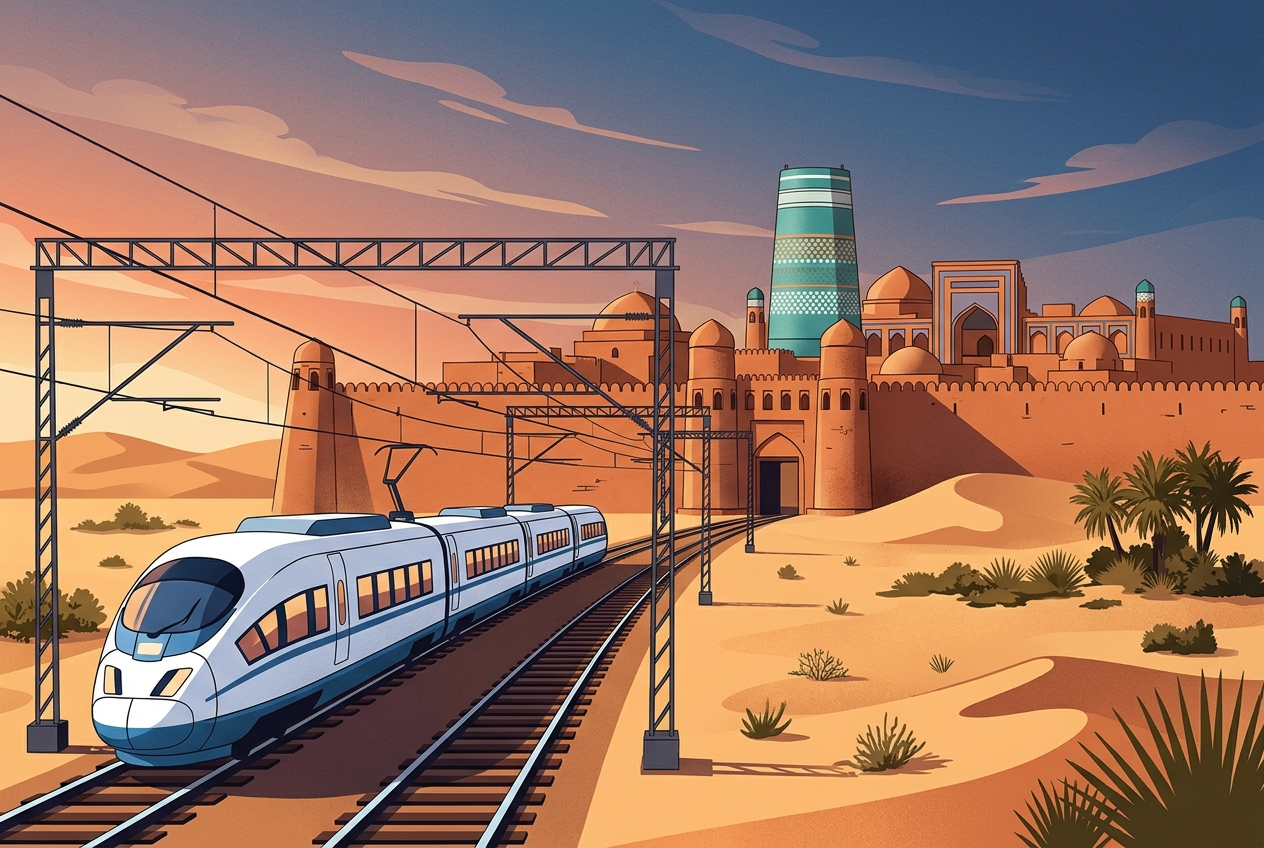
On May 5, 2026, the Jaloliddin Manguberdi — built by South Korea's Hyundai Rotem — launched commercial service on the Tashkent–Khiva route, cutting travel time from roughly 14 hours to 7 hours 30 minutes. The trainset runs at a maximum of 250 km/h, seats 389 passengers across seven cars, and covers more than 1,000 kilometers, effectively halving the journey that once required an overnight train commitment. It stops at both Samarkand and Bukhara along the way, linking all four major Silk Road cities in a single rail trip. Per IntelliNews, this is the first time a Korean-built high-speed train has entered commercial service abroad, and the contract is worth 270 billion won for six trainsets and 42 cars, including two years of light maintenance and nine months of heavy maintenance. The kun.uz pre-launch report sets the fare at 780,000 soums, with westbound departures at 07:00 from Tashkent arriving 14:31 in Khiva on Tuesdays, Thursdays, and Saturdays, and eastbound departures at 07:20 from Khiva arriving 14:51 in Tashkent on Wednesdays, Fridays, and Sundays. This launch shifts Khiva from a logistically demanding detour to a same-day destination from Tashkent, which is the foundational change that makes everything else in this story possible.
The 9.1 Million Figure — What's Actually Inside the Tourism Headline
The Tourism Committee reported 9.1 million foreign visits in January–August 2026, a 21.1% year-on-year increase according to Euronews's September 15 report — an impressive headline number on its face. But stat.uz Q1 2026 data shows that of 2,872,502 people classified as "tourism-purpose" arrivals, 76.7% came from Kyrgyzstan (807,095), Tajikistan (713,904), and Kazakhstan (681,921) — three neighboring countries. The National Statistics Committee's 2025 January–August breakdown, as cited by Euronews, records relative and family visits at about 5.17 million and travel-purpose visits at about 1.15 million, which by my math is roughly 15% of the 7.5 million total that year. The 2026 purpose breakdown has not been released, so I cannot apply those ratios directly to the current year, but a structural reversal of that magnitude in a single year is unlikely. What this means in practice: the traveler standing in Itchan Kala's alleys will encounter a very different picture than the 9.1 million headline implies. Gov.uz reports strong growth from China (2.3x), Japan (1.5x), and the U.S. (1.4x), but absolute numbers from those markets remain modest — and it's those long-distance visitors, not the neighboring-country numbers, that determine Khiva's actual tourism economy.
Train Capacity Reality — 121,000 Annual Seats vs. 9.1 Million Visits
The Jaloliddin Manguberdi runs six times per week at 389 seats, which by my math works out to 2,334 seats per week and roughly 121,000 per year, assuming one passenger per seat per leg. Euronews reported approximately 30,000 passengers in roughly the first 12 weeks of operation, against a supply of about 28,000 seats in that period; Euronews didn't define "passenger," so intermediate-stop boarders may be included in that count. The annual figure of about 121,000 represents roughly 1.3% of the January–August visit total of 9.1 million, and this math simultaneously dismantles two common narratives. The train is not flooding Khiva with visitors, and Khiva is not about to become the "next Kyoto" — The Star's reporting put Kyoto's 2025 foreign visitor count at 12.68 million, with total annual visitors at about 62.79 million, a scale that makes the current comparison almost meaningless. The real variables determining Khiva's near-term trajectory are how many of the remaining Hyundai Rotem trainsets get assigned to this route after full delivery by September 2027, and whether service frequency increases from three to more weekly departures. Until those decisions are made official, the supply picture remains limited and the current window of relatively uncrowded access remains open.
Urgench Airport Expansion — The Key to Khiva's International Future
Daryo's October 6, 2026 report details a $242 million Urgench Airport expansion project in which South Korea's Incheon International Airport Corporation holds the private partner role under a 19-year PPP arrangement. When complete, the project will raise hourly passenger handling capacity from 300 to 1,300 and annual capacity to roughly 3.5 million, with late 2028 as the projected operational start. The critical addition is wide-body aircraft capability — Boeing 747, Airbus A350 — which makes direct long-haul flights from Europe and East Asia physically possible. This is a qualitatively different kind of access shift compared to what the train provided: the train connected Khiva within Uzbekistan, while the expanded airport would connect Khiva directly to source markets worldwide. Incheon Airport Corporation's 19-year operating role means Korean airport management expertise is embedded in Khiva's primary international gateway for nearly two decades, a detail that carries practical relevance for Korean travelers and signals sustained operational continuity. As with any PPP project, there is execution risk — financing or regulatory delays are not unusual at this scale — and whether the late 2028 timeline holds will be the single most important indicator to watch for Khiva's medium-term development.
Itchan Kala — 2,500 Years of Living Heritage in the Age of Tourism Growth
Itchan Kala, Central Asia's first UNESCO World Heritage Site, is a walled city where people have lived continuously for over 2,500 years. The Islam Khodja Minaret stands 187 feet tall, the second-tallest structure in Central Asia, while Juma Mosque's 213 wooden columns include pillars dating to the tenth century — structures that carry a thousand years of physical history in a space designed for far fewer visitors than modern tourism demands. National Geographic named Khiva one of its Best of the World destinations for 2026 and recommends March and November as optimal visiting months; local food highlights include plov (a UNESCO Intangible Cultural Heritage) and shivit oshi, Khiva's signature green noodle dish. The walled structure of Itchan Kala creates a natural physical constraint on visitor density, which could function as an inadvertent preservation mechanism even as rail and air access expand. Whether the government, local community, and UNESCO can maintain effective joint management of heritage conservation alongside infrastructure growth will define whether Khiva becomes a model for sustainable heritage tourism or a cautionary tale about what high-speed rail connectivity can do to a fragile old city.
Positive & Negative Analysis
Positive Aspects
- The Full Silk Road in a Single Journey
Tashkent, Samarkand, Bukhara, and Khiva — the complete Silk Road circuit — are now strung together along one high-speed rail corridor. Before May 2026, visiting Khiva required absorbing a roughly 14-hour overnight train or a separate domestic flight to Urgench, making it a genuine commitment that most travelers with limited vacation days simply skipped. Now a 7 a.m. departure from Tashkent puts you in Khiva at 2:31 p.m., with the train stopping at Samarkand and Bukhara along the way, so the journey itself covers two other major destinations. A ten-day itinerary covering all four cities is no longer a feat of logistical engineering — it's a standard trip that any traveler can build. This fundamentally changes not just who visits Khiva, but how the entire structure of Silk Road travel packages is designed. In my view, once tour operators systematically incorporate Khiva as a default stop, the city's visitor numbers will grow faster than the train's raw seat count alone would imply, as packaged itineraries tend to generate demand beyond what individual booking behavior alone produces.
- South Korea's First Overseas High-Speed Train — A Meaningful First
IntelliNews reported that "Never before has a Korean-built high-speed train gone into commercial service overseas." For Korean readers, this is a moment with real symbolic weight: the same Hyundai Rotem technology behind South Korea's KTX is now running through Central Asia, carrying passengers across more than 1,000 kilometers of Silk Road terrain. The 270 billion won contract covers six trainsets and 42 cars, plus two years of light maintenance and nine months of heavy maintenance — a service export model, not just a vehicle sale. On top of that, South Korea's Incheon International Airport Corporation is the private partner in the $242 million Urgench Airport PPP expansion, meaning Korean infrastructure expertise is present in both the rail corridor and the air gateway serving Khiva. Hyundai Rotem on the tracks and Incheon Airport Corporation at the planned new airport make South Korea an important partner in Uzbekistan's tourism infrastructure. In my view, that could set a positive precedent for later contracts in Central Asian rail and airport markets.
- Uzbekistan's Government Is Putting Real Spending Behind Its Tourism Goals
Gov.uz's 2030 strategy targets 20 million foreign visitors, a tourism GDP share rising from 3.5% to 7%, and annual tourism exports above $6 billion — and these aren't just stated ambitions. The $242 million Urgench Airport expansion, the $26 million Mercure Khiva foreign investment, and the 270 billion won high-speed trainset contract represent concrete spending already in motion or complete. Euronews reports 705 new hospitality properties and 22,296 new beds opened nationwide in January–July 2026 alone, which I read as a sign that private investment is moving alongside the government's push. Visitor growth from China (2.3x), Japan (1.5x), the U.S. (1.4x), Russia (1.3x), Germany (25%), and France and the UK (both 21%) points to real market diversification, not just neighboring-country volume gains. The 94-country visa-free policy continues alongside rising visits, so while I can't prove cause and effect, it's hard to say the government's strategy is spinning its wheels.
- Khiva's Not-Yet-Overtouristed Appeal Is Still Real
Compared to Samarkand's Registan Square or Bukhara's Mir-i-Arab Madrasa, Itchan Kala still has more access constraints working in its favor right now. The current combination of three weekly train departures at 389 seats and a pre-expansion Urgench Airport is, paradoxically, part of what keeps the city's character intact. Walking the lanes of a walled city inhabited for over 2,500 years with relative ease, taking in Juma Mosque's forest of wooden columns, the oldest from the tenth century — that kind of travel experience is increasingly rare at recognized heritage sites. The Mercure Khiva being the first international brand hotel in the entire Khorezm region underscores how early-stage this market genuinely is. The Silk Road Hotel's growth from 38 rooms in 2019 to 43 rooms today, hosting 7,000 to 8,000 guests annually, gives a sense of scale, even though it's only one property. In my view, there is a window of two to three years — before the airport expansion changes the access equation — to experience Khiva as it exists right now.
Concerns
- Itchan Kala's Conservation Vulnerability Under Rising Visitor Pressure
Itchan Kala is a walled old city with genuine physical constraints, and increased visitor numbers translate directly into physical pressure on structures that were never designed for mass tourism. The oldest columns in Juma Mosque date to the tenth century; in my view, wooden heritage of that age gets harder to manage even when crowds grow only modestly. I wasn't able to verify UNESCO's official conservation assessment of Itchan Kala from primary documents, so I won't claim damage has already started. But the order of events is worth taking seriously here: better access can arrive long before better conservation planning does. The Kyoto comparison isn't perfectly applicable given the scale difference (The Star reported 12.68 million foreign visitors there in 2025 versus Khiva's roughly 121,000 annual train seats), but the directional lesson holds: the risk I'm most concerned about is sequencing, where access improvement comes first and heritage protection planning follows, leaving a gap in which irreversible damage can occur.
- The Structural Problem With the 9.1 Million Headline
The 9.1 million figure is striking, but stat.uz Q1 2026 data shows 76.7% of classified "tourism-purpose" arrivals came from three neighboring countries: Kyrgyzstan, Tajikistan, and Kazakhstan. The 2025 purpose-by-type breakdown puts travel-purpose visits at roughly 15% of total visits, while family and relative visits account for roughly 69% by my math, and the 2026 purpose breakdown has not been published. For January–July 2026, Germany contributed 26,100 visitors and Italy 21,000 — solid numbers but modest in absolute terms for major European source markets. With only 7,813 South Korean visitors recorded in Q1 for all of Uzbekistan, the subset actually reaching Khiva is certainly far smaller. Investors, policy makers, and travelers who take "9.1 million" at face value without understanding the composition are going to reach systematically incorrect conclusions about Khiva's market conditions and capacity constraints. The number is real; it just needs its context to be useful, and that context changes the story considerably.
- Accommodation and Service Infrastructure Is Still Early-Stage
The Mercure Khiva being the first internationally branded hotel in the Khorezm region is remarkable both as a milestone and as evidence of how underdeveloped the area's hospitality infrastructure remains. At 145 rooms, it adds real capacity, but a single 145-room international hotel is a thin base for absorbing a meaningful surge in long-distance visitor arrivals. If high-speed rail frequency increases and airport access opens on schedule, demand could outpace accommodation supply in the near term — particularly during the March and November peak seasons. When accommodation is scarce and demand is concentrated, prices spike and quality suffers, creating an "expensive and inconvenient" first impression that can damage a destination's reputation with exactly the long-haul travelers it most needs to attract. The Silk Road Hotel's seven-year growth from 38 to 43 rooms hints at the limited elasticity of smaller guesthouses in responding to rapid demand increases. Infrastructure buildout at a pace that matches — rather than lags — visitor growth is the single most important execution challenge for Khiva's tourism development right now.
- Train Capacity Constraints and Route Allocation Uncertainty
The current service level of six weekly runs at 389 seats each gives Khiva roughly 121,000 annual seat-equivalents, and the allocation of future trainsets between routes is not yet determined. The full Hyundai Rotem order of six trainsets is planned for delivery by September 2027, but other Uzbek routes including Andijan and Termez also need high-speed service, and kun.uz reports an eight-trainset additional purchase is under consideration specifically for those corridors. If the Tashkent–Khiva route doesn't capture a proportional share of the additional trainsets, the frequency and capacity improvements travelers expect may not materialize quickly. National Geographic's 2026 Best of the World designation could amplify demand for this destination while supply remains constrained. Seasonal booking pressure — especially around Navruz in March and autumn departures in November — could become a practical barrier for travelers who don't plan far ahead. The airport expansion scheduled for late 2028 would relieve some of this pressure through alternative access, but until then the train stays a key option for travelers already in Uzbekistan.
Outlook
Let's start with the next six months through spring 2027. The clearest near-term variable is additional trainset delivery. The third Hyundai Rotem trainset arrived in Uzbekistan in June 2026, and full delivery of all six is planned by September 2027. What isn't yet officially confirmed is how many of those will be assigned to the Tashkent–Khiva route versus others. If even one additional trainset shifts this route to daily service, weekly supply grows from 2,334 seats to around 2,723 by my estimate. If the route ever gets two trains a day, annual capacity could exceed 200,000 seats by my math — still modest relative to 9.1 million total visits, but a meaningful jump from today's roughly 121,000. The kun.uz report on possible additional purchases of eight trainsets for Andijan and Termez routes adds another dimension: Uzbek Railways clearly intends to expand its high-speed network broadly, which means competition for trainset allocation between routes is real. The train is a beginning, not a ceiling, but the specifics of network planning will determine how fast Khiva's access actually improves. I'll be watching the official route assignment announcements as the remaining trainsets arrive — that's the near-term signal that matters most.
The more immediate shift to watch is how travel patterns change. Before this train, visiting Khiva required essentially building a separate trip — commit to the roughly 14-hour overnight journey or fly domestically to Urgench. Now, Tashkent, Samarkand, Bukhara, and Khiva are linked along a single high-speed rail axis, and "four cities in one trip" is no longer a logistical feat. If tour operators build packages around this corridor, Khiva's visitor numbers could rise faster than the train's raw seat count alone would suggest. Oybek Hakimov told Euronews that more visitors are travelling beyond the classic four-city route, which suggests some demand is already looking past that circuit. Booking pressure during the spring Navruz season in March and autumn departures in November is likely to intensify as more travelers try to replicate this multi-city route. For the individual traveler, that means booking as early as the system allows will become increasingly important, well before the airport expansion adds alternative access options.
The real medium-term game changer — somewhere between 2027 and 2028 — is the Urgench Airport expansion. Daryo's October 6, 2026 report describes a $242 million project in which South Korea's Incheon International Airport Corporation holds the private partner role in a 19-year PPP arrangement. Completion targets raising hourly passenger handling from 300 to 1,300 and annual capacity to roughly 3.5 million, with late 2028 as the projected operational start. The critical addition is wide-body aircraft capability — Boeing 747, Airbus A350 — which means direct long-haul flights from Europe or East Asia become physically possible. This is a qualitatively different kind of access shift. The train connected Khiva within Uzbekistan; the expanded airport would connect Khiva directly to source markets worldwide. Incheon Airport Corporation's 19-year operating mandate also means Korean airport management expertise is embedded in Khiva's primary international gateway for nearly two decades, a detail Korean travelers may find reassuring.
In the same medium-term window, accommodation infrastructure is likely to evolve. The fact that the Mercure Khiva is the first internationally branded hotel in the entire Khorezm region tells you how early-stage this market genuinely is. But the $26 million in foreign investment signals that capital sees a favorable demand trajectory here. Euronews reports 705 new hospitality properties and 22,296 new beds opened across Uzbekistan in January–July 2026 alone, and if that buildout trend reaches Khiva in proportion, accommodation options will widen considerably in the next few years. The tension is real, though: expanding lodging capacity within and around Itchan Kala's historic footprint isn't a neutral act. Converting historic structures to guesthouses, building new properties adjacent to medieval walls — these decisions carry genuine preservation stakes. How well the relationship between the Uzbek government, local community, and UNESCO manages that development pressure will shape whether Khiva grows in a way that preserves what makes it worth visiting in the first place.
Looking two to five years out, the Uzbek government's 2030 strategy is the framework everything else fits inside. Gov.uz targets 20 million foreign visitors, a GDP tourism share rising from 3.5% to 7%, annual tourism exports exceeding $6 billion, inter-city transport times cut by at least a third, and four- and five-star hotels doubled. The 9.1 million in eight months is already pace-setting for the 20 million goal — in early 2026, gov.uz publications were already describing 11 million as exceeded. But the quality-of-growth question matters more than the headline number. If 2030 brings 20 million visits with roughly the same compositional structure — 76.7% neighboring-country arrivals, travel-purpose visits a small minority — the economic targets for GDP share and tourism exports become much harder to hit, because I'm assuming per-visitor spending is lower on neighboring-country trips. That's my assumption, not something the statistics confirm. China at 2.3x, Japan at 1.5x, the U.S. at 1.4x are growing fast, but absolute numbers are still modest. Closing that gap is the real structural challenge inside the 2030 strategy, and Khiva's role in closing it depends on becoming a destination that specifically attracts long-distance, high-spend visitors.
Khiva's most likely trajectory, in my judgment, is a gradual step-up. Train access improves in increments as additional trainsets are delivered and route frequency increases. Airport access makes a larger jump when the Urgench expansion opens, assuming it stays on schedule. International visitor numbers grow proportionally, with Europe and East Asia contributing more than they do today. Itchan Kala's physical constraints — narrow lanes, finite space inside the walled city — act as a natural limiting factor on daily visitor density, which could paradoxically help preserve experience quality even as access expands. This path allows Khiva to maintain something close to its current character as a "less-discovered" destination while generating meaningful economic returns. The key condition is that heritage management keeps pace with access expansion — that plans for visitor flow, site maintenance, and conservation funding are executed alongside the infrastructure spending, not years behind it.
In the optimistic scenario, all timelines hold. Full delivery of six Hyundai Rotem trainsets by September 2027, route frequency increases, and the eight additional trainsets for other routes are ordered on a matching schedule. The Urgench Airport expansion opens by late 2028, long-haul routes follow, and international hotel brands follow the Mercure's lead. Khiva becomes Uzbekistan's signature destination for the long-haul international traveler — the city that closes the Silk Road loop and delivers the distinctive experience that Samarkand and Bukhara alone no longer provide. The 2030 strategy's $6 billion export target looks achievable, and Khiva becomes a meaningful contributor.
The cautious scenario centers on infrastructure delays. PPP projects frequently encounter financing or regulatory timeline drift, and a $242 million expansion in a Central Asian market carries real execution risk. If the airport opening slips significantly beyond late 2028, Khiva's second access revolution is pushed back accordingly. In that case, the train alone — running at 121,000 to perhaps 200,000 annual seats — produces gradual, steady growth without the step-change that direct international flights would bring. Tourism value creation continues concentrating in Tashkent and Samarkand, and Khiva remains the committed traveler's destination rather than a primary draw in its own right. Hotel investment beyond the Mercure would likely slow in that scenario too, since the business case for a second international brand is weaker without air access. The train is still real and still meaningful in this outcome; it just means the transformation plays out on a longer, more muted timeline than the optimistic path suggests.
My forecast has clear failure conditions. A visa policy change could reverse trends quickly if Uzbekistan's 94-country visa-free access tightens. Geopolitical shifts in Central Asia could reshape the travel calculus altogether. And I've assumed the neighboring-country compositional structure is relatively sticky, but if Uzbekistan's government succeeds in major marketing pushes into Western Europe or East Asia, that assumption could break down fast. Gov.uz's figures show 1.3x Russia, 25% Germany, 21% France and UK, and 15% Turkey — multiple growth vectors moving simultaneously. Which of those feeds Khiva specifically, rather than stopping at Samarkand, is a question the available data can't answer. For practical planning: if you want the four-city Silk Road experience, target spring 2027 or fall 2027. Book the train at eticket.uzrailpass.uz as early as possible, plan for three nights in Khiva minimum, verify current fare from the 780,000 soum pre-launch baseline, and confirm your government's current visa rules before departure. In my honest assessment, the window for experiencing Khiva before it becomes a fully recognized international destination is open — but it is not open indefinitely. Two to three years is my best guess at how long it lasts.
Sources / References
- Beyond the Silk Road: Visitors stay longer, spend more and venture further across Uzbekistan — Euronews
- More than 2.8 million tourists visited Uzbekistan in 3 months — Statistics Committee of Uzbekistan (stat.uz)
- Reaching 20 million international tourists by 2030 is a priority goal — Tourism Committee of Uzbekistan (gov.uz)
- High-speed Jaloliddin Manguberdi train service to link Tashkent and Khiva starting May 3 — kun.uz
- Tashkent-Khiva high-speed rail opens with Hyundai Rotem train never before seen outside Korea — IntelliNews
- Khiva 2026: When to visit, where to stay, and what to do — National Geographic
- Urgench airport to undergo $242mn modernization — Daryo
- Uzbekistan imports third Hyundai Rotem high-speed train from South Korea — kun.uz
- Uzbekistan welcomes 9.1 million foreign tourists in eight months — Tourism Committee of Uzbekistan (gov.uz)
- Uzbekistan considers high-speed rail links from Tashkent to Andijan and Termez — kun.uz
- Uzbekistan opens $26mn Mercure hotel in Khiva — Daryo
- Kyoto tourism hits record 62.8 million visitors in 2025, including 12.7 million from overseas — The Star (Japan News/ANN)
- UTY EMU-250 — Wikipedia