
Spotify Paid $11 Billion in Royalties. But 87% of Tracks Got $0. Here's the Uncomfortable Math.
Summary
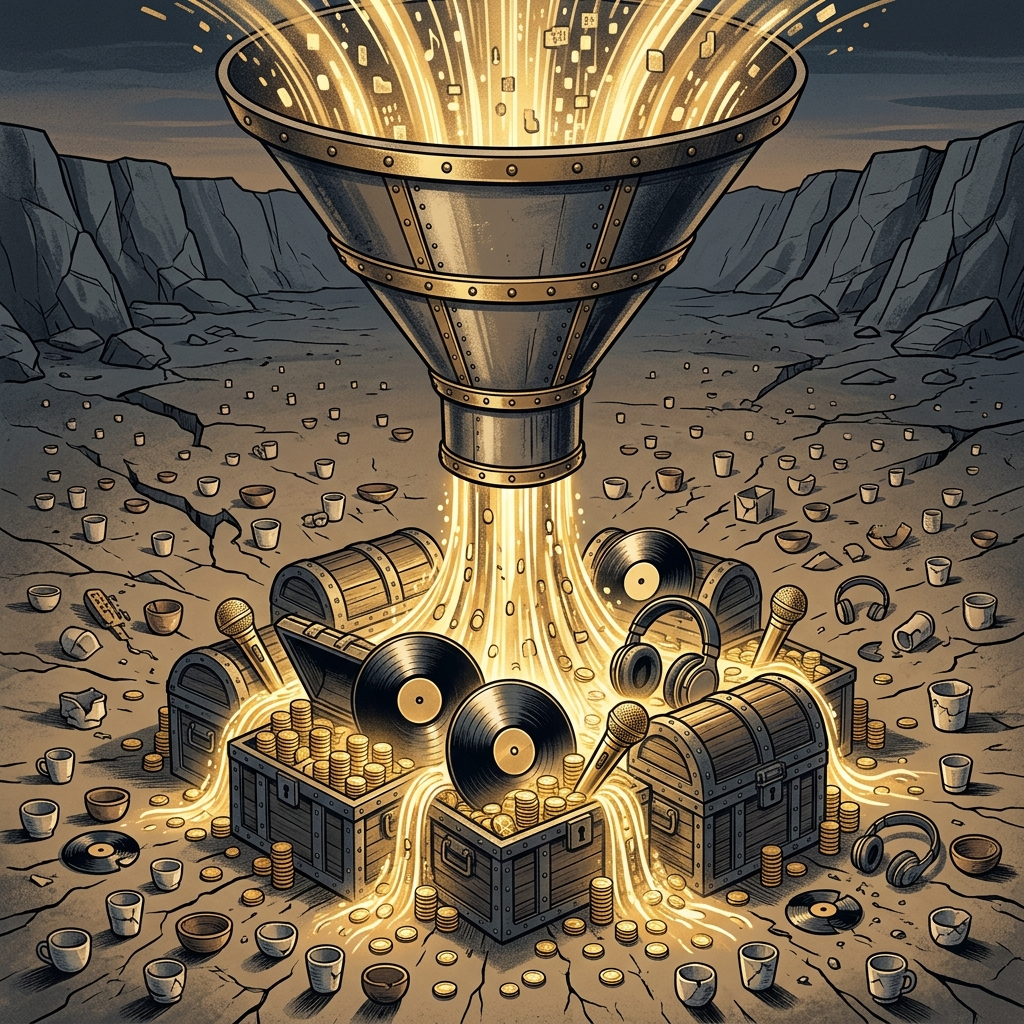
The coexistence of Spotify's record-breaking $11 billion in royalty payouts for 2025 and the zero-dollar earnings for approximately 175 million of its 202 million total tracks — 87% of the entire catalog — is not a contradiction but two sides of the same structural equation baked into the platform's design. The April 2024 threshold policy, which eliminates royalties for any track below 1,000 annual streams, redirects approximately $40 million per year to qualifying tracks, and Spotify defends the mechanism with a single data point: those excluded tracks account for just 0.5% of all platform streams. According to a 2025 IMPALA report, however, up to 70% of some independent label catalogs were stripped of monetization overnight, and niche genres like classical and jazz face structural disadvantages in crossing that threshold that threaten their viability on the platform entirely. The conflict-of-interest structure — UMG, Sony Music, and Warner Music Group each holding approximately 6% of Spotify's equity while simultaneously serving as the largest royalty recipients — was called out directly by the Open Markets Institute, which projects that the arrangement will transfer hundreds of millions of dollars from smaller players to major labels over the coming years. This analysis dissects the structural exclusion mechanism hidden beneath the "record-breaking payout" growth narrative and examines the likely end of streaming's "democratization" story and the arrival of a new era defined not by voluntary reform but by regulation.
Key Points
The 1,000-Stream Threshold — Efficiency or Structural Exclusion?
The policy that took effect in April 2024 eliminates royalties for any track below 1,000 annual streams and redirects approximately $40 million per year to qualifying tracks via the existing streamshare formula. Spotify's official defense rests on two claims: that the excluded tracks account for just 0.5% of all platform streams, and that those small payments get trapped behind distributors' minimum payout thresholds anyway and never actually reach the artists they nominally belong to. The blog post launching the policy stated directly: "This money often doesn't reach the uploaders. And these small payments are often forgotten about." On these terms, Spotify frames the change as a practical housekeeping measure — redistributing money that was functionally inaccessible to artists while simultaneously eliminating white-noise and artificial-streaming strategies that exploited the system for trivial gains.
But the 0.5% stream-share figure tells only part of the story. The tracks representing that 0.5% total approximately 175 million songs — which means the policy's impact in terms of number of affected creators is enormous, even if the dollars involved are modest. A small stream share means "the money moving is small," not "the number of people affected is small." IMPALA reported that some independent label catalogs saw up to 70% of their tracks stripped of monetization in a single policy change. The distinction between "rational efficiency" and "structural exclusion" is precisely what's contested here. Spotify's framing treats the 0.5% as a rounding error worth cleaning up; critics treat the 175 million tracks as 175 million human creative efforts — many from niche genres and non-English-speaking markets — that have been structurally removed from the earning ecosystem. The legitimacy of the threshold ultimately depends on which frame you accept, and that choice has consequences for how the music industry develops over the next decade. If volume of impact is defined by dollars, Spotify's argument holds. If it's defined by number of creators excluded from basic monetization access, the argument collapses under its own weight.
Major Labels' Dual Role — Shareholders and Largest Beneficiaries
The Open Markets Institute called it out directly in its July 28, 2026 newsletter: UMG, Sony Music, and Warner Music Group each hold "nearly six percent" of Spotify's equity — a structural conflict of interest positioned at the core of the streaming royalty debate. These three companies are simultaneously the distributors for the artists receiving the largest royalty payouts on Spotify, creating a situation in which the parties with greatest influence over how royalties are structured are also the parties most advantaged by the current structure. In plain terms, the shareholders in the platform that sets the royalty rules are the same entities that benefit most from those rules — and they have both the incentive and the proximity to decision-making to keep it that way.
The Open Markets Institute projected that this arrangement would transfer "hundreds of millions of dollars" from smaller players to major labels over the coming years. The streamshare redistribution mechanism that moves money from below-threshold tracks to qualifying ones inherently favors artists generating massive stream counts — precisely the kind of artists that major labels manage and distribute. So major labels benefit doubly: as Spotify shareholders when the platform's profits grow, and as royalty recipients when the streamshare pool expands in their artists' direction. This is not an incidental overlap — it's a structural alignment of financial incentives that, as the Open Markets Institute noted, tilts the ecosystem in a direction that may be very difficult to correct through market forces alone. The conflict of interest doesn't merely exist at the edges of this debate; it's embedded in the decision-making architecture that determines who earns what in streaming. Antitrust regulators and legislators in both the EU and the U.S. have begun paying closer attention, and the growing body of criticism around this structure suggests that some form of regulatory intervention may be necessary before the distribution imbalance is meaningfully addressed.
The Structural Crisis in Genre Diversity — Classical and Jazz on the Streaming Frontier
IMPALA's June 2025 report explicitly named the damage: the 1,000-stream threshold is "stripping revenue from independent labels and niche genres, disproportionately impacting classical, jazz, regional and non-English repertoire." Some independent labels saw up to 70% of their catalogs demonetized in a single policy shift — not as a gradual reduction but as an overnight removal of monetization status from works that had previously qualified. These aren't marginal or hypothetical losses; they represent real, immediate economic displacement for entire categories of musical creation that happen to be structurally incompatible with the streaming platform's core traffic patterns.
The problem isn't musical quality or cultural relevance — it's consumption architecture. K-pop and Anglophone pop are structurally engineered for viral replication: short format, repetition-friendly, algorithmically surfable. A 30-minute classical symphony or a regional folk recording simply doesn't fit that pattern and never will. The threshold doesn't ask whether a work is culturally significant or beloved by its community. It asks only whether enough people streamed it in the past year to cross an arbitrary numerical line. Classical and jazz fail that test not because of any deficiency but because of how music streaming is consumed — and that structural incompatibility is now a policy that eliminates an entire segment of cultural production from the monetization ecosystem. The downstream consequences compound over time: once a genre is systematically demonetized, new creators have diminishing incentives to produce in that space for streaming platforms, the genre's streaming presence shrinks further, and it becomes even harder for remaining artists to cross the threshold. IMPALA has proposed alternatives — the Pro Rata Temporis model distributing royalties proportionally to listening duration, and the Active Engagement Model rewarding intentional listening behavior. Both would address the structural mismatch more fairly. IMPALA's formal demand for complete elimination of the monetization threshold reflects the depth of the crisis as they see it: not an extreme position but a measured response to documented, ongoing structural damage with long-term cultural consequences.
The AI Music Explosion and the Royalty Ecosystem Crisis
Deezer's July 2026 announcement that more than 50% of all new daily uploads are AI-generated tracks — up from 44% in April 2026, with a daily peak of 90,000 tracks in June — represents a structural escalation in the threat to royalty ecosystem integrity. The jump from 44% to over 50% in just three months is not a gradual trend. It's a signal that AI-generated music is flooding streaming platforms at a pace that existing filtering mechanisms may struggle to contain. At that scale, even a modest fraud rate creates an enormous volume of fake stream activity that dilutes the royalties flowing to legitimate artists.
Deezer's data puts the fraud rate for AI-generated track streams at up to 85% — meaning the vast majority of AI track activity is not organic listening but artificial engagement designed to redirect royalty flows. Spotify removed 75 million spam tracks over a single year, and Apple Music blocked approximately 2 billion fraudulent streams in 2025, protecting an estimated $17 million in royalties. Industry experts estimate that at least 10% of all global streaming activity consists of fraudulent streams, causing approximately $2 billion in annual royalty misdistribution across the industry. These numbers validate the fraud-prevention rationale that Spotify used to justify the 1,000-stream threshold — there is a genuine threat, and blunt filtering does reduce it. But the threshold's fundamental limitation is that it cannot distinguish between an AI fraud operation and a legitimate jazz quartet that plays concert venues but hasn't built a Spotify streaming following. The same net catches both. As AI-generated content continues to proliferate, increasingly more legitimate creators will be caught as collateral damage alongside the fraudulent accounts the policy actually targets. A blunt stream-count threshold is simply not a scalable or accurate long-term response to a problem that is specifically about intent, authentication, and content origin — not about whether an individual track has crossed an arbitrary annual play count.
The Regulatory Clock Is Ticking — From EU Parliament to the Courtroom
The European Parliament adopted a streaming fair remuneration resolution in January 2024 by a vote of 532 to 61 — an overwhelming majority that makes the political direction of travel unmistakably clear, even if the resolution itself carries no binding legal force. The resolution called explicitly for the EU to ensure fair pay for artists and fair algorithms in streaming platforms, and it pointed to the inadequacy of existing EU law in protecting streaming-era creators from structural imbalances. The DSM Copyright Directive (2019/790), Article 18, guarantees the right to "appropriate and proportionate remuneration" — but Parliament's own assessment was that this guarantee had been insufficiently implemented for the streaming context, leaving creators without an effective legal claim against royalty structures that systematically disadvantage them.
In the United States, attorney and musician Mark Kratter filed suit against Spotify in Connecticut Superior Court in May 2026, alleging that the threshold policy violates Connecticut state law. The case is currently pending under docket number 32802292. IMPALA has issued a formal demand for the complete elimination of the monetization threshold. In the U.S., the CRB Phonorecords IV agreement covering 2023–2027 sets royalty rates at 15.35%, with the 2026 physical mechanical rate at 13.1 cents — parameters that define the legal floor but don't directly address streamshare mechanics. The EU legislative process, the U.S. courtroom, and the CRB rate-setting operate on different timelines, but together they represent a convergent pressure on the streaming royalty model that is likely to intensify over the coming years. The direction of regulatory travel is clearly toward more explicit protections for creators, and the question is whether that travel arrives quickly enough to prevent irreversible damage to the niche genres and independent artists who are structurally disadvantaged by the current threshold design. My read is that regulation will come — but slowly enough that some of the damage will already be permanent before it does.
Positive & Negative Analysis
Positive Aspects
- The Total Royalty Pie Is Growing Every Year
Spotify's annual royalty payouts have more than doubled in five years — from roughly $5 billion in 2020 to over $11 billion in 2025 — with cumulative total payouts now approaching $70 billion. This growth is the direct product of a subscription base that now includes 761 million monthly active users and 293 million premium subscribers, combined with price increases that have consistently pushed individual plan rates higher over the same period. Artists earning over $100,000 grew by 1,400 year-over-year to reach 13,800, which is evidence that the benefits of expansion are reaching beyond the very top tier of earners into what might reasonably be called the professional middle class of working musicians. As Goldman Sachs projects total music industry revenue growing from $105 billion in 2024 to $200 billion by 2035, the structural expansion of the streaming royalty pool should continue — even with the streaming CAGR revised downward from 9.8% to 7.9%. The 100,000th-ranked artist's annual earnings rising from $350 in 2015 to $7,300 in 2025 demonstrates that the gains have extended meaningfully down the earnings hierarchy, not just accumulated at the summit. The growth of the pie itself is a distinct and real positive that should be evaluated separately from the distribution structure's fairness — criticizing one does not require denying the other, and honest analysis requires acknowledging both.
- Fraud Prevention Is Genuinely Working
Spotify removing 75 million spam tracks in a single year represents meaningful ecosystem-level protection that directly benefits legitimate artists whose royalties would otherwise be diluted by fraudulent activity competing for the same streamshare pool. The scale of the threat makes this protection non-trivial: industry experts estimate that at least 10% of all global streaming activity consists of fraudulent streams, causing approximately $2 billion in annual royalty misdistribution across the industry — a figure that would be substantially higher without active filtering. Deezer's data indicating that up to 85% of AI-generated track streams are fraud-motivated — combined with the fact that AI tracks now exceed 50% of new uploads — illustrates the scale of the problem that mechanisms like the threshold are attempting to address. Apple Music's 2025 experience of blocking approximately 2 billion fraudulent streams and protecting an estimated $17 million in royalties provides a comparative benchmark showing that the fraud problem is industry-wide, not Spotify-specific. The 1,000-stream threshold does effectively block the micro-streaming strategies that use white-noise tracks and artificial plays to extract tiny royalty payments at scale, protecting the broader royalty pool from being further diluted. In an environment where AI-generated spam may reach 60% or more of new daily uploads by year-end, having a filtering mechanism in place — even an imperfect one — is materially better than having none. The fraud-prevention argument may not fully justify all of the threshold's structural consequences, but its basis in real and growing fraud activity is genuine and should not be dismissed as pretext.
- Independent Artists Generate Nearly Half the Royalty Pool
Spotify's Loud & Clear 2026 report states that "roughly half of those royalties were generated by independent artists and labels" — a figure that directly challenges the simplistic framing that streaming royalties flow exclusively to major label artists and their beneficiaries. The independent sector generating close to half the total royalty pool demonstrates that streaming platforms create genuine economic opportunity for artists operating outside the major label system, even within an imperfect distribution structure that clearly advantages the top tier. Two years of publishing royalty payouts totaling approximately $5 billion represent a significant real flow of value to songwriters and publishers who are often overlooked in the public debate about who benefits from streaming. The 100,000th-ranked artist's annual earnings rising from $350 in 2015 to $7,300 in 2025 — roughly a 20x increase — shows that meaningful economic gains have extended well down the earnings hierarchy, not just accumulated at the summit where the 80 artists earning over $10 million sit. The indie sector's 50% contribution to the royalty pool is not a minor footnote in a major-label story; it's evidence that the platform's economic logic, for all its documented flaws, does not simply reproduce the pre-streaming order in which major labels held near-total control over commercial music distribution. Acknowledging this data is not a concession to Spotify's preferred narrative — it's a prerequisite for honest assessment of streaming's net impact on music's creative economy.
- Global Music Accessibility Has Expanded Dramatically
Artists earning over $10,000 from Spotify are now distributed across more than 150 countries, and those earning over $500,000 hail from 75 countries — up from 66. These are numbers that would have been logistically impossible a decade ago, when global music distribution required physical infrastructure, established label relationships, and region-by-region deal-making that locked out most artists outside the major commercial markets. The global distribution infrastructure that streaming has built is real, genuinely accessible, and has enabled artists from sub-Saharan Africa, Southeast Asia, and other regions previously excluded from global commercial music to reach international audiences in ways that simply weren't available to them before. The 100,000th-ranked global artist earning $7,300 per year from streaming in 2025 represents income that is economically meaningful in many markets and that would have been simply unavailable in the pre-streaming distribution environment. Spotify contributing over $1.5 billion to concert ticket sales in the first half of 2025 alone demonstrates that the platform creates economic value beyond direct streaming royalties — building artist audiences and converting streaming listeners into concert-goers who generate additional live revenue. The streaming model's democratization of distribution — even if its democratization of earnings remains incomplete — represents a genuine and significant shift in the geography of global music commerce that cannot be attributed only to platform self-interest.
- Alternative Distribution Models Are Already Emerging From Within the Industry
Deezer's artist-centric model, announced jointly with UMG in September 2023, applies a 2x stream-weight multiplier to artists with at least 500 monthly listeners and 1,000 monthly streams, with an additional 2x multiplier for tracks where users actively searched and chose to play them — delivering up to a 4x benefit for qualifying professional artists who meet both conditions. Launched in France in Q4 2023 and expanded to Brazil, with a publishing partnership with Sacem added in January 2025, the model represents a concrete alternative to the pure stream-count formula that currently governs Spotify's distribution. The model is designed to reward intentional music consumption over passive or automated play and to disadvantage white-noise and artificially streamed content relative to genuine listening — addressing some of the fairness concerns about the current streamshare mechanism without abandoning the fraud-prevention rationale entirely. The emergence of alternative models from within the industry itself is evidence that internal reform pressure exists and that the consensus around the current model is not monolithic. The possibility that Apple Music, Amazon Music, or other competitors could adopt similar artist-centric weighting approaches in the coming years creates real competitive dynamics that may eventually pressure Spotify to respond in order to maintain its position with independent artists and labels. The fact that this conversation about distribution reform is happening inside the industry — not only from outside critics — is a meaningful signal that the ecosystem recognizes the current model's limitations and retains some capacity to evolve.
Concerns
- Genre Diversity Is Being Structurally Eroded
IMPALA's June 2025 report stated explicitly that the 1,000-stream threshold is "stripping revenue from independent labels and niche genres, disproportionately impacting classical, jazz, regional and non-English repertoire." Some independent labels saw up to 70% of their catalogs stripped of monetization in a single policy change — not a gradual fade-out but an overnight removal of economic viability for works that had previously qualified for payouts. Classical and jazz are inherently niche genres not because of any deficiency in quality or cultural significance, but because their audience structure and listening patterns are fundamentally different from those of viral-optimized pop and hip-hop. Reaching 1,000 annual streams for a 30-minute classical recording or a regional folk track is structurally harder than for a three-minute pop song built for algorithmic recommendation, and the threshold treats this structural difference as entirely irrelevant to its assessment of value. The downstream consequences are severe and compounding: once a genre is systematically demonetized, new creators have diminishing incentives to produce in that space for streaming platforms. As fewer new works appear, the genre's streaming presence shrinks further, making it even harder for remaining artists to cross the threshold — a feedback loop that produces not just economic loss but irreversible cultural loss. IMPALA's formal demand for complete elimination of the monetization threshold reflects not an extreme position but a direct, measured response to the documented severity of this structural damage and the long-term cultural consequences it is already beginning to produce across the global music catalog.
- The Structural Exclusion of Indie Artists Is Becoming Permanent
The fact that 87% of tracks on the platform earn $0 is not merely a statistical observation — it represents the growing permanence of structural exclusion for the vast majority of music creators who chose to participate in streaming's supposedly democratic ecosystem. According to unofficial analysis, indie artist losses from the threshold policy are estimated at approximately $46.9 million in 2024 — which actually exceeds the $40 million that Spotify redistributes annually through its streamshare mechanism, suggesting that the policy's efficiency gains come at a net cost to the independent creator community it claims to serve more effectively. Spotify defends the policy with its 0.5% stream-share data, but the core of the argument isn't about dollars in motion — it's about whether creators have the right to participate in the monetization system at all. The 175 million tracks earning $0 represent 175 million creative decisions by human beings who put their work on the platform under terms it originally offered. When those terms change retroactively, the creators are not being cleaned out of a marginal niche — they are being structurally excluded from a game that was explicitly sold to them as accessible to everyone. The long-term consequence is predictable: if the streaming platform cannot provide basic monetization access to the broad base of creators it depends on for catalog depth and variety, the incentive to contribute to that catalog progressively weakens — and the platform's own diversity and discovery ecosystem suffers along with the indie artists it has displaced.
- The Conflict-of-Interest Structure Distorts Distribution at the Source
UMG, Sony Music, and Warner Music Group each holding approximately 6% of Spotify's equity while simultaneously serving as the distributors for the largest royalty recipients on the platform constitutes a structural conflict of interest that, as the Open Markets Institute has argued, the platform's internal governance cannot neutrally resolve. These major labels occupy a position in which they have both influence over Spotify's strategic direction — through their shareholder status — and a direct financial stake in the royalty distribution rules that Spotify sets. The streamshare redistribution mechanism, which moves money from below-threshold tracks to qualifying ones, inherently advantages artists who generate the highest stream counts — precisely the artists managed and distributed by the major labels with the largest Spotify equity positions. This is not a coincidental overlap; it's a structural alignment where the parties with the most influence over the rules also benefit most from those rules being structured the way they are. The Open Markets Institute's projection that this arrangement will transfer "hundreds of millions of dollars" from smaller players to major labels over the coming years is a warning about the long-term trajectory of the current structure if left unreformed. Without regulatory intervention or meaningful governance reform that creates genuine independence between equity holders and royalty beneficiaries, the conflict of interest cannot be resolved through market forces alone — the very parties whose interests would be served by reform are the same parties whose proximity to decision-making currently prevents it.
- AI Fraud and Indie Artists Are Filtered by the Same Blunt Threshold
The 1,000-stream threshold is effective at reducing certain forms of fraud, but its fundamental limitation is that it cannot distinguish between an AI-generated spam account and a legitimate indie artist who has simply not yet built a large streaming following — and it treats both identically by eliminating their royalties. Deezer's data shows that more than 50% of new uploads are now AI-generated and that up to 85% of AI-generated track streams are motivated by fraud — which demonstrates both that the fraud problem is real and growing, and that the fraudulent activity is concentrated in AI-generated content specifically rather than distributed evenly across all small-stream tracks. But the same data reveals the inadequacy of stream-count-based filtering: if the majority of AI-generated content is fraudulent, the correct response is to identify and remove fraudulent content based on its origin and intent, not to use stream counts as a blunt proxy that inevitably catches legitimate creators in the same net. At 90,000 AI-generated tracks per day at its June 2026 peak, the scale of the problem makes clear that the threshold alone cannot scale as a sustainable solution — it will simply capture more and more legitimate indie artists as collateral damage as AI-generated content continues to proliferate and crowd out human creators in platform catalogs. A more sophisticated identification mechanism — one that uses content analysis, upload pattern detection, behavioral signals, or AI authentication tools to distinguish fraud from authentic indie artistry — is necessary. Reducing the problem to a blunt numerical threshold is not a scalable or fair long-term approach to a problem that is fundamentally about intent and authentication, not about stream count.
- Price Increases Don't Translate to Distribution Improvement
Spotify's U.S. individual plan climbed approximately 30% in three years — from $9.99 in 2022 to $12.99 by 2026 — and Goldman Sachs anticipates continued price hikes in 12 to 24-month cycles, with the individual plan potentially reaching $15 to $17 in the coming years. Consumers are paying significantly more for the service than they were, and that increased spending does translate into a larger absolute royalty pool. But unless the distribution structure itself changes, every additional dollar of subscription revenue flows into the same streamshare model and concentrates at the same top of the same pyramid — meaning price increases function as an amplifier of the existing distribution inequality rather than a corrective to it. Spotify's Q1 2026 results illustrate this dynamic precisely: 33.0% gross margin (all-time high) and operating income of approximately $837 million (up 46% year-over-year). The platform's profitability is at historic peaks, yet the distribution structure that determines how those profits flow to creators is operating on the same logic that produced 87% zero-royalty rates in the first place. With indie artist losses estimated at approximately $46.9 million according to unofficial analysis, and only $40 million being redistributed annually through the threshold policy, the gap between what the policy extracts and what it returns represents a net extraction from the independent creator community — a dynamic that price increases without distribution reform will only widen over time as the royalty pool grows while its allocation mechanics remain fixed.
Outlook
The next one to six months will be a period when the legal and regulatory pressure surrounding this structure begins to crystallize into something visible. Mark Kratter's Connecticut lawsuit is currently pending, and the direction of the court's initial ruling has real potential to send a signal across the entire industry. The Open Markets Institute's decision to frame this issue through an antitrust lens in its July 28, 2026 newsletter has also contributed to raising the volume of the regulatory conversation. In the short term, I believe the probability that Spotify makes structural changes to its policy framework is low. That said, there may be movement — micro-adjustments to the threshold or exploratory discussions about genre-specific carve-outs — driven more by legal risk management than genuine philosophical change. With Deezer having announced that AI-generated tracks now exceed 50% of all new uploads, the defensive logic supporting the threshold's fraud-prevention framing may actually gain ground in the near term. Spotify's Q2 2026 operating income guidance of €630 million — down from €715 million the prior quarter — adds internal resistance to any structural cost changes. And Spotify's dominant 31.7% paid subscription market share continues to function as a structural shock absorber against competitive pressure for reform.
Let's sketch the short-term scenarios in more concrete terms. In an upside scenario, if the Kratter court issues an early ruling favorable to the plaintiffs, similar suits could follow in other states, and the pressure on Spotify to revisit its policy could escalate rapidly. Short of IMPALA's demand for complete threshold elimination, there's a plausible middle-ground concession — lowering the threshold or introducing genre-weighted distribution factors. In a baseline scenario, the litigation drags out and Spotify holds its current policy, shielded by its 99.5% stream-share data. In a downside scenario, given that AI music uploads leaped from 44% to over 50% in just three months, it's plausible that the figure hits 60% by year-end. That trajectory would further reinforce the fraud-prevention justification for the current policy while simultaneously providing more structural cover for indie artist exclusion. And as Apple Music's 2025 experience of blocking approximately 2 billion fraudulent streams illustrates, the cost of fraud defense itself can become a drain that squeezes the entire ecosystem's distribution capacity.
Looking at the medium term — six months to two years out — the central variable is whether the EU's regulatory intention evolves from a non-binding resolution into binding legislation. The European Parliament's January 2024 vote of 532 to 61 in favor of the streaming fair remuneration resolution sends a clear political message. But it remains a non-binding resolution with no legal enforcement. The EU's Digital Single Market Copyright Directive (DSM 2019/790), Article 18, does guarantee "appropriate and proportionate remuneration" for creators — but, as Parliament itself noted, no EU-specific rule for streaming exists yet. If binding legislation is completed, platforms would be compelled to fundamentally redesign their distribution structures. In parallel, in the U.S., the CRB Phonorecords IV agreement covering 2023–2027 sets royalty rates at 15.35%, with the 2026 physical mechanical rate at 13.1 cents. The cumulative pressure these figures exert on the streaming cost structure could, over the medium term, lay the groundwork for a broader renegotiation of how value is split between platforms and artists.
The other critical medium-term variable is whether Deezer's artist-centric model spreads across the industry. Announced jointly with UMG in September 2023, the model applies a 2x stream-weight multiplier to artists meeting at least 500 monthly listeners and 1,000 monthly streams, with an additional 2x multiplier for tracks where a user actively searched and chose to play them — delivering up to a 4x benefit for qualifying artists. Launched in France in Q4 2023 and expanded to Brazil, the model added a publishing partnership with Sacem in January 2025. If this approach demonstrates measurable results and competitors like Apple Music or Amazon Music adopt similar frameworks, real competitive pressure on Spotify would follow. That said, critics raise a legitimate concern: Deezer's model was co-designed with a major label (UMG), which means it may simply reproduce the same star-heavy bias under a different architecture. The upside scenario sees alternative models proliferate across the industry. The baseline scenario sees Spotify maintain its current approach behind its dominant market position, with alternative models remaining limited to Deezer and smaller platforms.
Looking further out — two to five years — growth in the music streaming market itself will continue. Grand View Research projects the market will expand from approximately $62.5 billion in 2026 to $158.1 billion by 2033, at a compound annual growth rate of 14.2%. Goldman Sachs' Music in the Air 2025 report sees total music industry revenue growing from $105 billion in 2024 to $200 billion by 2035, though it revised its streaming CAGR estimate downward from 9.8% to 7.9%. The pie will get bigger — that much is clear. The real question is whether the distribution structure evolves as the pie grows. If the current structure holds, the gains will flow to the top, and the 87% zero-royalty rate may actually climb higher as AI-generated music continues flooding platform catalogs. Global paid streaming subscribers grew from 752 million in 2024 to 827 million in 2025 — a 10% increase — but subscriber growth doesn't automatically translate into distribution improvement, as the past two years have already demonstrated. Spotify's Premium ARPU rose 5.7% year-on-year to €4.76, further expanding the absolute pie — but without structural reform, that ARPU growth simply means more money flowing to the same existing winners.
Subscription prices will continue rising. Having climbed roughly 30% in just three years — from $9.99 to $12.99 for the U.S. individual plan — there is a plausible case for prices reaching $15 to $17 within the next five years, which would physically expand the total royalty pool. But if the distribution structure continues operating on the same streamshare model, the beneficiaries of that expanded pool will also remain unchanged. Growth of the pie, absent structural reform of its distribution, is simply a larger pie divided by the same rules in favor of the same people.
In the long-term upside scenario, binding EU legislation is completed and legally imposes genre diversity obligations or minimum artist remuneration standards on streaming platforms. If the CRB pushes songwriter compensation higher in Phonorecords V, composer earnings improve incrementally. If Goldman Sachs' superfan monetization potential — estimated at $4.3 billion in additional annual revenue — becomes real, it could function as a direct indie artist revenue channel, reducing dependence on the streamshare model. IMPALA's proposed alternative models — Pro Rata Temporis, which distributes royalties proportionally to listening duration, and the Active Engagement Model, which assigns a premium for active listening behavior — could replace today's blunt "1 stream = 1 count" formula if adopted as industry standards. In the long-term downside scenario, AI-generated music comes to dominate the overwhelming majority of platform catalogs, structurally squeezing the discoverability of human creators. If the pace Deezer documented — from 44% to over 50% in just three months — continues, the majority of catalog content could be AI-generated within two to three years. If genre monoculture takes hold, classical and jazz could effectively disappear from streaming, pushed onto live performance and direct-sale channels as their only remaining venues.
Putting it all together, I believe the structural direction of change points toward reform — but the pace will be slow. The three axes of change will be EU legislative will, the spread of the Deezer model, and the accumulation of legal challenges. But Spotify's 31.7% market dominance and the conflict-of-interest structure embedded with the major labels will function as a brake on the speed of that change. The pivotal variable, ultimately, is a race between the speed at which AI music floods and corrupts the royalty ecosystem, and the speed at which regulators can meaningfully respond. If AI corrupts the ecosystem faster than regulation can follow, the structural exclusion of indie artists will deepen further. Conversely, if the EU or the U.S. completes legislation that genuinely imposes distribution obligations on platforms, this system will have no choice but to be redesigned from the ground up. I believe the latter will eventually happen — but I worry that the genres and creators lost in the process will represent irreversible casualties.
Ultimately, this is not a technology problem. It's a political one. Who sits at the table making the rules determines how distribution outcomes flow. Right now, Spotify and the major labels are at the table. Independent artists and niche genre creators are outside the door. Until that seating arrangement changes, no technical model or incremental policy tweak will fundamentally resolve the structural exclusion. The system will keep working exactly as designed — which is precisely the problem.
Sources / References
- Spotify Newsroom — Loud & Clear 2026: 2025 Record-Breaking $11B+ Royalty Payouts and Artist Earnings Tier Data — Spotify
- Spotify for Artists — Modernizing Our Royalty System: Official Announcement of the 1,000-Stream Threshold Policy and 99.5% Stream Share Data — Spotify
- Open Markets Institute — The Corner Newsletter: Analysis of UMG/Sony/Warner Spotify Equity Stakes and Conflict-of-Interest Structure — Open Markets Institute
- IMPALA — Combating the Emergence of a Two-Tier Industry: Evidence of Up to 70% Indie Label Catalog Demonetization and Disproportionate Genre Impact — IMPALA
- European Parliament — Music Streaming Sector: Streaming Fair Remuneration Resolution Adopted 532-to-61 — European Parliament
- Deezer Newsroom — AI Music Exceeds 50% of Daily Uploads: AI-Generated Track Upload Rate Crossing the 50% Threshold — Deezer
- Music Business Worldwide — Spotify Q1 2026: 293M Subscribers and $837M Operating Profit (+46% YoY) — Music Business Worldwide
- Goldman Sachs — Music in the Air 2025: $200B Music Industry Revenue Projection and Revised Streaming CAGR — Goldman Sachs