
Blame Katy Perry All You Want — The Real Culprit Is Sitting in FIFA's Boardroom
Summary
The 2026 FIFA World Cup marks a historic structural departure from 96 years of tournament tradition by staging simultaneous opening ceremonies in three separate host cities — Mexico City, Toronto, and Los Angeles — while introducing the first-ever official halftime show for the championship final, modeled explicitly on the NFL Super Bowl template. While widespread public discourse has centered on Katy Perry's widely criticized LA opening performance, described as a "trainwreck" and "screeching" by social media audiences, individual-level criticism fundamentally misidentifies where the structural problem originates and who bears responsibility for it. The three-city ceremony format, with each city's artist lineup engineered to target a distinct regional advertising demographic, represents not a multicultural celebration but a sophisticated market segmentation strategy designed to multiply commercial inventory across three simultaneously monetizable audiences. The first-ever World Cup final halftime show — featuring Madonna, Shakira, and BTS curated by Coldplay's Chris Martin — directly transplants the Super Bowl entertainment model onto a sport whose rhythms, global viewing scale, and audience composition differ categorically from American football. This piece examines why blaming Katy Perry lets FIFA off the hook, what irreversible precedents the 2026 tournament is establishing for football's long-term identity, and what the road to 2030 looks like when the sport and showbusiness are forced to share equal billing.
Key Points
Three Simultaneous Opening Ceremonies: Market Segmentation Dressed as Cultural Diversity
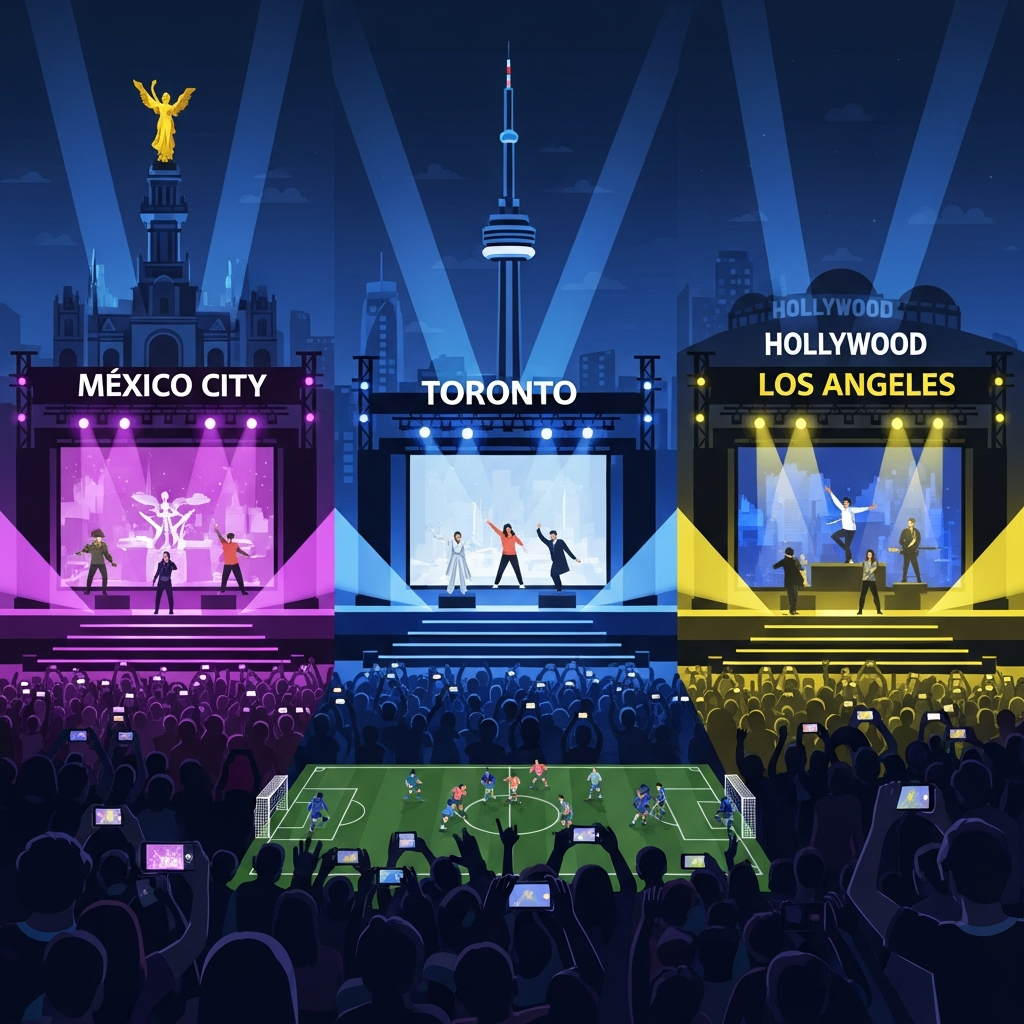
The 2026 FIFA World Cup made history by staging opening ceremonies in three cities simultaneously — Mexico City on June 11 at Azteca Stadium, and both Toronto at BMO Field and Los Angeles at SoFi Stadium on June 12. Combined live attendance across all three venues reached approximately 200,000 people, with creative direction coordinated by Marco Balich, the same director who oversaw the Milan-Cortina Winter Olympics ceremonies. FIFA's official explanation centered on honoring the unique cultural identities of three distinct host nations — a narrative that is partially true and consistently appealing. But the artist selection logic tells a different story. Mexico City's lineup — Shakira, Burna Boy, J Balvin, Alejandro Fernández, Maná, Lila Downs, and Tyla — targeted Latin American and Afrobeats markets with precision. Toronto's bill — Alanis Morissette, Michael Bublé, Alessia Cara — spoke directly to English-speaking Canadian mainstream demographics. The LA lineup — Katy Perry, LISA, Future, Anitta, and Rema — stacked American pop mainstream against K-pop fandom mobilization and Afrobeats crossover appeal. Cultural diversity and market segmentation look identical from the outside, but their underlying motivations are entirely different. A single opening ceremony produces one advertising inventory slot; three simultaneous ceremonies produce three, each attached to its own regional sponsor infrastructure and each targeting a distinct audience demographic that can be sold separately to geographically relevant brands. FIFA's 2026 tournament is already generating a projected $13 billion in total revenue, with sponsorship income reaching $2.8 billion — a 56% increase over Qatar 2022. The three-city format is one structural mechanism powering that commercial expansion. The multicultural framing is a genuinely appealing narrative — and it's also, from a business architecture standpoint, a near-perfect justification for tripling monetizable air time simultaneously.
The Katy Perry Pile-On Targeted the Wrong Person
The social media response to Katy Perry's performance at SoFi Stadium on June 12 was immediate and unsparing. Fans called it "screeching," a "trainwreck," "absolutely brutal," and "she can't sing." The Mirror characterized the show as "lackluster." Perry performed "Wonder" alongside a 10-year-old Norwegian artist named Tius, wearing a Stella McCartney silver sequin gown that drew additional ridicule for its resemblance to a candy wrapper. None of these reactions change a fundamental structural reality: a 10-minute outdoor slot at a football stadium is physically incapable of producing Super Bowl halftime show quality, regardless of the performer. The Super Bowl halftime production operates on $10–20 million in dedicated budget, months of full-cast rehearsal, over 2,000 crew members, and a custom stage design engineered for each specific venue. A soccer stadium's primary engineering priority is pitch protection, which compresses stage installation windows to a fraction of what a Super Bowl production allows, and the acoustic environment was never designed for amplified live performance at concert scale. There is no documented evidence that FIFA invested comparable resources in any of the three opening ceremonies. When production conditions are structurally unequal, applying the same quality standard to both outputs is not criticism — it is scapegoating. The more consequential observation is this: every unit of public blame redirected at Perry is a unit of accountability removed from the institutional designers who built an unworkable format and handed it to performers as if the conditions were equivalent to what they'd need for success. Shakira's World Cup performances worked not because she was technically superior but because she owned the stage on her own terms — a very different arrangement from being packaged as a demographic targeting component inside a commercial entertainment suite.
The First-Ever World Cup Final Halftime Show Is a Direct Super Bowl Transplant
In 96 years of FIFA World Cup history, the championship final has never featured an official halftime show — until July 19, 2026, at MetLife Stadium in East Rutherford, New Jersey. Coldplay's Chris Martin is curating the event. The confirmed headliners are Madonna, Shakira, and BTS, performing within FIFA's mandatory 15-minute halftime window. Revenues from the show go toward a $100 million FIFA Global Citizen Education Fund, with anchor sponsors Bank of America, MetLife, and Cisco already pledging $15 million combined. FIFA frames this as a historic convergence of sport, culture, and social purpose. The structural reality is a direct replication of the NFL's proven commercial formula applied to a sport with fundamentally different characteristics. The Super Bowl's quarterly format was built for commercial insertion; soccer's continuous 45-minute halves were not. The Super Bowl operates within a domestic single-market advertising ecosystem; the World Cup broadcasts simultaneously to 200 nations. The 2022 World Cup final drew 1.42 billion viewers — roughly 11 times the Super Bowl's audience — but a larger reach does not make the underlying format transferable. When the halftime show slot is planted inside a 15-minute break that barely allows players time for tactical adjustments, the structural tension between entertainment ambition and sporting rhythm is visible from the first minute. The precedent established at MetLife Stadium in July 2026 will shape every World Cup final for decades — not because FIFA will necessarily succeed with this first attempt, but because institutional precedents in sporting formats do not reverse once established. They only escalate.
Live Authenticity at Mega-Events Is Already in Structural Crisis
Future's lip-sync controversy at the LA opening ceremony was not an isolated incident — it was the clearest visible symptom of a systemic problem embedded in the mega-event format. The Mirror reported that viewers accused multiple performers across all three ceremonies of utilizing pre-recorded tracks, with one viewer writing that "all of the acts seemed to be lip syncing, quite badly in many cases." LISA's fanbase was debating the possibility of pre-recorded performance before she even took the stage. And Katy Perry's attempt at a full live vocal delivered the opposite result from what the format presumably wanted: a "screeching" verdict from an audience that simultaneously demands authenticity and perfection. This is the structurally impossible double bind. Perform live and risk imperfection — get destroyed for imperfection. Perform pre-recorded for guaranteed audio quality — get accused of fraud. There is no winning move for the performer within this format design; there are only different categories of public humiliation. The rational management response is to shift progressively toward pre-recorded audio, which improves technical quality at the cost of live legitimacy. As that shift accelerates across more events, the distinction between "live performance" and "live entertainment production" collapses. I believe at least one major jurisdiction will introduce mandatory disclosure requirements for large-scale events that market pre-recorded performances as live within the next two years — and those regulatory discussions will intensify as the mega-event entertainment format expands its global footprint into more commercial and legal contexts that demand transparency.
The Real Issue Is Football's 96-Year Identity Crossing a Point of No Return
The deepest question raised by the 2026 World Cup entertainment decisions isn't about vocal performance or lip-sync technology. It's about whether football's fundamental identity as a sport-first event has just been permanently renegotiated without the sport's fans being consulted. The Super Bowl comparison is instructive and uncomfortable. In 2025, Super Bowl LIX's halftime show with Kendrick Lamar averaged 133.5 million viewers, exceeding the game's own average of 127.7 million — the first time in Super Bowl history that had occurred. That tipping point took more than 30 years to arrive after Michael Jackson's 1993 watershed performance. The World Cup final in 2022 drew 1.42 billion viewers — 11 times the Super Bowl's scale. When FIFA attaches a halftime entertainment spectacle to that 1.42-billion-viewer event, the velocity of the identity shift in football could be dramatically faster than anything the NFL experienced. The 1930 inaugural World Cup established a 96-year premise: football is a sport-first event. On June 12, 2026, FIFA made its most explicit institutional statement yet that the game and the entertainment show are now co-equal attractions. The critical observation is this: the Katy Perry trending cycle is noise. The structural precedent being set in the institutional DNA of the World Cup is the signal. Everyone spending the day debating the silver sequin dress is creating exactly the cover story FIFA needs to avoid accountability for the deeper transformation being engineered — and the format designers, facing no public reckoning, will show up to the next tournament with an even more ambitious version of the same blueprint.
Positive & Negative Analysis
Positive Aspects
- New Audiences Get Pulled In Fast and at Scale
The World Cup's shift toward entertainment territory is arguably the most cost-efficient strategy available for dramatically expanding the sport's global reach. Katy Perry fans who have never watched 90 minutes of football, the BTS ARMY, Madonna's multigenerational following, K-pop's internationally distributed fanbase ecosystem — all of these audiences now have a personal, identity-based reason to tune into the tournament. A single BTS concert in Seoul generates an estimated economic impact of up to $800 million, according to the Korea Culture and Tourism Research Institute. Mobilizing BTS at a World Cup final means pulling a fandom whose collective engagement power reshapes markets. The Super Bowl demonstrated exactly this dynamic over three decades: the halftime show became the primary viewing motivation for millions of Americans who care marginally about football, and that expanded viewership base made the entire property more commercially valuable at every level of the ecosystem. Applied to a World Cup final that already drew 1.42 billion viewers in 2022, the incremental audience from entertainment-motivated viewership could push global reach into territory no single event has ever touched. First-time viewers who tune in for their favorite artist and accidentally discover a genuine interest in the sport represent the lowest-cost fan acquisition path available. No marketing budget replicates the organic pull of knowing your favorite artist is performing at the biggest event on Earth.
- Multi-Polar Cultural Representation Gets Its Own Dedicated Stage
The three-city format, regardless of its commercial motivations, achieves something genuinely worth acknowledging: it gives multiple cultural traditions their own headline moment rather than reducing them to supporting roles in a single dominant ceremony. Burna Boy representing Afrobeats, LISA representing K-pop and Thai cultural identity, J Balvin representing reggaeton, Maná representing Mexican rock — in a conventional single-venue format, several of these artists would have been compressed into brief cameos behind a single global headliner. Distributed across three cities, each artist gets a full production and a stage that belongs to their own cultural context. That's structurally more equitable than the alternative. The comparison with historical World Cup ceremonies underscores the point: a single ceremony dominated by two global superstars inevitably marginalizes every other cultural tradition in the building. Splitting across three cities allows multiple musical traditions to occupy center position simultaneously, even if the commercial logic driving that choice was more economically motivated than culturally principled. For global audiences watching their cultural tradition headlining rather than briefly appearing, this matters in ways that aren't reducible to the underlying economic calculation. The experience of seeing your musical identity treated as a primary event rather than a supporting act carries genuine symbolic value — and that value doesn't disappear simply because the format decision that produced it was primarily commercial in motivation.
- Expanded Commercial Revenue Creates Potential for Football Development Investment
FIFA's 2026 tournament is projected to generate $13 billion in total revenue, with sponsorship income reaching $2.8 billion — a 56% increase over the $1.8 billion Qatar 2022 generated. Ticket and hospitality revenue is estimated to reach $3 billion, triple Qatar 2022's $950 million. These extraordinary numbers reflect a commercial premium partly attributable to the entertainment expansion. If revenue distribution is transparent and accountable — a significant condition — the football ecosystem stands to benefit substantially. Youth development programs, women's football infrastructure, broadcast access for emerging markets, and financial support for smaller national associations are all plausible investment destinations for a portion of this expanded revenue. The halftime show alone, through the FIFA Global Citizen Education Fund, targets $100 million for children's education globally, with $15 million in corporate pledges already secured. The optimistic case for FIFA's commercial strategy is that the entertainment layer serves as a funding mechanism for the sport's long-term health rather than a replacement for its identity. More advertising inventory, higher sponsorship rates, and broader viewership reach translate into resources for parts of the game that currently operate on margins too thin to sustain meaningful development. I hold this as the most conditionally framed argument in favor of this strategy — "if the money is reinvested responsibly" carries substantial weight — but the potential scale of resource generation is genuinely unprecedented in sporting history.
- The Final Becomes a Multi-Generational Cultural Event That Extends Its Own Reach
The first World Cup final halftime show, with Madonna, Shakira, and BTS curated by Chris Martin, creates something no previous World Cup final could claim: a compelling reason for audiences across multiple generations and cultural backgrounds to treat July 19, 2026 as a personally relevant date. Madonna's cultural footprint spans four decades. Shakira carries three decades of global recognition and specific World Cup cultural resonance from 2010 and 2014. BTS commands one of the most financially powerful and geographically distributed fanbases in recorded music history. A single event that meaningfully engages all three demographic layers simultaneously is extraordinarily rare in any entertainment context. The broadcast mathematics compound this advantage: a final that already drew 1.42 billion viewers in 2022 now adds an entertainment layer that can realistically push that figure higher, potentially making it the most-watched entertainment event in recorded broadcasting history. For advertisers, the multi-generational and multi-cultural reach presents a placement opportunity that simply cannot be purchased through any other single channel. For host regions, the economic spillover from a final that is simultaneously a major entertainment event extends well beyond match-day revenue into tourism, hospitality, and media coverage that would otherwise be directed elsewhere — turning a single evening into a multi-day cultural event with lasting economic impact.
Concerns
- "The Game Comes First" Is a 96-Year Premise That Just Got Quietly Erased
The most serious long-term risk is also the hardest to quantify in advance: the structural erosion of football's identity as a sport-first event. The Super Bowl provides the only available historical precedent for where this trajectory leads. In 2025, the halftime show averaged more viewers than the game itself — the first time in Super Bowl history that had occurred. That tipping point took more than 30 years to reach, but once reached, it functions as a permanent structural feature of the event's identity. There is no mechanism by which the NFL can credibly reposition the Super Bowl as primarily a football event now. FIFA has introduced the same architectural element into the World Cup final without any publicly stated policy protecting the game's formal primacy over the entertainment layer. Once the precedent is established — once "the World Cup final has an official halftime show" becomes institutional fact — the logic of successive tournaments will be to make that show larger, not smaller. The 2030 version will be more elaborate. The 2034 version will be more elaborate still. At some point along that escalation, the entertainment spectacle will exceed the match itself in emotional resonance for a substantial portion of the global audience. When that happens, the shift will be structural and essentially irreversible — and every core football supporter who objected but tuned in anyway will have communicated to FIFA exactly what it needed to hear: the ratings are real, the backlash is manageable noise, and the format has institutional permission to keep expanding.
- Live Authenticity Has Been Replaced by Engineered Audio Production
The lip-sync controversy surrounding Future — and the ambient anxiety around LISA's performance, and the visceral backlash to Katy Perry's live vocal attempt — collectively map the edges of a trust crisis that will only deepen as the mega-event entertainment format expands. When audiences cannot reliably distinguish what is live from what is pre-recorded, the core value proposition of a "live performance" is systemically undermined. The experience of attending or watching a live performance rests on a shared belief that what you're hearing is happening in real time and that the performer is taking a genuine creative risk. As pre-recorded audio becomes the operational standard for events of this production scale, that belief becomes increasingly difficult to sustain. The performers themselves are caught between a format that makes live performance technically hazardous and an audience that will punish them if pre-recording is confirmed. I believe this will push at least one major regulatory jurisdiction toward live performance disclosure requirements within the next two years. The asymmetry that produces this crisis is the gap between what audiences are sold — a live event — and what they are receiving — an engineered sound production with live visual components. That asymmetry is not new to entertainment, but the global scale and the formal sporting context of the World Cup make it unusually exposed to scrutiny and unusually consequential when the exposure occurs publicly.
- "Diversity" as Market Segmentation Reduces Cultures to Commercial Signals
The risk embedded in three-city market segmentation dressed as multicultural celebration is not abstract or merely conceptual. When Burna Boy represents Africa, LISA represents Asia, and J Balvin represents Latin America — and each of those representations is structurally attached to a specifically targeted advertising audience — the cultural identity at stake is being processed as a commercial signal rather than a human expression. That's a form of reductionism that can appear respectful from the outside while functioning as exactly the opposite on the inside. Real cultural exchange produces friction, surprise, and unfamiliar combinations — genuine encounter across difference. What FIFA's three-city format produces instead is a commercially legible map of cultural territories, with each tradition slotted into its pre-assigned market segment. The edges have been filed smooth. The complexity has been replaced with demographic targeting accuracy. The performer is poorly served by this arrangement as well: LISA is not "Asia." Burna Boy is not "Africa." Reducing internationally significant artists to their geographic market value strips them of everything that makes their work worth experiencing. There's also a legitimate question about what message this format sends to artists from smaller markets who don't map cleanly onto a defined commercial demographic — they simply don't appear in FIFA's lineup logic, because their audiences can't be efficiently packaged and sold to regional sponsors.
- Structural Failures Get Deflected Onto Performers While the Format Designers Walk Free
The most insidious consequence of the 2026 opening ceremony controversy isn't what it revealed about any individual performer — it's the pattern it institutionalized for how the public processes the inevitable failures of an overambitious format. Katy Perry absorbed the full weight of a coordinated social media pile-on for a performance that was structurally set up to underperform. FIFA, which designed the 10-minute outdoor slot and chose not to invest Super Bowl-equivalent production resources into it, faced no proportional public accountability. That asymmetry is not accidental — it's the predictable outcome of a system in which the visible, named performer absorbs all public criticism while the invisible institutional format designers remain safely behind the event's production machinery. The pattern is already established: the next time a FIFA entertainment segment underperforms, and there will be a next time, the cycle will repeat identically. The performer trends on social media. The format architects revise their brief in private and move forward. No one inside FIFA's event strategy operation faces a public reckoning for designing conditions that made an unfavorable outcome structurally likely. Without that accountability, there is no correction mechanism. The format keeps expanding, the production conditions keep being inadequate relative to the expectations they generate, and the public keeps cycling through individual artists as targets while the institutional logic that created the problem continues without interruption or consequence.
Outlook
The next 1–6 months will function as the largest live experiment in sports entertainment history. I expect entertainment-related keywords — halftime show lineup, opening ceremony backlash, LISA World Cup, BTS final — to pull social traffic that rivals, and at certain moments surpasses, actual match results. That dynamic already began before a single group stage ball was kicked, which is itself a diagnostic signal about which direction the audience's attention is drifting. But the numbers that will actually matter aren't trending topics. They're the viewership figures for the July 19 final at MetLife Stadium, and specifically how many of those viewers tune in because of the Madonna-Shakira-BTS halftime show rather than the football match. If that number is measurable — if even 5% of the global audience cites the halftime show as their primary reason for watching — FIFA will have its proof of concept, and the format will be institutionally locked in.
The advertising revenue data point I'm watching most closely is the final's 30-second commercial slot pricing. The 2022 World Cup final drew 1.42 billion viewers. The Super Bowl's record 30-second ad slot runs $7–8 million against an audience of roughly 127 million. Apply that per-viewer economic premium to 1.42 billion viewers plus a halftime entertainment multiplication factor, and the math suggests the World Cup final could set advertising rate records that dwarf anything in broadcasting history. I think FIFA is betting on exactly this, and I think the bet is commercially reasonable in the short term. The risky side of that bet is already visible: the Katy Perry backlash demonstrated that any live mishap in this new high-stakes format becomes a global PR liability within hours. That pressure will push FIFA and its performers increasingly toward pre-recorded audio for the final — and Future's lip-sync controversy will read, in retrospect, as the cautionary dress rehearsal for a far larger backlash when pre-recording is confirmed at the championship itself.
There's a third dynamic worth tracking across the full tournament. The 2026 World Cup runs 104 matches across 48 teams — nearly double the previous format's game count. More matches mean more broadcast slots, more advertising inventory cycles, and a far larger dataset on which entertainment interventions actually move viewership numbers versus which generate noise without audience retention. I believe FIFA is treating this entire tournament as a controlled data-collection exercise, feeding real-time performance metrics on every ceremony and every viral clip directly into the design brief for the 2030 World Cup entertainment architecture. The Katy Perry backlash is not a crisis from FIFA's institutional perspective — it's a data point labeled "what did not work in this market at this production level." Every viral clip, every Nielsen number, every trending topic is going into the file. That file will produce the next generation of opening ceremony specifications.
In the medium term — roughly six months to two years out — I expect this format to become contagious across the sports entertainment landscape. Once the World Cup final demonstrably carries an official halftime show without the sport's audience collapsing, every other major sports property will run the same calculation internally: the UEFA Champions League final, Copa América, the Olympics opening and closing ceremonies. The institutional logic is nearly inescapable. One successful proof of concept eliminates the last credible argument against attempting it elsewhere. Sports media rights negotiations will begin including dedicated "entertainment bundle" line items. Artist management companies will stop pricing World Cup appearances as performance fees and start treating them as global launch platform activations, because a single World Cup stage appearance now competes directly with a stadium tour in terms of streaming impact and fanbase expansion.
The medium-term picture also carries a counter-pressure that's easy to underestimate: the live authenticity disclosure question. Future's controversy will not be the last. As mega-events lean progressively harder on pre-recorded audio engineering, the gap between what audiences believe they're experiencing — a live performance — and what they're actually receiving — an engineered sound production with live visual components — will widen to the point of becoming a consumer protection question in some markets. I think there's a real probability that at least one major jurisdiction introduces mandatory disclosure requirements for large-scale ticketed events that include pre-recorded performance elements marketed as live entertainment within the next two years. That regulation wouldn't kill the mega-event format — but it would force a renegotiation of what "live" actually promises commercially and legally.
The power dynamics around artist selection will also shift substantially in this period. LISA's appearance at the LA opening generated more than a million Twitter views independently of any other content. BTS at the final brings a fandom that Korea's Cultural and Tourism Research Institute has valued at up to $800 million in economic impact per Seoul concert. Management teams for artists with comparable fan mobilization power will price World Cup appearances accordingly — and the bidding competition among FIFA, national associations, and competing events for these slots will intensify dramatically. The lineup choices will increasingly be made on fanbase size, streaming footprint, and regional market penetration data rather than on musical grounds. That shift will produce more predictable, more commercially optimized lineups — and less surprising, less artistically resonant ones.
Looking further ahead to the 2030 World Cup — shared between Spain, Portugal, and Morocco, with centennial commemoration matches in Uruguay, Argentina, and Paraguay — the structural template is already established. A multi-continent, multi-culture event distributed across six countries will demand an even more elaborate opening ceremony architecture than the three-city format FIFA ran in 2026. I expect 2030 to feature four or five simultaneous opening events, and by that point the "opening ceremony" brand will have substantially detached from its football context. It will be positioned and marketed as an independent global entertainment spectacle — closer in cultural positioning to the Grammy Awards than to a pre-match warm-up. If the 2026 final halftime show delivers the viewership premium FIFA is projecting, the 2030 version will be longer, more lavishly produced, and structurally more central to the tournament's commercial proposition.
Now let me map the three possible trajectories. The optimistic scenario — the bull case — holds that entertainment expansion and football authenticity find a durable equilibrium: the entertainment layer draws first-time viewers who become genuine football converts, ancillary revenue funds youth development in markets that currently operate on thin margins, and FIFA proves the Super Bowl model can coexist with a global sport whose structure differs fundamentally from American football. The condition that makes this work is FIFA explicitly encoding that the entertainment show exists to serve the game — not the reverse — and establishing baseline live performance standards that make the format sustainable. I put the bull case at approximately 30% probability.
The base case — which I consider most likely at around 50% — is that commercialization continues accelerating without stabilizing resolution. Every World Cup cycle produces one or two major entertainment controversies that generate enormous noise while the ratings keep climbing. Core football fans express outrage and still tune in. Advertising revenue grows tournament over tournament. The bear case — 20% probability — sees over-commercialization trigger measurable defection among the traditional football supporter base. A catalyzing event — a large-scale production failure at the final, a cultural appropriation explosion, or a transparency scandal involving the $100 million education fund — cracks the facade, sponsors re-evaluate, and FIFA is left holding an entertainment spectacle that has lost its sporting legitimacy.
The historical comparison that clarifies the stakes is Michael Jackson's 1993 Super Bowl halftime show. That performance is widely credited as the precise moment the halftime show transformed from "the game's intermission" into "the game's co-equal attraction." The NFL took more than 30 years to reach the 2025 milestone where the halftime show drew a larger average audience than the game itself. The World Cup final starts from a 1.42-billion-viewer baseline — eleven times the Super Bowl's scale. If FIFA has replicated the 1993 inflection point, the same structural shift that took American football three decades could arrive in global football within a single generation. The velocity of change will be dramatically faster, because the global scale amplifies every feedback loop.
The practical implication for anyone in the music, sports marketing, or media industry is clear: a World Cup stage slot is no longer a prestige appearance. It's a global launch platform, and the strategy around it should be as sophisticated as any stadium tour. For fans who still care primarily about 90 minutes of football, the most important thing to understand is this: the Katy Perry pile-on is the story that replaces the accountability story. Every hour spent debating her vocal performance is an hour not spent asking whether FIFA's format designers should face consequences for the structural decisions they made. The Super Bowl reached its current state because fans who loved the sport stayed quiet while the entertainment industry filled the vacuum. The World Cup is standing at the same junction in 2026. The path of least resistance leads exactly where the Super Bowl went. Whether football takes it is still, just barely, an open question.
Sources / References
- World Cup Kicks Off in US as Katy Perry, Future Headline Opening Ceremony — Al Jazeera
- Katy Perry World Cup Performance Backlash — The Mirror
- Katy Perry Slammed for 'Screeching' During Performance — AOL
- 2026 FIFA World Cup Opening Ceremonies — ABC News
- FIFA World Cup 2026 Opening Ceremony Artists Involved — Olympics
- 5 Reasons Why FIFA World Cup 2026 Opening Ceremony Is Different From Previous Editions — WION
- FIFA World Cup 2026 Opening Ceremony Photos — Deadline