
BBC Pulled the Plug on BTS at the World Cup — Football Tradition? Try European Pride
Summary
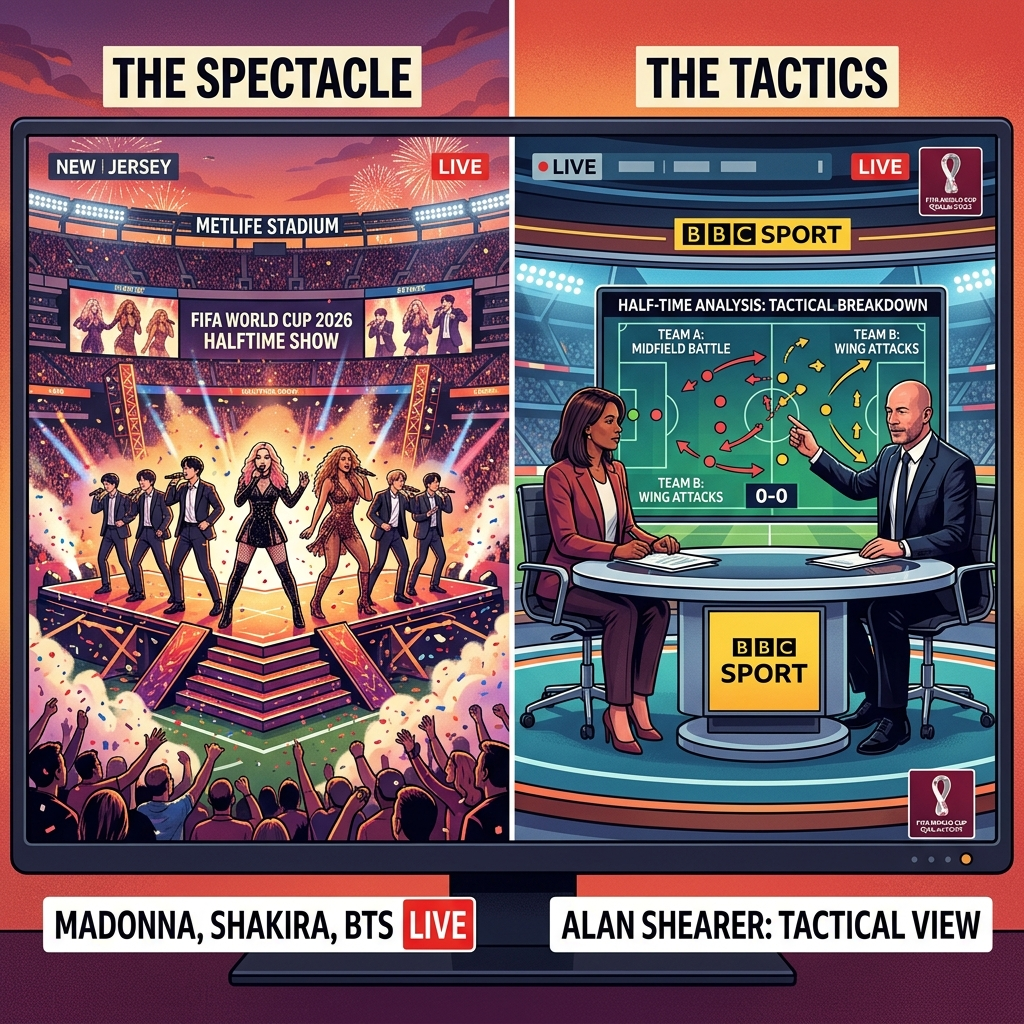
The 2026 FIFA World Cup Final, scheduled for July 19 at MetLife Stadium in New Jersey, will host the first halftime entertainment show in World Cup history, with Madonna, Shakira, and BTS set to perform under the creative direction of Coldplay's Chris Martin. Britain's BBC and ITV have officially declared they will not broadcast the 15-minute performance, choosing instead to air traditional halftime tactical analysis with football legends Alan Shearer and Wayne Rooney. The broadcasters have framed this refusal as a defense of football's European cultural identity against the so-called "Super Bowl-ification" of the world's most-watched sport. However, the actual performing lineup — Colombia's Shakira, South Korea's BTS, and the United States' Madonna — constitutes the most geographically decentralized cultural roster ever assembled for a major international sporting event, directly undermining the "Americanization" framing as a factual mischaracterization. This controversy ultimately reveals something far more significant: Europe's institutional resistance to the reality that cultural authority over football is no longer exclusively European, and that the sport's majority audience now lives well outside the continent that claims to have invented it.
Key Points
The Historic Significance of FIFA's First-Ever World Cup Halftime Show
FIFA's decision to stage the first halftime entertainment show in 100 years of World Cup history marks a fundamental paradigm shift in how major football events are designed, broadcast, and experienced by global audiences. Chris Martin's creative direction, combined with Global Citizen's advocacy partnership, positions this not merely as a commercial spectacle but as a statement about football's institutional mission on a planetary scale. The performing lineup — Madonna, Shakira, and BTS, representing three separate continents and three entirely different musical traditions — opens the possibility of the World Cup halftime becoming as culturally iconic as the NFL Super Bowl halftime has become within American culture, but on a genuinely global and multipolar scale rather than a domestically anchored one. With the 2022 Qatar World Cup Final drawing 1.5 billion viewers worldwide, the potential cultural impact of this inaugural show dwarfs anything the Super Bowl halftime has achieved in terms of raw audience reach and geographic diversity. Whether it succeeds or fails by conventional metrics, the fact that FIFA has chosen to run this experiment tells us everything we need to know about the direction the organization believes football must travel to remain culturally relevant across the next decade. If it works, the template for how international sports events integrate global entertainment will be permanently and irreversibly rewritten.
BBC and ITV's Broadcast Refusal — Editorial Independence or Cultural Resistance?
The decision by BBC and ITV to black out the halftime show and replace it with traditional punditry appears at first glance to be a straightforward exercise of editorial judgment, since broadcasters routinely decide what content to carry and what to leave out of their coverage. The surface argument holds some water: purchasing the right to broadcast a football match is not logically the same as committing to transmit every piece of entertainment content that FIFA chooses to attach to the broadcast package. But the selective application of this principle — applied rigidly to this halftime show while never previously applied to Olympic opening ceremonies, Eurovision, or any comparable cultural event attached to sports broadcasting — reveals something more than routine editorial caution at work. At a deeper level, FIFA's failure to communicate even the basic logistics of the halftime break duration to its broadcast partners represents a genuine governance failure that gives BBC and ITV a legitimate practical grievance that is entirely separate from their cultural objection to the show's format. The critical question — the one that reveals what is actually driving this decision — is whether BBC would have made the same call even with perfect FIFA communication and a fully cooperative operational arrangement. The honest and most probable answer is yes, because the cultural discomfort with the show format predates any logistical complaint and reflects a long-standing institutional disposition about what football broadcasting should prioritize.
The "Americanization" Paradox — The Most Globally Diverse Lineup in Sports History
The central irony of the "Super Bowl-ification" criticism is that the lineup being described as "American" is, in factual and geographic terms, the least American major entertainment lineup ever assembled for an international sporting event of this scale. Shakira was born in Barranquilla, Colombia, and has spent her entire career as the defining global voice of Latin pop's international expansion, selling concerts across every continent. BTS hail from Seoul, South Korea, and represent the most commercially successful non-English-language musical act in the modern streaming era, with a fanbase that dwarfs most Western acts in Asia, Latin America, and beyond. Only Madonna — precisely one of three headline acts — holds American citizenship, making the headline claim of "American cultural imperialism" a mischaracterization of the basic facts. The "Americanization" framing rests ultimately on the idea that the halftime show format itself is American, regardless of who actually performs in it. But this argument proves far too much: press conferences, fan zones, official merchandise, VAR technology, and stadium naming rights are all American-originated formats now universally adopted by global football without anyone calling them Yankeefication. The real issue is not the format's national origin — it is that this particular format challenges who gets to define what the World Cup experience should feel like, and European football culture carries a 130-year investment in the answer to that question.
Football's Cultural Hegemony and the Global Power Shift
The deepest layer of this controversy involves a question that European football institutions have long avoided confronting directly: who holds the cultural authority to define what football is and what it should become? Europe invented the game, developed it, and exported it globally through commercial and colonial structures, but in doing so it created a sport that the rest of the world then genuinely made its own through decades of passionate investment, creative evolution, and local cultural transformation. Today, the majority of football's global audience lives in Asia, Africa, and Latin America, and the 2026 expansion to 48 teams is not simply a FIFA revenue calculation — it is the institutional acknowledgment that football's political and commercial center of gravity has already shifted decisively outside Europe. The 2022 Qatar World Cup demonstrated convincingly that integrating non-European cultural identity into the tournament's programming is commercially successful and culturally enriching rather than diluting: the tournament drew 1.5 billion viewers to a host nation that European traditionalists had disputed, validating the direction of travel. What BBC's halftime refusal signals is that European football media institutions are not yet ready to follow where both FIFA's strategy and the global audience demographics are pointing, even as the trajectory has already been determined by forces well outside any broadcaster's control. Resistance to this shift is understandable as a cultural reflex rooted in 130 years of institutional identity. It is not, however, a position that can be sustained as the audience composition of the sport continues to evolve along its current trajectory.
The Irreversible Merger of Sports and Global Entertainment
The convergence of elite sport with global entertainment is not a World Cup-specific phenomenon or a temporary commercial experiment — it is a structural transformation affecting every major sporting property on the planet and reflecting fundamental shifts in how audiences worldwide consume both sport and culture simultaneously. The NFL Super Bowl halftime has become the most-watched entertainment event in the United States, annually outperforming the Grammys and the Academy Awards in total domestic audience, while generating cultural conversation that extends the NFL's cultural reach well beyond its established base. IPL cricket in India has built a model in which Bollywood performance, celebrity culture, and cricket combine to create an $11-billion annual economic event that has transformed cricket from a niche British colonial export into India's dominant cultural institution. Netflix's acquisition of NFL Christmas game rights and Amazon Prime's Premier League coverage both confirm that major technology platforms now view live sport as the last frontier of high-value premium content, and they are willing to pay dramatically to access it. Forbes data from 2025 placed the global live entertainment market at $130 billion, with sports-plus-entertainment hybrid events as the single fastest-growing category across the space, a data point that reflects genuine audience demand rather than institutional preference. The World Cup halftime show is not an outlier experiment or a one-time commercial calculation — it is football's formal entry into a structural merger that every other major global sport has already completed, and the only question now is whether football's traditional institutions choose to lead that integration thoughtfully or be reshaped by it involuntarily.
Positive & Negative Analysis
Positive Aspects
- Recruiting an Entirely New Global Audience for Football
BTS's global ARMY fanbase numbers over 40 million active members, the majority of whom live in East Asia, Southeast Asia, and Latin America — regions where football competes intensely with a range of entertainment alternatives for sustained audience attention and loyalty. For a significant proportion of those fans, the World Cup Final halftime show will represent their first sustained engagement with a football broadcast as a live event, creating conditions for lasting audience acquisition at a scale that no conventional sports marketing campaign could replicate or approach. The 2010 South Africa World Cup provides the clearest and most directly applicable precedent for this dynamic: Shakira's "Waka Waka" generated over 4 billion YouTube views and drove measurable viewership increases in markets that had previously shown limited engagement with the tournament, particularly across sub-Saharan Africa and Southeast Asia. FIFA's core institutional mission is the global development and propagation of football, and the halftime show represents perhaps the most direct and powerful single execution of that mission in the organization's century-long history. Football cannot grow indefinitely by deepening engagement with fans who are already committed to the sport — it needs cultural gateways that make the sport legible and inviting to the hundreds of millions of people who currently have no meaningful relationship with it, and music has proven to be one of the most effective such gateways available.
- A Genuinely Global Cultural Statement That Defies the Americanization Frame
The performing lineup for the 2026 World Cup halftime show — Shakira from Colombia, BTS from South Korea, Madonna from the United States — offers football something it has genuinely never had before: a cultural moment that simultaneously and explicitly represents three continents, three entirely different musical traditions, and three audience communities whose relationship with football varies enormously. This isn't Super Bowl-style American entertainment exported to a reluctant world; it's the first time in football history that the game's biggest stage has been used to say, through its programming choices alone, that football belongs equally to Latin America, to Asia, and to everyone beyond the traditional European and North American axis. Shakira's "Waka Waka" already proved that the intersection of football and globally popular music from outside Europe and North America creates something both culturally powerful and commercially successful, with 4 billion YouTube views providing the most concrete evidence available. The Coldplay-Global Citizen partnership adds a layer of social advocacy and civic purpose that differentiates this production from pure commercial entertainment, positioning the halftime show as a statement about the kind of world that football, at its best, represents and aspires to reflect. When Spanish, Korean, and English are performed on the same pitch during the World Cup Final, football becomes something no single culture owns — and that is precisely the point.
- Healthy Market Competition Between Traditional Broadcasting and Streaming Platforms
BBC's refusal to air the halftime show will paradoxically accelerate the market competition that ultimately makes both traditional and digital sports broadcasting sharper and more valuable for audiences. When BBC fills halftime with studio analysis while streaming platforms carry the entertainment show, audiences gain a genuine and meaningful choice — and the comparative viewership data that results will be the most important market signal in sports broadcasting in years, providing clarity that years of market speculation has not produced. Netflix's NFL Christmas game deal and Amazon Prime's Premier League coverage have already established that streaming platforms are willing and able to pay premium prices for live sports rights, fundamentally changing the negotiating dynamics between rights-holding organizations and their broadcast partners. A successful World Cup halftime show gives streaming services a compelling and commercially tested argument for acquiring not just match rights but attached cultural content rights as a separate and distinct licensing category, creating new revenue streams for FIFA and new content differentiation for platforms. In the long run, this competitive pressure forces traditional broadcasters to sharpen their editorial offering — making analytical content genuinely more insightful and valuable rather than adequate — while simultaneously giving audiences more options for how they engage with the full broadcast event. The ultimate beneficiary of this competitive dynamic is the viewer, who ends up with more choice and higher quality across every platform.
- Revenue Diversification and the Potential to Reinvest in Global Football Development
A successful World Cup halftime show creates an entirely new revenue stream for FIFA, one that extends meaningfully beyond the match broadcast rights and corporate sponsorship packages that have historically dominated the organization's commercial model. The economic impact associated with the NFL Super Bowl halftime show — including merchandise sales, streaming rights, artist exposure value, and sponsor activations — is estimated at over $500 million annually, and the World Cup's larger global footprint and dramatically bigger international audience create conditions for potentially exceeding that figure within the first few cycles. If FIFA successfully develops halftime entertainment as a distinct and scalable commercial product, those revenues create the genuine possibility of meaningful reinvestment in football infrastructure across developing markets, women's football programs, grassroots coaching development, and facilities construction in regions that currently lack adequate access to high-quality football environments. The key and honest caveat is institutional accountability: FIFA's track record on transparent reinvestment of commercial revenues into football development programs is mixed at best, and the governance structures required to ensure that halftime show profits actually flow toward the sport's developmental needs require strengthening before this potential becomes practice. But the expansion of the revenue base itself creates options that do not currently exist, and that expansion is a net positive for the possibilities available to the global game regardless of how the distribution debate ultimately resolves.
Concerns
- Serious Risk of Disrupting Match Rhythm and Players Physical Preparation
Football's standard 15-minute halftime exists as a carefully calibrated interval designed for specific physiological and tactical reasons that have been validated across more than a century of competitive play at the highest level. Players use this time for tactical adjustments, wound treatment, hydration management, and — critically — maintaining muscle temperature above the threshold required for safe and explosive movement in the second half. Research from UEFA sports science programs suggests that halftime extensions beyond 20 minutes correlate with a measurable increase in muscular injury rates in the first 15 minutes following the restart, with one analysis indicating a 23% elevation in soft tissue injury incidence when breaks exceed this threshold significantly. For a World Cup Final — the highest-stakes competitive match in global football — introducing a new and potentially significant variable into player preparation during the most consequential rest period of the tournament imposes real physical costs on athletes for the commercial benefit of broadcasters, sponsors, and the organizing body. The question of who bears actual medical and legal responsibility if a high-profile player is injured in circumstances directly attributable to an extended halftime break remains unaddressed in any public FIFA communication, and that accountability gap will become urgent the moment the first significant injury occurs.
- FIFA Communication Failure and the Erosion of Broadcaster Trust
Broadcasting organizations who paid hundreds of millions of dollars for the rights to air the 2026 World Cup Final were reportedly never given a definitive answer on how long the halftime break would actually last — a fact that, if accurate, represents a fundamental failure to provide commercial partners with the operational information they paid for and depend on to fulfill their own commitments. Advertising schedules, studio booking arrangements, commentary team logistics, and technical production planning all depend on knowing the precise duration of every segment of a live broadcast, and FIFA's apparent refusal to commit to a figure left BBC, ITV, and other rights holders in an untenable operational position before any editorial decision was even made. This pattern of unilateral decision-making — making major structural changes and communicating with affected parties only after commitments are locked in — is a recurring feature of FIFA governance that has eroded trust across multiple previous decisions, from the Qatar 2022 host selection to the VAR implementation to the 48-team expansion format announced without adequate consultation. Broadcast partnerships are long-term multi-year commercial relationships that require a reasonable baseline of operational predictability to function effectively, and FIFA's behavior in this case makes future rights negotiations more adversarial and ultimately more expensive for all parties, including FIFA itself. If this communication failure becomes the established pattern for how FIFA manages halftime entertainment integration, it will create structural resistance from the broadcast community that limits the format's potential success regardless of its artistic quality.
- Alienating Traditional Football Fans and Threatening the Sport Cultural Identity
Decades-long football supporters who have built a deep personal relationship with the sport around the experience of 90 minutes of pure competitive football may reasonably feel that the halftime show represents their game being restructured for an audience that has never previously cared about football and may not sustain engagement after the entertainment moment has passed. The Football Supporters Association in England has already issued statements expressing genuine concern about the direction FIFA is taking with the World Cup product, and their grievance represents something culturally significant that deserves serious weight rather than dismissal as nostalgic resistance to inevitable change. The in-stadium experience for the 82,500 people who paid to attend a football match — rather than a concert — will be quite different from the broadcast experience for home viewers, and there is a legitimate question about whether the halftime show format serves or alienates the live audience who have already committed their attendance and financial investment to the sporting event specifically. The risk inherent in aggressively pursuing new audiences is always the possibility of alienating existing loyal ones, and FIFA's history of prioritizing commercial expansion over fan relations gives little reassurance that it has thought carefully about where the line between cultural evolution and institutional overreach actually falls. If the price of attracting 40 million BTS fans to one World Cup Final is the permanent disengagement of a comparable number of long-term football supporters who feel the sport's identity has been sold to entertainment interests, the arithmetic of that trade is considerably less favorable than it might initially appear.
- The Slippery Slope Toward Over-Commercialization and Loss of Sporting Purity
If the 2026 World Cup Final halftime show is commercially successful by any major metric, FIFA will face strong and well-funded internal and external pressure to expand the entertainment format to semi-finals, quarter-finals, and eventually further into the tournament structure, following the commercial logic wherever it leads. The NFL provides a direct and widely-discussed cautionary precedent: what began as a single halftime entertainment innovation has progressively transformed the Super Bowl into an event where the football itself is, for significant portions of the viewing audience, genuinely secondary to the halftime show, the commercials, and the pre-game entertainment package. The 2024 UEFA Champions League Final already generated controversy around its opening entertainment segment, and Saudi Arabia's Super Cup competition has made large-scale concerts a routine fixture attached to matches — with the resulting criticism that football has become incidental to the surrounding commercial and entertainment spectacle. Once the economic logic of attaching entertainment events to football matches is validated at the highest possible competitive level, the incentive structures for expanding that model become extremely difficult to resist within the organizational culture of bodies like FIFA, even when the artistic justification for further expansion weakens with each iteration. The risk is not that a single halftime show damages football permanently, but that a commercially successful halftime show makes it structurally impossible to resist demands for two shows, then three, then a fundamentally different kind of event in which competitive football is only one component of a broader entertainment package.
- No Established Framework for Protecting Players During Extended Halftime Breaks
FIFPRO, the global professional footballers' union, has already been engaged in active legal and advocacy disputes with FIFA over fixture congestion and player welfare standards, and the 2026 halftime show extension lands directly in the middle of that ongoing institutional conflict at the sport's most sensitive pressure point. Players who reach the World Cup Final have typically played through seven or more high-intensity matches in four to five weeks, arriving at the final in conditions of peak cumulative fatigue where every additional physical variable carries meaningfully elevated injury risk compared to mid-season conditions. The specific physiological risks of an extended halftime — including muscle temperature reduction, disruption to established warm-up and mental preparation routines, and altered recovery rhythms — are well-documented in sports science literature, but FIFA has not published any formal impact assessment of the proposed halftime extension on player health, welfare, or injury risk profiles. FIFPRO issued an explicit statement in 2025 warning that non-match-related events must not compromise athlete health, and FIFA's public response has not included the concrete protective protocols, medical monitoring commitments, or compensation frameworks that the union's statement reasonably demanded. If a significant player injury during or immediately following the extended halftime can be credibly linked to the duration of the break — and legal standards for establishing such causation are not insurmountably high — FIFA faces both substantial legal liability and the reputational catastrophe of having chosen entertainment value over athlete safety at the single most-watched event in global sport.
Outlook
With less than a month remaining before the July 19 final, the first and most concrete battle is viewership. BBC and ITV will carry their traditional halftime studio coverage, anchored by punditry from former players, while FIFA's own digital platforms and third-party streaming rights holders will carry the halftime show. The two sets of numbers — BBC's halftime ratings versus the streaming view count for the show — will be directly compared when published, and those numbers will set the terms of every subsequent argument about whether this was the right call. My read is that BBC's halftime coverage holds reasonably well in absolute terms among UK viewers 35 and older, where generational habit runs deep. But globally, I think the halftime show wins decisively. BTS's ARMY alone numbers over 40 million active global members, and for the majority of them, a World Cup Final halftime featuring BTS is a genuinely once-in-a-generation live event. On the day of the final, the dominant trending topics on X, TikTok, and Instagram are far more likely to center on the performers than on any first-half tactical discussion, and social media momentum will define public memory more powerfully than any television rating.
The fortnight following the final is when the real verdict arrives, because everything depends on the actual quality of the show. If Shakira, BTS, and Madonna genuinely own the 82,500-seat outdoor MetLife Stadium — if they fill it with the kind of sustained energy that only elite live performers can generate — then "why didn't our broadcaster show us this?" becomes a genuine and lasting public grievance in the UK, not just a transient social media complaint. The clip-sharing numbers on short-form platforms will be the fastest-moving signal: if the show generates 500 million or more plays across social platforms within 48 hours of the final, FIFA wins the cultural argument and BBC looks like it missed the defining media moment of the decade. That creates a darkly ironic cascade effect: BBC iPlayer would likely see a surge of UK viewers searching for the archived show, meaning the broadcaster profits from digital traffic generated by content it declined to air on television. On the other hand, if the production is logistically troubled — if the extended break visibly disrupts team preparation and the second half suffers for it — BBC's editorial judgment gets vindicated in real time. I'd set 70% positive post-show sentiment as the threshold: above it, FIFA wins; below 50%, the traditionalists have their evidence for the next decade.
Looking at the 2027-2028 window, the most consequential downstream effect is what a successful halftime show does to UEFA and the broadcast rights market structure. UEFA has historically been the more conservative wing of international football governance, but if the 2026 show delivers strong commercial and cultural metrics, UEFA faces internal pressure it hasn't previously experienced. Euro 2028 is being co-hosted by the UK and Ireland, which creates a near-perfect irony: BBC could find itself in 2028 deciding whether to broadcast a halftime entertainment segment for a tournament staged on its own national soil, using a format it publicly rejected at the 2026 World Cup. The broadcast rights market is where the economic consequences land most sharply. FIFA's 2026 World Cup broadcast rights are estimated at approximately $2.6 billion, and a demonstrably successful halftime show could justify a 15-20% premium on the 2030 rights cycle. More disruptively, if FIFA packages halftime show content as a separate licensing category from match rights — which the organizational logic strongly favors — streaming platforms gain a new high-value asset to bid for, while traditional TV networks face another dimension of market displacement that compounds their existing competitive pressure from platform entrants.
By the 2028-2031 horizon, football's cultural definition will be actively renegotiated at a structural level, and the outcome will look genuinely different from the European status quo that has governed the sport for 130 years. The fundamental tension is between two paradigms that cannot permanently coexist: the European "90 minutes is everything, nothing else belongs" framework, and the emerging Asia-Latin America-Africa framework that treats football as one component within a broader shared cultural experience. The 2030 World Cup — co-hosted by Morocco, Spain, and Portugal, with Morocco representing the first African co-host nation — will arrive in a world shaped by the 2026 experiment's outcome. I'm inclined to think normalization is the more probable outcome by then: African music and arts will likely occupy the kind of central position in 2030 World Cup cultural programming that Arab culture occupied in Qatar 2022 — celebrated rather than debated, integrated rather than imposed. The BBC's 2026 decision will read as a historical footnote by that point: the moment a traditional institution tried to hold a line the world had already crossed, leaving the institution behind rather than stopping the momentum.
Here's my scenario breakdown stated as directly as I can. The bullish case: the halftime show surpasses expectations in almost every measurable dimension. Total final viewership clears 2 billion. BTS's performance generates over 1 billion social media impressions within 72 hours. ARMY members who tuned in for BTS show measurable sustained engagement with football content in the following weeks, as tracked by Asian streaming platform data. FIFA announces halftime shows for the 2030 World Cup semi-finals as well as the final. The broadcast rights market begins formally bifurcating into "match rights" and "cultural content rights" as distinct licensing categories. BBC, facing sustained audience pressure and competitive disadvantage relative to streaming platforms, quietly adopts an entertainment segment for its Euro 2028 halftime coverage without officially framing it as following FIFA's model. The international standard for what a major football event should deliver is permanently reset upward. I put this at approximately 35% probability — meaningful, but not the most likely path.
The base case, which I assign 50% probability, is more measured. The halftime show is well-received overall but generates genuine division: production quality is strong, the performers deliver, but the extended break creates some visible disruption to match rhythm that gives traditionalists a legitimate point. Post-event sentiment comes in around 60-65% positive — a clear majority favorable, but not unanimous. FIFA maintains halftime shows for World Cup finals only through 2030, keeping them off semi-finals at least for the next cycle. Traditional broadcasters adopt a hybrid approach: live match on the main channel, halftime show on a secondary digital stream. The rights structure doesn't dramatically bifurcate, but streaming platforms begin using halftime show access as a competitive differentiator in their sports content packaging. The controversy fades into background noise — not a cultural turning point but not a disaster either — and both sides claim partial vindication, which is what tends to happen when genuinely novel things are introduced into institutions with long historical memories.
The bearish scenario, at roughly 15% probability, is the one where the experiment visibly fails. The halftime show is logistically troubled: the extended break disrupts team preparation in a way that's perceptible in the second half, cramps appear earlier, intensity drops, and the quality of play is noticeably affected. FIFPRO files a formal protest and demands structural protections before any similar experiment is attempted. Fan groups inside MetLife are audibly hostile to the entertainment segment. Post-event sentiment analysis comes in below 50%, and FIFA walks back the format for 2030, limiting entertainment integration to opening ceremonies only. BBC's editorial decision gets retrospectively praised as foresight rather than conservatism. The key wildcard affecting all three scenarios: which teams actually make the final. If England reaches the final, BBC's halftime ratings will be historically elevated regardless of what competes against them, muddling the viewership comparison significantly. If the United States makes the final, the "Americanization" criticism intensifies precisely as the commercial energy peaks, creating a charged atmosphere that could distort the reception of the show itself.
The deeper pattern running through all of this goes well beyond one halftime show or one tournament. K-pop's global streaming market share rose from 3% to 8% between 2019 and 2024. Latin music went from 6% to 12% in the same window. Forbes placed global live entertainment at $130 billion in 2025, with sports-plus-entertainment hybrid events as the fastest-growing segment. IPL cricket's Bollywood-integrated model has validated the hybrid format at scale in the world's second-largest economy, generating $11 billion in annual economic value. These are convergent signals that the cultural center of gravity in global entertainment — once firmly anchored in Anglo-American production — is becoming genuinely multipolar, and football is not exempt from that structural shift.
This halftime show is the sport's first formal engagement with what that shift means for how it presents itself to the world. My final read is this: football won't lose what makes it football. It will gain audiences who discover through this moment what makes football worth watching. That is not the world's game losing something. That is the world's game finally, fully, earning the title it has long claimed.
Sources / References
- Why BBC and ITV Refuse to Air the World Cup Final Halftime Show — FourFourTwo
- BBC Refusing to Air the First-Ever World Cup Final Halftime Show — Yahoo Sports
- Madonna, Shakira, BTS Co-Headline Historic World Cup Final Halftime Show — FIFA
- FIFA World Cup Final Halftime Show — Global Citizen
- Controversial Halftime Show Could Change World Cup Branding Forever — Creative Bloq
- FIFA World Cup 2026 Halftime Show Sparks Backlash — Breezy Scroll
- BBC Refuses to Air First-Ever World Cup Final Halftime Show — Awful Announcing