
America Just Banned a Digestive System Textbook. This Isn't Child Protection — It's Anti-Intellectualism.
Summary
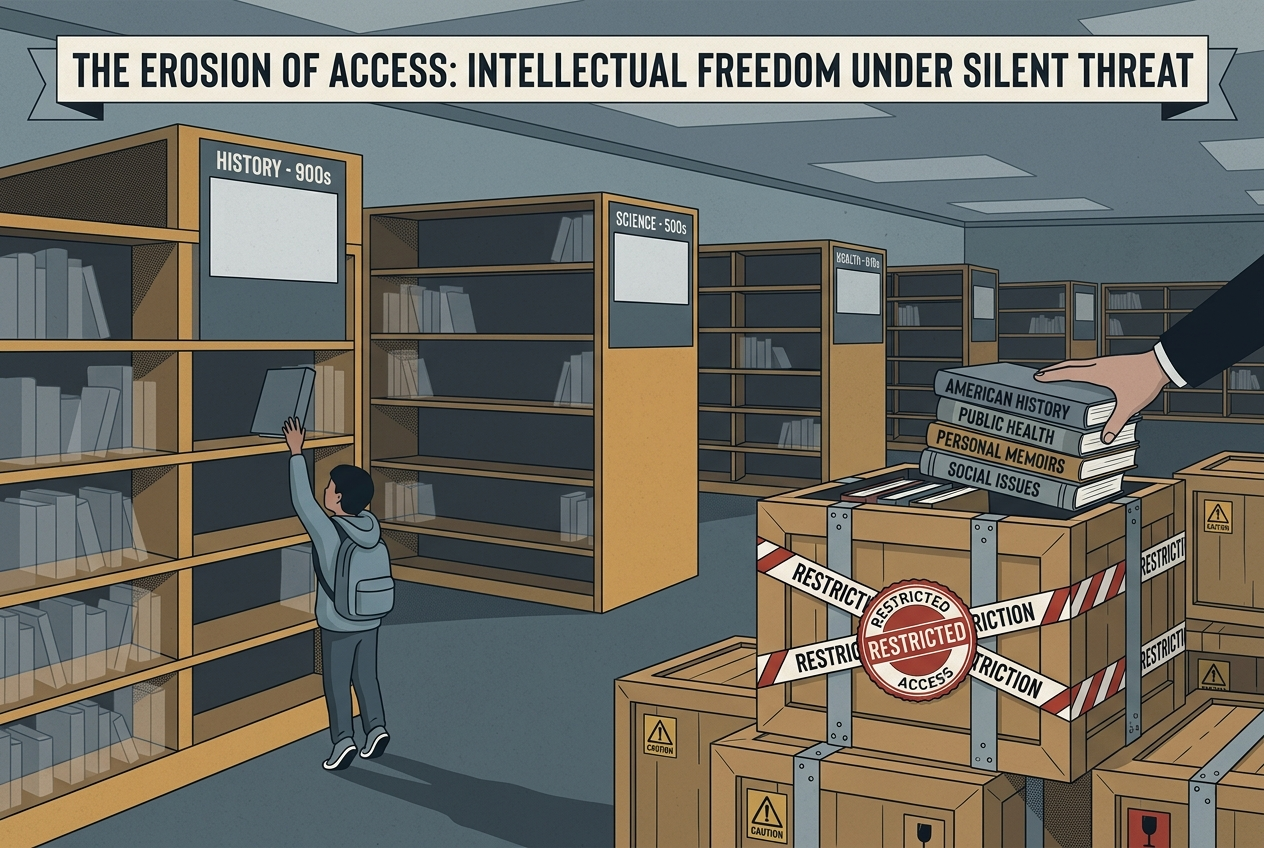
The 2024-25 school year witnessed 6,780 book bans across U.S. public schools, pushing the post-2021 cumulative total past 22,810 and establishing the current era as the most aggressive school censorship campaign in modern American history. Nonfiction titles — including a children's guide to the digestive system, an ancient Egypt educational text, and Elie Wiesel's Holocaust memoir Night — now account for 29% of all banned books, more than double last year's 14%, marking a decisive shift from fiction-targeted content sensitivity to the systematic suppression of verifiable facts. Organized advocacy groups drive 92% of all book challenges, a fifteenfold increase from the 6% figure recorded in 2005, with a single coordinated network capable of distributing a pre-assembled ban list to dozens of school districts in one campaign cycle. While a 34% decline in physical ban counts superficially suggests improvement, the deeper reality is that widespread self-censorship among teachers and librarians — with 65% reporting negative professional impact — has already internalized the censorship pressure, erasing books before any formal challenge is ever filed. The economic toll on publishing, the Supreme Court's refusal to hear a pivotal First Amendment library case, and the looming transition from physical bans to algorithmic content filtering together constitute a censorship infrastructure of far greater durability than any single law or school board decision.
Key Points
Nonfiction Bans Doubled: When Textbooks and Memoirs Become Targets
The 2024-25 academic year produced a data point that has not received adequate attention: nonfiction titles now account for 29% of all book bans in U.S. public schools, up from just 14% the previous year — a doubling in a single academic cycle. Among the 3,743 unique titles banned, 1,102 were nonfiction, and 52% of those nonfiction titles addressed social movements and activism. Educational reference books — textbooks, encyclopedias, health guides — jumped from 5% to 13% of total bans, representing approximately 500 titles in a single year. The specific titles appearing on ban lists tell a more powerful story than any aggregate statistic: Home Life in Ancient Egypt, a straightforward history educational text; A Tour of Your Digestive System, a children''s science guide; Night by Elie Wiesel, the canonical Holocaust memoir that has been taught in American schools for generations. When you ban a book explaining how the stomach works, you are no longer making a content sensitivity judgment about mature themes in fiction. You are telling children that verifiable, documented facts are too dangerous for them to encounter in a school building. PEN America''s Kasey Meehan named this precisely as an embrace of anti-intellectualism, and the data behind that characterization is both specific and alarming.
92% Advocacy-Group-Driven: The Real Anatomy of Organized Censorship
The most structurally important finding in PEN America''s 2026 report is one that should permanently retire the concerned parent framing that has dominated public discussion of book bans. In 2025, 92% of all book challenges were led by organized advocacy groups or the decision-makers those groups had influenced — up from 6% in 2005 and 25% in 2020, a fifteenfold increase across two decades. Fewer than 3% of all challenges now originate with individual parents acting independently on a specific concern. Moms for Liberty alone operates chapters in 48 states with 130,000 members, and 94% of formal challenges arrive not as individual objections but as pre-assembled ban lists for bulk school board processing. George Mason University research found that 90% or more of fundraising emails connected to book ban campaigns originated from Republican political candidate accounts, making the partisan political function of these citizen-language campaigns explicit. What this means structurally is that a small number of national organizations — not a diffuse community of locally concerned parents — are effectively deciding what every child in their target districts can access in their school libraries. I believe this represents the most evolved form of censorship currently operating in a democratic society: the weaponization of parental-rights language to accomplish, at institutional scale, what would be recognizable as political censorship if implemented by government agencies directly.
The Streisand Effect and Its Fatal Statistical Blind Spot
Research from George Mason University and Carnegie Mellon, published in Marketing Science, quantified what many had intuited: the 25 most-banned books saw a 12% increase in library circulation and a 41% improvement in Amazon sales rankings. Gender Queer experienced a 130% surge in U.S. print sales after media coverage of its challenge wave. In Seattle, children''s challenged-book readership rose 19%. These findings are widely cited as evidence that book banning is self-defeating — the ban functions as inadvertent marketing. In specific high-profile cases, that interpretation is correct and important. But the same research contains a finding that fundamentally complicates that optimism: between 82% and 97% of book bans receive no media coverage whatsoever, which means the Streisand Effect — which requires media attention to activate — describes the exception, not the rule. For the vast majority of banned books, there is no sales spike, no advocacy campaign, no cultural moment. They disappear quietly and permanently. Furthermore, sales increases accrue to buyers with purchasing power — the student whose only accessible library is their school library receives no benefit from the fact that a challenged book now ranks higher on Amazon.
Self-Censorship: The Structural Danger That Evades Every Statistic
The 34% decline in formal book ban counts — from 10,046 in 2023-24 to 6,780 in 2024-25 — might appear to indicate that the censorship pressure is easing. I want to argue that this interpretation is not just premature but genuinely dangerous, because it redirects attention away from the more consequential trend underneath that number. First Book Research''s national educator survey found that 65% of teachers report the book ban climate has negatively affected their ability to teach, 71% say their professional judgment has been undermined, 40% describe the experience as feeling like people and histories are being deliberately erased, and 36% report that their capacity to foster critical thinking has been suppressed. These responses describe a profession in which the rational self-protective response is to preemptively remove anything that might invite a formal challenge — before any challenge is filed, before any statistics register, before any legal process begins. That preemptive removal is structurally invisible to the ban-count data. Meanwhile, the conversion rate — the proportion of formal challenges resulting in actual removal — has reached 66%, the highest level recorded since 1990. A declining formal ban count that reflects internalized compliance rather than reduced censorship pressure is not progress; it is the completion of the campaign''s deepest and most durable objective.
America, Russia, China: Three Methods, the Same Destination
The global context for American book banning is instructive in ways that resist comfortable self-congratulation about American democratic exceptionalism. Russia''s 2025 Foreign Agents Book Law has resulted in more than 600 titles being pulled from store shelves, and two prominent writers — Boris Akunin, sentenced to 14 years, and Dmitry Glukhovsky, sentenced to 8 years — are now imprisoned for the content of their published work. China has maintained the world''s lowest internet freedom ranking for over a decade, deleting more than one million pieces of content in early 2025 alone. PEN America recorded 401 imprisoned writers across 44 countries in 2025, with China accounting for 119 of them for the sixth consecutive year. The American censorship model does not involve imprisonment or state violence, and that distinction carries significant moral weight. But in terms of functional outcome — systematic restriction of access to specific facts and perspectives, with the restriction falling disproportionately on children from less privileged backgrounds — the direction of travel is identical across all three systems. The critical difference that makes the American model the most durable of the three is that it operates through democratic language, democratic institutions, and the genuine participation of organized citizen groups. Authoritarian censorship can be reversed when governments change. Censorship normalized through participatory democratic mechanisms is far harder to dislodge once it achieves cultural embedding.
Positive & Negative Analysis
Positive Aspects
- Freedom to Read Legislation Is Building Real Legal Infrastructure
Nine states — California, Colorado, Delaware, Illinois, Maryland, Minnesota, New Jersey, Vermont, and Washington — have already enacted versions of the Freedom to Read Act, which prohibits the removal of books based solely on an author''s background, viewpoint, or identity. These laws represent the most concrete institutional counterweight to organized advocacy campaigns, because they shift the legal default in a fundamental way: instead of needing a successful legal challenge after the fact to undo a ban, the ban itself becomes presumptively illegal under state law. Massachusetts, New Mexico, and Pennsylvania are actively advancing similar legislation, and if all three pass, the number of protected states rises to twelve. Some of these laws include mandatory procedural requirements — such as requiring librarian professional input in any formal challenge review — and several link state funding compliance to anti-removal standards. At the federal level, H.Res. 797 and S.Res. 443 have placed book ban opposition on the national legislative agenda. This growing legislative infrastructure creates structural constraints on organized ban campaigns and provides an expandable model that advocates in other states can use as both precedent and template.
- Federal Courts Are Providing Meaningful Constitutional Guardrails
The federal judiciary has not been passive in the face of aggressive book ban legislation, and the pattern of rulings in multiple circuits has created meaningful legal friction against unlimited censorship expansion. The Eleventh Circuit Court of Appeals found Florida''s HB 1069 unconstitutionally overbroad, and the Eighth Circuit issued a preliminary injunction against the major provisions of Iowa''s SF 496. Three provisions of Florida law were also stayed in Penguin Random House v. Reynolds, preventing enforcement pending further judicial review. These rulings demonstrate that multiple circuits are willing to apply First Amendment scrutiny to book removal laws, and they create the circuit split that may eventually compel Supreme Court resolution. While the Fifth Circuit''s Llano County ruling is deeply concerning — effectively allowing government book removal without First Amendment protection in three states — the existence of contradictory rulings in multiple other circuits prevents that framework from achieving unchallenged national legal dominance. Suing states over unconstitutional book bans has demonstrably succeeded in slowing implementation in several high-profile cases.
- Banned Books Are Generating Record Public Interest and Political Accountability
The research paradox embedded in book ban data is genuinely encouraging on one important dimension. Marketing Science research from George Mason and Carnegie Mellon confirmed that challenged books become culturally significant in ways that ban advocates clearly did not intend, generating 41% improvements in Amazon sales rankings and 12% increases in library circulation across the most-challenged titles. Gender Queer''s 130% print sales surge following challenge coverage is the most dramatic individual example, but the broader pattern is consistent across multiple titles and years. A 19% increase in children''s readership of challenged books measured in Seattle suggests that ban coverage is actively driving young readers toward the very materials being removed — precisely the opposite of the intended effect. Banned Books Week, the Unite Against Book Bans coalition, and increasing social media engagement are collectively shifting public awareness. The political data is consistent with this: Moms for Liberty-backed school board candidates won fewer than 50% of contested races in 2023, suggesting that the political risks of aggressive book ban advocacy are not negligible.
- Civil Society Organizations Are Deploying Increasingly Sophisticated Counter-Infrastructure
The organizations tracking, publicizing, and legally contesting book bans have grown substantially more capable and better-resourced over the past three years. PEN America''s annual Facts & Fiction report now provides school-district-level and state-level ban granularity that enables targeted advocacy campaigns and supports specific legal challenges with precise data. The ALA publishes regular challenged-title updates that function as real-time alerts for librarians and parent advocates across the country. Unite Against Book Bans has established a national organizing network that mirrors the structural model of the advocacy organizations it opposes. Brooklyn Public Library''s Books Unbanned program now provides free ebook access to any U.S. resident, effectively creating a national-level digital bypass for local school removal decisions that cannot be touched by any individual school board vote. These institutional investments represent a genuine capability uplift on the side of intellectual freedom — not just reactive legal defense after removals occur, but proactive infrastructure-building that makes the information ecosystem structurally more resilient to censorship pressure over the long term.
- Digital Access Infrastructure Creates Structural Bypass Routes That Physical Bans Cannot Block
One of the underappreciated structural advantages that defenders of intellectual freedom hold in this fight is fundamentally technological. Physical book bans operate on physical library shelves, and the digital access infrastructure now surrounding those shelves provides meaningful workaround capacity for students who can access it. Brooklyn Public Library''s national ebook lending program, Internet Archive''s digital lending service, Project Gutenberg''s public domain access, and the growing network of state-supported digital library consortia collectively represent an alternative access layer that no individual school board decision can directly touch. A student whose local school library has removed a specific title can, with internet access and basic digital literacy, find that same content in digital form through multiple independent channels. As digital library infrastructure continues expanding through public library e-lending programs requiring only a library card, the structural effectiveness of physical book bans as a comprehensive information restriction tool will continue declining regardless of legislative outcomes.
Concerns
- Self-Censorship Has Become Structurally Invisible and Nationally Pervasive
The most dangerous development in the American book ban story is not any specific law, court ruling, or advocacy campaign — it is the widespread internalization of censorship pressure by teachers and librarians who are removing materials before any formal challenge is ever filed. First Book Research found that 65% of educators report negative professional impact from the book ban climate, 71% say their professional judgment has been undermined, 40% describe the experience as feeling like people and histories are being deliberately erased, and 36% report that their capacity to foster critical thinking has been actively suppressed. These are not descriptions of an external restriction being imposed from above. They are descriptions of an internal professional calculus being made — a rational calculation that preemptive removal is career-safer than waiting for a formal complaint. Self-censorship generates no formal ban count, triggers no legal process, creates no court record, and leaves no statistically visible trail. The conversion rate reaching 66% further strengthens the rational case for preemptive self-removal, because when challenges do get filed, they overwhelmingly succeed. The ban nobody hears about is the most effective and durable ban of all.
- The Publishing Ecosystem Faces Structural Economic Damage That Reshapes What Gets Written
The economic consequences of sustained book ban pressure are reordering the publishing industry in ways that will persist long after any individual ban is reversed. Levine Querido, a specialist in diverse and multicultural children''s and young adult literature, reported a 50% revenue decline in 2023, directly attributable to school district purchasing decisions being shaped by ban-risk calculus. Penguin Random House has publicly disclosed sales declines in challenged-book categories due to school purchasing avoidance before any formal removal occurs. In 2024-25, more than 2,600 creators — 2,308 authors, 243 illustrators, and 38 translators — had their work directly affected by bans. The cumulative structural effect on publishing decision-making is profound: editorial teams that internalize school-market risk become systematically less likely to acquire titles on topics that organized advocacy groups have flagged. More than 40% of banned titles address LGBTQ+ lives or the histories of communities of color, concentrating the chilling effect on the voices and perspectives that have most recently gained mainstream publishing access. This economic restructuring reshapes what books get written, acquired, published, and distributed.
- The Supreme Court''s Non-Intervention Creates a Dangerous and Expanding Legal Vacuum
The most consequential and least publicly discussed legal development in the American book ban landscape is the Supreme Court''s December 2025 decision to decline review of Little v. Llano County. The practical effect of that refusal is to leave intact the Fifth Circuit Court of Appeals'' ruling that a public library''s decision to select or remove books constitutes government speech — and therefore falls entirely outside First Amendment protection. In Texas, Louisiana, and Mississippi, this ruling means that governments can now remove books from public libraries based on their ideas or perspectives without any constitutional scrutiny. If other circuits eventually converge on the Fifth Circuit''s government-speech framework, the entire legal strategy of challenging book removals through First Amendment litigation collapses nationally. Florida''s pending HB 1119 and SB 1692, which would prohibit courts from considering literary, artistic, or scientific merit when evaluating book challenge decisions, represent the legislative frontier of exactly this scenario. Organized advocacy networks would then possess essentially unchecked legal authority to shape public library collections through political pressure.
- The Knowledge Access Gap Disproportionately and Permanently Harms Low-Income Students
Every structural analysis of book bans ultimately returns to an inequity that is rarely named with the directness it deserves: the children for whom the school library is the only library bear the entire cost of removal decisions, while children with economic resources can circumvent those decisions easily with a credit card or a parental digital subscription. Affluent families can order any banned book online within two days. Their children can access ebook collections through parental accounts on platforms that do not mirror school removal decisions. The Streisand Effect sales spikes that researchers document accrue almost exclusively to buyers who already have purchasing capacity. For the student in a low-income household attending a school in a high-ban-activity state — disproportionately a student of color, given that 40% of banned titles address LGBTQ+ lives and communities of color — the school library''s removal of a title is functionally absolute. Book bans thus function as a regressive information tax: the cost falls entirely on those with the least capacity to pay it, while those with resources absorb the impact with minimal disruption, creating a knowledge divide that compounds over years of schooling and across generations.
- Algorithmic Filtering Represents a Far More Powerful and Legally Invisible Next Phase
Physical book bans operate on physical shelves and generate discoverable paper trails — formal challenges, board votes, removal records — that can be contested through legal channels and reversed through democratic accountability processes. The emerging algorithmic equivalent of censorship possesses none of those accountability features, and it operates at a scale that makes physical book bans look like a minor inconvenience by comparison. Amazon controls more than 50% of print book transactions and approximately 80% of ebook sales in the United States, making it a single structural point of extraordinary systemic vulnerability. A quiet recalibration of search result ranking or recommendation weighting can reduce any given title''s effective discoverability to near-zero without generating a formal record or triggering any legal threshold. Educational AI adds a rapidly accelerating dimension: China has already mandated that AI educational platforms comply with official party positions, and early American examples of AI tutoring platforms silently declining to discuss internally flagged topic categories are already appearing in K-12 classrooms. By 2028, more information will likely be effectively inaccessible to American students through algorithmic filtering than through all formal physical book bans combined.
Outlook
In the next six months, the most consequential battles over American book access will unfold simultaneously on two fronts: state legislatures and the federal courts. Massachusetts, New Mexico, and Pennsylvania are all actively advancing Freedom to Read legislation, and if all three pass, the number of states with formal legal protections against ideologically motivated book removal will rise from nine to twelve. On the opposing legislative front, H.R. 7661 — a federal bill that would effectively nationalize certain book restriction standards — is currently in the House Committee on Education and the Workforce, while H.R. 2616 would cut federal funding from schools teaching certain gender-related content. I assess the probability of H.R. 7661 passing the full House at around 40%, with the Senate remaining a structural barrier to final enactment. Even if it stalls, the symbolic elevation of book censorship to a formal federal legislative priority in the world''s most prominent democracy would carry significant normative weight for the advocacy networks driving ban campaigns at the local level.
The federal court landscape is equally active and arguably more consequential for long-term outcomes. Seven or more book-ban-related lawsuits are progressing across the Tenth, Eleventh, Eighth, and Ninth Circuit Courts simultaneously. The central legal fault line is the circuit split between the Eleventh Circuit''s finding that Florida''s HB 1069 is unconstitutionally overbroad and the Fifth Circuit''s Llano County ruling that a public library''s book selection decisions constitute "government speech" outside First Amendment protection. That circuit split is the structural mechanism by which this issue will eventually reach the Supreme Court — but given the Court''s December 2025 refusal to hear the Llano County case, I assess high-court intervention in the next twelve months as unlikely. In the interim, the Fifth Circuit''s government-speech framework gives legal shelter to censorship operations in Texas, Louisiana, and Mississippi, where governments can now remove books on ideological grounds without triggering constitutional scrutiny, a condition that will persist until that split is resolved.
Looking at the twelve-to-twenty-four month horizon, I believe the United States is moving toward a condition that resembles two distinct educational republics operating under the same flag far more than a single country with a unified information environment. Blue-state jurisdictions — California, Colorado, Illinois, and their Freedom to Read allies — are actively fortifying legal protections and expanding digital access infrastructure. Red-state jurisdictions — Florida, Texas, and Tennessee at the center — are institutionalizing and deepening their ban infrastructure in ways that will outlast individual election cycles. This divide is not merely political difference; it is a structural fracturing of the educational ecosystem that will compound over time as students in the two zones accumulate meaningfully different knowledge bases. Publishers specializing in diverse literature will increasingly concentrate their school marketing efforts in receptive blue-state markets, while red-state school libraries will be shaped more by preemptive self-censorship than by formal ban proceedings. I project that the diverse literature sector of the school acquisition market will contract by 30 to 40% from current levels by 2027, measured by school district purchasing budgets. Levine Querido''s 50% revenue collapse is an early-stage symptom of this structural separation already in progress.
The self-censorship trajectory is the medium-term development I find most alarming, precisely because it is hardest to measure and address through existing legal and political tools. Currently 65% of teachers report that the book ban climate has negatively affected their professional judgment and teaching capacity. I expect that figure to reach 75 to 80% by the 2027-28 school year, because book selection decisions are increasingly linked to teacher performance evaluations and employment security in multiple states, with documented disciplinary cases against educators who assigned challenged materials already on record. When teachers weigh professional risk against curricular principle, the rational response under those conditions is preemptive compliance. Physical ban counts might stabilize or even decline to the 5,000 to 6,000 range annually, but the number of books effectively inaccessible due to self-censorship will be two to three times that figure. Invisible censorship is categorically more dangerous than visible censorship: it cannot be measured with precision, challenged through formal legal processes, or reversed through democratic accountability mechanisms. If this trajectory continues uninterrupted, the effective diversity of U.S. public school library collections could fall below half of its 2020 levels by 2028.
Five years out, I believe physical book bans will gradually lose their status as the primary censorship mechanism, displaced by algorithmic content filtering operating at far greater scale and with far less legal exposure or accountability. Amazon''s dominance — controlling over 50% of print book sales and approximately 80% of ebook transactions — creates a structural point of systemic vulnerability that physical library policies cannot touch. A quiet recalibration of recommendation or search algorithms can reduce any title''s effective visibility to near-zero without a school board meeting, without press coverage, and without any legal challenge, because no one banned anything — it''s a private company making a business decision. Educational AI represents an accelerating additional variable: China has already mandated that AI educational platforms comply with official party positions, and early American examples of educational AI platforms declining to discuss internally flagged topic categories are already appearing in K-12 classrooms. I believe that by 2028, AI-based educational platform content filtering will restrict access to more information than all formal physical book bans combined. The technical infrastructure for this already exists. The political and commercial incentives to deploy it are present and growing.
Here are the three scenarios I find most plausible, with explicit probability assignments. In the bull case — which I assign approximately 20% probability — Freedom to Read legislation reaches twenty or more states by 2028, the Supreme Court resolves the circuit split by affirming First Amendment protections for school and public library collections, and annual ban counts fall below 2,000. For this scenario to materialize, either the Court''s ideological composition shifts significantly or public opposition to book bans crystallizes into a decisive electoral force. Research showing a 30% increase in small-dollar donations to anti-ban political candidates suggests that mobilization potential exists, but it has not yet reached the scale needed to overcome the structural advantages held by organized advocacy networks.
In the base case — which I assign 55% probability — the current polarization hardens into permanent geographic divergence. Blue states strengthen protections, red states expand ban infrastructure, and the national annual figure stabilizes in the 5,000 to 7,000 range. Self-censorship continues spreading, diverse publishing continues contracting, and the educational quality gap between state clusters widens in ways that compound across student lifetimes. The Moms for Liberty 2023 electoral performance — winning fewer than 50% of supported school board races — suggests the movement''s momentum may be peaking even as its institutional infrastructure remains durable and well-funded.
In the bear case — which I assign 25% probability — H.R. 7661 passes into law, the Supreme Court either declines to intervene further or actively affirms the government-speech doctrine nationally, and the combination of federal legislative pressure with federal education funding leverage pushes annual bans above 10,000. Florida''s pending HB 1119 and SB 1692, which would prohibit courts from considering literary, artistic, or scientific merit in evaluating book challenge decisions, represent the legislative frontier of this scenario. If enacted and upheld, they would create a regime of effectively unlimited censorship bounded only by the organizational preferences of whichever advocacy network is most active at any given moment.
I want to be transparent about where this forecast could be meaningfully wrong. A strong anti-ban backlash in the 2026 midterm elections could create political dynamics I have not fully weighted in these scenarios. Technology could develop accessible digital infrastructure — distributed library systems, peer-to-peer book-sharing platforms, comprehensive open-access archives — faster than censorship mechanisms can adapt. The advocacy movement itself has natural limits: coalition fatigue, internal fractures, generational turnover, and shifting political priorities all represent genuine vectors of organizational exhaustion. What I remain most confident about is this: the next three to five years will determine whether physical book bans are remembered as a transitional crisis that American legal and civic institutions successfully contained, or as the visible opening chapter of a far longer and far less reversible suppression of the American intellectual commons.
Sources / References
- PEN America "Facts & Fiction: Stories Stripped Away By Book Bans" — PEN America
- 2025 Book Ban and Challenge Data — American Library Association
- Book Bans in American Libraries: Impact of Politics on Inclusive Content Consumption — Marketing Science
- Banned Nonfiction Books Double in Public Schools, Erasing Authentic Stories and Histories — PEN America
- Freedom on the Net 2025: China — Freedom House
- Russia''s Law Against Books by Foreign Agents Signals Tightening Grip — Al Jazeera
- Teacher Self-Censorship National Survey: Impact of Book Bans on Educators — First Book Research
- States Are Banning Book Bans. Will It Work? — Education Week