
Culture

Pandora's Library — The Question 10,000 Authors Asked with a Blank Book, and Whether AI Can Answer
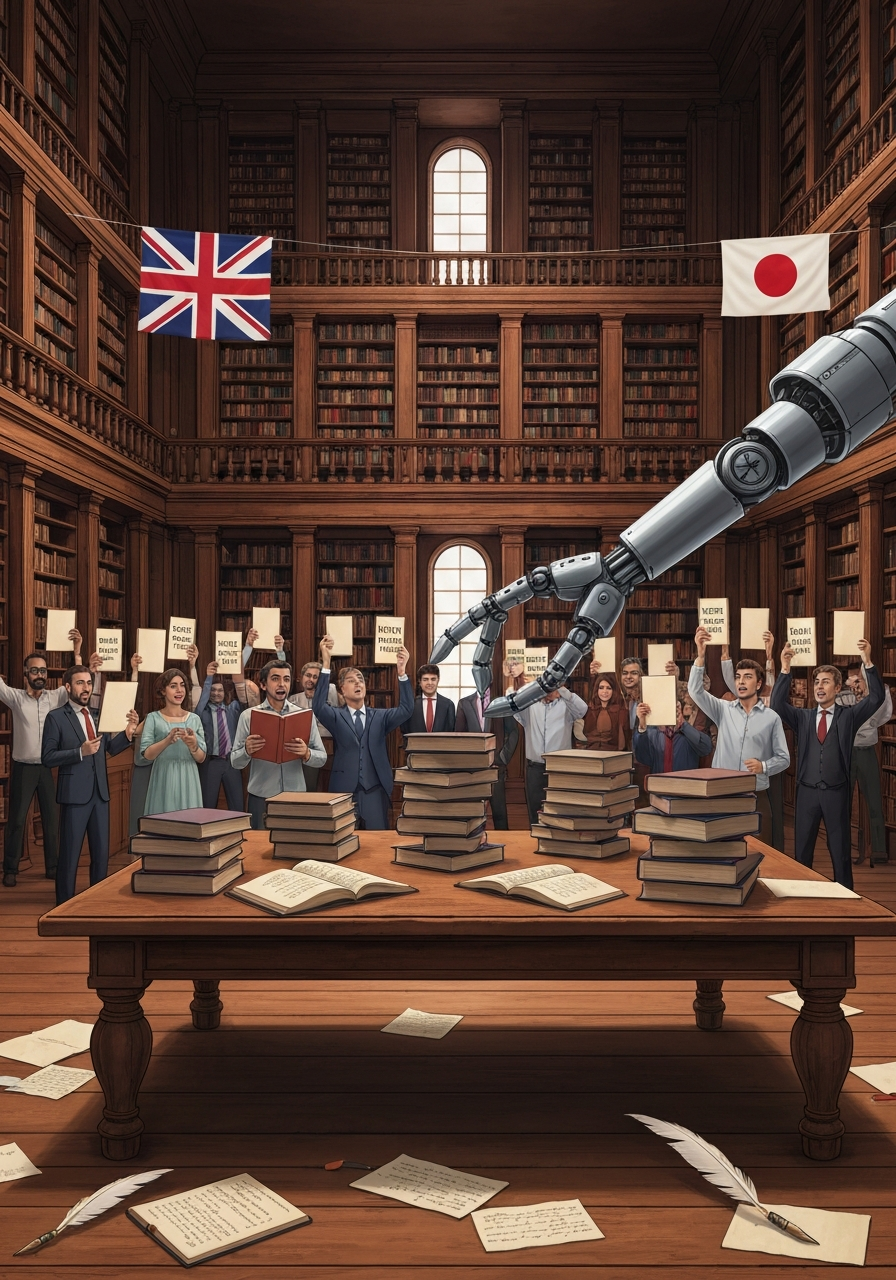
AI Generated Image - Diverse authors in a classical library defiantly holding blank-paged books against a mechanical AI robot arm, with UK and Japan flags on the balcony, quill pens and manuscripts scattered on the floor
AI Generated Image - Authors protesting AI copyright infringement in a grand library symbolizing the global copyright war

Summary

In early 2026, 10,000 authors published 'Don''t Steal This Book,' an 88-page volume containing nothing but their names, as a powerful protest against unauthorized AI training data usage. With the UK government's official withdrawal of its opt-out approach, Anthropic's landmark $1.5 billion settlement, and the US Supreme Court's refusal to recognize AI copyright all converging simultaneously, the global AI copyright war has reached a genuine watershed moment. This analysis examines whether symbolic protest through a blank book can actually reshape industry power structures, evaluates the realistic options for addressing the 'opened Pandora's box' of billions of already-ingested texts, and proposes royalty pools and licensing models as the most viable path forward for both creators and technology companies.

Key Points

1

The Blank Book Paradox — Emptying Content Reveals Its Value

The 10,000-author 'Don''t Steal This Book' is an 88-page volume containing nothing but names, and it has become the defining symbol of the 2026 AI copyright movement. The campaign went beyond simple protest, paradoxically proving that human creative works are the irreplaceable core of AI training data. Similar movements are now being organized on visual art platforms like DeviantArt and ArtStation, with usage of AI training prevention tools like Glaze and Nightshade surging 340% compared to 2025.

2

The UK's U-Turn — Symbolic Victory or Empty Gesture

The UK government's official withdrawal of the opt-out approach for AI training data on March 18, 2026, appears to be a landmark victory for authors, but the reality beneath the surface is far more complex. Whether the framework is opt-out or opt-in, there is currently no technical method to reverse data that has already been learned by AI models. The UKIPO has begun a formal public consultation on a new framework, with approximately 60% probability of introducing compulsory licensing.

3

The Four-Pole Global Copyright War

The global regulatory landscape around AI copyright has fractured into four distinct poles. The US has become a case law laboratory with over 70 active lawsuits. The EU takes a transparency-centered approach through the AI Act. Japan maintains the world's most permissive stance. The UK is now seeking a new framework after withdrawing opt-out. This regulatory inconsistency creates regulatory arbitrage, with approximately 40% probability of a WIPO-led international treaty between 2028 and 2030.

4

The $1.5 Billion Dilemma — Can Money Change the Structure

Anthropic's $1.5 billion settlement is the largest copyright-related settlement in AI industry history. OpenAI also spent approximately $500 million on copyright-related legal costs in 2025 alone. However, compensation is almost certain to be skewed toward major publishers and famous authors. Nevertheless, considering the music industry precedent of 14 years from the Napster lawsuit in 2001 to Spotify stabilization in 2015, the publishing industry may find a new equilibrium by the early 2030s.

5

The Rise of Synthetic Data — The Ultimate Solution to Pandora's Box?

Synthetic data technology is emerging as the most discussed long-term solution. Nvidia and Meta are already investing hundreds of millions of dollars in synthetic data generation pipelines. By 2029, an estimated 30-40% of all AI training data could be replaced by synthetic datasets. However, the initial seed data underlying any synthetic data pipeline is still human creative work, meaning the dependency relationship won't be easily severed.

Positive & Negative Analysis

Positive Aspects

  • Opportunity for Fundamental Redesign of Creator Compensation

    The music industry offers a compelling precedent of transforming the Napster-era crisis into the Spotify streaming model. Anthropic's $1.5 billion settlement serves as a critical first step. The global AI training data licensing market is projected to grow to $5-8 billion by 2027.

  • Elevated Public Awareness and Shifting Political Landscape

    The blank book campaign has been remarkably effective at raising intuitive awareness of AI training data issues among the general public. The 340% increase in usage of AI training prevention tools demonstrates creator communities are moving beyond protest into active self-protection.

  • Formation of a Global Regulatory Laboratory

    The EU's AI Act, US case law accumulation, UK policy shifts, and Japan's permissive approach are simultaneously conducting different regulatory experiments. If the EU's transparency requirements spread as a global standard, ingredient labeling for AI training data will become an industry norm between 2027 and 2028.

  • Reaffirmation of Premium Value in Human Creative Works

    In an era where AI can generate virtually unlimited content, the premium value of genuinely human-written works is paradoxically being highlighted rather than diminished. An era where the Human-Written label becomes a recognized quality assurance mark is rapidly approaching.

  • Voluntary Expansion of AI Company Licensing

    Awareness of escalating legal risk and rapidly shifting public opinion are driving major AI companies to voluntarily build licensing models. OpenAI's agreements with AP and Axel Springer, Google's deal with Reddit demonstrate genuine market-driven momentum toward creator compensation.

Concerns

  • The Unleashed Genie — Irreversibility of Already-Learned Data

    Machine unlearning remains firmly in early research stages with no production-ready solutions on the horizon. With current technology, selectively deleting training data from models with billions of parameters is virtually impossible.

  • Structural Skewing of Compensation — Royalties Concentrated in the Top 1%

    The music streaming industry's royalty distribution provides a sobering precedent. The same structural dynamic is very likely to be replicated in AI training data compensation. Median full-time author income has already dropped to just $20,000 annually, a 42% decline from a decade ago.

  • Global Regulatory Arbitrage — The Trap of a Borderless Digital World

    As long as Japan maintains the most permissive stance, companies can strategically relocate training infrastructure to jurisdictions with looser regulations. A WIPO-led international treaty is expected to take at least 3-5 years.

  • The Time Gap Between Law and Technology

    The 70-plus AI copyright lawsuits currently in progress are expected to take an average of 2-3 years. By the time courts issue definitive rulings, the technological reality may be entirely obsolete.

  • Innovation Suffocation Risk — Counterproductive Effects of Excessive Regulation

    Excessive restriction of AI's access to humanity's knowledge could severely dampen critical public-interest applications. If AI training costs increase 200-500%, small startups and research institutions would be effectively priced out.

Outlook

The ripple effects of 'Don''t Steal This Book' are only just beginning. I expect at least 3-5 similar campaigns to emerge in the first half of 2026. Visual artists, photographers, and illustrator communities are particularly likely to mount their own symbolic protests. Usage of AI training prevention tools like Glaze and Nightshade has increased 340% compared to 2025.

Sources / References

Related Perspectives

Culture

Britain's "Offer" After 240 Years Wasn't a Return — It Was a More Sophisticated Form of Theft

The Parthenon Marbles dispute between the UK and Greece reached a defining turning point in 2026, but the British Museum's proposed "reciprocal loan" arrangement constitutes a structural deception that retains legal ownership in London while offering only temporary physical access to the sculptures. Removed from the Parthenon in 1801 under Ottoman occupation through legally dubious means, these works represent approximately 60% of the surviving Parthenon sculptures and have remained severed from their original context for over two centuries. Despite 56% of British citizens supporting return and UNESCO's Intergovernmental Committee formally calling for intensified negotiations backed by 13-plus nations, the three narrow exceptions embedded in the British Museum Act 1963 continue to function as a legislative wall against any ownership transfer. In an era when the Netherlands returned 119 Benin Bronzes with full title transfer, Germany repatriated over 1,000 artifacts, and even the Vatican returned three Parthenon fragments as outright gifts, the British Museum's loan proposal represents a calculated effort to perpetuate colonial-era legal structures well into the 21st century. At its core, this controversy is not a bilateral diplomatic dispute between Greece and the UK — it is a fundamental stress test of whether the 19th-century concept of the "universal museum" retains any moral legitimacy in the world we actually live in.

Culture

Perfect Technology Kills Civilizations — Angkor's Royal Water System Delivers an 800-Year Warning

Cambodia's APSARA national authority has excavated a large-scale 12th-century Khmer hydraulic infrastructure beneath the royal palace complex of Angkor Thom, revealing a 65-meter reservoir with nine to eleven laterite-step tiers and six canal outlets that once served as a core operational node in the ancient water management network. This discovery adds crucial physical evidence to our understanding of how Angkor sustained up to one million residents across a thousand square kilometers — making it the largest pre-modern city in the medieval world — through an engineering system that achieved sub-centimeter elevation tolerances across dozens of kilometers of canals without modern surveying equipment. The excavation confirms that the hydraulic infrastructure built during Jayavarman VII's reign was not a simple utility but an integrated complex combining royal ceremonial function, urban water supply, agricultural irrigation, and flood regulation within a single, exquisitely calibrated network. Yet this same engineering brilliance that enabled three annual rice harvests became the civilization's fatal vulnerability when extreme climate variability in the 14th and 15th centuries overwhelmed the precision design and triggered cascading infrastructure failures that ultimately emptied the city into jungle. The finding is far more than an archaeological milestone: it is an 800-year-old structural warning about the civilizational risk of total dependence on a single technological system — a warning that resonates with particular urgency for our own era of hyper-centralized AI infrastructure, semiconductor supply chains, and globally interconnected digital networks.

Culture

When the Excavator Stopped, a 2,500-Year-Old Celtic Prince Woke Up Beneath a Solar Farm

The discovery of a circa 500 BCE Celtic princely grave during solar-park construction in Bad Camberg, Hesse, Germany, is reshaping European Iron Age archaeology and forcing a long-overdue conversation about who funds the excavation of the past — and whether "discovery by accident" is ever an adequate heritage strategy. Approximately 100 cataloged artifacts — including three gold rings, an Etruscan bronze beaked jug traced to Vulci in Tuscany, and the iron fittings of a two-wheeled war chariot — provide the first material proof of a local Celtic elite whose existence had been assumed but never physically confirmed for more than 150 years. The Etruscan jug's documented journey of more than 1,200 kilometers from Tuscany to central Germany demonstrates that sophisticated long-distance luxury trade networks were fully operational in fifth-century BCE Europe, directly undermining the assumption that globalization is a modern phenomenon. This find is also the latest installment in a structural pattern in which renewable-energy infrastructure projects — solar parks, offshore wind farms, and high-speed rail corridors — have inadvertently become Europe's most productive engine of archaeological discovery, accounting for roughly 90 percent of all fieldwork through rescue and preventive excavation. Taken together, the Bad Camberg discovery exposes both a chronic structural vulnerability in how historical scholarship operates without adequate material evidence and a genuinely exciting technological opportunity to move from accidental discovery toward systematic, pre-planned heritage recovery in the coming decade.

Culture

South Africa's Empty Venice Pavilion Just Became the Biennale's Most Talked-About "Exhibit" — Minister, That Wasn't Really the Plan, Right?

At the 2026 Venice Biennale, South Africa's national pavilion stands completely empty — a vacancy created when Sports, Arts and Culture Minister Gayton McKenzie canceled multimedia artist Gabrielle Goliath's acclaimed decade-long project "Elegy," objecting specifically to a section memorializing civilian women and children killed in Gaza. The cancellation was delivered unilaterally just eight days before the national submission deadline, directly overriding the unanimous recommendation of South Africa's independent curatorial selection committee, triggering immediate international outrage. Goliath and curator Ingrid Masondo challenged the decision in court, but the North Gauteng High Court dismissed their emergency injunction in February 2026, offering almost no substantive legal reasoning while ordering Goliath to pay the government's legal costs. What followed defied all expectations: the international art world rapidly rallied around Goliath, funding a complete alternative exhibition at Venice's historic Sant'Antonin Church that attracted far more global media attention and public interest than any conventional pavilion appearance could have generated. This episode exposes fundamental structural weaknesses in South African cultural governance, illustrates the enduring paradox of censorship amplifying the very voices it seeks to silence, and raises urgent questions about the relationship between democratic governance and artistic freedom that reach well beyond any single nation's borders.

Culture

The Religion That Kept Its Secrets So Well It Erased Itself from History

Mithraism was a large-scale mystery religion that competed directly with early Christianity for the spiritual allegiance of Rome's legions throughout the first through fourth centuries CE, constructing a network of underground sanctuaries across every major military frontier of the empire. The Mithraeum excavated beneath Zerzevan Castle in southeastern Turkey stands as the best-preserved Mithraic shrine from the Roman period, sealed underground for approximately 1,700 years until its discovery in 2017, featuring a nearly intact tauroctony relief, original altar, and surviving polychrome wall paintings. Scheduled for UNESCO World Heritage Committee review in July 2026, the site represents not merely an archaeological milestone but a convergence of religious history, heritage politics, and Turkey's deliberate nation-branding strategy. The deeper irony at the heart of Mithraism's story — that its absolute commitment to secrecy was both the engine of its explosive growth among soldiers and the structural flaw that guaranteed its eventual extinction — provides a historically unprecedented case study in organizational self-destruction through excessive closure. In an era when global cultural heritage discourse is shifting toward recovering histories deliberately suppressed by political and religious victors, the Zerzevan Mithraeum arrives as the most dramatic physical evidence yet of what gets buried when one tradition conquers another.

SimNabuleo AI

AI Riffs on the World — AI perspectives at your fingertips

simcreatio [email protected]

Content on this site is based on AI analysis and is reviewed and processed by people, though some inaccuracies may occur.

© 2026 simcreatio(심크리티오), JAEKYEONG SIM(심재경)

enko