
Democracy Wasn't Born in Greece — A Study Rewriting 4,500 Years of History
Summary
A study of 31 ancient societies proves democratic governance existed 2,000 years before Athens, dismantling the Eurocentric origin myth.
Key Points
A Comparative Study of 31 Ancient Societies Proves the Pluralistic Origins of Democracy
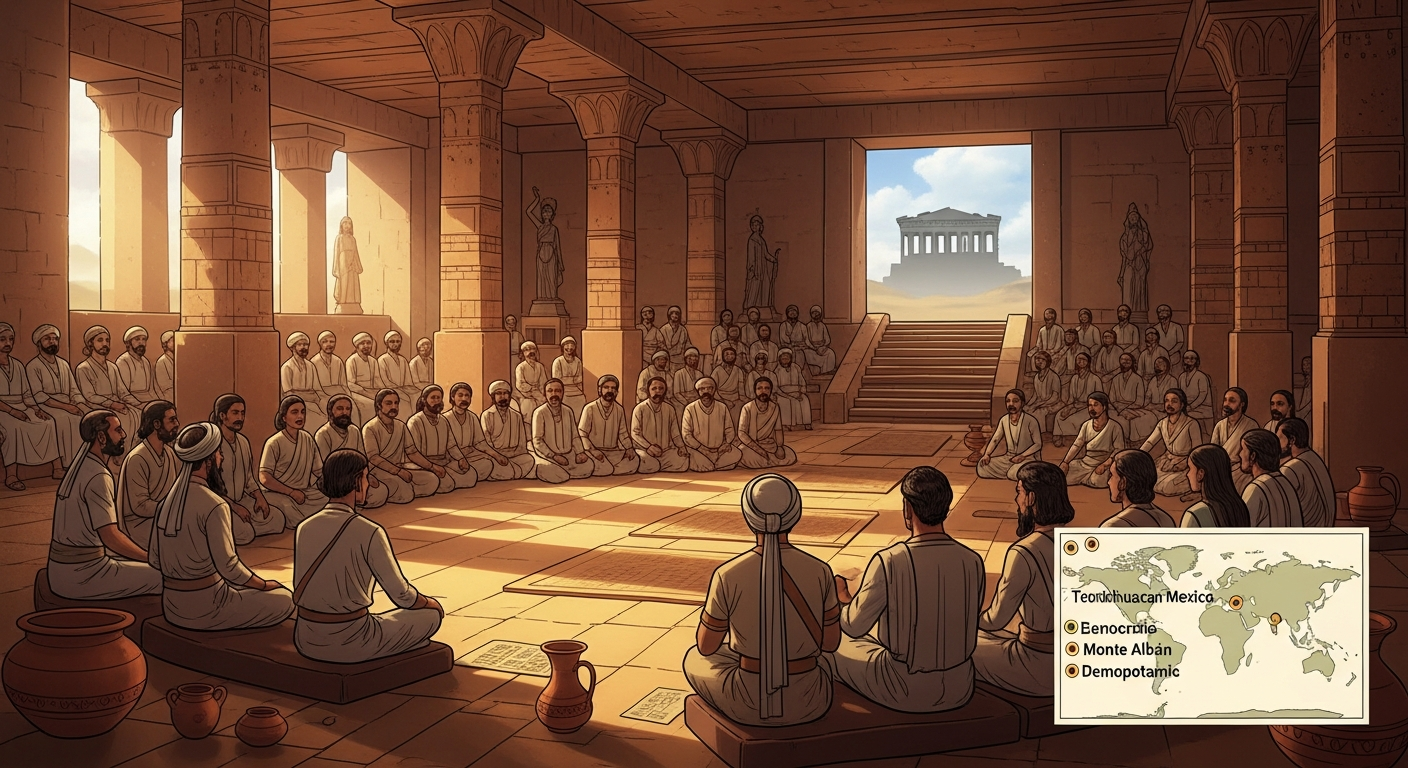
A paper by Feinman et al. published in Science Advances systematically compared 31 ancient societies worldwide using a unified analytical framework. This was a large-scale international collaboration involving researchers from Arizona State University, New York University, Durham University, York University, and other institutions, analyzing 31 polities through 40 case observations. The results demonstrate that democratic governance was by no means exclusive to Greece and Rome — it existed extensively across the Indus civilization, Mesoamerica, and North American Indigenous societies.
Mohenjo-daro's Pillared Hall — Democratic Governance 2,000 Years Before Athens
The Indus civilization city of Mohenjo-daro contained a large-scale assembly space known as the 'Pillared Hall,' capable of seating hundreds of people. This hall was approximately 27.5 meters square, with 20 square brick pillars arranged in four rows, and the complete absence of residential artifacts confirms it was a purely public assembly space. Around 2500 BCE — roughly 2,000 years before Athenian democracy — the physical infrastructure for collective decision-making was already in place.
Teotihuacan and Monte Alban — Evidence of Democratic Governance Lasting 1,000 Years
In Mesoamerica, Teotihuacan maintained collective governance for several centuries, while Monte Alban in Oaxaca sustained this system for over 1,000 years. Compared to the roughly 200-year duration of Athenian democracy, these figures are staggering. This data directly refutes the widespread assumption that ancient democracies were inherently unstable systems that couldn't last.
Fiscal Foundations Determine Governance Type — Regardless of Population Size
The most devastating finding of this study is the consistent correlation between fiscal foundations and governance type. Societies that could monopolize mineral resources or trade routes tended toward autocracy, while societies dependent on community members' taxes developed toward democracy — a pattern observed across all 31 societies. This pattern operated independently of population size.
Dismantling Eurocentrism and Implications for the Modern Democracy Crisis
This research carries direct implications for contemporary politics that go far beyond a simple correction of ancient history. According to Freedom House's 2026 report, global democracy indices have declined for 20 consecutive years, with 54 countries regressing and only 35 improving in 2025 alone. The study offers a new diagnostic framework that locates the causes of the democracy crisis in fiscal structure.
Positive & Negative Analysis
Positive Aspects
- Expanding Recognition of Civilizational Pluralism
If this research becomes established in academia, the Indus and Mesoamerican civilizations will be re-examined as independent agents that developed democracy on their own terms. This is an issue directly tied to the cultural dignity of billions of people and could contribute to the recovery of historical identity for Global South nations.
- Strengthening the Universality of Democracy
Paradoxically, dismantling the 'democracy belongs to the West' frame actually strengthens the case for democracy's universality. Evidence that civilizations with no contact independently arrived at collective self-governance suggests that democracy may be a common human instinct rather than the product of any single culture.
- A New Analytical Framework for Modern Democratic Reform
The finding that fiscal structure determines governance can serve as a concrete policy indicator. By analyzing fiscal concentration, the structural causes of democratic crisis can be diagnosed with far greater precision.
- Educational Innovation and a Generational Worldview Shift
If world history textbooks begin teaching the pluralistic history of democracy rather than the linear 'Greece to Rome to Enlightenment to Modernity' narrative, the next generation will develop a fundamentally different worldview.
- Catalyzing Follow-Up Archaeological Research
This paper is expected to spark additional excavation and research at non-Western civilization sites including Mohenjo-daro and Teotihuacan. Currently, only about 10% of the Mohenjo-daro site has been excavated.
Concerns
- Deep-Rooted Academic Resistance from Eurocentrism
The canon of Western political science stands on centuries of tradition stretching from Plato's Republic through Locke, Montesquieu, and Tocqueville. Resistance from scholars invested in preserving this tradition will be formidable.
- Potential for Political Conflict with Big Tech
When the fiscal-governance model is applied to the present, it highlights an uncomfortable truth about tech giants' monopolization of digital infrastructure. This has the potential to escalate into a massive political conflict between Silicon Valley and governments worldwide.
- Risk of Authoritarian Regimes Co-opting the Research
The conclusion that 'democracy is not a Western invention' could be twisted by authoritarian regimes into 'therefore we need not follow Western-style democracy.' Countries like China and Russia clearly have room to exploit this research.
- Interpretive Controversies Around Archaeological Evidence
An inherent limitation of archaeological research is that inferring political systems from physical remains always leaves room for interpretive debate. The counterargument that 'a pillared hall doesn't prove democracy existed' is entirely plausible.
- Practical Barriers to Textbook Revision
There is typically a 10- to 20-year lag between academic discoveries and their incorporation into educational materials. In the United States, where curricula vary by state, the 'Western Civilization vs. Global History' frame risks becoming another front in the culture wars.
Outlook
Let me start with what's likely to happen in the next few months. This paper was published in March 2026, so the first half of the year will be dominated by the initial wave of academic reaction. Science Advances is a high-impact journal, and major universities have already issued press releases, so media attention is essentially guaranteed. I expect at least 15 academic commentaries and response papers by summer 2026. The strongest pushback will come from Classics and Western political thought scholars. Meanwhile, the reception in archaeology, anthropology, and comparative politics will be overwhelmingly positive. By fall conference season, I anticipate at least 3 to 5 dedicated panels at the SAA and APSA annual meetings.
The social media and public discourse dimension deserves attention too. Popular science outlets have already begun publishing articles, and the headline 'democracy didn't start in Greece' has obvious viral potential. In India and the broader South Asian community, the Mohenjo-daro findings will resonate particularly deeply. The documentary potential alone is enormous; I would not be surprised to see Netflix or BBC commission a major series within the next 18 months.
In the medium term — six months to two years out — structural changes will begin in earnest. Currently, more than 70% of introductory political science courses worldwide begin the story of democracy in ancient Greece. I predict this figure will drop below 50% by 2028. On the follow-up research front, I expect at least 30 related papers by 2027. Additional excavation projects at Mohenjo-daro and Harappa will gain momentum. In Mesoamerica, precision studies of Teotihuacan's governance structure will intensify.
The ripple effects in international political discourse will also become visible. Once the premise that 'democracy is a Western gift' is academically discredited, cracks appear in the power structure of international politics. Between 2027 and 2028, I believe there is a real possibility that international forums like the UN or G20 will produce declarations recognizing diverse forms of democracy.
Looking at the long term — two to five years out — the truly fascinating transformations come into view. The most fundamental is the redefinition of democratic theory itself. Because the word 'democracy' comes from the Greek 'demos' plus 'kratos,' we automatically associate it with Greece. But a movement to give a new name to collective self-governance could emerge. By the 2030s, introductory political science textbooks may begin not with Athens but with 'the human instinct for self-governance.'
The modern application of the fiscal-governance model is where the long-term destructive power truly lies. Once the analysis that tech giants' monopolization of digital infrastructure is structurally identical to ancient resource monopolies becomes academically established, the Big Tech regulation debate ascends to an entirely new plane. The EU's Digital Markets Act would gain historical grounding. Amazon Web Services alone controls approximately 31% of the global cloud infrastructure market, Google Cloud holds 11%, and Microsoft Azure commands 25%. Together, three companies control roughly 67% of the digital infrastructure that modern economies depend on.
Scenario analysis: Bull case (20% probability) — this paper becomes the catalyst for an academic revolution, with UNESCO publishing an official report on the global history of democracy by 2030. Base case (55%) — academia gradually embraces the research while full integration takes another 5 to 10 years. Bear case (25%) — organized resistance from Western political science establishment, with the paper remaining confined to academic debate.
Regardless of which scenario materializes, one thing is certain: the era when 'democracy equals Greece' was taken for granted is over. A question once asked does not disappear. And when that question carries the weight of '4,500 years of evidence,' ignoring the answer becomes progressively harder.
Sources / References
- Collective governance was a common alternative to autocratic rule in the premodern world — Science Advances
- Deep history of democracy: Study reveals origins of self-governance go beyond Greece and Rome — Arizona State University
- Democracy was not just a Greco-Roman affair in the ancient world — New York University
- It wasn't just Greece: Archaeologists find early democratic societies in the Americas — Science/AAAS
- Ancient societies reveal surprising global history of democracy — Durham University
- Mohenjo-daro as democratic as ancient Greece and Rome: Study — Down to Earth
- Scale raises the ceiling, but fiscal foundations determine whether autocracy or democracy prevails — NationofChange
- Ancient societies reveal democratic governance — University of York
- Democracy has deep global roots beyond Greece — phys.org
- The Growing Shadow of Autocracy — Freedom in the World 2026 — Freedom House
- The Mysterious Pillared Hall in Mohenjo-daro — Harappa.com
- The Haudenosaunee Confederacy and the Constitution — Library of Congress
- The Foundation of Monte Alban, Intensification, and Growth: Coactive Processes and Joint Production — Frontiers in Political Science
- Can Government Be Self-Organized? A Mathematical Model of the Collective Social Organization of Ancient Teotihuacan — PLOS ONE
- Monte Alban endured for centuries without extremes in wealth and power — Archaeology Wiki
- The Fiscal Economy of Good Government: Past and Present — Current Anthropology