
5.68 Million People Watched It Live — So Why Does Everyone Keep Saying Esports Is Dead?
Summary
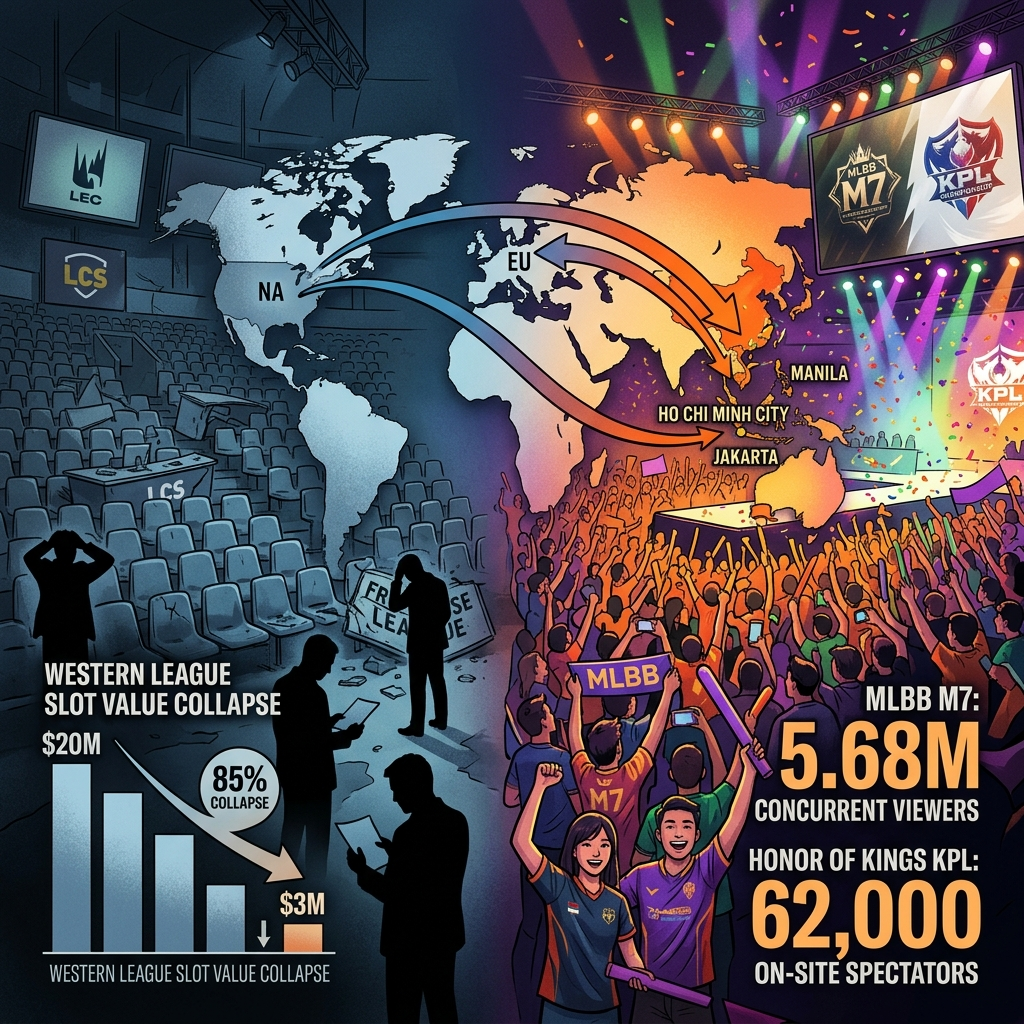
The global esports industry has fractured into two structurally irreconcilable realities: the catastrophic collapse of Western PC franchise leagues and the record-breaking ascent of Southeast Asian mobile esports. LCS and LEC franchise slot values have plummeted more than 85% — from $20 million down to $1-3 million — as Riot Games executed multiple rounds of mass layoffs and organizations including MISA Esports and Los Ratones exited the League of Legends ecosystem permanently in 2026. In sharp contrast, the MLBB M7 World Championship posted 5.68 million peak concurrent viewers in January 2026 — the highest figure in mobile esports history and fourth-highest in all of esports — while Honor of Kings' KPL Grand Final drew 62,000 spectators to Beijing's Bird's Nest stadium, setting a Guinness World Record for the largest live esports audience ever recorded. The Western media narrative of "esports failure" fundamentally misdiagnoses what is occurring: this is not industry decline but a geopolitical power transfer, from Los Angeles and Seoul to Jakarta and Manila, driven by the structural advantages of mobile accessibility and open tournament formats over franchise-based, publisher-controlled models. With 56% of all competitive gaming viewers already watching mobile content and the Southeast Asian gaming market valued at $8.7 billion with a 27.6% compound annual growth rate through 2036, this transition represents a permanent structural shift rather than a cyclical correction.
Key Points
Western Esports Franchise Slots Collapse 85% — A Business Model's Structural Failure
The collapse of LCS and LEC franchise slot values from $20 million to $1-3 million is not a market correction — it is a structural indictment of the entire franchise model as applied to esports, and the numbers make that verdict unavoidable. Riot Games in 2026 alone executed multiple rounds of layoffs, cutting 80 developers from the 2XKO team and 12 more from publishing operations, signaling that even the publisher at the center of the ecosystem can no longer sustain its existing organizational commitments. MISA Esports withdrew entirely from League of Legends citing financial unsustainability, and Los Ratones dissolved their LoL roster — concrete consequences of a franchise architecture that promised permanent value but delivered permanent erosion of capital. Gen.G's CEO publicly declared that "the era of franchising is coming to an end," and when the CEO of one of esports' most commercially successful organizations makes that statement on the record, it reflects not personal frustration but collective industry calculation among people who understand the balance sheets. The fundamental flaw was always that franchise buyers thought they were purchasing something analogous to an NFL team, when they were actually purchasing a revocable license that a game publisher could modify or terminate at any time — as the Overwatch League demonstrated at enormous and very public cost to its investors. The current LoL ecosystem is running the same script and producing the same results: organizations watching $20 million investments trade at $1-3 million, paper losses that will define this era of esports business history as its most instructive cautionary tale.
MLBB M7's 5.68 Million Peak Concurrent Viewers — Mobile Esports All-Time Record
The 5.68 million peak concurrent viewers recorded at the MLBB M7 World Championship in January 2026 is not just a mobile esports milestone — it is the fourth-highest viewership figure in all of competitive gaming history, fundamentally reframing who the global esports audience actually is and where it actually lives. To appreciate the real scale of this number, consider that LCS and LEC regular season matches typically attract 10,000 to 300,000 concurrent viewers — meaning MLBB M7 outperformed Western PC league averages by factors ranging from 20 to 50 times, in a single event. Indonesia's MPL Season 15 independently registered 4.13 million concurrent viewers that same year, surpassing the LCK's peak of 2.03 million by more than double — a result in which a single-country regional mobile league outperformed the world's most prestigious PC esports competition by raw viewership measure. The fact that 56% of all competitive gaming viewers are already watching mobile esports, combined with these record figures, makes one conclusion structurally unavoidable: the center of esports gravity has already crossed the Pacific, regardless of what English-language headlines continue to report. Every narrative calling esports a dying industry is implicitly using LCS and LEC viewership as its baseline for what "esports" means — and that baseline now represents a shrinking minority of what the global competitive gaming audience actually watches in 2026.
Why the Traditional Sports Franchise Model Failed in Esports
The NFL and NBA franchise systems function because they rest on structural foundations that have no equivalent in esports: more than a century of institutional history, deep geographic fan identities rooted in specific cities and communities, physical infrastructure that cannot evaporate overnight, and near-certainty that the league itself will continue operating indefinitely. When Riot Games and Blizzard built closed esports franchises in 2017-2018, they imported the form of the professional sports franchise model without importing any of the structural conditions that make that form viable in the first place. Franchise buyers were told they were purchasing permanent, appreciating assets comparable to owning an NFL team, when what they were actually purchasing was a revocable license contingent on a single corporation's strategic decisions — with no geographic roots, no physical assets, and no independence from the publisher's choices about game longevity or league structure. The Overwatch League stands as the textbook example: organizations paid $10-30 million for franchise slots, then watched those investments become functionally worthless when Blizzard restructured the league on its own terms. The League of Legends ecosystem is currently running the identical experiment and producing the identical results, with 85%-plus value losses confirming the pattern at scale across multiple organizations. The failure of Western esports franchising will serve as a definitive case study in what happens when a century-old industrial business model is grafted onto a fundamentally different digital entertainment ecosystem without the structural adaptations that model requires to function.
Mobile Accessibility and the Democratization of Esports Competition
The explosive growth of Southeast Asian mobile esports is fundamentally a story about access — specifically, about what happens when you remove the hardware cost barrier that previously excluded billions of potential participants and viewers from an entertainment category. Indonesia, with 270 million people and smartphone penetration above 73%, has relatively low PC ownership rates, meaning PC-based esports simply could not reach the majority of the population regardless of content quality. MLBB's open tournament structure compounds the accessibility advantage: unlike Western franchise leagues where entry to top-tier competition requires millions of dollars, open tournaments allow any team with sufficient competitive skill to earn its way into professional play without any buy-in at all. The $8.7 billion Southeast Asian gaming market, with Indonesia accounting for nearly 30% of that value, and mobile esports' projected 27.6% CAGR through 2036, are direct consequences of this access-first model producing real audience growth at scale. A teenager in Manila playing on a secondhand smartphone can realistically pursue a professional MLBB career — a path structurally unavailable in a PC esports ecosystem that requires over $1,000 in hardware before competition is even possible. When you eliminate the hardware cost barrier and replace it with pure skill gates, you transform esports from a wealthy-country niche into a genuinely global sport, and the Southeast Asian viewership numbers represent the measurable expression of that transformation happening in real time.
Honor of Kings' 62,000 Live Spectators and the Guinness World Record
The fact that 62,000 people attended the Honor of Kings KPL Grand Final at Beijing's Bird's Nest Olympic Stadium — setting a Guinness World Record for the largest live audience at an esports event in history — represents something more significant than a single impressive data point or marketing achievement. It demonstrates that mobile esports has achieved the cultural legitimacy and fan intensity that drives people to physically travel to a venue, purchase tickets, and experience an event in person at the scale of the world's most prestigious sports infrastructure. Western esports at its competitive peak managed arena events of 10,000 to 20,000 attendees; the KPL Grand Final tripled or sextupled that figure in a single event held at one of the most iconic venues on Earth. The Honor of Kings World Cup 2026, scheduled for July 30 through August 8 in Paris with a $3 million prize pool — among the largest in mobile esports history — represents an opportunity to establish further benchmarks and meaningfully expand the game's profile in European markets where its penetration has historically been limited. If this tournament succeeds at scale, it will signal to traditional sports media companies, major global sponsors, and international broadcasters that mobile esports commands the same serious commercial attention as premium PC esports, and institutional capital and media rights investment will follow that recognition with lag time but inevitable trajectory.
Positive & Negative Analysis
Positive Aspects
- True Global Democratization of Esports
Mobile esports is accomplishing what PC-based competitive gaming spent a decade and hundreds of millions of dollars attempting and failing to achieve: making esports genuinely accessible to audiences across the full economic spectrum worldwide, rather than a premium product reserved for consumers in wealthy countries with gaming infrastructure. Unlike PC esports, which required expensive hardware that remained out of reach for the majority of the world's population, mobile esports requires only a smartphone — a device that has penetrated developing economies far more deeply than desktop or laptop computers have ever managed at comparable price points. Countries like Indonesia, the Philippines, Vietnam, and Brazil now have robust mobile esports ecosystems because the device that plays the game is also the device that most of the population already carries, reducing the participation barrier essentially to zero for hundreds of millions of potential fans and players. The aggregate data confirms this structural shift: 56% of all competitive gaming viewers globally now watch mobile esports, a majority share that would have seemed implausible to project just five years ago given how completely PC esports dominated the conversation. This democratization does not just expand today's audience — it fundamentally raises the ceiling of how large the esports industry can ultimately become, because an entertainment category accessible to four billion smartphone users has a structurally much larger potential market than one restricted to the fraction of the global population that owns gaming PCs and chooses to spend time in front of them.
- The Healthy Competition Dynamics of Open Tournament Systems
The open tournament model adopted by Southeast Asian mobile esports creates a structurally healthier competitive ecosystem than franchise leagues — one that rewards skill, results, and audience engagement rather than the size of the initial buy-in check written in an investor meeting. Under the franchise system, the same organizations compete year after year regardless of on-field performance, creating the kind of stagnant predictability that gradually erodes fan investment in the competitive outcome and makes the product feel predetermined. Open tournament structures, by contrast, allow new organizations to emerge and challenge incumbents, generating the underdog storylines, unexpected upsets, and competitive unpredictability that make sports compelling in the first place and keep fans emotionally engaged across full seasons. Fans of MLBB and MPL leagues experience genuine stakes in every match because the teams they follow can be eliminated entirely based on competitive results — a consequence that franchise league teams never face no matter how badly they perform against each other. This model is not only more entertaining for fans; it is more financially accessible for competing organizations, since entry does not require a multi-million-dollar franchise fee that would exclude the vast majority of serious competitive teams from even attempting to participate at the top level. Valorant Champions Tour's adoption of a hybrid open-qualifier structure alongside its international leagues suggests that even Riot Games has begun learning from this approach, making the divergence in growth trajectories between VCT and LCS esports all the more instructive.
- Organic Formation of Regional Fan Communities
One of the most striking failures of Western esports franchising was its inability to create genuine geographic fan communities despite deliberately branding teams after cities and investing significantly in local identity campaigns: the LA Gladiators never became "LA's team" in the way the Lakers are, and the New York Excelsior never captured city pride the way the Yankees have sustained for over a century. Southeast Asian mobile esports leagues, by contrast, have generated authentic regional fan communities organically — without top-down branding mandates, artificially constructed geographic affiliations, or expensive marketing campaigns designed to simulate local identity. Indonesian MPL teams carry real regional pride because the players are genuinely from those communities, the broadcasts happen in the local language and cultural idiom, and the culture surrounding the league grew from grassroots participation rather than strategy documents prepared in investor conference rooms. This bottom-up fan development turns out to be exactly what franchise leagues paid hundreds of millions trying to manufacture from the top down — and they simply could not do it, because the conditions that allow authentic fandom to develop are not purchasable at any price. Real sports fandom is built from shared geography, shared language, and shared identity: conditions that money cannot simply acquire, but that naturally exist when a competitive league emerges from within a community rather than being strategically installed on top of one by outside investors.
- Geopolitical Risk Diversification and Industry Resilience
A structurally important but underappreciated benefit of the simultaneous Western esports decline and Southeast Asian rise is that the combination has produced a more geopolitically diversified, and therefore more resilient, global esports industry than has ever previously existed. When Western esports was the only major recognized ecosystem, a crisis in LCS or OWL meant a crisis for "esports" as a category — and media coverage amplified that equivalence, damaging the entire industry's reputation and investor perception simultaneously across all regions. Now, the structural collapse of Western franchise leagues is occurring while overall global esports viewership, participation, and economic activity continue growing, because Southeast Asia and China provide independent growth axes that do not move in lockstep with Western market dynamics or Western investor sentiment. This is directly analogous to geographic diversification in an investment portfolio: when one regional market declines, the overall portfolio can remain healthy if other regional exposures are performing on different cycles. The structural implication is that the global esports industry is now more robust against single-region disruptions than it was five years ago, and whether or not Western franchise esports recovers, the existence of a thriving Asian mobile ecosystem means this industry is unlikely to face the catastrophic total collapse that was a genuine risk when LCS and OWL were effectively the only recognized pillars of professional competitive gaming.
Concerns
- Mobile Esports' Fragile Monetization Infrastructure
The most serious structural challenge facing Southeast Asian mobile esports is the gap between its extraordinary viewership scale and its current monetization effectiveness — a gap that has profound implications for the long-term financial health and institutional sustainability of the ecosystem. Advertising CPM rates in Southeast Asian markets run roughly one-fifth to one-tenth of North American and European equivalents, which means revenue generated per viewer is dramatically lower than what Western PC esports achieves with a much smaller audience in absolute terms. In concrete terms, 5.68 million concurrent viewers in Indonesia might generate less total advertising revenue than 200,000 concurrent viewers in the United States — a disparity that has significant consequences for team economics, league operational budgets, and the overall financial foundation that professional competition requires. Media rights markets, which serve as the primary revenue engine of major global professional sports leagues, have barely been commercialized for Southeast Asian mobile esports, limiting the total economic ceiling of the ecosystem in the critical near-term period when institutional infrastructure needs investment to develop properly. The risk is that mobile esports replicates the trap that threatened Western esports at different points: a large, genuinely passionate audience that nonetheless fails to generate the economic activity needed to sustain professional-grade competition, player salaries, and organizational health at scale. Closing the monetization gap is the single most important structural challenge this ecosystem must solve to fulfill the extraordinary promise its viewership numbers suggest is possible.
- Publisher Dependency — The Unresolved Structural Risk
The most fundamental criticism of Western esports franchise models was that they concentrated too much structural power in game publishers — creating ecosystems that could be disrupted or effectively dismantled by a single corporate strategic decision — and mobile esports faces exactly the same problem, just with different publishers occupying the controlling position. MLBB's entire competitive ecosystem is contingent on Moonton's strategic priorities; Honor of Kings' competitive scene depends entirely on Tencent's willingness to maintain its esports investment at current levels and in current formats. If Moonton decides to reduce competitive gaming spending, shift resources to a new title, or restructure MLBB's league format for business reasons, the entire ecosystem built around that game — regional leagues, professional teams, player careers, broadcaster relationships — faces immediate disruption from a single decision made in a corporate boardroom. The Overwatch League did not fail because of bad ownership decisions or inadequate fan engagement; it failed because Blizzard changed its corporate priorities, and no external authority had the power or standing to prevent that outcome. There is no structural reason the same scenario cannot unfold with Moonton or Tencent, and the current absence of any independent governing body with meaningful authority over publisher decisions means there is no institutional check on this power. For mobile esports to achieve the institutional permanence that makes it a genuinely safe ecosystem for long-term investment and career development, it needs mechanisms that reduce this existential publisher dependency in ways the ecosystem has not yet begun to seriously develop.
- Dangerous Audience Concentration in Just Two Titles
A significant structural vulnerability of the mobile esports boom is that the majority of its viewership and economic activity is concentrated in just two games — MLBB and Honor of Kings — creating a fragility that the impressive headline growth numbers can easily obscure in optimistic analysis. This title concentration means that the entire perceived success of mobile esports as a category is heavily dependent on the continued popularity of two specific products whose longevity and peak popularity are not guaranteed by any structural mechanism. Gaming history provides no examples of a single title maintaining peak popularity indefinitely: PUBG Mobile was once the dominant mobile esports property before MLBB surpassed it in viewership and competitive standing, demonstrating that the leadership position is genuinely contestable and can shift within a relatively short competitive window. If a new title captures the audience currently concentrated around MLBB and Honor of Kings, the transition could happen rapidly, and organizations, leagues, sponsors, and broadcasters built around those specific games would face severe disruption without meaningful advance warning. A genuinely healthy long-term esports ecosystem requires multiple viable competitive titles operating at different scales, giving the industry redundancy against any single game's inevitable decline and creating diverse entry points for different demographics and gaming communities. The current concentration may reflect natural early-stage market dynamics, but it represents a structural vulnerability that the mobile esports industry needs to proactively address before its entire growth trajectory becomes existentially dependent on the continued popularity of two specific products.
- Player Welfare and Labor Standards Lagging Behind Growth
The rapid commercial and viewership growth of Southeast Asian mobile esports has not been accompanied by proportional improvements in player welfare, labor protections, or post-career support infrastructure — creating a situation where the ecosystem's human foundation is developing far more slowly than its commercial and audience metrics. Professional mobile esports players in Southeast Asia earn significantly less than their counterparts in established Western PC leagues, and the relatively shorter competitive lifespans of mobile titles compound the financial instability of careers that may peak in a player's early twenties and then offer limited viable transition pathways. Open tournament structures, for all their genuine competitive virtues, mean that lower-tier teams often cannot guarantee even basic stable income for their players, creating a large class of semi-professional competitors operating across the region without financial safety nets or organizational support when competitive results disappoint. The retirement pathway from professional mobile gaming remains seriously underdeveloped: meaningful support systems for athletes whose peak competitive years end in their mid-twenties are rare, and the specific technical and strategic skills that define professional mobile gaming do not translate into broader employment markets in obvious or easily communicable ways. If the industry's commercial growth continues to substantially outpace the development of player protection infrastructure and labor standards, it risks the kind of high-profile disputes and reputational damage that have periodically complicated the public perception of other professional sports industries. The publishers and organizations driving this growth have both a moral obligation and a clear commercial self-interest in ensuring that the human cost of building this ecosystem is not entirely externalized onto the players whose performance and dedication make it possible.
Outlook
The next six months in Western PC esports will be defined by further structural deterioration before any meaningful recovery becomes plausible. I am placing the probability above 60% that LCS franchise slot values continue declining from their current $1-3 million range toward $500,000-$1.5 million by the end of 2026. The Gen.G CEO's public declaration about the end of franchising is not isolated contrarianism — it reflects calculations being made across the industry by stakeholders who can see the math clearly and have stopped pretending it works. Following MISA Esports and Los Ratones, I expect at minimum two to three additional organizations to exit the LoL ecosystem in the next six months. The operational cost of maintaining a franchise slot alongside player salaries, coaching staff, and content production cannot be justified when the commercial return has collapsed and the slot itself is worth a fraction of its acquisition cost. The rational decision for most remaining holders is an orderly exit rather than continued loss absorption in a model that shows no path to profitability.
Riot Games is almost certainly already modeling alternatives to pure franchising internally, but the path forward is genuinely complicated by its existing legal and financial relationships with current franchise holders. When organizations paid $13-20 million for assets they were explicitly told would appreciate and hold permanent value, you cannot simply announce a model restructuring without triggering substantial disputes. What I expect to see announced in the second half of 2026 is some version of a hybrid structure: partial reintroduction of promotion and relegation, a reduction in total franchise slots, or a parallel open pathway for emerging teams operating alongside the existing franchise layer. The Valorant Champions Tour has already road-tested this blended architecture — combining international franchise leagues with open regional challengers — and that format represents the most pragmatic template available. That structure is, I would argue, the near-inevitable direction for LoL esports within the next twelve to eighteen months, because the current model is no longer attracting new investment and is actively hemorrhaging existing participants who see no path to return on their commitments.
Southeast Asian mobile esports, meanwhile, enters the second half of 2026 with significant momentum and a clear event calendar that provides multiple opportunities for additional records. The most important near-term milestone is the Honor of Kings World Cup 2026, running from July 30 through August 8 in Paris, with a $3 million prize pool — among the largest in mobile esports history. Given that the KPL Grand Final already broke the all-time live attendance record with 62,000 spectators at the Bird's Nest, the Paris event has a credible shot at establishing new benchmarks, particularly for Western market exposure to a title that has historically been concentrated in Asian demographics. For MLBB, the second-half regional schedule — featuring MSC and multiple national MPL seasons — offers the ecosystem continued opportunities to expand its viewership base. With the M7 having set 5.68 million concurrent viewers in January and the ecosystem continuing to grow, I put the odds at approximately 40% that a single mobile esports event crosses the 7 million concurrent viewer threshold before the end of 2026, a figure that would have seemed impossible to contemplate for mobile esports just three years ago.
In the one-to-three-year timeframe, the most consequential structural development will be the maturation of Southeast Asian mobile esports' monetization infrastructure. Right now, the ecosystem's primary revenue streams are sponsorships and in-game item sales — meaningful, but structurally insufficient to support the kind of professional institutional infrastructure that defines mature sports leagues globally. The next major evolution is media rights commercialization. I project that by mid-2027, MLBB's global media rights package could realistically trade in the $30-50 million annual range. That falls below the peak LCS media rights valuation, but it represents a legitimate business foundation — and its trajectory is sharply upward while LCS moves in the opposite direction simultaneously. The CPM differential between Southeast Asian and Western markets will narrow gradually as regional GDP per capita rises and digital advertising infrastructure matures. Indonesia and the Philippines are both sustaining 5-6% annual GDP growth rates, and digital advertising spend across the region is expanding rapidly. The monetization gap is structurally real today; I expect it to be meaningfully smaller by 2028, and the industry will look substantially different as a result.
By the end of this decade, the global esports landscape will be unrecognizable compared to its 2020 configuration. My single strongest long-range prediction: by 2030, at least six of the world's top ten most-viewed esports events will be Asia-Pacific based. The data already points emphatically in this direction — MLBB M7 at 5.68 million, Indonesia MPL at 4.13 million, Honor of Kings KPL at multiple millions, all setting records that Western leagues cannot approach even on their best days. Apply the Southeast Asian gaming market's overall 11.4% annual growth rate and mobile esports' projected 27.6% CAGR, and by 2030 this ecosystem will be approximately three to four times its current scale. That is not just more viewers — it is more sponsorship value, more media rights revenue, more professional infrastructure, and more cultural legitimacy globally. When South Asian markets — India, Bangladesh, Pakistan — fully activate for competitive mobile gaming, the shift becomes structurally irreversible. India already has over 500 million mobile gamers, and both MLBB and Free Fire are growing rapidly in that market. The Asia-Pacific region could command 70% or more of all global esports activity by 2030.
The long-term wildcard that deserves substantially more analytical attention than it typically receives is the Olympics. The IOC's discussions around esports as a potential official competitive discipline are expected to intensify significantly between 2026 and 2028, and the outcome of that selection process has the potential to either dramatically accelerate or significantly complicate the current power shift. I would argue mobile games hold a structural advantage in any Olympic selection process: they are accessible to athletes from virtually any country, require no expensive specialized hardware, and align naturally with the IOC's stated values around global participation and inclusion across economic levels. If MLBB or Honor of Kings achieves Olympic recognition, Asia-Pacific dominance of esports becomes institutionally cemented — the world's most prestigious athletic event would be validating precisely the games currently setting viewership records. If League of Legends is selected instead, it would provide Western esports a significant but potentially temporary revival, structurally limited unless the underlying franchise model issues are simultaneously resolved. Either outcome reshapes the trajectory of this industry in ways that go far beyond what any single tournament record can accomplish.
Let me map the 2030 scenario in explicit terms. The bull case requires mobile esports achieving Olympic recognition, Southeast Asian media rights values crossing $100 million annually, and Western leagues successfully transitioning to open circuit models that generate a new growth cycle. In this scenario, the global esports market exceeds $5 billion by 2030 and the industry achieves genuine mainstream cultural standing. The base case sees mobile esports growing steadily without Olympic inclusion before 2032, Western esports transitioning slowly to hybrid models while facing continued organizational attrition, and the overall market sustaining 8-12% annual growth — putting global market size at $3-3.5 billion by 2030. The bear case involves mobile esports also failing to monetize effectively at scale, the Western franchise collapse poisoning investor sentiment across the entire category, and esports retreating to its status as a defining subculture of the 2010s rather than a mainstream entertainment industry. I place the bear case probability below 15%, and here is precisely why: 5.68 million verified concurrent viewers is not a projection or a model output — it is an audited data point from a real event watched by real people. The demographic reality of Southeast Asia, one of the youngest, fastest-urbanizing, and most mobile-connected populations on Earth, is not a trend that reverses based on what English-language media chooses to cover. Even if individual titles decline, the structural conditions for mobile esports growth remain firmly, demonstrably intact.
There are scenarios that could substantially alter or delay this trajectory, and intellectual honesty requires acknowledging them plainly. If Western publishers develop genuinely innovative competitive formats — not cosmetic adjustments to broken franchise structures, but real reinventions that address the fundamental publisher-dependency and asset-impermanence problems — the Western esports revival could change the timeline significantly and complicate the straightforward power-shift narrative. A meaningful political disruption or unexpected regulatory crackdown on gaming in Southeast Asian markets could constrain growth in ways that are difficult to model in advance from outside those regulatory environments. And the emergence of a genuinely new platform or genre — VR esports, augmented reality competition, or something we cannot currently envision — could fracture the mobile esports audience before the ecosystem has fully consolidated its institutional position. These are real risks, not hypothetical edge cases. But the forces driving this power shift — demographic, economic, and technological — rank among the most durable forces in any market analysis. They do not reverse because a publisher posts a strong quarter or a Western media outlet finally decides to report from Jakarta. The center of esports power is moving East and South, it is moving faster than most Western analysis has grasped, and the window for positioning ahead of that shift is measurably closing.
Sources / References
- The Rise, Fall, and Reset of Esports — D Magazine
- MLBB M7 World Championship Sets Mobile Esports Viewership Record — Esports Insider
- Esports Trends 2026: Industry Figures & Insights — Esports Charts
- Franchise Fatigue: The Big League Model's Breaking Point — Esports Insider
- Why Southeast Asia's Gaming Market Is Bigger Than a Games Story — TechNode Global
- Gen.G CEO: The End of Franchises in Esports — Esports.net
- MISA Esports Withdraw from League of Legends — Sheep Esports
- Los Ratones Shut Down LoL Roster — Esports Charts
- Riot Games Lays Off 80 2XKO Developers — Sunday Guardian Live
- How Esports Viewership Is Going Global in 2026 — Esports Charts