
You Never Owned That Game — The Uncomfortable Truth 1.3 Million EU Signatures Finally Forced Into the Open
Summary
The Stop Killing Games initiative delivered 1,294,188 validated signatures to the European Commission, which formally declined on June 16, 2026, to impose legal obligations on the gaming industry, offering a voluntary code of conduct as its non-binding institutional response. This decision confirmed what the gaming industry has long asserted and consumers have long contested: digital game transactions are legally licenses rather than purchases, meaning 3.6 billion gamers worldwide have never held ownership over the software they believed their "Buy Now" clicks conferred. Data from the Stop Killing Games Wiki shows that 81.2% of 738 tracked online-dependent titles are already unplayable or at acute risk of permanent closure, with 52 server shutdowns recorded in the first half of 2026 alone — a pace that outstrips any proposed regulatory response. California's state legislature pushed back by passing AB 1921, the Protect Our Games Act, by a decisive 43–16 margin, marking the first meaningful legislative milestone for game preservation in the United States and raising the prospect of a "California Effect" comparable to the one that followed the CCPA. The contrast between the EU's institutional retreat and California's legislative momentum suggests the decisive front in the digital ownership debate has shifted westward, and that the next 12 to 18 months — shaped by the AB 1921 Senate vote and the EU's forthcoming Digital Fairness Act — will determine whether enforceable consumer rights in digital gaming become a global standard or remain a regional experiment.
Key Points
The "Buy Now" Button Is a Documented Legal Fiction
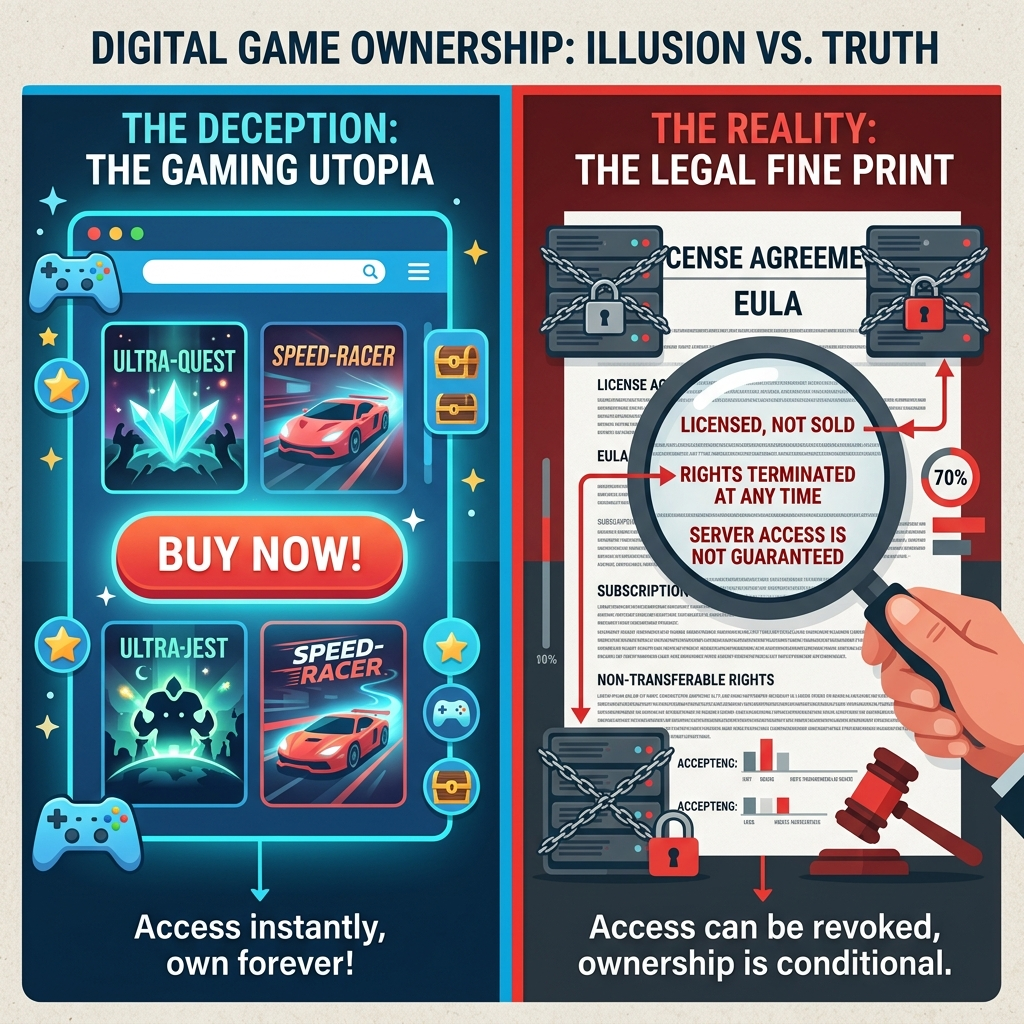
Digital game storefronts built their commercial empires on a single word that doesn't legally mean what it implies. Every time a consumer clicks "Buy Now" on Steam, the PlayStation Store, or the Xbox marketplace, they are not purchasing software — they are acquiring a limited-access license that the publisher can revoke, restrict, or terminate without notice. Ubisoft made this explicit during The Crew litigation, arguing that consumers "never owned The Crew" and therefore had no legal standing to demand continued access or refunds. The Entertainment Software Association echoed this publicly, insisting that "games are licenses, not ownership" and that consumers should have understood the distinction from the start — while simultaneously lobbying against any requirement to disclose that distinction at the point of sale. California became the first US state to address this contradiction legally with AB 2426 in 2024, requiring that any digital media labeled "Buy" or "Purchase" must explicitly disclose its license-only nature starting January 1, 2025. In a market where 95% of game sales are digital and the global gaming industry is valued at $188.8 billion, almost every major commercial transaction in gaming rests on this structural gap between marketing language and legal reality. The unanswered question — who decided to put the word "Buy" on that button in the first place — remains the most damning one in the entire debate.
EU Commission's Refusal — IP Law vs. 1.3 Million Democratic Voices
The European Commission's formal rejection of the Stop Killing Games ECI on June 16, 2026, was not a procedural technicality but a substantive policy decision with far-reaching implications for digital consumer rights across the continent. The Commission's two-part rationale stated that existing intellectual property frameworks already grant rights holders exclusive control over their creative works, and that imposing mandatory obligations on publishers would violate the EU's proportionality principle. Officials pointed to the Digital Content Directive (2019/770) as adequate existing protection, claiming it already provides consumers with rights to proportional refunds when digital content fails to perform — a claim that collapses under examination. That directive was fully in force when Ubisoft terminated The Crew's servers, and no automatic refund mechanism triggered; Ubisoft successfully used license language to escape accountability entirely. French consumer organization UFC-Que Choisir filed suit against Ubisoft in March 2026 specifically because the existing legal framework proved inadequate in practice, which is itself the most damning rebuttal to the Commission's "existing law is sufficient" position. The episode also exposed the structural limitation of the European Citizens' Initiative mechanism: reaching one million signatures compels the Commission to "review" a proposal, not to act on it, meaning the entire process was always advisory rather than binding by structural design, regardless of the signature count achieved.
California AB 1921 — The Most Pragmatic Game Preservation Law Yet Designed
California's Protect Our Games Act stands out not just for passing but for how it was designed, because it actively grapples with the technical and economic realities that have caused game preservation legislation to fail in other contexts. The bill's three-option compliance structure — provide an offline-playable version, release a standalone operating patch, or issue full refunds — is specifically engineered so that publishers always have at least one achievable path to compliance regardless of their technical architecture or anti-cheat system dependencies. The ESA's most-deployed counterargument, that live server dependencies make offline conversion technically impossible, is effectively neutralized by the refund option, which requires zero engineering resources to implement. Subscription services, free-to-play games, and titles already supporting offline play are explicitly exempt, reducing regulatory burden on smaller studios and indie developers who were not the bill's intended target. The law's January 1, 2027, forward-looking application covers only games released after that date, avoiding the technical and legal complexity of applying retroactive obligations to thousands of existing titles simultaneously. The precedent set by AB 2426 — which California passed in 2024 requiring license disclosure on digital media marketed as "Buy" — reveals a deliberate sequential legislative strategy: establish disclosure requirements first, then preservation requirements second, building a coherent consumer protection architecture one enforceable layer at a time.
Voluntary Codes Have a 30-Year Track Record of Structural Failure in Gaming
The EU Commission's voluntary code of conduct proposal is not just inadequate in ambition — it is the type of response that a detailed historical record shows to be structurally incapable of producing meaningful change in gaming industry commercial practices. A 2025 Royal Society and PubMed Central study examined the UK's voluntary loot box self-regulation framework and found that not one of the top 100 iPhone games on the App Store obtained explicit consent from minors before enabling loot box purchases — a documented compliance rate of exactly zero percent. The University of Chicago's Stigler Center traced the pattern from the ESRB's founding in 1994 through the loot box era, documenting how structural commercial conflicts of interest prevent self-regulatory bodies from enforcing standards that would cost their member companies meaningful revenue. This pattern — what regulatory scholars call industry capture — involves creating governance-adjacent institutions whose primary function is forestalling external regulation, not achieving actual compliance with stated objectives. The Commission's own press materials describing the voluntary code explicitly noted the absence of enforcement mechanisms, meaning compliance is entirely elective even under the framework's own stated terms. For the Entertainment Software Association, the EU's decision to substitute a voluntary code for mandatory law was functionally equivalent to a win declaration — and the 30-year historical record of gaming self-regulation provides no rational basis for expecting a different outcome this time around.
Digital Fairness Act — The Real Legislative Fight Has Just Opened
The Stop Killing Games movement's pivot from the ECI to the Digital Fairness Act is a strategically significant shift that received far less attention than the Commission's headline rejection, but it may ultimately prove to be the more consequential development in the long run. While the ECI process positioned SKG as a petitioner asking the Commission to "please consider" a proposal, inserting amendment language into the DFA through the European Parliament positions the movement as a direct participant in binding legislation that the Commission cannot simply choose to decline. The Digital Fairness Act is expected as a Commission proposal in Q4 2026, with its current scope covering dark patterns, manipulative digital design, and deceptive personalization practices — all areas where the gaming industry has significant regulatory exposure. Dozens of MEPs had already signed letters calling for legal action as of June 2026, giving the SKG coalition meaningful internal parliamentary allies to work with during the amendment drafting and negotiation process. The critical structural difference between a successful DFA amendment and the ECI outcome is that DFA provisions cannot be unilaterally declined by the Commission once they pass as Parliament-initiated legislation — they bind all 27 EU member states with full legal force and real enforcement mechanisms. If both AB 1921 in California and a DFA game preservation provision take effect in overlapping timeframes, the combined regulatory pressure would represent the first genuine two-front squeeze on global publishing practices from the world's two most powerful consumer markets simultaneously.
Positive & Negative Analysis
Positive Aspects
- Digital Ownership Has Finally Reached Formal Institutional Agenda Status
The Stop Killing Games campaign achieved something no prior gaming advocacy effort has managed: placing digital game ownership on the formal institutional agenda of a supranational governing body and a major US state legislature simultaneously, in the same news cycle. Before this campaign, the debate lived almost exclusively in gaming forums, industry journalism, and advocacy reports — spaces that produce no binding outcomes and carry no political weight beyond public pressure. The delivery of 1,294,188 validated signatures triggered formal hearings at three European Parliament committees and produced an official written Commission response, a level of institutional engagement that gaming consumer issues have essentially never received before at this scale. California's Assembly vote of 43–16 demonstrated that game preservation is no longer a niche concern — it commands a legislative supermajority when properly framed as a mainstream consumer rights issue rather than a gaming hobbyist complaint. France's UFC-Que Choisir lawsuit simultaneously opened a third institutional channel — the judiciary — operating independently of both the petition and legislative tracks, which means the pressure on publishers is now coming from three directions at once. Once an issue enters the institutional agenda through this many simultaneous and independent channels, it is structurally very difficult to remove entirely, which means the political momentum Stop Killing Games created has durable staying power regardless of any single decision going against it in the short term.
- AB 1921's Three-Option Design Is Technically and Commercially Achievable
The greatest risk for game preservation legislation has always been that technically unachievable mandates would expose the law to court challenges or exemption lobbying that guts it before implementation. AB 1921's designers addressed this directly by building flexibility into the compliance structure rather than mandating a single technical solution that some game architectures genuinely cannot meet. The three-option approach — offline version, standalone patch, or full refund — means every publisher can always identify at least one achievable path to compliance regardless of their technical architecture, anti-cheat dependencies, or server infrastructure. The fan community "The Crew Unlimited" empirically disproved the "technically impossible" argument by successfully restoring unofficial servers for The Crew without the corporate resources that Ubisoft claimed were required for such an undertaking. Exempting subscription services and free-to-play games makes the law more politically durable by concentrating obligations on high-value commercial transactions while limiting opposition from the independent developer community that often shapes moderate legislative opinion. California's sequential approach — AB 2426 in 2024 establishing disclosure, AB 1921 establishing preservation — shows a policy architecture designed for refinement and extension rather than a one-off effort with no follow-through path.
- California Effect Could Make a Single State's Law a Global Publishing Standard
The prospect that California's game preservation requirements might become the de facto global publishing standard is not optimistic speculation — it is a documented historical pattern that has repeated across multiple industries driven by the same underlying commercial logic. After the CCPA took effect, more than 20 states passed their own comprehensive data privacy laws, and the majority of globally operating companies found it more cost-efficient to adopt the California standard as a universal baseline than to maintain 50 distinct compliance architectures across separate state jurisdictions. Vehicle emissions regulations followed identical logic: California's stricter standards became the functional US national standard because manufacturers found building to one specification operationally cheaper than building to two, regardless of their philosophical position on the regulation itself. The US gaming market generates revenues that no major publisher can afford to exit, California alone represents the largest single state economy in the country, and AB 2426's 2024 passage — enforced without significant industry defection despite ESA public opposition — already established that gaming companies will comply with California consumer protection requirements when they are legally mandatory. A sequential legislative architecture moving from disclosure to preservation creates a progressively stronger consumer protection framework that other states can adopt wholesale without the years of policy development California itself invested in establishing the baseline.
- Academic Research Now Gives Regulators Evidence-Based Grounds to Reject Self-Regulation
One of the most significant but underappreciated developments in the Stop Killing Games debate is the emergence of peer-reviewed academic research that quantifies exactly how and why gaming industry self-regulation fails on measurable outcomes. The Royal Society and PubMed Central study documenting zero percent compliance in UK loot box self-regulation is methodology-compliant research published in credible academic venues, which means regulators, courts, and legislators can cite it as evidentiary support rather than relying on moral intuition or advocacy claims alone. The Stigler Center's 30-year analysis of gaming self-regulation failure provides the theoretical framework — industry capture — that explains the mechanism behind the data, not just the outcome numbers. Together, these bodies of work give European Parliament members, US state legislators, and consumer protection attorneys a foundation for systematically dismissing self-regulatory proposals that previously had to be challenged primarily on ethical or intuitive grounds rather than empirical evidence. The EU Commission's voluntary code proposal is no longer just questionable in principle — it is now empirically predictable as ineffective, based on documented evidence from a directly analogous situation in the same industry with the same major actors involved. This shift from moral argument to evidential argument changes the political dynamics of the debate in ways that structurally favor legislative action over industry-preferred voluntary frameworks in any jurisdiction where evidence-based policymaking has traction.
Concerns
- The Gap Between Legislative Timelines and Game Extinction Rates Is Already Critical
Even under the most optimistic legislative scenario, there is a fundamental structural mismatch between how fast the law moves and how fast games are disappearing — and games already lost cannot be recovered by any law passed afterward. AB 1921, if it clears the California Senate and receives the governor's signature in 2026, applies only to games released after January 1, 2027, meaning every title currently operating that could be shut down tomorrow receives no protection from the bill whatsoever. The Video Game History Foundation established that 87 percent of games released between 1960 and 2009 are already commercially inaccessible, and the Stop Killing Games Wiki data on 738 tracked titles shows 34.3 percent already unplayable and another 46.9 percent actively at risk of imminent shutdown. Fifty-two servers went dark in the first half of 2026 alone, projecting to more than 100 annual closures if the pace holds through the year. Every game that disappears before protective legislation takes full effect takes with it not just software but artistic design decisions, community memory, cultural context, and in many cases the only existing playable instance of that creative work — a form of loss that has no analog in literature or film, where physical copies and archival institutions create redundancy. Unlike books or movies, server-dependent games leave no artifact when their infrastructure is removed: the loss is immediate, complete, and irreversible in a way that no subsequent legal remedy can address retroactively.
- Subscription Growth May Render the Ownership Debate Commercially Obsolete
The most sophisticated long-term threat to the digital ownership movement is not legislative failure but market evolution that makes the ownership category commercially and legally irrelevant before protective frameworks can fully take hold. The gaming subscription market reached $14.3 billion in 2025 with annual growth of 14.3 percent, with PlayStation Plus at 51.6 million subscribers and Xbox Game Pass at 37 million — representing 35 to 40 percent of active gamers already paying for "access" rather than "ownership" as their primary gaming consumption model. AB 1921 explicitly exempts subscription services from its requirements, which means the fastest-growing market segment is structurally excluded from the consumer protection framework the bill creates. Xbox Game Pass Ultimate's price increased approximately 50 percent over two years while subscriber counts grew 12 percent, which suggests consumers have already internalized an access model and will absorb higher prices for it without significant resistance or political backlash. If publishers accelerate their shift toward subscription specifically to reduce exposure to preservation obligations — which is the most commercially rational corporate response to AB 1921's existence — the entire ownership rights debate could become culturally and politically obsolete before the legislative architecture designed to protect ownership is fully operational. The most elegant regulatory escape route available to the industry is not to fight the law in court but to restructure business models so the law's protections cover an ever-shrinking share of actual commercial activity.
- ESA's Lobbying Resources Represent a Structural Asymmetry Civil Society Cannot Match
The Stop Killing Games campaign represents one of the most impressive grassroots mobilizations in gaming advocacy history, but the resource asymmetry between a volunteer-driven movement and a trade association backed by the world's largest entertainment technology companies is a genuine and persistent structural constraint on what legislative outcomes are achievable. The ESA's member companies — Microsoft, Sony, EA, Ubisoft, Capcom, Epic, and dozens of others — collectively generate revenues in the hundreds of billions of dollars annually, and deploying even a small fraction of that financial capacity in targeted legislative lobbying can reshape bill text during Senate committee markup in ways that public petition campaigns cannot effectively counter. AB 1921 passed the California Assembly 43–16, but the Senate committee process is where specific amendment language gets negotiated in technical sessions that receive far less public attention than floor votes — and scope reductions, expanded exemptions, weakened enforcement provisions, and delayed timelines are exactly the modifications lobbyists are trained to insert at that stage, often framed as technical clarifications rather than substantive changes. In the EU context, the DFA amendment process will face sustained industry lobbying over a multi-year negotiation timeline that is structurally more favorable to organized corporate interests than to civil society coalitions whose public momentum naturally dissipates between news cycles. Industry lobbying is professionally staffed, continuously funded, and structurally persistent in a way that volunteer-driven advocacy cannot match over the duration of a multi-year legislative process.
- Retroactive Protection Is Absent, and Cultural Losses Already Incurred Are Permanent
Perhaps the most sobering dimension of the Stop Killing Games debate is the acknowledgment embedded in every legislative proposal that games already lost are not coming back, and that any law passed now operates entirely on a forward-looking basis that provides no remedy for destruction already completed. AB 1921's 2027 application date, the EU's focus on voluntary codes for current practice, and the DFA's prospective scope all share a common limitation: they address what happens next, not what happened to the thousands of titles that have already gone permanently dark. Stop Killing Games Wiki data documents that 229 of 738 tracked titles are already fully unplayable — 34.3 percent gone permanently — and only 16 of those (2.4 percent) received voluntary developer preservation action before shutdown. Fan communities have preserved 110 additional games (16.5%) through efforts that often operate in legally ambiguous territory involving unauthorized server emulation, but these efforts cannot scale to address the full scope of the problem and remain contingent on volunteer availability and legal tolerance. The games lost in the period between 2024 and whenever protective legislation fully takes effect represent irreplaceable cultural material: early esports ecosystems, cooperative multiplayer communities built over years, game design innovations that influenced subsequent development, and in many cases the only playable version of titles never distributed through physical media. No refund, offline patch, or legislative provision passed in 2026 or 2027 will restore access to what has already been erased from the accessible cultural record.
Outlook
The most pressing near-term question is what happens to California AB 1921 in the state Senate. The Assembly vote of 43–16 was commanding, but the Senate operates under different committee dynamics and attracts more sustained industry lobbying attention. The Entertainment Software Association — backed by the resources of Microsoft, Sony, EA, Ubisoft, Capcom, and Epic Games — will concentrate lobbying expenditures on Senate members in ways it couldn't apply as forcefully during the Assembly floor process. I put the probability of AB 1921 passing the California Senate at 60 to 65 percent. Even if it passes, the final text may look meaningfully different: scope reductions, expanded exemption categories, or technical carve-outs are all plausible outcomes of committee markup. Governor Newsom's calculus is more straightforward — he already signed AB 2426 into law, and vetoing the direct follow-on preservation bill would be politically inconsistent and difficult to justify publicly.
Simultaneously, the EU will begin assembling its voluntary code of conduct through industry-consumer stakeholder roundtables. Let me be direct about what this is: it is primarily a time-buying exercise. Six months is technically sufficient to draft a non-binding guidance document, but whether that document changes actual industry behavior is an entirely separate question from whether it gets written. Game server shutdowns are not waiting for the code. Fifty-two titles terminated in the first half of 2026 alone, projecting to more than 100 annual closures if the pace holds. In a $188.8 billion market where games disappear at roughly two per week, a Commission response of "we'll have a conversation" will look increasingly untenable against the data. The UFC-Que Choisir lawsuit against Ubisoft in France also has the potential to become a significant landmark — a French court ruling that "purchase" marketing constituted deceptive practice would ripple across EU consumer law and directly undercut the Commission's "existing law is sufficient" argument.
The medium-term picture shifts dramatically if AB 1921 clears the Senate and receives the governor's signature. Starting January 1, 2027, every paid online game launching in California would be subject to its requirements, creating an immediate compliance decision for every major publisher. The question is whether they build California-specific compliance tracks or adopt the California standard as a universal baseline. The CCPA precedent gives a directional signal: after it took effect, more than 20 states passed their own data privacy frameworks, and the overwhelming majority of globally operating companies chose to treat California compliance as their single default rather than maintain 50 distinct architectures. Vehicle emissions regulations followed identical logic — California's standards became the de facto US standard because building to one specification was more operationally efficient than building to two. I assess the probability of a similar California Effect in game preservation at approximately 80 percent, driven by the same operational efficiency logic that produced the same outcome in every prior analogous regulatory context.
In the EU context through the same period, the Digital Fairness Act becomes the central legislative battleground. The Commission proposal is expected in Q4 2026, with parliamentary and council negotiations beginning in 2027. The current DFA scope covers dark patterns, influencer marketing, addictive design practices, and personalization abuses. Whether a game preservation amendment survives that process depends on how effectively SKG's parliamentary allies can move amendment language through committee drafting. As of June 2026, dozens of MEPs had signed letters calling for binding legal action, giving the coalition meaningful internal parliamentary support. I assess the probability of game preservation provisions appearing in the final DFA text at 40 to 50 percent — below a coin flip, but if it lands, the implications are transformative: binding obligations across all 27 EU member states that the Commission cannot simply decline as it did with the ECI. Combined with California, this creates a regulatory squeeze that would effectively function as a global standard for publishers operating in both markets simultaneously.
Looking toward 2028 through 2031, two structural forces are moving on a collision course. The first is the emerging legislative architecture of digital ownership protection — California, potentially followed by additional US states, plus the EU's DFA if the preservation provision survives. The second is the rapid expansion of subscription and cloud gaming, which erodes the concept of individual ownership from the market side regardless of what legislation passes. Newzoo projects the global gaming market will reach $206.5 billion by 2028, with digital sales comprising well above 95 percent of revenue — meaning virtually every title will carry the existential risk of server shutdown at some point in its commercial life. The Video Game History Foundation's finding that 87 percent of games from 1960 to 2009 are commercially inaccessible is an alarming baseline, and the rate could accelerate through the 2028 to 2030 window in ways no retroactive legislation can address.
Of the 738 tracked titles in the SKG Wiki, only 16 (2.4 percent) received voluntary developer preservation action before shutdown. Fan communities preserved 110 more, but 313 remain at active risk and 229 are already permanently gone. Without legal compulsion, there is no market mechanism that changes this structural trajectory. The subscription market already has PlayStation Plus at 51.6 million subscribers and Game Pass at 37 million — representing 35 to 40 percent of active gamers already operating in an "access" rather than "ownership" paradigm. If publishers accelerate subscription adoption specifically to reduce exposure to preservation obligations, the political energy behind ownership rights debates will dissipate as consumers increasingly internalize a world where ownership simply isn't a feature of digital games anymore.
Here is how I see the three scenarios. In the optimistic case — probability 25 to 30 percent — AB 1921 clears the California Senate and takes effect in January 2027. California Effect follows: New York, Illinois, Washington, and others pass similar bills within two years, and major publishers adopt the California standard globally as their single compliance baseline. The EU's Digital Fairness Act includes a game preservation provision taking effect around 2028, and by 2030 more than 70 percent of major publishers' new paid titles include verifiable shutdown remediation provisions. In the base case — probability 45 to 50 percent — AB 1921 passes with a narrowed scope, the DFA moves forward without game preservation language, and California becomes a single-state protection zone while some publishers offer voluntary offline patches as goodwill gestures without systemic industry change. Litigation like UFC-Que Choisir gradually builds precedent over years, but at a pace far slower than the rate of game extinction.
In the pessimistic case — probability 20 to 25 percent — AB 1921 fails in the Senate or is vetoed, the EU voluntary code delivers the same effective zero-percent compliance rate the Royal Society documented for UK loot box self-regulation, and the DFA advances without any game preservation provisions. Digital game ownership remains entirely dependent on publisher goodwill for five or more additional years. Given the current pace of 52 shutdowns per half-year, hundreds of additional titles would disappear before any protective legal framework is operational. The cultural loss in this scenario is not recoverable — it is permanent in a way that distinguishes it from most other consumer rights failures. Unlike overpriced products or deceptive advertising, a game that goes dark takes an irreplaceable creative and cultural artifact with it, and no retrospective remedy can restore it.
Two wildcards are worth flagging before closing the forecast. The first is subscription model acceleration: if publishers deliberately restructure business models toward subscription to avoid preservation obligations, the regulatory architecture designed to protect ownership will cover an ever-shrinking share of actual commercial activity — which is the most elegant escape route available. The second is geographic scope: China and India together represent roughly half of global gaming market value, and neither has shown meaningful institutional momentum on game preservation rights. If California-EU standards don't find parallel traction there, major publishers may maintain dual compliance tracks rather than adopt a universal global standard. For anyone watching this situation unfold, the practical advice is straightforward: save purchase receipts and review license terms for every major game in your library, and if you're in California, contact your state senator about AB 1921. The same organizing energy that put 1.3 million names in front of the EU Commission is exactly what could move the California Senate — and the Senate is where the bill's real fate will be decided in the months ahead.
Sources / References
- EU ECI "Stop Destroying Videogames" official page, signature counts and Commission official response (Tier 1) — European Commission
- EU Commission official press release, voluntary code decision details (Tier 1) — European Commission
- California AB 1921 "Protect Our Games Act" official bill text (Tier 1) — California State Legislature
- Video Game History Foundation, 87% game extinction study for 1960–2009 titles (Tier 1) — Video Game History Foundation
- Royal Society, UK loot box self-regulation failure study (Tier 1) — Royal Society
- PC Gamer, AB 1921 passing 43:16 in California Assembly (Tier 2) — PC Gamer
- Engadget, AB 1921 first legislative victory (Tier 2) — Engadget
- Dexerto, SKG EU rejection and Digital Fairness Act pivot coverage (Tier 2) — Dexerto
- IAPP, CCPA and California Effect analysis (Tier 2) — IAPP
- Newzoo 2025 Global Gaming Market Report, $188.8B projection (Tier 2) — Newzoo