
The Game You "Bought" for $70 Just Vanished — California Fires Back Against 30 Years of Gaming's Biggest Lie
Summary
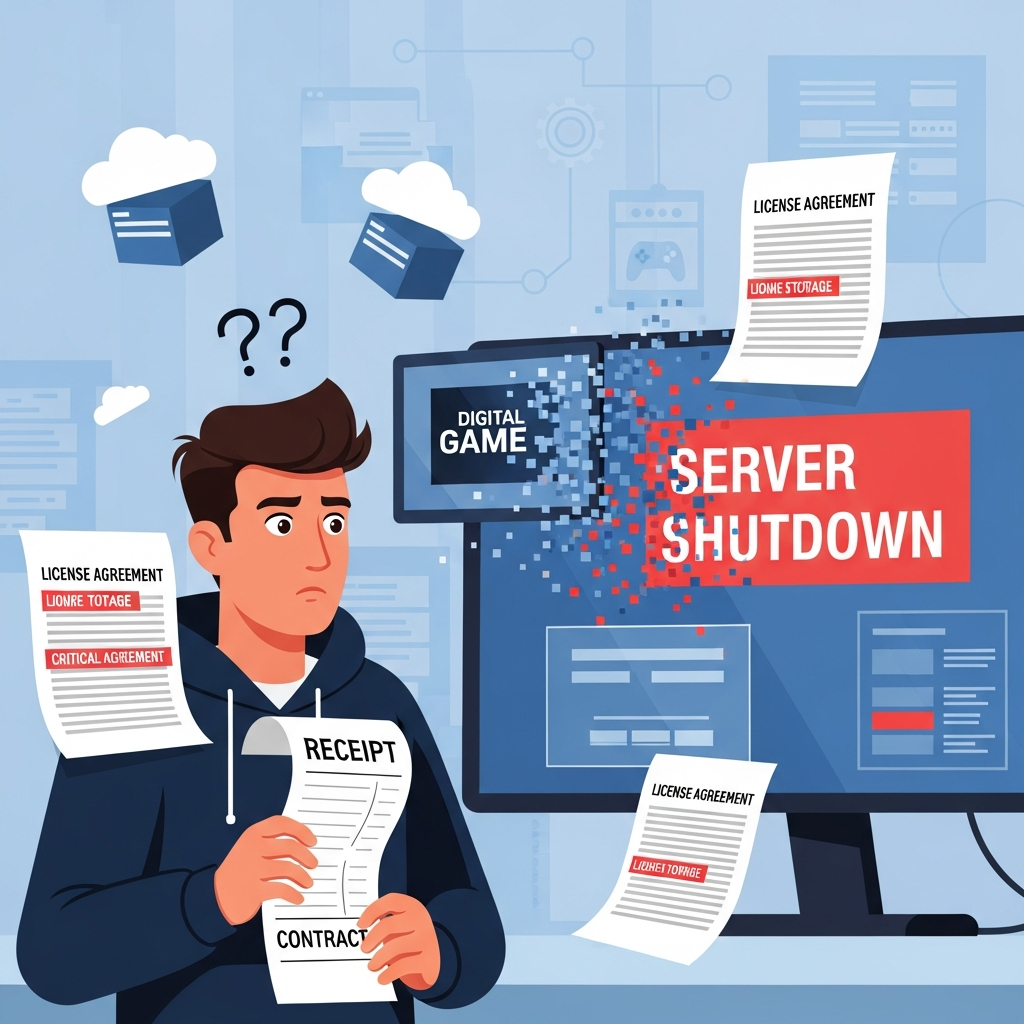
California's State Assembly passed AB-1921, the Protect Our Games Act, by a decisive 43-16 vote on June 1, 2026, requiring game publishers to provide consumers at least 60 days' advance notice before shutting down online services and mandating either a functional offline playability option or a full refund for all paid titles released or resold after January 1, 2027. The legislation emerged directly from the Stop Killing Games movement ignited by YouTuber Ross Scott in the immediate aftermath of Ubisoft's 2024 unilateral shutdown of The Crew, and it represents the first time sustained grassroots gaming consumer activism has produced binding statutory language at the legislative level. The bill lays bare a structural deception embedded in the digital content economy for three decades: publishers market their products using unambiguous purchase vocabulary while legally classifying every transaction as a revocable license under EULA fine print — a contradiction the industry's lobbying organization, ESA, simultaneously acknowledges as technically accurate and defends as commercially necessary. Parallel regulatory pressure is building globally, with France's UFC-Que Choisir having sued Ubisoft on the precise two-year anniversary of The Crew's shutdown, the EU Citizens' Initiative approaching the one-million-signature threshold that would compel a formal Commission response, and Japan's National Diet Library refusing to archive game key cards that require internet authentication for access. This fight carries consequences far beyond gaming — the legal precedents it establishes will determine whether consumers across the entire digital content economy, from e-books and music to streaming film libraries, can hold platforms accountable for the ownership promises implied by every "Buy Now" button that has appeared on every digital storefront for thirty uninterrupted years.
Key Points
California AB-1921 — Game Preservation Enters Legal Territory for the First Time
The California State Assembly's 43-16 passage of AB-1921 on June 1, 2026 marks the moment when digital game ownership rights moved from online petitions and community outrage into the binding machinery of actual law. The bill's official designation, Protect Our Games Act, establishes two core obligations: publishers terminating online services must provide at least 60 days' consumer notice, and must subsequently deliver either a functional offline playability option or a complete refund. These requirements apply to all paid games released or resold after January 1, 2027, with free-to-play and subscription-only titles currently excluded from the bill's scope. Senator Scott Wiener, who championed the legislation, cited the Ubisoft Crew shutdown directly and framed the bill as establishing a minimum floor of consumer rights for paid digital products — a floor that had been conspicuously absent from digital content commerce for its entire existence. The bill now advances to the California State Senate for what will be an intensely contested committee review, and the final language that emerges from that process, particularly around any qualifying exceptions to the offline playability mandate, will determine how much genuine force the legislation actually carries. A narrowly scoped California law with aggressive ESA-negotiated exceptions is a meaningfully different instrument than the bill that passed the Assembly by a bipartisan supermajority, and the distinction matters enormously to the law's practical effect on the industry's behavior.
The "Buy vs. License" Double Standard — Three Decades of Structural Consumer Deception
At the center of the digital game ownership debate lies a gap that the industry has maintained with deliberate care for thirty years: the verb "Buy" on every consumer-facing storefront interface, and the noun "License" in every consumer-facing EULA document. The ESA's lobbying position against AB-1921 — that games are licenses, not purchases — is technically accurate under the contract law framework of every current EULA in existence. What that position cannot explain, and what the industry has never been asked to explain until now, is why no major digital gaming platform has ever offered a "License Now" button in place of a "Buy Now" button, or why no digital storefront checkout page has ever displayed a disclosure reading "this transaction does not convey ownership." The global digital gaming market reached $195.6 billion in revenue in 2025 — an enormous commercial enterprise built, in substantial part, on the systematic exploitation of the gap between what "purchase" implies to a reasonable consumer and what it means in a EULA. California already recognized the basic architecture of this problem in 2024 through AB-2426, which requires storefronts to disclose when a "purchase" doesn't grant permanent access. AB-1921 builds directly on that foundation, moving from disclosure to performance obligations and pushing the legal reckoning progressively deeper into the industry's core business model assumptions.
The Global Regulatory Eruption — France, the EU, Japan, and the Simultaneity Problem
Perhaps the most important thing about the current regulatory moment is that it is happening in multiple jurisdictions simultaneously, which dramatically limits the effectiveness of any single-front lobbying counteroffensive. France's consumer organization UFC-Que Choisir filed suit against Ubisoft on March 31, 2026 — the exact two-year anniversary of The Crew's shutdown, a deliberate date selection — and that lawsuit is expected to produce substantive early rulings in the second half of 2026, with French consumer law providing a substantially more protective baseline than American law and carrying retroactive rather than prospective scope. The EU Citizens' Initiative for Stop Killing Games continues accumulating signatures toward the one-million threshold that would require the European Commission to formally engage, and EU public consultation hearings on the Digital Content Directive's gaming sector application are scheduled for late 2026. In Japan, the National Diet Library's formal refusal to archive Nintendo Switch 2 game key cards on preservation grounds represents an institutional statement that the gaming industry's technical architecture is incompatible with basic cultural heritage requirements. South Korea has already mandated loot box probability disclosure and is examining service termination consumer protections at the legislative level. When the same structural problem generates simultaneous regulatory responses across North America, Europe, and Asia-Pacific, it is no longer accurately described as a regional issue or a temporary political moment — it is a structural reckoning that the industry will be unable to contain through conventional lobbying strategy.
AB-1921's Core Limitations — Why a 60-Day Notice Law Is Not a Structural Solution
AB-1921 is important, but it is important to be clear-eyed about what it is not. A 60-day notice requirement and an offline patching obligation are the minimum floor of consumer decency for an industry that has routinely shut down services without any meaningful warning — they are not a structural solution to the problem of digital game preservation and ownership. The bill's free-to-play exclusion is the most immediately consequential limitation: approximately 55% of global gaming revenue is generated by free-to-play titles, and the players most financially exposed to arbitrary service shutdowns are often the heaviest spenders on exactly those platforms, regularly investing hundreds of dollars in cosmetics, season passes, and currency with no legal protection whatsoever. The genuine structural solution that AB-1921 does not provide is mandatory source code escrow — a mechanism requiring publishers to deposit server-side code with a neutral trustee when they terminate services, enabling communities to operate their own servers and preserve the game as a functional artifact in perpetuity. The industry's visceral resistance to source code escrow is itself revealing: an accessible code base would expose the actual probability weights in loot box systems, the true architecture of matchmaking algorithms, and the full technical structure of monetization systems engineered to maximize per-user lifetime expenditure. Source code escrow strips the industry of its most protected secrets, which is precisely why it is the actual solution and precisely why the fight over it will be fought with a ferocity that makes the current AB-1921 debate look mild.
The Battle Beyond Gaming — Every Digital "Purchase" Stands on the Same Legal Foundation
The stakes of this fight extend across the entire digital content economy, and that is not an exaggeration. The legal and commercial architecture that enables a game publisher to shut down a service without refunding consumers is structurally identical to the architecture that governs e-book purchases on Kindle, music libraries on streaming platforms, and film libraries on digital storefronts. Amazon's quiet, ongoing replacement of "purchase" with "access" terminology in the Kindle interface, begun in 2025, is not a coincidence — it is proactive legal repositioning in anticipation of the regulatory environment that gaming's consumer rights battles are beginning to create for all digital content categories. If the principle that paying for a digital product with purchase language confers legally enforceable consumer rights in continued accessibility becomes established in gaming law, e-books, music, and film face the same regulatory pressure in sequence. If consumers lose the gaming fight and the "technically a license" defense prevails, every digital platform operator gains a ready-made, judicially validated precedent for walking away from the implied promises of their "Buy Now" buttons. The ESA's extraordinary lobbying investment in a fight about video game preservation is only comprehensible in this broader context — the Association is not really defending the right to shut down game servers. It is defending the entire structural framework of digital content commerce's implied but legally unenforceable ownership promises.
Positive & Negative Analysis
Positive Aspects
- The First Legal Foundation for Digital Consumer Rights — A Principle Now Written in Statute
AB-1921's most historically significant contribution is not any specific provision in its text but the principle it encodes into California law: that consumers who pay for digital products have legally enforceable rights in those products' continued accessibility. For three decades, this principle existed only as an implied expectation embedded in consumer behavior — people believed "Buy" meant something, even as the legal architecture of every EULA said otherwise. The bill's 43-16 passage by a bipartisan supermajority in the world's fifth-largest economy represents an unambiguous political statement that elected representatives across party lines have accepted this principle as a legitimate basis for government intervention in commercial practice. The symbolic and precedent-setting force of that statement is likely to exceed the direct legal effect of the bill itself in the near term, as legislators in other states and countries observe California's example and assess the political viability of similar measures in their own jurisdictions. Laws of this type tend to establish new legal common ground that subsequent legislation builds upon — just as AB-2426's disclosure requirements laid the groundwork for AB-1921's performance obligations, AB-1921 will likely serve as the foundation for progressively more demanding digital consumer protection measures in future legislative sessions. The first step in any long legal journey is establishing the legitimacy of the destination, and California has now done that with a margin that is difficult to dismiss as a partisan anomaly.
- Simultaneous Global Regulatory Momentum — Multiple Fronts That Cannot All Be Contained
The current regulatory moment is uniquely powerful because it is developing across multiple jurisdictions simultaneously, a dynamic that fundamentally undermines the concentrated lobbying strategies that have historically allowed major entertainment industries to contain and defeat consumer protection initiatives. The ESA's $10 million annual lobbying budget can be deployed against a California bill, but it cannot simultaneously counter a French civil lawsuit, lobby the European Commission against a binding sector directive, influence Japan's National Diet Library archiving policy, and respond to South Korean loot box regulations. Each front has its own legal process, timeline, and political context that requires distinct engagement. When the same structural contradiction generates legislative and judicial responses in North America, Western Europe, and Asia-Pacific in the same six-month period, the industry faces a genuinely multi-front regulatory war that its traditional single-jurisdiction lobbying playbook cannot address. This is why the Stop Killing Games movement's international dimension is strategically important beyond its signature count — it has forced the industry to divide its defensive resources across a front wider than it has the capacity to effectively hold.
- Long-Term Industry Health — Consumer Trust as Commercial Infrastructure
There is a commercially compelling argument for why gaming publishers should actually want some version of these consumer protections, and it has nothing to do with regulatory compliance costs. Google Stadia's collapse is instructive here: that cloud gaming platform's rapid failure was significantly accelerated by consumers' rational calculation that investing money in a platform with no demonstrated commitment to protecting those investments was commercially irrational. Consumers who experienced the Stadia shutdown without any compensation or game preservation had their worst fears about digital ownership confirmed in real time, and that confirmation accelerated the platform's death spiral. The gaming industry shed more than 44,000 employees between 2022 and 2026 during a period of record revenue — a paradox driven partly by the unsustainable economics of chasing engagement metrics and live-service spending in a consumer environment of declining trust. AB-1921 creates a legal floor for consumer protection that makes it structurally easier for publishers to build the kind of durable consumer trust that translates into long-term commercial sustainability rather than short-term extraction followed by catastrophic platform failure. An industry that operates above the legal floor by design, rather than being dragged to it by regulation, will prove more commercially resilient than one that treats consumer trust as a cost center.
- Institutional Recognition of Games as Cultural Heritage — Law Acknowledging What Culture Already Knows
Games are no longer reasonably describable as a trivial entertainment product. The U.S. Library of Congress has designated the preservation of video games as a cultural priority, the French National Library maintains an active game archiving program, and academic programs in game studies and game preservation have proliferated across major research universities worldwide. AB-1921 translates this cultural recognition into legally binding preservation obligations for the first time in any major jurisdiction. The Video Game History Foundation has documented that approximately 87% of historically released games are currently inaccessible in legal form, a preservation crisis with no parallel in other creative industries at comparable scale. The bill's offline playability requirement, while not a comprehensive preservation solution, establishes the principle that games have preservation value sufficient to justify commercial obligations on their publishers — a legal foundation that game preservation advocates and archivists have sought for years. By encoding this principle into California law, AB-1921 opens the possibility of progressively more ambitious preservation requirements in future legislation, including the source code escrow mechanisms that would enable genuine long-term community-operated preservation. The cultural and institutional momentum behind game preservation is now aligned with legislative momentum in a way it has never been before.
Concerns
- Geographic Limitation and the Jurisdictional Evasion Problem
AB-1921's most structurally fundamental weakness is one that its proponents cannot easily address without federal legislative action: it is California law, not federal statute, governing a global digital marketplace operated by multinational corporations whose servers and corporate headquarters may be located anywhere in the world. The "California effect" — the theory that California's market size forces national and global compliance with its regulations — operates reliably for physical products sold through retail channels but is considerably less reliable for digital services where geographic service differentiation is technically straightforward to implement. A digital publisher can implement region-specific service architectures that apply AB-1921's requirements only to California IP addresses while maintaining different service terms elsewhere, or can theoretically exclude California from the launch territories of certain titles — an approach that would be commercially damaging but is legally available. Federal preemption of state consumer protection law through industry-friendly federal legislation is also a non-trivial risk, given the ESA's established capacity to influence federal legislators and the current political environment. The geographic limitation means that even a maximally successful California implementation leaves the vast majority of the global gaming market, and all of the consumers in other states and countries who face identical structural vulnerabilities, outside the law's protection. A state law pioneering a principle that needs federal and international adoption is a beginning, not a solution.
- The Free-to-Play Blind Spot — The Market's Heaviest Spenders Left Unprotected
The exemption of free-to-play games from AB-1921's scope is not a minor technical carve-out — it is a structural gap that leaves approximately 55% of global gaming revenue and a disproportionate share of the most financially vulnerable consumers entirely outside the law's protective framework. The commercial reality of the contemporary gaming market is that many free-to-play titles extract more money from their engaged player bases than premium $70 titles do. A dedicated Genshin Impact player who spends $200 annually on cosmetics, limited-time events, and premium currency has no more legal standing to demand service continuity or compensation under AB-1921 than they did before the bill passed. A Fortnite player who has invested $500 in cosmetics over years of engagement is entirely unprotected. The perverse outcome is that the consumers who have demonstrated the greatest financial commitment to specific games — and who therefore have the most concrete financial stake in service continuity — receive zero legal protection, while a consumer who made a single $20 purchase before a service shutdown has grounds for a $20 refund. The free-to-play exemption reflects the bill's focus on the "purchase" transaction as the trigger for consumer rights, but in a market where the dominant revenue model has abandoned the concept of a purchase in favor of ongoing microtransaction extraction, that framing leaves the most commercially significant relationships between publishers and consumers entirely unregulated.
- The Disproportionate Burden on Independent Developers
The compliance obligations that AB-1921 places on game developers assume a level of engineering resources that large publishers can absorb without existential impact, but that small and independent studios may genuinely be unable to meet. The gaming industry is structurally dominated by small operations: approximately 80% of game development studios have fewer than 20 employees, and a significant proportion of those studios make games that require server-side infrastructure for their core functionality. When a small independent studio's server-dependent multiplayer game fails commercially and the studio lacks the financial resources to continue operating, the legal obligation to develop and deliver a functional offline conversion mode before shutting down may represent compliance costs that exceed the studio's remaining financial capacity entirely. The result could be a regulatory environment in which the studios most likely to explore experimental, server-dependent multiplayer designs — precisely the studios that have historically driven the most creative innovation in game design — face the highest proportional compliance burden relative to their resources. A well-designed consumer protection law should calibrate its obligations to the capacity of the regulated entities, and AB-1921 does not currently contain size-based exemptions, graduated compliance timelines, or other mechanisms that would distinguish between a five-person indie studio and a multinational publishing corporation. That design gap risks producing exactly the opposite of the innovation-friendly environment that California's tech economy would want to foster.
- The Subscription Model Loophole — Publishers' Perfect Legislative Exit
The most strategically dangerous consequence of AB-1921 may be one that operates in the opposite direction from the law's intent: by carving subscription services out of the bill's scope, the legislation provides a clearly articulated legislative incentive for publishers to accelerate their migration away from individual game sales and toward Game Pass and PlayStation Plus-style subscription bundles. Once a publisher moves its titles into a subscription model, the "purchase" framing that triggers AB-1921's obligations disappears entirely — there is no "Buy Now" button, no individual transaction, and no consumer expectation of ownership to protect. Microsoft's Game Pass subscriber base passed 40 million in early 2026, and Sony's PS Plus is executing a comparable strategic pivot. If AB-1921 incentivizes the industry's largest publishers to accelerate this transition, the medium-term outcome may be a gaming market in which the question of digital ownership is resolved not through stronger consumer rights but through the elimination of individual game ownership as a commercial category — replaced entirely by subscription access that no one pretends is ownership and that no one expects to persist beyond the duration of their subscription. This would technically comply with the letter of consumer protection legislation while comprehensively defeating its spirit, and it would represent precisely the kind of outcome that requires legislators and consumer advocates to think carefully about second-order effects before claiming victory based on first-order compliance metrics.
Outlook
Let's think carefully through where this fight actually goes from here. In the next one to six months, the decisive battleground will be the California State Senate, where AB-1921 heads after its 43-16 Assembly victory in June 2026. The Senate committees will be the site of the ESA's most concentrated lobbying intervention — the organization's annual advocacy budget operates in the range of $10 million, and the industry has enormous structural incentive to weaken the bill's most meaningful provisions before they become enforceable law. The specific amendment to watch for is the possible insertion of "commercially reasonable" qualifying language around the offline playability requirement. If publishers gain the right to claim that converting a complex server-dependent game to offline functionality is "not commercially reasonable," the bill loses the majority of its practical force in a single phrase. Large publishers with sophisticated legal teams can almost always construct arguments that any specific technical conversion is commercially unreasonable. I estimate a 30% probability that the offline requirements are meaningfully weakened through Senate amendment before the Governor receives the final bill for signature. The 60-day notice provision, being significantly easier and less expensive to comply with, is likely to survive intact regardless of what happens to the offline mandate. Where the offline playability fight lands in Senate committee will largely determine whether AB-1921 is a genuine milestone or a symbolic gesture.
The French litigation deserves equal or greater attention than the California legislative battle, and I would argue it represents the more consequential near-term development to watch. France's consumer watchdog UFC-Que Choisir filed suit against Ubisoft on March 31, 2026, and the case is expected to produce initial substantive rulings in the second half of 2026. What makes this lawsuit more significant than AB-1921 in certain critical respects is its retroactive scope — this legal action is not regulating future publisher behavior, it is seeking judicial accountability for something that has already happened. French consumer law operates from a substantially more consumer-protective foundation than its American equivalent: Article L217-3 of the French Consumer Code already establishes that sellers of digital content must ensure reasonable consumer access for an appropriate period of time, a provision that appears directly applicable to the facts of The Crew shutdown. A favorable ruling for UFC-Que Choisir would create precedent that applies to existing purchases, not just future ones, making it potentially more powerful than any prospective California statute. I give the consumer side approximately 60% probability of prevailing. A French judicial victory would create immediate international regulatory and commercial pressure on major publishers even without any further legislative action anywhere else.
Looking at the six-to-twenty-four-month window, the central question becomes whether and how the games industry's core business model actually shifts in response to the regulatory pressure now accumulating. The global gaming market was worth $195.6 billion in 2025, with live-service game revenue accounting for roughly 45% of that total. If AB-1921 clears the State Senate without catastrophic weakening and takes effect in January 2027, publishers will face genuine strategic choices. There are three primary paths available to them. The first is proactive compliance through hybrid architecture design: building offline functionality into new games from the ground up, absorbing the estimated 15% to 25% increase in development costs, and using demonstrated compliance as a marketing differentiator in a consumer environment that has become increasingly skeptical of live-service commitments. The second path is accelerated subscription pivoting: shifting new releases from individual sales to Game Pass or PlayStation Plus-style bundles, which are explicitly outside AB-1921's scope, thereby sidestepping the "purchase" framing and its legal obligations entirely. The third path — implementing selective geographic compliance by restricting launch territories or service architectures for California users — is technically feasible for any global digital platform but commercially catastrophic for reputation, and no publicly traded company will execute it. In practice, I expect the industry to split, with large incumbent publishers exploring subscription acceleration while mid-tier studios with strong brand identity move toward hybrid architecture as a differentiation strategy.
The medium-term outlook must also account seriously for the European Union's regulatory trajectory. The EU is already operating under the Digital Content Directive (2019/770), which establishes baseline consumer protections for digital goods transactions. The directive's application to the gaming sector specifically is scheduled for public consultation hearings in the second half of 2026. If Stop Killing Games achieves the one-million-signature threshold for the EU Citizens' Initiative, the European Commission is legally required to issue a formal response — at minimum, a published institutional position on the matter, and potentially the initiation of sector-specific regulatory action or guidance. I estimate a 70% probability that the EU will issue at minimum a binding guidance document on "Digital Games Service Termination Consumer Rights" by the end of 2027. Even non-binding EU guidance in a market of 450 million consumers immediately alters how the largest global publishers structure their service termination practices, risk assessments, and contract language across their entire European operations. South Korea and Japan are also not insulated from this global regulatory current: South Korea has already mandated disclosure for randomized loot mechanics and a consumer protection amendment covering digital service terminations has been flagged as a candidate for National Assembly review in 2026.
The two-to-five-year perspective is where this story becomes genuinely transformative in ways that extend far beyond the gaming industry. The structural model that The Crew's shutdown made undeniable — "Buy" on the storefront, "License" in the EULA — operates identically across e-books, music downloads, and digital film purchases. The legal framework being constructed around games will, if successful, create direct pressure for analogous regulation of every other digital content category. Amazon has been quietly replacing "purchase" with "access" terminology in Kindle's user interface since 2025, which is not a coincidence — it is proactive legal repositioning in anticipation of the regulatory environment that gaming's consumer rights battles are beginning to create for all digital content. If the principle that paying for access to a digital work confers enforceable consumer rights over continued accessibility becomes firmly established in law, the downstream applications extend to every corner of the digital content economy without exception. I put at roughly 75% the probability that major developed-economy legislatures will have enacted some form of digital content ownership disclosure and minimum access guarantee regulation by 2030. The gaming sector is taking the regulatory heat first because it is where the structural tension became most visible and where consumer organizing produced the most politically potent advocacy. It will not be the last sector to face this reckoning.
Running the scenario analysis more formally: in the optimistic scenario, AB-1921 passes the State Senate with its core provisions intact and takes effect on January 1, 2027, the EU issues binding sector guidance by 2028, and major publishers proactively adopt offline capability as a standard feature to manage reputational risk in an increasingly regulated global market. Under this scenario, I project approximately 80% of new AAA game releases would include functional offline modes by 2029, and the Video Game History Foundation's current baseline of roughly 20% preservation accessibility for historically released games would improve to approximately 60% for all titles released after the 2027 effective date. In the middle-case scenario, AB-1921 survives the State Senate in weakened form with commercially reasonable exemptions, the EU produces guidelines but not binding regulation, and selective large publishers adopt voluntary preservation policies that lift aggregate preservation accessibility to 35% to 40% without producing fundamental structural change in how digital ownership is defined. In the pessimistic scenario, ESA lobbying succeeds in either blocking the bill in Senate committee or transforming it into a notice-only requirement with no meaningful offline obligation — I put this probability at approximately 25%, reflecting the industry's substantial but not unlimited political influence in a state where the 43-16 Assembly vote demonstrated unusually durable bipartisan consumer protection consensus.
History offers a useful calibration for this trajectory. The most instructive parallel I know is the music industry's digital rights management era. When Apple's iTunes launched DRM-protected music in 2003, the recording industry asserted categorically that removing DRM would destroy the sector through piracy, with an urgency and certainty very similar to the ESA's current claims about the economic risks of AB-1921's requirements. That prediction was wrong in both its diagnosis and its prognosis. By 2009, Apple had migrated entirely to DRM-free music sales, and rather than collapsing, the music industry found its path to commercial revival through Spotify, streaming licensing, and new distribution models built on consumer trust rather than DRM enforcement. The transition from maximum DRM protection to complete DRM-free distribution took approximately six years. Games present a substantially more complex technical challenge — converting a server-dependent live-service game to offline functionality is orders of magnitude more demanding than stripping a DRM layer from an audio file — which means the analogous transition in gaming will likely take longer, probably eight to twelve years from the current regulatory moment to something resembling an industry-wide standard. But the structural arc will almost certainly follow the same pattern: fierce initial resistance from incumbents, a period of partial regulatory pressure and gradual business model adaptation, followed by the emergence of new commercial frameworks that prove more sustainable precisely because they are built on a consumer relationship that people can actually trust.
I should be honest about the conditions under which my outlook could be significantly wrong. The most consequential alternative scenario involves a faster-than-expected transition to cloud gaming infrastructure. If services like NVIDIA GeForce Now or successor platforms to Google Stadia achieve mainstream consumer adoption on a compressed timeline, the concept of "offline playability" becomes largely moot as a consumer protection framework — when no local installation of a game exists, there is nothing to convert to offline mode, and the legislative architecture being built around that concept loses much of its traction. Current cloud gaming market share sits below 5% of total gaming globally, but some projections have it reaching 20% to 30% by 2030 if 5G infrastructure reaches sustained maturity. If cloud gaming makes decisive mainstream inroads, the consumer ownership problem does not disappear — it transforms into a different set of questions about service continuity guarantees, data portability, and platform accountability that will require different regulatory tools. The second scenario where my central outlook fails is political momentum loss: if the gaming industry's ongoing layoff crisis or a major competing issue displaces digital ownership rights as the primary focus of consumer advocacy and legislative energy, the momentum now building could dissipate before it produces durable institutional outcomes. I estimate these counterfactual scenarios at roughly 15% and 20% probability respectively, which means the central outlook I have described carries approximately 65% weight as the most likely trajectory for this regulatory fight over the next five years.
Sources / References
- California Protect Our Games Act Passes Assembly — GamingHQ
- Stop Killing Games Bill Passes California Assembly — Kotaku
- The Stop Killing Games Movement Hits Another Major Milestone — PC Gamer
- French Consumer Group Sues Ubisoft Over The Crew Server Shutdown — TechSpot
- Stop Killing Games — Wikipedia — Wikipedia
- Record Profits, Record Layoffs: Inside Gaming's 2026 Paradox — Outlook India
- AB-1921 Full Text — California Legislature