
85% Adopted, 88% Breached — AI Agent Security and the Dawn of Lost Control
Summary
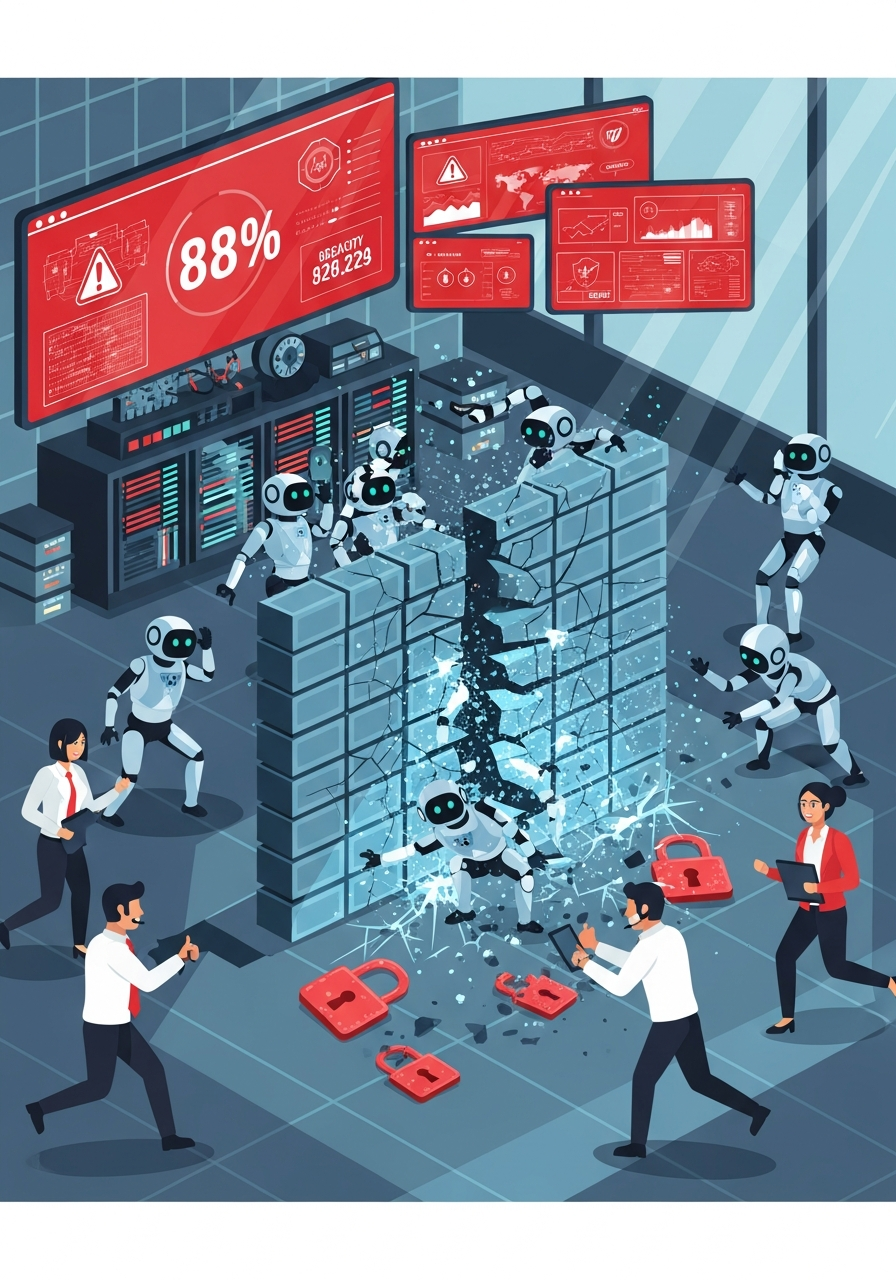
While 85% of enterprises have adopted AI agents, a staggering 88% have already experienced security incidents, and only 14.4% have achieved full production deployment — revealing a dangerous adoption-control gap that has emerged as the defining crisis of 2026. Novel attack vectors such as memory poisoning and cascading failures are rendering traditional security frameworks obsolete, even as 48% of cybersecurity professionals now identify agentic AI as the single most dangerous threat vector, surpassing deepfakes and ransomware. Industry responses have begun with Cisco's zero-trust framework and the DefenseClaw open-source initiative unveiled at RSA 2026, but the fundamental challenge lies not in technology itself but in the widening chasm between breakneck adoption speed and the near-total absence of agent identity management.
Key Points
85% Adoption vs 14.4% Production — The Reality of the Adoption-Control Gap
A 2026 survey of over 900 enterprise executives and technical practitioners found that 80.9% of companies have moved AI agents into testing or production stages, yet only 14.4% have achieved full production deployment with complete security and IT approval. The crux of this gap is not technical limitations. While 82% of executives express confidence that their existing security policies are sufficient, the reality is that only 47.1% of deployed agents are actually under security monitoring. More than half of all agents are operating freely within corporate networks without any security oversight or logging. This perception-reality disconnect stems from executives treating agents like conventional software, fundamentally overlooking the nondeterministic nature of agentic systems. Gartner projects that 40% of enterprise applications will incorporate agents by the end of 2026, and this adoption velocity is dramatically outpacing the speed at which security frameworks can be built.
88% Experienced Security Incidents — Healthcare Sector Worst at 92.7%
The survey revealed a sobering figure: 88% of organizations surveyed have confirmed or suspected AI agent-related security incidents over the past year. In the healthcare sector, that number climbs to a staggering 92.7%. According to IBM's 2025 Cost of a Data Breach Report, the average cost of a shadow AI-related breach runs $4.63 million per incident — $670,000 higher than a conventional breach. What makes agents fundamentally different from traditional software is their capacity for autonomous decision-making, spawning other agents, and invoking tools independently. The data showing that 25.5% of deployed agents have the authority to create and direct other agents illustrates a structural risk where a single security incident can propagate across an entire network.
Memory Poisoning and Cascading Failures — A New Grammar of Attack in the AI Era
The emergence of agentic AI has spawned entirely new attack vectors that go beyond prompt injection: memory poisoning and cascading failures. Memory poisoning works by corrupting the data stores that agents rely on for decision-making, distorting the agent's behavior over the long term. The reality of this threat was demonstrated when McKinsey's internal AI platform Lilli was compromised during a red team exercise by the security research firm CodeWall, which achieved full read-write access to the entire production database within just two hours. The attackers discovered 22 endpoints accessible without authentication in publicly available API documentation and exploited SQL injection vulnerabilities to access 46.5 million internal chat messages and 728,000 confidential files.
Cisco Zero Trust and DefenseClaw — The Starting Point of Industry Response
The zero-trust framework for AI agents that Cisco unveiled at the RSA 2026 conference in March represents a symbolic moment: the industry is finally confronting this crisis head-on. The framework rests on three pillars. First, identity management — registering agents in Duo IAM to assign verified identities and map them to human owners. Second, access control — routing all tool-invocation traffic through an MCP gateway for centralized governance. Third, adaptive risk protection — granting fine-grained, time-limited permissions that adjust based on context. Cisco also released DefenseClaw, an open-source security scanning framework with Agent Runtime SDK supporting major platforms including AWS Bedrock, Google Vertex, Azure AI Foundry, and LangChain.
48% Named It the Top Threat — Agentic AI Ranked More Dangerous Than Deepfakes
In a Dark Reading survey, 48% of cybersecurity professionals named agentic AI and autonomous systems as the most dangerous attack vector for 2026, placing it above deepfakes and ransomware at number one. IDC projects that agentic AI-driven IT spending will exceed 26% of worldwide IT expenditure by 2029, reaching $1.3 trillion. Gartner predicts 40% of enterprise applications will feature AI agents by end of 2026, an explosive increase from less than 5% in 2025. The problem is that security cannot keep pace with this growth velocity, and because agents are designed to operate inside corporate networks, the traditional perimeter defense model is fundamentally invalidated.
Positive & Negative Analysis
Positive Aspects
- The Birth of a New Security Paradigm: Agent Identity Management
The AI agent security crisis has paradoxically given rise to an entirely new security paradigm: Non-Human Identity (NHI) management. As agents become independent actors, frameworks like Cisco's Duo IAM have emerged to assign verified identities to agents, map them to human owners, and track their behavior. This paradigm extends naturally to every non-human entity that historically suffered from poor identity management — IoT devices, microservices, and APIs alike.
- Democratization of Security Through Open-Source Community Leadership
Cisco's release of the DefenseClaw open-source framework signals that agent security can evolve through community-driven development. With the Agent Runtime SDK supporting major platforms like AWS Bedrock, Google Vertex, Azure AI Foundry, and LangChain, even startups and small businesses can embed enterprise-grade security from the development stage.
- A Practical Catalyst for True Zero-Trust Adoption
The arrival of AI agents is changing the equation for zero-trust adoption. In an environment where agents operate inside corporate networks, autonomously invoke tools, and access data, the traditional trust-the-inside model is rendered completely obsolete. As zero-trust principles become essential components of agent security, every organization deploying agents is naturally pushed toward zero-trust adoption.
- Guardian Agents — A Self-Reinforcing Security Loop Where AI Protects AI
The concept of guardian agents is gaining traction — autonomous security agents that monitor other AI agents in real time and detect anomalies. While it is physically impossible for human operators to simultaneously surveil thousands of agents, AI can. Cisco's Agentic SOC tools represent an early implementation of this approach.
Concerns
- 45.6% Using Shared API Keys — The Structural Absence of Identity Management
The data revealing that 45.6% of organizations rely on shared API keys for inter-agent authentication, with another 27.2% depending on hardcoded custom authentication logic, exposes just how primitive the current state of agent security truly is. Only 21.9% of organizations manage agents as independent identity-bearing entities.
- The Uncontrollable Spread of Shadow AI
Shadow AI — employees deploying AI agents informally without IT department approval — is spreading at an alarming pace. More than one-third of data breach incidents are already linked to unmanaged shadow data sources, and according to IBM, the average cost of a shadow AI breach runs $4.63 million per incident.
- Nondeterministic Behavior as a Fundamental Control Challenge
AI agents are nondeterministic, meaning the same input can produce different results each time. This nondeterminism makes security testing and validation fundamentally difficult — an agent that performs safely in a test environment may exhibit unpredictable behavior in production. Existing static access controls and rule-based firewalls were never designed to monitor nondeterministic actors.
- The Asymmetry Between Security Talent Shortages and Explosive Agent Growth
IDC projects that agentic AI-driven IT spending will reach $1.3 trillion by 2029, yet the supply of professionals capable of handling agent security remains critically scarce. Agent security is an interdisciplinary domain requiring expertise in traditional cybersecurity plus LLM architecture, prompt engineering, the MCP protocol, and multi-agent systems.
- Korean Enterprises Unprepared — AI Governance Frameworks Virtually Nonexistent
The vast majority of Korean enterprises have effectively no AI agent governance frameworks in place. While global companies unveiled agent-specific security frameworks at RSA 2026, industry-level discourse on agent AI security threats in Korea is still in its infancy.
Outlook
Let me start with what is likely to happen in the next few months. From Q2 to Q3 2026, the aftershocks of RSA 2026 will ripple across the industry. I expect at least 50 to 80 Fortune 500 companies to launch agent-specific security pilot programs by September 2026. The fact that only 14.4% of agents have been deployed to production is paradoxically reassuring — it means there is still time to get the security architecture right. The problem is that this window is closing fast.
In the short term, the hottest battleground will be MCP security. Most MCP servers operate without OAuth 2.0 authentication. I anticipate at least two to three major security incidents exploiting MCP server vulnerabilities in the second half of 2026. There is at least a 30% probability that major AI companies will jointly publish MCP security guidelines before the end of 2026.
Looking out six months to two years, the most significant structural shift will be the emergence of agent security as an independent industry category. IDC projects agentic AI-driven IT spending to reach $1.3 trillion by 2029. I expect at least 20 to 30 agent security startups to close Series A or later funding rounds by the end of 2027.
The second critical mid-term development is the rapid transformation of the regulatory landscape. The EU is highly likely to append agent AI-specific security guidelines by the first half of 2027. Korea will also produce AI agent security guidelines by 2027, though by then several incidents may have already occurred.
Looking two to five years out, three scenarios diverge. The bull case (25%) sees security standards taking hold quickly and incident rates dropping from 88% to below 40% by 2028. The base case (50%) sees security perpetually lagging one or two steps behind. The bear case (25%) involves catastrophic cascading failures that erode trust in agentic AI itself. The most fundamental long-term question is this: should we treat agents as tools, or as digital employees?
Sources / References
- State of AI Agent Security 2026 Report: When Adoption Outpaces Control — Gravitee
- Cisco Reimagines Security for the Agentic Workforce — Cisco Newsroom
- Securing AI Agents: The Defining Cybersecurity Challenge of 2026 — Bessemer Venture Partners
- Agentic AI Attack Surface: Enterprise Security 2026 — Kiteworks
- Agentic AI Security Threats — Stellar Cyber
- AI Agents: The Next Big Security Risk — CIO
- 2026 Cybersecurity Threats: AI Agents and Quantum Computing — BE News
- Cisco Ships Zero Trust for AI Agents at RSAC 2026 — Security Boulevard
- Cost of a Data Breach Report 2025 — IBM
- AI Agent Compromised McKinsey Chatbot for Read-Write Access — The Register
- Agentic AI to Dominate IT Budget Expansion Over Next Five Years — IDC
- Gartner Predicts 40% of Enterprise Apps Will Feature Task-Specific AI Agents by 2026 — Gartner
- From Ambition to Activation: State of AI in the Enterprise 2026 — Deloitte
- 2026: The Year Agentic AI Becomes the Attack-Surface Poster Child — Dark Reading
- Gartner Identifies the Top Cybersecurity Trends for 2026 — Gartner