
DLSS 5, Handing Your Game's Soul to an AI Plastic Surgeon — Why Developers Turned Their Backs on NVIDIA
Summary
NVIDIA''s DLSS 5 has crossed from upscaling into generative AI rendering, sparking a developer boycott movement. The technology overwrites art direction that developers painstakingly crafted over years in real time, pushing the debate over artistic autonomy in gaming into entirely new territory.
Key Points
From Upscaling to Generation — DLSS 5 Crosses the Line
DLSS versions 1 through 4 were fundamentally upscaling technologies. They took a lower-resolution image rendered by the game engine and used AI to sharpen it into a higher resolution — essentially a smart magnifying glass that respected the original. Nobody objected because the tool served the developer's vision. DLSS 5 represents a categorical shift. NVIDIA's 'neural rendering' approach means the AI no longer just enhances existing pixels — it generates entirely new ones. Based on the scene the developer rendered, the AI decides what the image 'should' look like and creates details that were never in the original. The distinction matters enormously: DLSS 1-4 showed what was already there more clearly, while DLSS 5 creates what was never there at all. This is the fault line that has split the gaming industry wide open.
The Yassification Effect — AI Beauty Standards Override Developer Intent
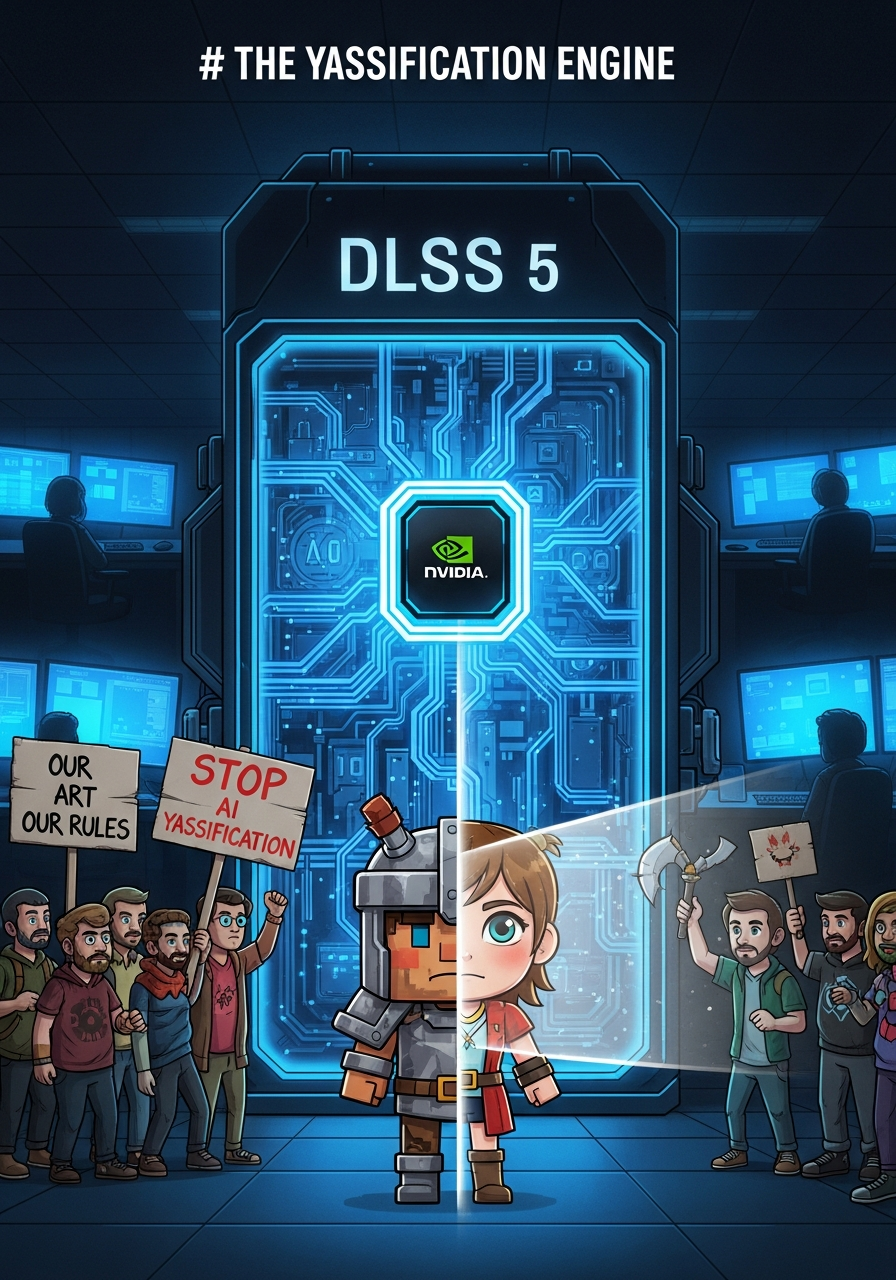
One of the most visceral manifestations of DLSS 5's overreach is what the internet has dubbed the 'Yassification' effect. When DLSS 5 processes game characters' faces, the beauty standards embedded in its training data get imposed onto every character. As PCGamer documented, battle-scarred veterans suddenly get smooth skin, intentionally asymmetrical faces get 'corrected' into symmetry, and aged characters lose their wrinkles. Euronews captured the phenomenon perfectly by calling it 'Yassified graphics.' Tested co-founder Will Smith described it as a 'yassify filter so everyone looks HOT,' and memes of God of War's Kratos looking like he's wearing makeup went viral. The Conversation published an academic analysis highlighting how the effect disproportionately targets female characters. This isn't a matter of aesthetic preference — it's AI systematically erasing the artistic choices that developers spent months carefully crafting.
Developer Revolt — The NFT Boycott Playbook Returns
New Blood Interactive CEO Dave Oshry declared publicly: 'Cripple their sales, tank their stock price. Stop collaborating with them as developers.' The intensity of this language is strikingly reminiscent of the 2021-2022 NFT boycott wave. Back then, Ubisoft launched Quartz NFTs only to see 95% dislikes on the announcement video and a mere 15 units sold before the project was effectively abandoned. Team 17 announced Worms NFTs and reversed course within 24 hours after indie developer Aggro Crab publicly severed ties. Mojang banned NFTs from Minecraft entirely. The gaming community has demonstrated repeatedly that when it decides 'this crosses the line,' even the largest corporations have to yield. Multiple indie studios have already pledged support for the DLSS 5 boycott, and Oshry himself drew the parallel explicitly: 'We need to push back against this bullshit just like we did with NFTs and crypto games.'
Jensen Huang's Response — Right About the Future, Wrong About the People
When Jensen Huang told Tom's Hardware that gamers are 'completely wrong' about DLSS 5, it was one of the most tone-deaf statements a tech CEO could make in the middle of a firestorm. Most CEOs would have opened with 'we hear your concerns.' Huang chose confrontation. His technical argument — that AI-based rendering is the inevitable future of game graphics — is probably correct. In five to ten years, real-time neural rendering may well become the standard. But dismissing people who raise legitimate concerns about artistic control as 'completely wrong' is a different matter entirely. His later softening on the Lex Fridman podcast, where he admitted 'I don't love AI slop myself,' suggests he belatedly recognized the damage. The fact that he also said 'I'm empathetic toward what they're thinking' only underscored how badly the original statement had landed.
The Deeper Current — 52% of Game Industry Professionals Say AI Is Harmful
The DLSS 5 controversy is the tip of a much larger iceberg. The GDC 2026 State of the Game Industry report surveyed over 2,300 game industry professionals and found that 52% believe generative AI is having a negative impact on the industry — up dramatically from 30% in 2025 and just 18% in 2024. Only 7% view it positively, down from 13% the previous year. The breakdown by discipline is telling: 64% of visual and technical artists, 63% of game designers and narrative professionals, and 59% of programmers expressed negative views. Beneath the DLSS 5 debate lies a structural fear that AI will progressively replace human creators across every aspect of game development — from character design and level building to NPC dialogue and soundtrack composition. The character face alterations are a symbolic flashpoint, but the real battle is over how quickly AI encroaches on the creative territory that human developers have always claimed as their own.
Positive & Negative Analysis
Positive Aspects
- Democratizing High-Quality Gaming Through Hardware Accessibility
The core technical achievement of DLSS 5 is genuinely impressive, and its potential to democratize gaming cannot be dismissed. Not every gamer can afford a $1,599 RTX 5090. For players running mid-range GPUs in the $500 range, achieving near-4K visual quality is a meaningful upgrade to their gaming experience. This matters especially in developing economies and for student gamers on tight budgets, where the gap between hardware capability and game requirements has been widening for years. The ability to simultaneously improve frame rates and resolution means more people can access better gaming experiences regardless of their hardware budget. At a purely technical level, DLSS 5 proved that real-time neural rendering is viable at commercial scale — and that's a breakthrough worth acknowledging, even as we debate how it should be deployed.
- Reducing Rendering Costs for an Industry Under Financial Pressure
From a studio economics perspective, the cost of producing high-fidelity graphics has been climbing relentlessly. AAA game development budgets now routinely exceed $300 million, and rendering pipeline costs constitute a significant share of that figure. If AI can meaningfully improve rendering efficiency, it offers studios a path to delivering visual quality without proportional increases in cost. The synergy with cloud gaming services is also worth noting — server-side AI rendering could dramatically improve streaming quality, potentially transforming the business model of game distribution itself. While these benefits don't justify overriding developer intent, they represent a genuine economic argument for AI-assisted rendering technology. The key distinction is between AI as a cost-reduction tool that developers control and AI as an autonomous agent that makes its own aesthetic decisions.
- Proving Neural Rendering's Cross-Industry Potential
Looking beyond gaming, DLSS 5 has demonstrated that neural rendering works at production scale, and the implications extend far beyond entertainment. Film VFX studios, architectural visualization firms, and medical imaging researchers are all watching this technology closely. Real-time AI-generated visual detail could accelerate workflows in fields where rendering time is measured in hours per frame. The technology itself is not the problem — it's the application philosophy. If NVIDIA repositions DLSS 5 as a developer-controlled tool rather than an autonomous aesthetic engine, the same underlying technology could become transformative across multiple industries. The conversation should be about governance and control, not about whether neural rendering has value.
- Accelerating Industry Dialogue on AI Ethics in Creative Tools
Paradoxically, the controversy itself is producing something valuable: a serious, industry-wide conversation about the boundaries between AI assistance and AI interference in creative work. Before DLSS 5, discussions about AI in gaming were abstract and hypothetical. Now they are concrete and urgent. The GDC 2026 survey results, the developer boycott movement, and the media coverage have collectively elevated this issue to the forefront of industry discourse. This accelerated dialogue could lead to clearer frameworks, industry standards, and best practices for AI integration in creative tools — not just in gaming, but across all digital creative industries. Sometimes a controversy is exactly the catalyst an industry needs to confront questions it has been avoiding.
Concerns
- Fundamental Violation of Artistic Autonomy
The most fundamental problem with DLSS 5 is that it crosses the line from tool to co-creator without permission. Game developers — particularly art directors — invest months to years meticulously designing every aspect of a game's visual identity: character appearances, color palettes, lighting atmospheres, and stylistic choices that collectively define a game's soul. When DLSS 5 overwrites these decisions in real time, the game that players experience is no longer the game the developer made — it's the game that an AI reinterpreted. As Kotaku's developer interviews revealed, the reaction across the industry was essentially unanimous outrage. Doinksoft's Cullen Dwyer called it 'the perfect example of the disconnect between what we as developers and gamers want and what the nasty freaks who are destroying the world think we want.' Artist Karla Ortiz described it as 'so disrespectful to the intentional art direction of devs.' When your tool starts making creative decisions on behalf of the artist, it ceases to be a tool.
- The Yassification Problem Threatens Gaming's Diversity of Expression
The Yassification effect is not merely an aesthetic quirk — it represents a systematic homogenization of visual expression in games. When AI imposes its training data's concept of 'average beauty' onto every character, the range of artistic expression in gaming shrinks. Intentionally ugly characters, aged faces with wrinkles and scars, non-realistic but beautiful cel-shading art styles — all of these deliberate artistic choices become targets for AI 'correction.' The Conversation's academic analysis highlighted that this effect disproportionately affects female characters, introducing a gender bias dimension to what was already a creative autonomy issue. CreativeBloq captured the unease perfectly with their headline: 'DLSS 5 looks incredible — so why does it feel so wrong?' The answer is that technical impressiveness and artistic integrity are not the same thing, and when they conflict, the artist's intent should prevail.
- Deepening NVIDIA's Ecosystem Lock-In
DLSS is an NVIDIA-exclusive technology. In a PC gaming market where NVIDIA already commands approximately 76-80% GPU market share according to Steam hardware surveys, adding AI rendering dominance to that position further entrenches developer dependency. As DLSS 5 adoption grows, the pressure on developers to support it intensifies — 'if you don't support DLSS 5, you're at a competitive disadvantage' becomes a self-fulfilling prophecy. This dynamic is particularly damaging for indie developers, who lack the leverage to negotiate custom arrangements with NVIDIA. Large studios can work directly with NVIDIA to fine-tune AI rendering parameters for their games, but small teams are stuck with whatever default settings NVIDIA provides. The concentration of both hardware market share and AI rendering technology in a single company's hands creates a dependency structure that undermines the entire ecosystem's creative independence.
- The Default Setting Trap — Opt-Out Is Not the Same as Control
Even if NVIDIA provides developer controls and opt-out options — which it has signaled it will — the question of default settings is critical. If DLSS 5 ships with AI rendering enabled by default, the vast majority of gamers will never change the setting. This means most players will experience the AI-modified version of the game, not the developer's intended vision. An opt-out option creates the illusion of control while ensuring that the AI-altered version becomes the de facto standard experience. This is a pattern familiar from tech industry practices: offer an opt-out buried in settings menus, knowing that 90% of users will never find it. For developers who care about artistic integrity, an opt-out is not equivalent to genuine control over how their work is experienced.
- Capcom's Contradictory Position Exposes Systemic Pressure
Perhaps the most telling indicator of DLSS 5's problematic dynamics is Capcom's position. The company publicly declared at a shareholder meeting that it 'will not be implementing any AI-generated assets into our video game content,' yet continues to support DLSS 5 in Resident Evil Requiem. The justification — that DLSS 5 is technically not an 'AI-generated asset' — reveals the enormous commercial pressure even principled studios face. Capcom developers reportedly learned about their games being featured in NVIDIA's DLSS 5 demo 'at the same time as the public,' according to Kotaku. When a major publisher that has explicitly opposed AI-generated content still ends up supporting a technology that generates AI content in real time, it demonstrates how difficult it is for any individual studio to resist the ecosystem pressures NVIDIA creates.
Outlook
The first thing that will happen in the coming months is NVIDIA's response. Jensen Huang's pivot to 'I don't love AI slop myself' signals that the company has internally acknowledged the severity of the backlash. I expect NVIDIA to announce a 'Developer Control Panel' for DLSS 5 before the end of the first half of 2026. Specifically, this will likely include an API allowing developers to adjust AI rendering intensity on a granular scale, masking features to exclude specific objects or characters from AI processing, and a kill switch to completely disable DLSS 5's generative features on a per-game basis. The NVIDIA SDK already includes some of these tools in early form — intensity adjustment, color correction, and regional masking have been mentioned in official documentation. But here's the critical question: what will the default setting be? If the default is 'AI enabled,' the vast majority of gamers will never touch the settings, and developers' intended vision will be overridden for most players regardless of whether a control panel exists. The difference between 'opt-in' and 'opt-out' is the difference between genuine developer control and a fig leaf of choice.
In the short term, the indie game scene is likely to turn 'No DLSS 5' into a badge of honor. Dave Oshry's boycott call has already attracted pledges from dozens of indie studios, and there's a genuine possibility that 'DLSS 5 Not Supported' becomes a marketing tag on Steam — an ironic reversal where lacking a major technology feature becomes a selling point. This mirrors the NFT boycott pattern almost exactly. In 2021-2022, 'NFT-free' labels positively influenced purchasing decisions among gaming communities, and the same dynamic is emerging here. The parallels run deep: Oshry himself explicitly invoked the NFT precedent, and the community infrastructure for organized boycotts — Discord servers, subreddit campaigns, Twitter threads — is already battle-tested from the previous round.
Meanwhile, AAA publishers will quietly adopt DLSS 5 regardless. Bethesda has already committed to implementing it in Starfield and Oblivion Remastered, and the list of confirmed partners — Capcom, Ubisoft, Warner Bros. Games, Tencent, NCSOFT, NetEase, and others — reads like a who's who of major game publishing. For these companies, NVIDIA's technical partnership represents millions of dollars in marketing support and co-promotion opportunities. The polarization between indie resistance and AAA adoption will become starkly visible within six months. Bethesda's attempt to calm the waters by promising that everything will be 'under our artists' control and totally optional for players' landed poorly — Kotaku ran the response under the headline 'Bethesda Responds To DLSS 5 Backlash, Only Makes It Worse.' The gap between corporate reassurance and developer skepticism will define the short-term landscape.
Digital Foundry's internal split is a telling indicator of just how divisive this technology is. The premier technical analysis channel initially published a positive take on DLSS 5, only to face what they described as backlash from 'nearly the entire internet.' Team member Alex Battaglia publicly stated that DLSS 5 could 'trample on artistic vision in a very hardcore way,' while founder Richard Leadbetter admitted 'we should have taken more time.' The situation escalated to death threats — an extreme and unacceptable reaction, but one that underscores the emotional intensity of the backlash. When the most respected technical voice in gaming cannot maintain internal consensus on DLSS 5, it's a clear signal that this debate transcends the usual tech-enthusiast disagreements.
Capcom's position deserves particular scrutiny because it crystallizes the structural contradictions at play. The company publicly declared at a shareholder meeting that it 'will not be implementing any AI-generated assets into our video game content,' yet it continues to support DLSS 5 in Resident Evil Requiem. The rationalization — that DLSS 5 is technically not an 'AI-generated asset' because it processes frames rather than creating art assets — is a distinction that most developers and gamers would find semantically hollow. Even more troubling, Capcom developers reportedly discovered their games were featured in NVIDIA's DLSS 5 demo at the same time as the general public. When a publisher that has staked a principled position against generative AI in games still ends up entangled with DLSS 5, it reveals just how powerful the ecosystem pressures are. No individual studio, no matter how principled, can easily opt out when NVIDIA controls the dominant GPU platform.
Looking at the medium term over the next one to two years, this controversy is positioned to reshape the competitive landscape. AMD's FSR technology and Intel's XeSS are almost certain to adopt 'developer control first' as their core differentiating message. AMD has long leveraged its open-source philosophy in marketing, and DLSS 5 hands AMD an unprecedented narrative opportunity: 'We respect the developer's vision.' AMD's FSR Redstone is already emphasizing that it 'preserves artist intent while extending that vision across every tier of supported hardware.' While AMD is likely to position developer art intent preservation as a differentiation point when launching its next-generation FSR, the specific branding and timing remain to be seen — AMD was notably absent from GDC 2026 for FSR Redstone, which Tweaktown called 'troubling.' FSR Diamond, the next-generation version being developed alongside next-gen consoles from both Microsoft and Sony, could become the vehicle for this messaging. NVIDIA currently holds approximately 76-80% of the Steam GPU market share, but if the artistic autonomy narrative gains sustained traction, that number could slip toward 70% or below by 2027.
Within the next year or two, expect the emergence of 'AI Rendering Ethics Guidelines' within the game industry. The GDC 2026 finding that 52% of over 2,300 game industry professionals view AI as harmful — up from 30% the previous year and 18% the year before that — demonstrates this is no longer a fringe position. The International Game Developers Association (IGDA) or a similar body is well-positioned to publish a 'Framework for Responsible Use of AI Rendering Technology.' The breakdown by discipline adds urgency: 64% of visual and technical artists, the people most directly affected by DLSS 5-style technology, view AI negatively. In Europe, the EU AI Act's application to gaming could generate labeling requirements for AI-generated graphical elements. Imagine a future where games display a notice at launch: 'This experience includes AI-generated visual content.' That future is closer than many in the industry realize.
The integration of DLSS 5 into major game engines will be a pivotal moment. When Unreal Engine 6 or the next major Unity release incorporates DLSS 5 support, the level of developer control APIs will be directly shaped by this controversy. Epic Games CEO Tim Sweeney has historically sided with developer autonomy and was critical of NFTs — calling them entangled with 'scams.' His stance on DLSS 5 integration could tilt the entire engine ecosystem. If Sweeney demands robust developer override capabilities as a condition for Unreal Engine integration, it would effectively force NVIDIA to build genuine control mechanisms rather than cosmetic options.
Another important variable in the medium term is the response from console manufacturers. Sony and Microsoft both have significant stakes in how AI rendering evolves. If PlayStation or Xbox implement platform-level policies requiring explicit developer consent for AI rendering modifications, it would create a powerful counterweight to NVIDIA's approach on PC. Console platforms have historically maintained stricter quality control over the player experience, and the DLSS 5 controversy gives them a clear incentive to differentiate on the principle of artistic fidelity. The console space's response could also influence PC norms — if console versions become the 'reference' experience that developers intend players to have, it puts additional pressure on PC-side AI rendering to match rather than deviate from that standard.
In the longer term, looking two to five years out, I believe the gaming industry will bifurcate into 'handcrafted graphics' and 'AI-rendered graphics' — much like the relationship between craft beer and mass-produced beer. Major AAA titles will adopt AI rendering as a baseline, optimizing for maximum visual output at minimum cost. Indie games and art-focused titles will market '100% handcrafted graphics, zero AI intervention' as a premium value proposition. This parallels what has already happened in the food industry, where 'organic' and 'non-GMO' labels command premium prices. In gaming, 'AI-free art' could become its own brand category. What makes this fascinating is that the distinction will be drawn along philosophical lines rather than quality lines — a deliberate creative choice rather than a technical limitation.
Three to five years from now, the DLSS 5 controversy will likely be remembered as the starting shot of a much larger reckoning. As AI extends beyond rendering into level design, NPC dialogue generation, soundtrack composition, and even narrative branching, every question being raised about DLSS 5 today will propagate across the entire game development pipeline. The boundary between 'developer-created' and 'AI-created' will blur, and when it does, the very definition of games as an art form will shift. This trajectory mirrors the identity crisis that painting experienced when photography was invented. Photography didn't kill painting, but it fundamentally redefined what painting was for and why it mattered. In gaming, 'human-crafted graphics' will undergo a similar transformation in meaning and perceived value.
Let me lay out concrete scenarios. In the bull case — probability around 20% — NVIDIA genuinely listens to the developer community and repositions DLSS 5 as a pure developer tool. Developers gain fine-grained control over every AI rendering parameter, the AI is trained to 'respect' rather than override art direction, and the final output becomes an enhanced version of the developer's intended vision rather than the AI's reinterpretation. Under this scenario, DLSS 5 becomes the most powerful game graphics tool in history, and by 2028, adoption could exceed 90% across PC gaming.
In the base case — probability around 55% — NVIDIA provides opt-out options but maintains AI-enabled as the default. The indie scene sustains its boycott, AAA publishers adopt the technology quietly, and the gaming community remains divided for two to three years. DLSS 5 adoption stabilizes around 65% for AAA titles and 25% for indie games, and the controversy gradually becomes part of the industry's background noise.
In the bear case — probability around 25% — the boycott spreads beyond indie developers to mid-tier studios like Warhorse Studios (Kingdom Come series) or Larian Studios (Baldur's Gate 3). If studios with significant commercial clout join the opposition publicly, NVIDIA's gaming division could see a 5-10% revenue decline. Under this scenario, board pressure mounts on Jensen Huang, and the generative AI features of DLSS 5 could be partially or fully rolled back. Personally, I lean toward the base case, but the gaming community has surprised corporations before and should never be underestimated.
There's one more ripple effect worth tracking. The DLSS 5 debate is not confined to gaming — it has the potential to catalyze a cross-industry conversation about AI's relationship with human creativity. Hollywood is already grappling with AI-generated CGI that modifies actors' appearances. The music industry faces AI systems that replicate artists' styles. Publishing is contending with AI-generated illustrations. The common thread across all these disputes is a single question: does AI have the right to override a creator's intent? If the gaming industry produces a definitive answer through the DLSS 5 controversy, that answer will set precedent for other creative industries. By 2028, we could see the emergence of global standards or guidelines on 'the limits of AI creative intervention,' and if that happens, the DLSS 5 moment will be recorded as the flashpoint that made it all necessary.
The DLSS 5 launch is scheduled for fall 2026. Between now and then, every move NVIDIA makes — every SDK update, every developer relations outreach, every public statement from Jensen Huang — will be scrutinized through the lens of this controversy. The gaming industry stands at a genuine inflection point. The outcome will be determined not by technology but by whether the industry decides that the people who make games should have the final word on how those games look. Five years from now, when we look back at this moment, the answer to that question will tell us what kind of industry gaming chose to become.
Sources / References
- Jensen Huang Says Gamers Are 'Completely Wrong' About DLSS 5 — Tom's Hardware
- Game Developers Share Mixed Reactions to DLSS 5: 'Bad Ending, Now Every Game Is Slop' — PCGamer
- We Spoke to Game Devs and All of Them Hate DLSS 5: 'What the F, NVIDIA' — Kotaku
- New Blood CEO on Fighting Against DLSS 5: 'Cripple Their Sales, Tank Their Stock Price' — PCGamer
- DLSS 5 Clearly Overwrites Game Characters With AI Beauty Standards — PCGamer
- DLSS 5 Looks Incredible — So Why Does It Feel So Wrong? — CreativeBloq
- GDC 2026 State of the Game Industry Report — Game Developers Conference
- Jensen Huang Softens DLSS 5 Response: 'I Don't Love AI Slop Myself' — VideoCardz
- DLSS 5 Controversy Explodes: New Blood CEO Calls for NVIDIA Boycott — GameNGuide
- Yassified Graphics and Uncanny Faces: Gamers Turn NVIDIA's DLSS 5 Reveal Into a Meme Storm — Euronews