
What 8 Million Americans Shouting 'No Kings' Really Means — And Why the Scariest Part Isn't the Crowds
Summary
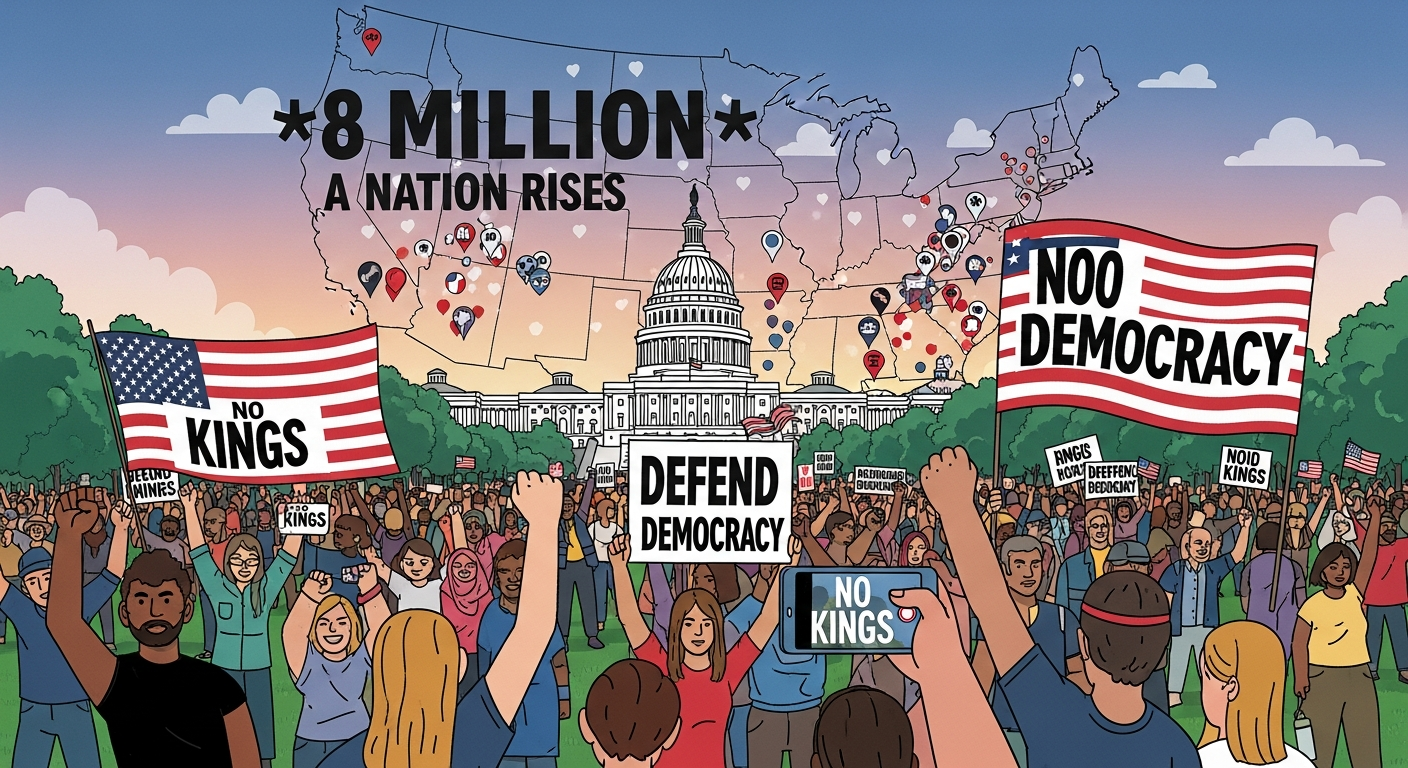
On March 28, 2026, an estimated 8 million people participated in 'No Kings' protests across all 50 U.S. states — the largest single-day demonstration in American history, nearly doubling the 2017 Women's March record. What makes this movement structurally different from prior mass mobilizations is that nearly half the events occurred in Republican strongholds, with two-thirds of RSVPs originating outside major urban centers. The movement grew 60% over nine months across three waves of escalating protests. This analysis examines whether the movement can convert street energy into electoral infrastructure capable of reshaping 20–30 competitive districts in the 2026 midterms, or whether it risks dissipating into symbolic exhaustion.
Key Points
Largest in American History: 8 Million People, 3,300+ Events
The March 28, 2026 No Kings protest was recorded as the largest single-day demonstration in 250 years of American history. More than 3,300 events took place across all 50 states, with organizers estimating between 8 and 9 million participants. City-level estimates cross-verified through Wikipedia's comprehensive article include Boston at 180,000, New York at 350,000-plus, Seattle at 90,000 to 100,000, St. Paul at 100,000 (Minnesota State Patrol estimate), San Diego at 40,000 to 54,000 (police vs. organizer estimates), Pittsburgh at 15,000 to 20,000, and Rhode Island at 35,000-plus. This nearly doubles the 2017 Women's March turnout of 3.2 to 5.3 million. According to Britannica, the movement grew approximately 60 percent over nine months — from 4 to 6 million at the first rally in June, to 7 million at the second in October, to the current figure. Internationally, solidarity protests were held in more than 22 countries including Australia, Canada, the UK, France, Germany, Japan, Greece, Iceland, Ireland, Italy, Kenya, Mexico, the Netherlands, Portugal, Spain, Sweden, Switzerland, and Thailand. This scale approaches the threshold identified by Harvard political scientist Erica Chenoweth's '3.5 percent rule' — at roughly 2.4 percent of the U.S. population. Chenoweth's analysis of 323 movements from 1900 to 2006 found that nonviolent campaigns succeeded 53 percent of the time versus 26 percent for violent ones, and not a single nonviolent movement that crossed the 3.5 percent threshold failed. No Kings is approaching this historic critical mass.
The Red-State Rebellion: Half the Protests Were in Conservative Territory
The single most defining difference between No Kings and all prior American protests is its geographic composition. Two-thirds of RSVPs originated outside major cities, and nearly half of all events took place in Republican strongholds. Texas, Florida, and Ohio each saw more than 100 events organized, with Michigan logging 128, Wisconsin approximately 100, Arizona 70, Colorado roughly 80, and Connecticut 50. In Florida's Polk County — where Trump won by 21 points — more than 2,000 people gathered. Deep-red states including Idaho, Wyoming, Montana, Utah, South Dakota, and Louisiana all hosted double-digit events. Protests also took place in Alabama, Alaska, Arkansas, Mississippi, and Oklahoma, extending to military-base communities like Pensacola and Jacksonville. Swing suburban areas reported 'explosive' surges in interest — Bucks and Delaware counties in Pennsylvania, East Cobb and Forsyth in Georgia, Scottsdale and Chandler in Arizona. This strongly suggests that the 2024 electoral map could be redrawn by 2026.
Convergence of Multiple Grievances: Anti-ICE, Antiwar, and Pro-Democracy
No Kings is not a single-issue protest but a convergence of compounding grievances into a unified movement. Anger over ICE immigration enforcement — including the shootings of Renee Good, Keith Porter, and Alex Pretti — merged with opposition to the Iran war launched without congressional authorization. Concerns about democratic backsliding, the Epstein files cover-up controversy, and the federal government shutdown further fueled the mobilization. The human-letter formation at the San Francisco rally captured it in a single image: 'No ICE, no wars, no lies, no kings.' Stanford sociologist Susan Olzak warned that a broad coalition carries the risk of internal conflict over competing priorities, while also recognizing the powerful foundation it provides for solidarity. The multi-issue convergence itself is a signal of structural crisis — it reflects a comprehensive distrust of the American political system rather than dissatisfaction with any single policy.
From Protest to Ballot Box: The Infrastructure Conversion Has Begun
The critical test for No Kings is whether street energy can be translated into votes. Voter registration drives, letter-writing campaigns, and election volunteer recruitment were running simultaneously at protest sites. Indivisible reported that its local chapters have surged 150 percent nationwide since Trump's second term, with more than 2,700 groups now active. This pattern is structurally identical to the Tea Party's trajectory — beginning as protest rallies in 2009 and culminating in the 2010 midterms, where Republicans flipped a historic 63 House seats. Harvard Kennedy School research found that Tea Party protests generated an additional 2.7 to 5.5 million Republican votes in the 2010 House elections. The 2017 Women's March followed a similar path through its 'Power to the Polls' initiative, with Indivisible chapters formed by March participants becoming core infrastructure for the 2018 Blue Wave that flipped 40 House seats for Democrats. However, sociologist Patrick Rafail cautioned that 'the question is whether this emotion can be translated into policy and action,' warning that the movement's success hinges on whether it can sustain the tedious grassroots work that the Tea Party excelled at.
2026 Midterms: Potential to Reshape 20-30 Congressional Districts
If even 30 percent of the 8 million protest participants convert their energy into actual votes, that yields approximately 2.4 million additional voters — a number capable of altering outcomes in 20 to 30 competitive House districts where races are decided by margins of thousands to tens of thousands. As of March 2026, generic ballot polling shows Democrats with a D+5.5 lead over Republicans, and prediction markets place the probability of a Democratic House takeover at 85 percent. Democrats need just three additional seats to reclaim the majority. Trump's approval rating has fallen to 33 percent according to UMass Amherst — a second-term historic low — with net approval on cost-of-living at negative 39 (28 percent approve vs. 67 percent disapprove). The president's party historically loses seats in midterms, and the 2018 Blue Wave saw Democrats flip 40 seats. However, the SAVE America Act looms as a significant variable: Brennan Center analysis shows 21 million Americans lack immediate access to citizenship documentation, roughly half of all Americans do not hold passports, and the legislation could create substantial barriers to voter registration for precisely the populations energized by the movement.
Positive & Negative Analysis
Positive Aspects
- A Renaissance of Civic Participation
With U.S. midterm voter turnout typically hovering around 40 percent, the energy that drove 8 million people into the streets is cracking open the wall of chronic political disengagement. Voter registration drives running simultaneously at protest sites suggest this is not a one-off burst of anger but the beginning of a structural shift toward sustained participation. Indivisible reported roughly 340,000 new voter registrations completed during the March 28 events alone. The cross-generational solidarity on display — from 17-year-old first-time voters to surviving participants of Martin Luther King Jr.'s 1963 March on Washington — strengthens the case that a durable civic-participation culture is forming. If even a fraction of these newly registered voters follow through at the ballot box, the downstream effects on midterm turnout could be historically significant.
- A Revolutionary Decentralized Mobilization Model
The decentralized organizational structure adopted by the 50501 movement and Indivisible has transcended the limitations of top-down mobilization. Local autonomous groups independently registered and operated their own events, enabling events to expand more than 50 percent — from 2,100 in June to 3,300-plus in March. The reason protests could reach rural Colorado, suburban New Jersey, and Florida small towns that had never hosted a single political rally was precisely this decentralized model's scalability. It represents a genuinely new organizational paradigm for social movements in the digital age.
- Emergence of Bipartisan Solidarity
The AFL-CIO labor federation, the nonpartisan ACLU, the left-wing Democratic Socialists of America, and the senior-citizen Third Act Movement all marching together signals a form of civic solidarity that transcends the conventional Democrat-versus-Republican binary. The surge of participation in conservative areas is particularly significant — it suggests the movement is evolving beyond a simple Democratic base mobilization into a genuinely bipartisan effort to defend democratic norms. This cross-ideological breadth gives the movement a political legitimacy that purely partisan protests cannot claim. The presence of Republican voters in deep-red states like Idaho, Wyoming, and Utah demonstrates that the anti-authoritarian impulse cuts across traditional party lines in ways that neither party's leadership had anticipated.
- A Spreading Wave of Global Democratic Solidarity
Solidarity protests in more than 15 countries — Australia, Canada, the UK, France, Germany, Japan, and beyond — demonstrate that No Kings is becoming a symbol of global democratic solidarity that extends far beyond a domestic American issue. This international support serves a dual function: it reduces the sense of isolation among U.S. protesters while reinforcing the movement's legitimacy. The model could also be referenced as a template for citizen responses to far-right populism in Europe and democratic crises in Asia.
- Building Psychological Resilience Against Authoritarianism
As Philadelphia Inquirer columnist Will Bunch analyzed, the real power of these protests is not political but psychological. Against the premise that 'autocracy requires a demoralized populace to succeed,' 8 million people taking to the streets constitutes a collective declaration: 'We are not demoralized.' The administration's dismissal of the protests as 'Trump Derangement Therapy Sessions' only reinforced the protesters' resolve rather than diminishing it. This psychological resilience serves as a long-term immune system for democracy — arguably more important than any short-term policy change. It establishes a baseline of civic defiance that makes authoritarian consolidation structurally more difficult.
Concerns
- The Risk of a Broad Coalition Fracturing
As Stanford sociologist Susan Olzak warned, 'A movement with a focused message strengthens internal cohesion, whereas a broad coalition carries the risk of internal conflict over priorities.' Priority disputes could erupt at the policy-demand stage — between Latino activists who view ICE enforcement as the top issue, antiwar activists demanding an end to the Iran conflict, and moderate citizens primarily concerned about democratic institutions. They were able to unite under one slogan because they shared a common adversary. When the movement must articulate constructive alternatives rather than simply opposing a shared target, the coalition may crack. This is the classic vulnerability of big-tent movements, and history offers more examples of such coalitions fracturing than holding together.
- Institutional Backlash: The SAVE America Act
The Republican-backed SAVE America Act requires in-person proof of citizenship at voter registration and mandates photo ID at polling stations. On its surface, it is framed as an election-integrity measure, but in practice it restricts ballot access for low-income communities, the elderly, and minorities — precisely the demographics energized by the protests. The cruel irony is that the right to vote could be curtailed before protest energy even has a chance to convert into ballots. This represents the most direct institutional threat to the movement's outcomes, potentially blocking the very channel through which civic mobilization translates into political power.
- Protest Fatigue and Sustainability Questions
Participants who have turned out for three massive demonstrations over nine months face eight more months until the midterms — a long stretch to sustain peak mobilization energy. As sociologist Patrick Rafail pointed out, the Tea Party succeeded not through spectacular rallies but through showing up at town hall meetings and threatening incumbents in primaries — the tedious, repetitive grassroots work that rarely makes headlines. The historical pattern is clear: mass movements that fail to transition from dramatic street action to sustained institutional engagement lose steam within 12 to 18 months. Whether No Kings can push through this 'boring phase' is the decisive variable that will separate a transformative movement from a fleeting spectacle.
- Escalation Risk from Government Crackdowns
In Los Angeles, police fired tear gas and pepper balls at protesters, with more than 70 arrests — a troubling precedent. As the movement scales, government responses may grow harsher, and a single episode of violence can discredit an entire movement in the public eye. Maintaining nonviolent discipline across 3,300-plus decentralized protests is an enormously difficult practical challenge. The risk that isolated incidents of violence could be amplified in media coverage and turn public opinion against the movement is real and should not be underestimated.
- Strategic Government Concessions Could Drain Momentum
If the Iran war concludes quickly or the administration offers strategic concessions such as easing immigration enforcement, the movement's driving force could weaken dramatically. Government concessions are simultaneously a victory and a potential cause of organizational dissolution as the underlying tension that holds the coalition together dissipates. The precedent of Occupy Wall Street — which burned through enormous energy without achieving concrete demands — serves as a cautionary tale. No Kings faces a genuine risk of ending as a symbolic movement rather than a transformative one if it cannot convert street energy into durable institutional change before the moment passes.
Outlook
Let me start with what is likely to happen in the next few months. The most immediate inflection point after the March 28 protests will be May Day on May 1. As discussed in Will Bunch's column, discussions about a general strike are already well underway within the No Kings movement. Indivisible co-founder Ezra Levin officially announced a nationwide May 1 general strike immediately after the March 28 protests, rallying under the slogan "no work, no school, no shopping," with the Chicago Teachers Union declaring its support. According to Common Dreams, the action is being organized under the "May Day Strong" coalition banner, scaling up the model from the January 23 Minnesota general strike to a national level.
If this materializes, it opens an entirely new front — the transition from protest to economic action. Eight million people in the streets and millions more stopping work for a day represent qualitatively different forms of pressure. A full-scale May Day strike is unlikely to materialize in its purest form, but even partial success could force the administration to consider substantive concessions for the first time. If roughly 500,000 to 1.2 million service and tech workers join even a half-day walkout, the economic reverberations would parallel the cascading teacher strikes that spread from West Virginia to Oklahoma in 2018. On a GDP basis, a single day of total general strike costs approximately $45 billion; even partial participation sends a multibillion-dollar economic signal.
After May Day, the period from June through August becomes the decisive window in which protest infrastructure converts into electoral infrastructure. The 3,300-plus local event networks that 50501 has built are structurally identical to district-level campaign field offices. Indivisible reports that its local chapters have surged 150 percent since the beginning of Trump's second term, with more than 2,700 groups now active across the country. The contact lists, volunteer databases, and social media channels assembled by local organizers can be repurposed for voter registration and get-out-the-vote campaigns. Indivisible's internal tally of roughly 340,000 voter registrations completed at protest sites offers a concrete glimpse of this conversion already in motion. The summer primary season will serve as the proving ground. The critical question is whether No Kings participants can actually push or pull candidates in primary races.
With many incumbent legislators already announcing retirements, there are more open seats than usual — roughly 15 percent above the historical average. If No Kings participants demonstrate genuine organizational strength in competitive suburban districts in Pennsylvania, Georgia, and Arizona, signs of change could emerge at the primary stage. Primary turnout typically runs only 10 to 15 percent, which means a small group of organized voters can make an enormous difference. My projection is that by August 2026, at least three to five districts will see No Kings-affiliated candidates defeat incumbents or win open seats.
Stateline's analysis reveals that even in deep-red states like Idaho, Wyoming, Montana, and Utah, there has been a sharp surge in people organizing events and registering voters. This is not simply about boosting Democratic candidates. It means a foundation is being laid for moderate Republican challengers to take on far-right incumbents in their own party's primaries. The moderate Republican voters who seemed to vanish after Liz Cheney's 2022 primary defeat in Wyoming are showing signs of reorganization under the No Kings banner. In at least four to six of the 15 deepest-red states, primary turnout could rise 20 percent or more above historical averages — itself a harbinger of structural shifts in the American political landscape.
Now for the medium-term: the November midterm general election. Historically, the president's party tends to lose seats in midterms, with the 2018 Blue Wave as the textbook example. In 2018, Democrats flipped 40 House seats, with one key catalyst being the civic engagement energy that originated with the 2017 Women's March. No Kings is more than twice the size of the Women's March, geographically far broader, and incomparably more penetrative into conservative areas. If even 30 percent of this energy converts to actual votes, that generates approximately 2.4 million additional voters. Given that competitive House races are typically decided by margins of thousands to tens of thousands of votes, this number could alter the landscape in 20 to 30 districts. I estimate Democrats have a 55 to 60 percent chance of retaking the House in the 2026 midterms, with a potential net gain of one to two Senate seats.
As of March 2026, Nate Silver's generic ballot polling average shows Democrats with a D+5.5 lead, and prediction markets (Polymarket, Kalshi) place the probability of a Democratic House takeover at approximately 85 percent. Democrats need just three additional seats for a majority, and Trump's approval rating has hit a second-term low of 33 percent according to UMass Amherst polling — with net approval on cost-of-living issues plunging to negative 39 (28 percent approve versus 67 percent disapprove).
From the Democratic Party's perspective, No Kings presents both a strategic dilemma and an opportunity. To absorb the protest energy, party leadership needs a message that encompasses all three axes — opposition to immigration crackdowns, ending the Iran war, and defending democratic institutions. But these axes can conflict in terms of voter priorities. Given that one key reason Democrats lost Latino voters in 2024 was the absence of a clear economic message, relying solely on the "anti-autocracy" frame risks repeating the same mistake in 2026. That said, the DNC's recent announcement that it will revive a 50-state strategy — echoing Howard Dean's approach that laid the groundwork for Democratic victories in 2006 and 2008 — has the potential to synergize with No Kings' geographic expansion. The DNC's roughly 40 percent budget increase for the 2026 midterms should be read in this context.
Shifts in red-state political geography deserve closer attention in the medium term. Texas alone hosted more than 100 No Kings events, with Florida at comparable levels — both states Trump carried by double digits in 2024. But midterms are different from presidential elections. When turnout drops from the presidential-year range of 60 to 65 percent down to 40 to 45 percent, the influence of a passionate organized minority grows exponentially. In Texas suburban districts, the number of Democratic House candidates closing to within five points could increase from three in 2024 to seven or eight in 2026. In Ohio, reports indicate that protest participants in the Columbus and Cincinnati suburbs are already preparing to run for local school boards and city councils — an "up from the bottom" approach that could cascade into state legislature and federal House races within two to four years.
However, a critical variable must be factored in. If the SAVE America Act passes, voter registration and ballot-access restrictions could institutionally block a significant share of No Kings energy. The bill requires photo ID at the polls and in-person proof of citizenship — a passport or certified birth certificate — at registration. It passed the House in February 2026 and is now under Senate deliberation. The Brennan Center's analysis found that 21 million Americans lack immediate access to citizenship documentation, roughly half of all Americans do not hold a passport, and 69 million American women have a current legal name that differs from their birth certificate — requiring additional paperwork. In Kansas, a citizenship-proof requirement blocked roughly 31,000 eligible citizens (12 percent of registration applicants), and when Utah audited its entire voter roll of more than 2 million registrants, it identified exactly one noncitizen registration and zero noncitizen votes. Furthermore, if the Iran war concludes quickly or the administration makes strategic concessions such as easing immigration enforcement, the movement's momentum could weaken sharply. This is a double-edged sword: government concessions are both victories and potential catalysts for organizational dissolution as tensions dissipate.
Looking at the long-term horizon of two to five years, the most fundamental impact No Kings could have on American politics may be the creation of a "third political space." The deepest structural problem in American politics today is polarization. Republicans have shifted far right while Democrats are internally divided between moderates and progressives. A 2025 Pew Research Center survey found that approximately 38 percent of American voters identify as politically independent, dissatisfied with both parties. The fact that No Kings generated broad participation even in conservative regions can be read as this cohort finally finding its voice. These are not necessarily Democratic supporters — they are people who agree on a bipartisan agenda of opposing authoritarian overreach and preserving democratic institutions. Within three to five years, this group could crystallize into an independent political force.
Digging deeper into structural change within American democracy: the fundamental question No Kings raises is how to check executive overreach. That question does not disappear after Trump. Restoration of Congress's war-declaration authority, prevention of executive-order abuse, guarantees of federal prosecutorial independence, and mechanisms to enforce court rulings are already being discussed within the movement. This has the potential to evolve beyond a simple anti-Trump campaign into an effort to recalibrate the constitutional balance of power. Support for Supreme Court reform — term limits and strengthened ethics codes — has risen from 47 percent in 2023 to 58 percent in early 2026, a concrete indicator of the "institutional awakening" that No Kings has helped catalyze.
From the perspective of digital-age social movement theory, the global proliferation potential of No Kings' organizational model is also significant. The 50501 movement's decentralized event registration system created a platform capable of simultaneously coordinating thousands of local events without a central organization. The movement originated from a Reddit post by user Evolved_Fungi in late January 2025 and spread explosively through TikTok, Reddit, and X. No Kings and 50501 held a joint Twitch stream on March 20, and the first session of their "Eyes on ICE" virtual training program attracted more than 200,000 viewers. This model combines the "Be Water" strategy of the Hong Kong protests with the spontaneous self-organization of South Korea's candlelight vigils, effectively neutralizing the authoritarian playbook of decapitating centralized leadership. Solidarity protests in more than 15 countries signal that the model is ready for cross-border proliferation. With the global democracy index at a record low as of 2024, No Kings' decentralized mobilization model could become the new standard for citizen resistance in the digital age.
Let me analyze by scenario. In the bull case, No Kings energy plays a decisive role in the 2026 midterms, with Democrats flipping 25-plus House seats and netting two Senate seats to change the composition of Congress. This translates into real checks on the executive branch, with serious discussion of impeachment or invocation of the 25th Amendment. Protest infrastructure converts into a permanent civic-participation platform, with midterm turnout exceeding the historical high of 50 percent and structural voter turnout increasing by 5 to 10 points. When this energy reconverges around the 2028 presidential election, a fundamental realignment of American politics occurs. I estimate this scenario at roughly 25 percent probability. The key conditions are successful conversion of protest organizations into electoral organizations and maintaining a unified agenda without internal fractures.
In the base case, No Kings exerts partial influence on the 2026 midterms, changing results in 10 to 15 competitive districts without flipping overall congressional control. Democrats pick up 12 to 18 House seats, narrowing the gap but falling two to five seats short of a majority. Protest energy gradually weakens over time, but organizations like 50501 and Indivisible persist as permanent civic-participation infrastructure at the local level. This essentially becomes a left-wing version of the 2009-2010 Tea Party model. Harvard Kennedy School research found that Tea Party protests generated 2.7 to 5.5 million additional Republican votes in the 2010 House elections, powering a historic 63-seat gain. Just as the Tea Party maintained influence through 2012 and 2014, No Kings remains a political variable through 2028. I estimate this scenario at roughly 50 percent probability.
In the bear case, the movement's message fragments and internal conflicts explode. Priority disputes emerge between Latino activists who see immigration as the top issue, antiwar activists demanding an end to the Iran conflict, and moderate citizens concerned about democratic institutions. Protest fatigue accumulates as fourth-wave participation plummets 40 to 50 percent from March levels. Voter-restriction legislation like the SAVE America Act passes, blocking the very channels through which protest energy could convert to votes. If the administration strategically undermines the movement's rationale through targeted concessions — a rapid conclusion to the Iran war or selective easing of ICE enforcement — the 2026 midterms produce a disappointing gain of only five to eight seats and the movement fades into history. I estimate this scenario at roughly 25 percent probability.
One final ambitious long-term projection. The most profound impact of the No Kings movement on American politics may not be electoral outcomes but the formation of what I call "civic muscle memory." The 2,000 residents of Florida's Polk County who had never attended a protest in their lives, the people who gathered in Wyoming small towns where political events had never been held — through this experience they have internalized the feeling that "I too can participate in politics." Harvard Kennedy School research on civic engagement shows that a first-ever protest experience raises an individual's voting participation rate by an average of 15 to 20 percent over the following decade. If roughly 30 percent of the 8 million participants — around 2.4 million people — were attending their first protest, the long-term effect of this "civic awakening" is not something a single election can capture. It is the kind of change that transforms the soil of American civic culture over 5 to 10 years.
Ripple effects must also be considered. The decentralized mobilization model No Kings demonstrated could influence civic movements around the world. Solidarity protests in more than 15 nations signal that the model is ready for cross-border adoption. Civic responses to far-right populism in Europe, democracy movements in Asia, and anti-authoritarian resistance in Latin America are all likely to reference the No Kings organizational model. In particular, 50501's decentralized event registration system and Indivisible's community-based organizing strategy could become new post-social-media standards for social movements worldwide.
Of course, my projections could be wrong. If the Iran war concludes rapidly and Trump succeeds in a popularity rebound at the peak of his second term, No Kings could be remembered as this decade's Occupy Wall Street — massive but ultimately devoid of concrete results. But I believe that two structural differences — geographic expansion into conservative territory and active conversion of protest infrastructure into electoral infrastructure — will lead No Kings to a fundamentally different outcome than Occupy. The midterms, eight months from now, will provide the first answer.
Sources / References
- 2026 No Kings protests — Wikipedia
- No Kings protests draw 8 million people for the largest single day of protests in U.S. history — Democracy Now
- No Kings nationwide rallies — Common Dreams
- No Kings protests: Can they turn momentum into change? — Christian Science Monitor
- Trump No Kings protest record — Philadelphia Inquirer
- No Kings protests — Britannica
- No Kings marches attract crowds even in conservative areas of Florida — Florida Phoenix
- Record-breaking 'No Kings' protests sweep the United States — Kyunghyang Shinmun
- March 2026 No Kings protests — city-level attendance and international solidarity events — Wikipedia
- No Kings rallies draw crowds across U.S. and Europe as Springsteen headlines Minnesota demonstration — PBS News
- The 3.5% rule: How a small minority can change the world — Harvard Kennedy School
- Do Political Protests Matter? Evidence from the Tea Party Movement — Tea Party rallies generated 2.7-5.5 million additional votes — Harvard Kennedy School
- Nationwide General Strike Planned for May 1: No Kings Organizer — Common Dreams
- Generic Congressional Ballot: 2026 Polling Average — Democrats lead D+5.5 — Silver Bulletin (Nate Silver)
- New SAVE Act Bills Would Still Block Millions of Americans From Voting — 21 million citizens affected — Brennan Center for Justice
- 50501 movement — decentralized digital mobilization model and growth — Wikipedia
- The Women's Wave: Backlash To Trump Persists, Reshaping Politics In 2018 — NPR
- The Tea Party and the 2010 Midterm Elections — Republican 63-seat House gain analysis — U.S. Department of State (Foreign Press Center)
- President Trump Approval Rating March 2026 — Ipsos
- How the SAVE America Act would affect the 2026 elections — Votebeat
- No Kings 3 Was Everywhere — 50501 movement official analysis — The 50501 Movement
- As Americans Deepen Their Nonviolent Mobilization, the Trump Administration Begins To Make Concessions — Center for American Progress
- Voting Rights Act (1965) — historical precedent for translating protest into legislation — National Archives