
Hungarians Did Not Choose Democracy — They Picked a Better-Packaged Populist
Summary
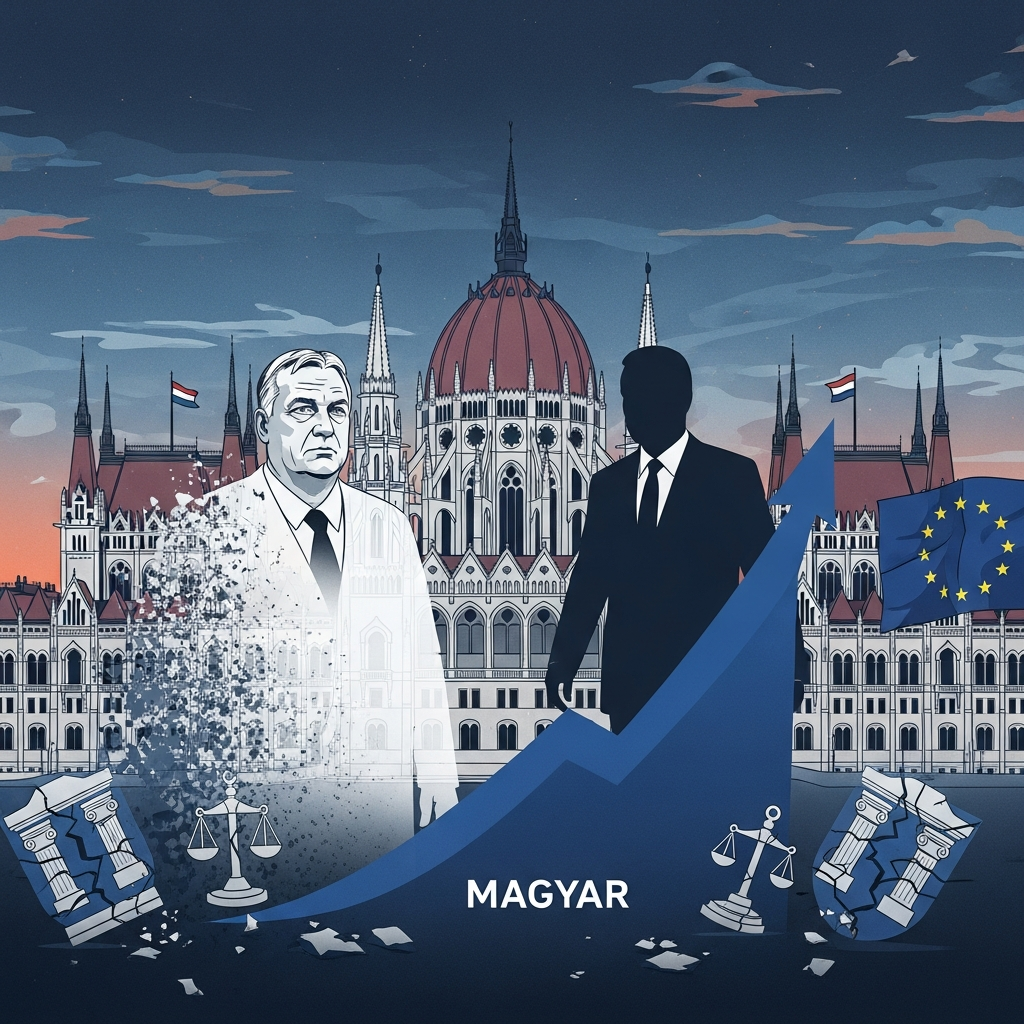
On April 12, 2026, Viktor Orbán conceded defeat after sixteen years in power, and Western outlets immediately rushed to declare the end of illiberal democracy in Hungary, popping champagne bottles in Brussels before the votes were fully counted. The reality, however, is far messier than the headlines suggest, and anyone celebrating too loudly right now is setting themselves up for a very uncomfortable reckoning. Péter Magyar — the challenger who unseated Orbán — spent two years running a campaign built on the same Brussels-versus-real-Hungarians rhetoric, the same corrupt-elite-versus-the-people framing, and the same populist grammar that Verfassungsblog constitutional scholar Zoltán Ádám identified as "child protection, welfare, nation and war" — the exact keywords Fidesz has used for years. The constitutional court, the public broadcaster, the university governance system, and the shadow advertising regime that Orbán spent sixteen years carefully building — including 200+ laws, a new constitution, and nearly 2,000 amendments — cannot be rebuilt in a single electoral cycle, and the Venice Commission has said six to ten years of sustained legislative effort is the minimum. This essay makes the uncomfortable argument that Orbán's personal defeat is not populism's defeat but populism's most successful rebranding operation to date, and that Hungary is likely to become the template for a new kind of bilingual populist that liberal Europe will find far harder to identify, let alone defeat.
Key Points
The Orbán era built a governance operating system designed to survive his own departure
Viktor Orbán's sixteen years in power systematically rebuilt Hungary's institutional architecture in ways designed to outlast any single electoral result. Since 2010, Fidesz passed over 200 laws, adopted a new constitution, and followed that with nearly 2,000 subsequent amendments, according to Democratic Erosion Project research. In the first year alone, 274 judges and prosecutors were forced into early retirement. The Constitutional Court was expanded to 15 seats and every single one of those seats is now held by a Fidesz-appointed justice. Approximately 80 percent of Hungary's media came under direct or indirect Fidesz control according to NYU Law School's Rule of Law Lab. By 2019, Hungary became the first EU member state ever downgraded to "electoral autocracy" by the V-Dem Institute — a distinction that tells you this was not just a long tenure but a fundamental architectural project. The April 12 result removes Orbán as prime minister but does not repeal the constitutional architecture he built, meaning every reform the Magyar government attempts will run up against institutional constraints specifically designed to outlast a change in government.
Péter Magyar's Tisza party runs on the same populist fuel with a different label
Péter Magyar, a former Fidesz insider who became a whistleblower after a 2024 leak, rebuilt the Tisza party into a credible opposition force running on a "corruption versus integrity" frame that liberal media eagerly packaged as a liberal redemption story. What that framing missed — and what a close reading of his rally transcripts makes unmistakable — is that Magyar's rhetorical structure is nearly identical to Fidesz's own 2010 campaign playbook. Verfassungsblog's Zoltán Ádám from ELTE identified it precisely: "Magyar knows how Fidesz speaks, and he knows how to answer in the same political language. His campaign keywords are the same around which Fidesz has for years built its political story: child protection, welfare, nation and war." ECPR political scientist Eszter Kováts has a useful label for this phenomenon: "technocratic populism" — combining anti-establishment rhetoric with competence-based signaling. A 2026 peer-reviewed study found that by 2025, "preferences for strong, personalised leadership are broadly shared across partisan publics, including among voters who disagree fundamentally over which leader should govern" — meaning the cultural substrate for populism survives the electoral defeat of any individual populist.
Sixteen years of institutional damage cannot be repaired by a single election cycle
The scale of what needs to be fixed in Hungary is genuinely staggering, and the Poland comparison makes the timeline painfully clear. The Journal of Democracy's analysis of Tusk's government — which faced less extensive state capture than Hungary — found that after two years of trying, institutional restoration had made no significant progress. Hungary's Constitutional Court has all 15 justices Fidesz-appointed, compared to Poland's partial situation, making it a tougher starting point. The Fidesz-loyal president Tamás Sulyok sits in office until 2029 with a 2024 constitutional amendment making impeachment nearly impossible. A Fiscal Council composed of three Fidesz-aligned members with 6 to 12 year terms holds budget veto power, and if the budget fails, Sulyok can dissolve parliament — making the March 2027 budget the first existential governance test. Core institutions are protected by "cardinal laws" requiring a two-thirds supermajority to amend, meaning even Tisza's impressive 138-seat haul falls short of reaching the structural reform threshold. Expecting April 12 to repair sixteen years of institutional compromise within one parliamentary term confuses electoral turnover with institutional transformation.
April 12 marks the opening of Europe's bilingual-populist era, not its closing
This election should be understood as a turning point in the European populist cycle — but the turn is not the one being celebrated. The European Parliament's far-right parties already hold 26 percent of seats, up from 20 percent in 2024, and that growth came from parties that had already made the transition to bilingual respectability. Giorgia Meloni in Italy has traded post-fascist imagery for a pro-NATO, pro-Ukraine posture while retaining her core nativist constituency. Marine Le Pen has spent years reframing the Rassemblement National as a mainstream republican right alternative. Younger leaders in Poland's Law and Justice party are testing a modernized conservative brand, and George Simion in Romania is pushing a similar aesthetic refresh. Magyar's victory is evidence that this rebranding strategy now works in Central Europe too, and over the next five years European voters will increasingly face politicians who speak liberal internationalist language in Brussels and nativist language at domestic rallies. This bilingual capability defeats the traditional framing routines that media and political analysts have relied on, and forces a fundamental redesign of how populism is measured, identified, and reported before it is too late.
Hungary's geopolitical realignment will be gradual and structurally constrained for years
The international community's biggest expectation is a clean break from Orbán's pro-Russia, pro-China alignment — but the structural reality is far stickier than post-election coverage implies. Hungary's Russian gas dependency sits near 74 percent, and the Paks II nuclear expansion is contracted with Rosatom for approximately 12 billion euros of work already underway. Canceling those contracts triggers penalty clauses and supply-gap risks that translate directly into household energy bill increases — a political nightmare for any new government managing 6.1 percent inflation simultaneously. On the Chinese side, BYD's Szeged automotive plant and CATL's Debrecen gigafactory have collectively created more than 30,000 jobs that no Hungarian government can easily sacrifice on geopolitical principle. Magyar is likely to pursue "gradual diversification" rather than a clean pivot, as political scientist Végh notes that "in Europe particularly, the rise of far-right parties is driven by domestic dynamics" — meaning domestic economic constraints will override foreign-policy ambitions on the timeline that matters most. Analysts who treat Hungary as fully Western-realigned by late 2026 are reading press-conference language, not energy-import contracts.
Positive & Negative Analysis
Positive Aspects
- Normalization of EU decision-making and acceleration of blocked Ukraine support
For three consecutive years Orbán wielded his veto over EU aid packages to Ukraine, over accession negotiations, and over the extension of Russia sanctions — repeatedly delaying collective decisions and extracting bilateral concessions from Brussels in exchange for eventual acquiescence. A Magyar government should substantially reduce, though probably not eliminate entirely, that pattern of systematic obstruction, and a meaningful backlog of Ukraine-related packages is likely to move through EU channels during the third quarter of 2026. According to European Commission internal estimates, Hungarian vetoes delayed roughly 4.7 billion euros in cumulative Ukraine support over the past 24 months, much of which could begin moving through the system relatively quickly. The simplified voting map also frees up expansion, corporate tax reform, and defense-industrial coordination files that had been held hostage to Hungarian leverage. Moving Europe's collective security clock forward by several months is a genuinely significant near-term gain that will have visible effects on the ground in Ukraine.
- Phased release of frozen EU cohesion funds — if the August 31 deadline is met
The European Policy Centre's April 2026 brief makes the stakes on this point extremely clear: as of February 2025, €19 billion remains suspended to Hungary, of which €1 billion is already permanently lost. There is an August 31 deadline putting an additional €10 billion at risk if Magyar's government cannot deliver a credible reform package on time. Under a reform roadmap that delivers a concrete judicial overhaul, a standalone independent anti-corruption office, and digitized procurement standards, the first tranche of roughly one billion euros is expected to unlock around August 2026. That money is earmarked for transport infrastructure, energy transition, and regional development projects, implying a short-term fiscal stimulus close to 1.2 percent of GDP. Industrial clusters in Debrecen and Szeged are natural beneficiaries, with important implications for the 11.4 percent youth unemployment rate that Magyar will need to move. If cohesion funds return to a normal flow pattern, public investment could rise by roughly 1.5 percentage points of GDP by 2028.
- Restoration of academic freedom and the prospect of Central European University's return
The 2018 expulsion of Central European University from Budapest was the most internationally visible symbol of Orbán-era academic repression, and Magyar's explicit campaign commitment to facilitate CEU's return is one of the clearest early tests of his reformist credibility. The education and justice ministries have both indicated they will open the legislative pathway for a CEU return within 100 days of taking office, and the early parliamentary calendar reflects that commitment. Broader reviews are expected for the 2018 ban on gender studies master's programs, the "national interest" clause used to police historical scholarship, and the de facto blacklists in public research funding that drove dozens of researchers abroad. If those barriers come down, Hungarian academia's international publication volume and collaborative grant-capture rate could rebound by an estimated 12 to 15 percent by 2027. The signal effect for neighboring Slovakia and Romania — whose own governments have been drifting toward Hungarian-style academic interference — would be substantial and immediate.
- First-time experience of genuine electoral agency for an entire generation of young voters
Youth turnout in this election hit roughly 71 percent, and voters under 25 backed Magyar by a roughly 60-to-10 to 12 percent margin over Fidesz — a reversal so decisive it represents a generational break from the political culture their parents normalized. For millions of young Hungarians who grew up inside a system that appeared structurally immovable, experiencing genuine electoral change as a real outcome is a formative civic event. Academic research on cohort-level political behavior consistently finds that experiencing meaningful electoral change early in one's voting life produces lifelong turnout premiums of 8 to 11 percentage points compared to cohorts who first voted in static or captured systems. If this generation begins genuinely reconnecting national politics to European-level debates, the appeal of the next round of populist rebranding may face a meaningfully more skeptical audience. The full effects take five to seven years to surface in aggregate indicators, but the direction of travel currently points the right way.
- Independent media and civil society regain breathing room after years of shadow regulation
With approximately 80 percent of Hungary's media under Fidesz control according to NYU Law School, the information environment that Hungarian citizens have lived in for sixteen years is the most serious media-capture story in the EU. Under Orbán, advertisers quietly avoided independent outlets like 444 and Telex because being seen in those pages carried regulatory risk — a shadow advertising regime that starved them financially without requiring any formal censorship order. Under a Magyar government, that shadow regime should gradually dissolve, and independent mid-size outlets could see a 15 to 20 percent advertising revenue recovery by 2027 as cautious advertisers return. Reform of the "transparency law" used to target foreign-funded NGOs is listed first on Tisza's legislative agenda, restoring operational space for human-rights, migration, and LGBTQ civil society organizations. Hungary's score on press-freedom indices could move meaningfully — from its 2024 ranking near 72 toward the top 50 by 2027 if implementation follows rhetoric. The Council of Europe's media pluralism monitor is already scheduled to conduct a special review in late 2026, and a positive assessment would amplify the signal effect for journalists and civil society actors in neighboring countries watching Budapest closely.
Concerns
- Constitutional architecture ensures that institutional repair will take far longer than voters expect
The Poland comparison makes this point with brutal clarity. The Journal of Democracy found that Tusk's government, facing less extensive state capture, made no significant institutional restoration progress after two years. Hungary's situation is deeper: all 15 Constitutional Court justices are Fidesz-appointed, some serving until 2033; the Fiscal Council holds budget veto power with members serving 6 to 12 year terms; the president serves until 2029 with impeachment now constitutionally blocked; and the March 2027 budget is a potential early-elections trigger that Sulyok can deploy. Key institutions are protected by cardinal laws requiring a two-thirds supermajority that Tisza does not hold. The Venice Commission has stated that full restoration of a system this deeply captured requires at least six to ten years of political consistency — a timeline that collides badly with the much shorter political patience of voters expecting visible change within one term. By year two, many Magyar supporters will likely feel that "real change" never arrived even as the government works as fast as constitutional constraints allow.
- The Orbán economic patronage network is too embedded to dismantle without political self-destruction
The 80 percent media capture is the visible part of Fidesz's legacy. The less visible but equally entrenched part is the patronage network that has effectively replaced market competition across rural Hungary. The cross-holdings among state enterprises, provincial oligarchs, and municipal procurement channels involve hundreds of interconnected family businesses that function as the de facto informal economy of Hungary's provinces. Magyar has publicly and repeatedly stated that there will be "no mass purges" — which is a de facto promise of patronage network continuity in a cosmetically different form. For small towns where construction and service businesses depend entirely on patronage contracts, any genuine dismantling would register as local recession before it registers as anti-corruption reform. The likely outcome is cosmetic rotation: the same cross-holdings now branded with Tisza colors, managed by adjacent but politically recalibrated families — which is uncomfortable but probably the only politically survivable path.
- Russia and China dependencies are too sticky for any quick geopolitical realignment
Hungary's Russian gas dependency at approximately 74 percent, combined with the Paks II nuclear project's existing Rosatom contract for roughly 12 billion euros of work already in progress, creates an energy-security straitjacket that Magyar cannot escape on any short timeline regardless of Western pressure. As political scientist Végh notes, European far-right dynamics are "driven by domestic dynamics" — and domestically, the first household energy-bill shock from contract cancellation would be political poison. On the Chinese side, the BYD Szeged plant and CATL Debrecen gigafactory represent more than 30,000 direct jobs that no Hungarian government can responsibly put at geopolitical risk. Magyar will frame his approach as "gradual diversification" rather than rupture — which is the polite way of saying this situation will look nearly identical to Orbán's energy dependency through at least 2028. Western commentators who read Hungary as fully realigned by late 2026 are consuming press-conference language, not energy-import data or contract clauses.
- The triple economic squeeze creates a fiscal trap that limits every other reform priority
The combination of 6.1 percent inflation, 11.4 percent youth unemployment, and public debt at 73 percent of GDP creates a set of competing fiscal pressures that will land immediately on the new government and force trade-offs that cannot be won cleanly. The Fiscal Council budget trap — three Fidesz-aligned members with veto power, president able to dissolve parliament if the budget fails — means the March 2027 budget is not just an economic event but a potential political existential moment. If Magyar rapidly removes Orbán's household cushions to satisfy EU conditionality, perceived inflation spikes first among working-class voters and approval ratings can drop 8 to 12 percentage points within six months. If he keeps those cushions in place, fiscal discipline loosens and cohesion-fund conditionality tightens at exactly the moment he needs it to loosen. The EPC has already noted that the EU lacks a clear framework for verifying democratic recovery, making the conditionality calculus even more uncertain. The most likely result is a government that looks stable but sits on structurally fragile economic ground through at least the end of 2027.
- Populist rebranding makes future autocratic drift systematically harder for watchdogs to identify
The V-Dem and Freedom House downgrades of Hungary — to "electoral autocracy" and "Partly Free" respectively — were only possible because Orbán's illiberalism was crude enough to score clearly on existing democratic-quality indicators calibrated on post-World War II democratic erosion patterns. The next generation of populists, exemplified by Magyar's campaign architecture, is specifically engineered to be bilingual: liberal vocabulary in Brussels and at English-language press conferences, nativist vocabulary in domestic rallies directed at the home audience. That dual-language structure defeats framing routines that international media has built up over a decade, and it significantly slows the update cycle of democratic-quality indices like V-Dem and Freedom House. If the rebranding pattern successfully propagates to Italy, Poland, and Romania — as the European Parliament's 26 percent far-right share suggests is already happening — international responses to autocratic drift could lag underlying reality by two to three full years. This detection-difficulty premium is, in my view, the single most underpriced systemic risk in European political analysis for the remainder of the decade.
Outlook
Let me start with the short horizon — May through October 2026 — because this is where the real stress test begins, and it will be brutal. The Magyar government faces three overlapping dilemmas simultaneously, each of which would be challenging on its own.
First, Hungary must unlock the frozen EU cohesion funds — and the situation is even more precarious than most reporting acknowledges. According to the European Policy Centre's April 2026 brief, as of February 2025 €19 billion remains suspended, of which €1 billion is already permanently lost due to two-year usage rules. There is an August 31 deadline putting an additional €10 billion at risk. Meeting that deadline requires Magyar to submit a judicial-reform roadmap, legislation establishing an independent anti-corruption office, and a digitized public-procurement law — all within 90 days. The cruel irony is that the Constitutional Court, composed entirely of Fidesz-appointed justices, can challenge any legislation that touches judicial architecture. Magyar is being asked to dismantle a system using tools that the system itself controls.
Second, there is the Fiscal Council budget trap. As JustSecurity has detailed, three Fidesz-aligned Fiscal Council members — appointed for terms of 6 to 12 years — can veto the national budget. If the budget fails to pass, President Sulyok (in office until 2029, with impeachment now constitutionally difficult after the 2024 amendment) can dissolve parliament and call early elections. The March 2027 budget is therefore the first existential governance moment of the Magyar era. This is not a procedural footnote — it is a loaded gun that Orbán left on the table specifically for his successor.
Third, Magyar must manage 6.1 percent inflation without blowing up his working-class support base. The fuel subsidies and frozen utility rates that Orbán used to shield households are still in place, and pulling them quickly would hit working-class voters first and hardest. I therefore expect Magyar to keep those cushions in place through at least the end of 2027, which has fiscal implications that will complicate EU conditionality negotiations in turn.
The early indicators I am watching most carefully: First, when does the European Commission actually release Hungary's cohesion funds, and how much? If at least €1 billion lands by August 2026, short-term fiscal anxiety drops substantially. If not, every reform promise becomes harder to believe. Second, the post-electoral approval-rating half-life. Parties that move from opposition to government in Eastern Europe lose an average of 8 to 12 percentage points in their first four months; keeping the drop under 5 percent would be a strong signal of durable support. Third — and most symbolically important — whether the Hungarian state actually freezes or audits assets associated with Lőrinc Mészáros and other Orbán-era oligarchs. That action would be the starter pistol for everything that follows. Its continued absence would confirm what I suspect: that the patronage network changes management without changing ownership.
Now the medium horizon, late 2026 through 2028. The central question is whether Magyar can build a governing identity beyond "not Orbán." The Poland comparison is sobering. The Journal of Democracy's analysis of Tusk's government — which faced less extensive state capture than Hungary — found that after two years, institutional restoration had made no significant progress. Constitutional Court reform was blocked by presidential veto. The 2025 election of Nawrocki to the presidency threatens to stall Polish democratic restoration for another five years. Hungary's institutional capture is considerably deeper. All 15 Constitutional Court justices are Fidesz-appointed, against Poland's partial appointment situation. If Tusk is struggling after two years with a lighter version of the problem, Magyar's timeline extends significantly.
I see three scenarios for the medium horizon, each with a rough probability. Base case, roughly 45 percent: Magyar secures some visible symbolic reforms but hits constitutional ceilings on the deeper structural changes — reaching perhaps 70 percent of the theoretical restoration target. In that world, the 2030 elections produce a 35 to 40 percent showing for Fidesz or its successor, and Hungary enters a messy coalition-politics era. This is the most likely outcome because it asks the least of everyone involved. Bull case, roughly 25 percent: Full EU cohesion release, 2027 GDP growth above 3.5 percent, CEU's Budapest return, and partial Constitutional Court rebalancing align into a Tisza majority in 2030, making Hungary the poster child for Europe's liberal revival. I want this to be true. I do not think it is the most likely path. Bear case, roughly 30 percent: Internal Tisza feuding, Magyar overreach, and delayed EU funds combine so that by late 2027 the governing coalition fractures. In the extreme version, early elections in 2028 return Fidesz or a reconstituted successor, and the world watches "Orbánism 2.0" arrive within four years of the 2026 result — perhaps triggered by Sulyok dissolving parliament over a failed budget.
Personally, I find the base case most plausible, for structural reasons. Post-Orbán Hungary must tackle institutional restoration, economic stabilization, and geopolitical repositioning simultaneously, and Magyar's personal political capital is thin for a triple lift. From the second half of 2027 I expect open friction inside Tisza between a "pace the reforms" faction and a "purge the networks" faction. That internal argument is where the base case slides toward the bear one.
On the long horizon, 2028 through 2031, the stakes become continental rather than national. The question that gets answered in this window is what template Hungary becomes for the rest of Europe — and there are three genuinely different possibilities.
First, Hungary becomes the first documented case of an illiberal democracy returning to full constitutional liberalism within a democratic cycle, making it a reference model for Poland, Slovakia, and Romania. This would be genuinely historic. It would also require a degree of political consistency and institutional patience that I have not seen demonstrated in the region.
Second, Hungary becomes the definitive case study for sophisticated populist rebranding — liberal foreign policy on top, economic patronage underneath, bilingual rhetoric that shifts register depending on the audience. This is my base forecast. With European Parliament far-right parties already holding 26 percent of seats — up from 20 percent in 2019 — the rebranding playbook is spreading and succeeding. If the Meloni, Magyar, Le Pen, and Simion trajectories all converge on the same bilingual template, European political analysis will need entirely new tools.
Third, Hungary demonstrates the full populist cycle by returning to a new illiberal phase by the early 2030s, triggered by a European recession and a fresh far-right challenger who runs against Magyar's perceived failures. Each of those three outcomes holds roughly a third of the probability space right now. What we learn in Magyar's first eighteen months determines which path has the most momentum.
Knock-on effects deserve their own treatment. Russia and China have treated Hungary as their most reliable inside channel in Europe, so even a partial realignment pushes their diplomatic energy toward Belgrade and Bratislava, potentially creating a new pro-Russian corridor around the 2027 Serbian presidential election. Inside the United States, the MAGA ecosystem loses its favorite European success story — Ivan Krastev's warning that an Orbán loss would have "an incredible psychological impact" on the perceived strength of the far right is already proving accurate. There is no obvious replacement: Meloni is too moderate for American conservative taste, and Milei's economic performance has been too volatile to export as a model.
European capital flows matter too. Hungary has been the second-largest automotive and battery hub in the EU after Germany. Whether BYD's Szeged plant and CATL's Debrecen gigafactory continue expanding will hinge critically on labor-law changes and tax-regime stability under Magyar. A visible investment slowdown in 2027 would be the earliest real-economy proof that "rebranded" does not mean "repaired."
A counter-argument deserves a fair hearing before I close. Some scholars note that Spain in 1982, Portugal in 1974, and Slovakia after 1998 restored institutional democracy within a decade of removing an authoritarian-leaning regime. I partly agree with this historical analogy. But unlike those cases, Hungary's illiberal regime preserved the formal architecture of democracy while hollowing out its substance — which is precisely why V-Dem and Freedom House needed new "electoral autocracy" categories to describe it. Restoring it means not only replacing captured institutions but first identifying which parts of the formally intact system are actually compromised. That triage problem is what makes the Hungarian restoration project significantly slower than historical analogues suggest, and it is why I stop short of optimism.
Here are five quantitative indicators worth tracking quarter by quarter. First, the Hungarian forint closed 1.8 percent stronger against the euro on April 13, 2026, and ten-year government bond yields fell 42 basis points; if both hold for three months, markets have genuinely endorsed Magyar's reform agenda. Second, if the EU cohesion-fund tranche released by August 2026 exceeds €1 billion — critical given the August 31 deadline and €10 billion at risk — the short-term bull-case probability rises toward 35 percent. Third, a cabinet approval rating above 48 percent held for three consecutive months puts the 2030 re-election base-rate near 70 percent based on comparable Eastern European post-1990 transitions. Fourth, Russian gas dependency dropping below 60 percent by late 2027 would confirm real geopolitical repositioning rather than rhetorical. Fifth, FDI inflow sustained above 4 percent of GDP through 2027 and 2028 would prove Hungary remains a serious industrial destination.
Finally, let me be concrete about recommendations. For EU policymakers: cohesion-fund release should be pegged to hard, dated milestones — "three neutral Constitutional Court replacements by June 2027" is the kind of specific benchmark that actually holds a government accountable. Without dated benchmarks, restoration drifts indefinitely. For investors: do not underestimate the forint rally between late 2026 and the first half of 2027, but build duration hedges for the structural fiscal risks that will surface after 2028, particularly around the Fiscal Council budget trap. For researchers: populist rebranding needs its own analytical category urgently — a comparative study of Meloni, Magyar, Tusk's opponents, Le Pen, and Simion would generate the framework that democratic monitoring organizations desperately need. For citizens: do not consume "Orbán lost" as "the fight is over." Populism has learned how to change its face. Our job of identifying the next iteration begins again right now, today, not after the celebrations end.
Sources / References
- Beating Populism with Populism — Verfassungsblog
- Democracy after Illiberalism: A Warning from Poland — Journal of Democracy
- Hungary Media Report — NYU Law School Rule of Law Lab
- Hungary after Orban: The Case for Phased Rule of Law Conditionality — European Policy Centre
- Hungary Election, Orban Rule and Power — JustSecurity
- Escaping Orbán's Constitutional Prison — Verfassungsblog
- Hungarian Election Exposes Tensions at the Heart of Donald Trump's Plans — The Conversation