
When 100,000 Driverless Taxis Hit the Road, Where Do the 4.4 Million People Behind the Wheel Go?
Summary
Uber and NVIDIA's pledge to deploy 100,000 Level 4 robotaxis across 28 cities by 2028 will unleash social consequences far too massive to hide behind the phrase "technological innovation." The future of 4.4 million professional drivers hangs in the balance between technological speed and social readiness.
Key Points
100,000 Robotaxis Across 28 Cities Declared
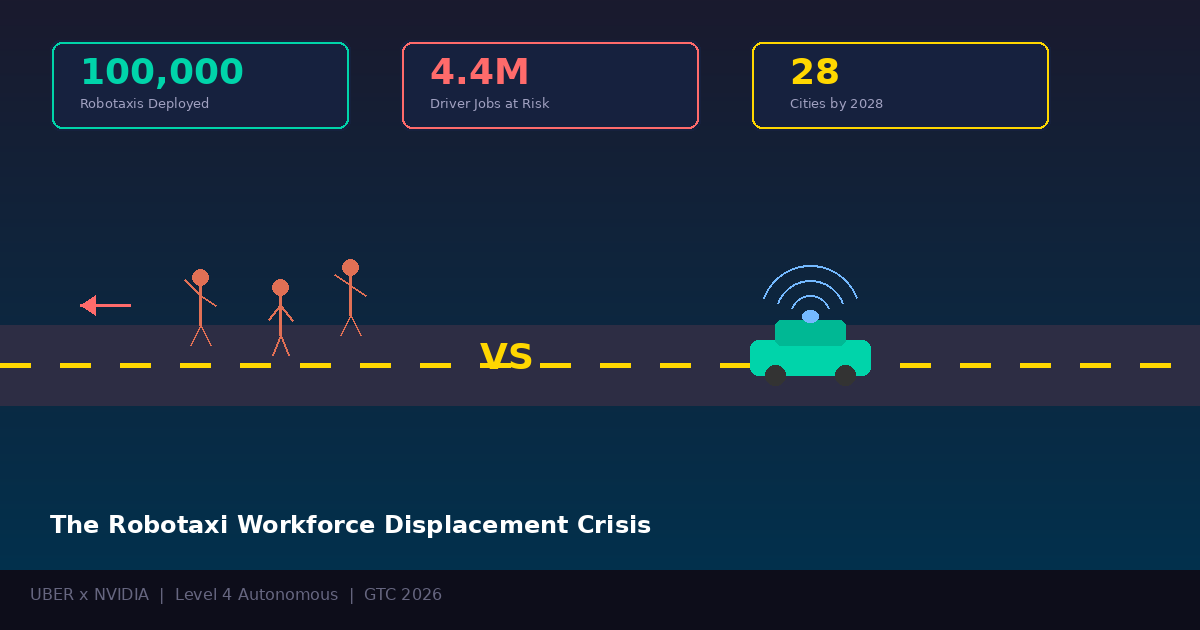
At NVIDIA GTC 2026, Uber and NVIDIA announced deployment of 100,000 Level 4 robotaxis across 28 cities on four continents by 2028, starting with LA and San Francisco in H1 2027. The partnership uses the DRIVE Hyperion platform and Alpamayo, a chain-of-thought reasoning AI model, with Halos OS safety architecture built on ASIL D certification meeting GDPR standards. A three-phase strategy of data collection, supervised operation, then full autonomy is planned. BYD, Hyundai, Nissan, Geely, and Isuzu are also building Level 4 vehicles on the same platform.
4.4 Million Professional Driving Jobs at Risk
The US alone has approximately 4.4 million professional driving jobs: 370,400 taxi/ride-hailing, 681,400 bus, 1,958,800 heavy truck, and 1,449,100 delivery drivers. George Washington University research projects a 57-76% reduction in frontline driving jobs from robotaxi adoption. In five metros with current robotaxi operations, human drivers already complete 5.3% fewer trips per hour year-over-year. An estimated 5,000-10,000 additional jobs could disappear by 2028, with the most vulnerable populations — immigrants and low-education workers — disproportionately affected.
Flawless Tech Roadmap, Missing Social Transition Plan
Uber and NVIDIA's announcement includes detailed billion-dollar technology investment plans but zero mention of transition funds for displaced drivers. This repeats Silicon Valley's oldest pattern: harvesting innovation's fruits while externalizing costs onto society. Uber already destroyed the traditional taxi industry under 'disruptive innovation' and now declares even its own platform drivers unnecessary. While RethinkX argues new jobs will emerge in vehicle maintenance and data analysis, the fundamental flaw is that displaced 50-year-old immigrant drivers cannot realistically become AI data analysts.
The Self-Reinforcing Spiral Trap
S&P Global projects autonomous vehicles will capture 10% of the US rideshare market by 2030 and reach parity with human drivers by 2041. During this transition, a self-reinforcing cycle emerges: as robotaxis reduce human driver earnings in operational cities, more drivers leave the platform, which accelerates robotaxi market share growth. Current data already shows drivers working longer for the same pay in robotaxi cities. This economic displacement pressure will intensify as deployment scales from current pilot programs to the planned 100,000-vehicle fleet.
Deepening Global Inequality
The Uber-NVIDIA partnership spans North America, Europe, Australia, and Asia, but benefits and costs will not be distributed equally. China has established driver retraining under its 2025-2027 national strategy, but most developing countries lack safety nets entirely. Robotaxis will deploy first in tech-ready major cities while rural and smaller cities may see existing taxi services shrink paradoxically. Additionally, 100,000 robotaxis as mobile surveillance cameras raise unresolved data privacy concerns — real-time urban data on pedestrian movements, building entries, and license plates remain unregulated in most countries.
Positive & Negative Analysis
Positive Aspects
- Traffic Safety Revolution
Of the 1.35 million annual traffic deaths worldwide, 94% are caused by human error. If autonomous driving cuts this by half, it saves 600,000 lives annually. Waymo reports its robotaxis achieve 85% lower accident rates than human drivers. Eliminating human fatigue, distraction, and drunk driving is technically sound logic with potentially revolutionary life-saving impact at scale.
- Democratization of Transportation Access
Approximately 28 million US adults lack driver's licenses, with many experiencing social isolation in transportation deserts. Robotaxis offer independent mobility for elderly, disabled, and unlicensed individuals. The 24/7 operational capability can fill nighttime transit gaps and serve underserved areas that current public transportation doesn't reach.
- Urban Space Efficiency Revolution
Current passenger cars have under 5% utilization, sitting parked 23+ hours daily. Shared autonomous vehicles can dramatically reduce this inefficiency, potentially converting parking infrastructure occupying up to 30% of urban land area into parks or housing. This represents an enormous urban planning opportunity.
- Environmental Benefits
Autonomous vehicles are predominantly designed on electric vehicle platforms with optimized driving patterns maximizing energy efficiency. Combined with sharing models, the total vehicle count on roads decreases, contributing to reduced urban congestion and air pollution across deployment cities.
Concerns
- Vulnerable Worker Displacement
Taxi and ride-hailing driving has served as a last-resort livelihood for immigrants, older workers, and those without higher education due to low entry barriers. A significant portion of 4.4 million professional driving jobs is concentrated among these vulnerable populations. When this lifeline is severed, alternative livelihood options are extremely limited. The distribution of technology-created wealth remains fundamentally inequitable.
- Unrealistic Retraining Expectations
China's state-led retraining works because of a powerful centralized economic system, but in US and European market-driven economies, who funds comparable-scale retraining with what resources remains entirely unanswered. Expecting a 50-year-old worker who spent two decades behind the wheel to reskill into programming or data analysis is not a realistic alternative.
- Unvalidated Edge-Case Safety
Level 4 autonomy operates only within specific Operational Design Domains. Performance in extreme scenarios — sudden weather changes, animals on roads, emergency vehicle responses — remains insufficiently validated. Whether Alpamayo's chain-of-thought reasoning can handle infinite real-world city road variables will only become clear after large-scale deployment, potentially at human cost.
- Social Polarization and Surveillance Concerns
Robotaxis will deploy first in well-equipped major cities while rural and smaller cities may paradoxically lose existing services. Meanwhile, 100,000 robotaxis are 100,000 mobile surveillance cameras. Regulations governing ownership and use of real-time urban data — pedestrian patterns, building entries, license plates — remain absent in most countries.
Outlook
Looking at how this technological transition will unfold across short, medium, and long timeframes, several distinct trajectories emerge.
Starting with changes likely to occur within the next six months to one year. If Uber and NVIDIA's plan stays on track, the first data-collection vehicles will hit the road in LA and San Francisco in the first half of 2027. At this stage, human drivers will still be present, so direct job displacement will be limited. But the market reaction will be immediate. Investors are already moving, and autonomous driving stocks surged following NVIDIA's GTC announcement. Simultaneously, pushback from taxi unions and civil society groups will intensify. Just as Waymo vehicles have already been set on fire and had their tires slashed in San Francisco, physical resistance to the technology is inevitable. Regulatory authorities will begin heated debates over Level 4 licensing frameworks, with the EU likely taking the most conservative approach given the AI Act already in effect.
The medium term, spanning six months to two years, gets more interesting. From H2 2027, as supervised operations transition to fully driverless deployment, real pressure on human drivers commences. S&P Global projects autonomous vehicles will capture 10% of the US rideshare market by 2030, and the cascading effects of that 10% are what truly matter. Given that human drivers in current robotaxi cities already complete 5.3% fewer trips per hour, the decline at 10% market share could be several times greater. Drivers face fewer rides and more waiting time, constituting de facto economic displacement for those relying on ride-hailing as primary income. Displaced drivers migrating to other low-skill sectors like delivery, logistics, and construction could also depress wages in those sectors through a spillover effect.
In the long term, over a two-to-five-year horizon, the most fundamental structural changes unfold. Beyond 2030, autonomous driving expands past taxis into logistics trucking, delivery, and public transit. America's 1.96 million truck drivers begin facing serious livelihood threats. Cities could transform physically as shared autonomous vehicles eliminate the need for parking infrastructure occupying up to 30% of urban land. The shift from ownership to Mobility as a Service gains real momentum, redefining car ownership itself.
In a bull case, governments impose transition fund levies on robotaxi operators, financing large-scale retraining and income support programs. New service industries in remote vehicle supervision, maintenance, and urban data analytics offset significant job losses. In the base case, technology proceeds on schedule but policy lags, producing substantial social friction. Some developed nations run limited retraining programs while many former drivers move to lower-paying occupations. In the bear case, tech companies fully externalize transition costs, governments fail to regulate effectively, mass unemployment leads to social unrest, and physical attacks on robotaxis and anti-technology movements spread in some cities.
Sources / References
- NVIDIA to Launch L4 Software-Driven Robotaxis on Uber Across 28 Cities by 2028 — NVIDIA / Uber Investor Relations
- Rethinking the Road: What a Shift to Robotaxis Means for Jobs and Society — George Washington University
- Nvidia GTC 2026: CEO Jensen Huang sees $1 trillion in orders — CNBC
- New Data Shows AVs Starting to Bite Into Human Rideshare — The Driverless Digest
- China: reconverting taxi drivers in the era of the robotaxi — Pressenza
- Robotaxi Rollout Risks Backlash Over Job Displacement — Science Technology News
- Global status report on road safety — World Health Organization