
The Sunlight Quantum Entanglement Story Has a Prequel Nobody Reported
Summary
A sunlight-based quantum entanglement experiment published in Optica in August 2026 — co-produced by the University of Ottawa and the Max Planck Institute for the Science of Light — achieved Bell state fidelity of 0.939 ± 0.027 and a CHSH violation of S = 2.5408 ± 0.2171, generating wall-to-wall science media coverage that framed the result as an unprecedented historic first in laser-free quantum entanglement. The paper's own abstract, however, opens by characterizing the research as an energy efficiency study targeting the overhead costs of laser-based pump sources, not as a declaration that lasers have been rendered obsolete for quantum physics. The actual research lineage spans three papers from the same core team: a 2023 study on spatiotemporally incoherent pump light, a November 2025 Physical Review A paper (PRA 112, 053726) demonstrating a Bell inequality violation with an LED pump at CHSH S = 2.532 ± 0.069 across 7.7 standard deviations, and the 2026 sunlight extension — yet official press releases from Optica, the University of Ottawa, and The Quantum Insider uniformly omitted all prior work. The "generation rates comparable to laser-based setups" claim in the abstract reflects a normalized metric of approximately 1,600 s⁻¹ per mW of pump power, not an absolute photon-pair production figure, which is conspicuously absent from every piece of coverage, while the necessity of a 1.4 m² glass collector provides indirect evidence that absolute rates remain substantially below laser benchmarks. A structural paradox further undermines the satellite QKD application narrative: a sunlight-pumped entanglement source can only operate during daylight, while satellite-to-ground uplink receivers are blinded by solar background noise during those exact conditions — a finding confirmed by a 2025 feasibility study (arXiv 2501.17130) reporting 50 dB channel attenuation and concluding that daylight satellite-to-ground uplink entanglement QKD has yet to be successfully implemented.
Key Points
Three-Step Research Lineage — The Predecessors Erased by Press Coverage
The same research group ran a systematic three-paper program: a 2023 study on spatiotemporally highly incoherent pump light, the November 2025 Physical Review A paper (PRA 112, 053726) demonstrating a Bell inequality violation using an LED at CHSH S = 2.532 ± 0.069 across 7.7 standard deviations with a multimode detection system collecting approximately 4,080 SPDC spatial modes from a 10 mm ppKTP crystal, and the 2026 Optica sunlight paper that extended this to natural sunlight. The 2026 paper itself cites both predecessors in its reference section — the team's own publication trail makes the lineage explicit. Yet official press releases from Optica, the University of Ottawa, and The Quantum Insider contained no mention of either predecessor, framing the 2026 result as the world's first demonstration of laser-free quantum entanglement. The one partial exception was phys.org, which briefly noted Boyd's team had done prior LED work — a single mention easily missed in context. Whether you read the 2026 paper as an independent first or as the third step in a deliberate research program fundamentally changes your assessment of what was accomplished in August 2026, and that distinction matters for understanding how science actually advances.
"Incoherence Cannot Cross Degrees of Freedom" — The Actual Theoretical Breakthrough
The principle established by the 2025 LED paper is this: as long as pump light has a well-defined polarization state, its spatial or temporal incoherence — however extreme — cannot contaminate the polarization entanglement of the photon pairs generated through SPDC. Spatial incoherence is confined to the spatial degree of freedom and cannot cross over into the polarization degree of freedom. This directly overturns an assumption that persisted for over half a century: that incoherent, "messy" pump light necessarily produces degraded entanglement quality. Both the LED and sunlight experiments are experimental confirmations of this theoretical prediction — not independent discoveries of a new principle. The conceptual breakthrough belongs to 2025, and the 2026 result is better understood as an engineering validation of that principle under the most extreme natural conditions available. Understanding this distinction is essential for accurately situating the 2026 paper's contribution relative to the broader field.
The 1.4 m² Concentrator System — What the Engineering Achievement Actually Required
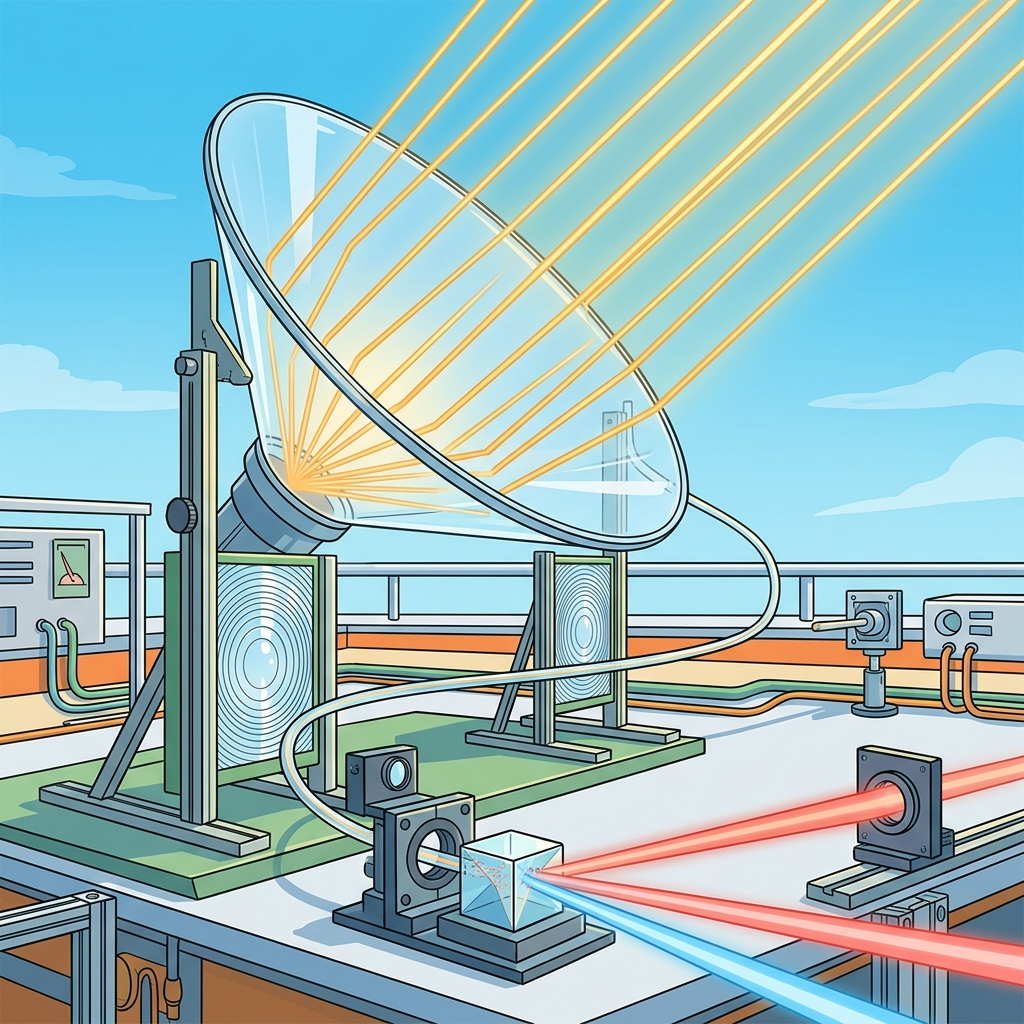
The core contribution of the 2026 sunlight paper is an engineering system that successfully channels an uncontrollable natural light source into a millimeter-scale nonlinear crystal for SPDC. The team fabricated a 1.4 m² conical all-glass light collector, integrated it with a Fresnel lens the size of a household window, mounted the assembly on a motorized solar tracking system, and coupled the concentrated output through total internal reflection into a hair-thin optical fiber feeding a Sagnac interferometer containing the 10 mm ppKTP crystal. This apparatus was made possible by a collaboration between Hanieh Fattahi's group at the Max Planck Institute for the Science of Light — contributing solar concentrator expertise — and Robert Boyd's team at the University of Ottawa, who provided the quantum optics theory and detection architecture. The 1.4 m² scale of the collection system is itself the most revealing piece of data the press releases overlooked: it indirectly tells you that the absolute photon flux from natural sunlight at the crystal is substantially below what a focused laser delivers, regardless of how the normalized efficiency figures compare. Physical scale is data, and this system's scale speaks clearly.
The "Comparable to Laser" Efficiency Claim — Normalized vs. Absolute
The abstract of the 2026 paper states that generation rates "comparable to laser-based setups" were maintained — without qualification. The clarification only appears in The Quantum Insider's explanatory coverage: the comparison is normalized by pump power and effective bandwidth, not measured in absolute terms. The full paper reports a normalized generation rate of approximately 1,600 s⁻¹ per mW of pump power, which is itself a normalized metric rather than an absolute count. The number that actually determines practical utility — absolute photon-pair production in pairs per second under operating conditions — is absent from the abstract, the full paper, and all press coverage. The absence of the absolute figure, combined with the necessity of a 1.4 m² collection system just to supply the crystal adequately, represents the most significant gap between what the press releases claimed and what the data can actually support — because the practical difference between normalized efficiency and absolute throughput is the difference between an interesting physics result and a deployable technology.
The "First Ever" Framing in Science Journalism — How Context Gets Erased
The 2026 sunlight paper became global science news precisely because it offered a compelling "historic first" narrative; the 2025 LED paper by the same team did not, because "LED" lacks the cosmic storytelling that "sunlight" provides. Press releases function as marketing documents for research, and "first ever" language drives news pickup while omission of prior-art references protects the narrative. The incentive structure of academic publishing — where institutional publicity metrics and funding visibility all favor high-profile coverage — naturally produces selective framing even when the researchers themselves fully cite their prior work. The distinction here is crucial: the Optica paper's reference section is honest about the lineage; the press release wasn't. This case offers a well-documented example of the gap that can exist between a paper's own self-representation and the institutional communication machinery surrounding it, and it illustrates why reading actual papers rather than press releases remains the only reliable way to understand scientific context.
Positive & Negative Analysis
Positive Aspects
- Establishing That Incoherence Cannot Cross Degrees of Freedom
Together, the 2025 LED paper and the 2026 sunlight paper establish, across multiple independent experimental conditions, that high-quality quantum entanglement is achievable with fundamentally incoherent pump sources. This result expands the theoretical foundations of quantum optics in a concrete and testable way. The principle that spatial incoherence cannot contaminate polarization-degree entanglement — confirmed first in a controlled lab setting with LEDs and then under extreme natural conditions with sunlight — provides a new theoretical tool that other researchers can apply to different source types, crystal configurations, and detection architectures. The multimode collection methodology collecting roughly 4,080 SPDC spatial modes from the 2025 paper provides a replicable experimental protocol that can serve as a community benchmark. Together, these results open a new experimental territory: the systematic study of entanglement robustness under varied incoherence conditions, which was not a viable subfield before the 2025 breakthrough.
- 94% Fidelity from a Natural, Uncontrolled Source — A Real Engineering Achievement
Achieving Bell state fidelity of 0.939 ± 0.027 from natural sunlight — a source with wildly variable intensity, continuous broadband spectrum, and no spatially imposed structure — represents a genuine engineering accomplishment by any honest measure. The 1.4 m² concentrator-Fresnel-tracker system that makes this possible demonstrates that building quantum optical experiments around natural incoherent sources is technically feasible, even if not yet practical for field deployment. The interdisciplinary collaboration between solar concentrator engineering at the Max Planck Institute and quantum optics at the University of Ottawa provides a model for tackling complex hardware challenges that span two distinct technical communities. Concurrence of 0.905 ± 0.053 and a CHSH value significantly exceeding the classical limit under genuinely adverse source conditions is a result that specialists and non-specialists alike can appreciate for its experimental difficulty. The engineering knowledge assembled to make this work — particularly the solar tracking and optical coupling system — has potential applicability beyond quantum optics, in solar concentration applications more broadly.
- Opening a New Direction for Fundamental Quantum Optics Research
The 2026 result, understood as the third step in a systematic program, opens a clear and well-motivated research direction: testing the boundaries of the "incoherence cannot cross degrees of freedom" principle across increasingly challenging source conditions. Subsequent experiments might extend to starlight, thermally broadened sources, fluorescent sources, or artificial sources with precisely controlled coherence properties — each adding another data point to the map of where this principle holds and where it breaks down. Understanding those boundaries is a legitimate and productive fundamental physics question, independent of any application timeline. Basic physics results of this type tend to have long half-lives in the literature, informing theoretical work in quantum information, quantum sensing, and quantum imaging for decades after the original experimental demonstration. Even if specific QKD applications from this work remain limited, the research program contributes to the field's understanding of entanglement robustness and the quantum-to-classical transition.
- Demonstrating a New Option for Space and Resource-Limited Environments
The 2026 paper proves in principle that a sunlight-pumped entanglement source can generate high-quality quantum correlations, which adds a previously unconsidered option to the design space for quantum communication systems in environments where laser power is genuinely constrained. In deep-space missions, where power budgets are severe and laser cooling and operation carry significant system cost and weight, having an alternative that runs on ambient solar flux — without dedicated laser hardware — is a conceptually valuable option that mission designers now need to consider. The authors themselves are careful to limit claims to "resource-limited environments like interplanetary missions" rather than overstating near-term Earth-orbit applicability, which is an honest positioning of the result. Even as a concept demonstration, this result changes what future mission planners need to account for when scoping deep-space quantum communication architectures. Concept demonstrations of this type are how long-range mission planning begins — the practical system won't look like the 2026 lab setup, but the existence proof that the physics permits this approach is the necessary first step.
Concerns
- Absolute Photon-Pair Generation Rate Is Absent — The Key Practicality Question
The most significant gap in both the paper and all associated coverage is the conspicuous absence of the absolute photon-pair generation rate: how many entangled pairs per second does the system actually produce under operating conditions? Normalized efficiency figures referenced to pump power and effective bandwidth are physically meaningful, but they don't answer the question that determines whether a technology is deployable for real communication protocols. A system with high normalized efficiency but low absolute throughput may be a fascinating physics demonstration while being practically useless for applications that require minimum pair rates to maintain key generation speed above channel loss. The requirement for a 1.4 m² collection system is the most informative indirect signal: no laser-based SPDC system requires a telescope-scale collection area to achieve adequate pump flux, and this scale difference strongly implies that the absolute pump intensity reaching the crystal from sunlight is substantially below what a focused laser delivers. Until absolute generation rates are reported, any assessment of practical QKD applicability rests on fundamentally incomplete data.
- Removing the Laser Does Not Simplify the Overall System
Coverage implied that laser-free quantum entanglement would lead to simpler, cheaper quantum systems — but this is not supported by what the experiment actually requires. Single-photon detectors such as superconducting nanowire single-photon detectors (SNSPDs) remain in the system, along with the nonlinear crystal, the precision interferometer, and the fiber coupling optics. On top of those existing requirements, the sunlight system adds a 1.4 m² motorized solar concentrator, a Fresnel lens, real-time solar tracking electronics, and all the mechanical complexity of managing a large outdoor optical assembly. A laser-based SPDC system is powered by plugging in a benchtop laser and aligning it on an optical table in a controlled environment; a sunlight-based system requires a daylight-only outdoor installation with weather-dependent performance variability. Whether total system cost and complexity are actually reduced by swapping the laser for a solar concentrator system depends on specific deployment context, and the 2026 paper provides no analysis to support an affirmative answer in any generalized setting.
- Weather and Day-Night Dependence Limits Operational Availability
Using sunlight as the pump source means operational availability is fundamentally tied to weather conditions and the solar cycle in ways that laser-based systems are not. Cloud cover directly reduces the optical intensity reaching the collection system, with thick overcast potentially cutting useful pump flux by orders of magnitude and forcing the system to either wait for clearing or accept degraded performance. Night operation is simply unavailable — the source disappears entirely. For applications requiring continuous or on-demand quantum key distribution, such as financial infrastructure or government communications where 24-hour availability may be operationally critical, this intermittency is a structural limitation that no engineering improvement within the sunlight-pumping approach can address. Laser-based SPDC systems operate continuously and deterministically regardless of weather, season, or time of day. Geographic variability in solar resource availability would further concentrate any practical sunlight-based systems in high-insolation regions, limiting deployment flexibility and creating infrastructure dependencies on weather patterns rather than electrical grid access.
- QKD's Competitive Position Against PQC Is Already Structurally Weak
Quantum key distribution — the primary application domain that sunlight-based entanglement research targets — already faces a severe competitive disadvantage against software-based post-quantum cryptography that is difficult to overcome regardless of which light source powers the entanglement generation. NIST's 2024 finalization of FIPS 203 ML-KEM, FIPS 204 ML-DSA, and FIPS 205 SLH-DSA provides a complete suite of quantum-resistant cryptographic algorithms that deploy via software updates on existing hardware — no new physical infrastructure required. A fourth standard, HQC, was selected for standardization in March 2025 with final publication expected around 2027. PQC is already appearing in consumer software and enterprise deployments; QKD remains in laboratories and small pilot networks. Adding a solar concentrator system to QKD's existing hardware requirements makes the total system cost and deployment complexity even harder to justify against PQC alternatives. For sunlight-based QKD to find a real market, it would need to demonstrate advantages in highly specific scenarios where physically secure channels are required and PQC's mathematical guarantees are deemed insufficient — a very narrow and currently unproven value proposition.
Outlook
In the near term — over the next several months — the most predictable response from the research community will be replication attempts and variation experiments. Now that the 2025 LED paper's core principle ("incoherence cannot cross degrees of freedom") has been validated with both LEDs and natural sunlight, research groups with multimode SPDC setups are likely assessing whether these results hold under independent scrutiny and with different pump sources. The 4,080-spatial-mode collection architecture detailed in the 2025 LED paper (arXiv 2507.05106) provides a relatively concrete experimental protocol that other laboratories can work from directly. If that system becomes a community reference point, incoherent-source SPDC could develop from a specialty of one research group into a recognized subfield with multiple competing teams. I expect the 2025 LED paper's citation count to accelerate significantly over the next six to twelve months, as replication teams necessarily reference the theoretical and experimental foundation before building on top of it. The scientific record will eventually produce a cleaner picture of this research program's actual architecture than any press release managed to.
There's also a secondary near-term possibility: the science communication community may pick up this case as a concrete example for internal discussion. The gap between the 2026 paper's own citation record (which references the LED predecessor) and its press releases (which don't mention it) is the kind of specific, documented discrepancy that science communication researchers sometimes use as case material. Preprint servers and academic social media — particularly physics-adjacent communities — are likely channels through which more complete contextual framing will circulate. This is the scientific community's self-correction mechanism doing what it's supposed to do, even if it operates on a much slower and quieter timescale than the initial headlines that drove the miscorrection. The corrective commentary won't generate the same audience that "sunlight quantum entanglement" generated, but it will exist in the literature and in specialist discussions, and that's not nothing.
That said, the self-correction process in science communication faces real structural barriers that tend to slow it down. Publicly questioning why a research team's press release omitted a direct predecessor risks being misread as a criticism of the researchers personally, creating social friction that most colleagues prefer to avoid. Drawing attention to a prior paper in a way that implicitly weakens a team's "first ever" claim is simply not the kind of action that earns goodwill in any scientific community. These dynamics mean that the most accurate contextual framing of the 2026 result will most likely emerge through the citation record — replication papers, review articles, and graduate course syllabi — rather than through any high-visibility public correction. Science corrects itself over years, not days, and typically does so through accumulation rather than retraction. The mechanisms are real, just not fast enough to counteract an initial viral news cycle.
Over the medium term — six months to two years — the central technical challenge for this research program becomes miniaturization and absolute generation rate improvement. The current setup, with its 1.4 m² conical glass collector, household-window-scale Fresnel lens, and motorized solar tracking system, is more telescope installation than laboratory component. For any realistic deployment scenario outside a purpose-built observatory, the collection system needs to shrink dramatically while maintaining enough photon flux to drive entanglement generation at rates useful for communication. The critical bottleneck is precisely the number that all the press releases left out: how many entangled photon pairs per second does the system actually produce in absolute terms? As the collection area shrinks, absolute photon intensity at the crystal drops proportionally, and with it the absolute pair generation rate. Normalized efficiency figures, however favorable, don't tell you what happens when collection area is cut by an order of magnitude. That tradeoff is the engineering question on which practical applicability of this approach genuinely depends.
Parallel to miniaturization, improvements in nonlinear crystal materials represent another medium-term development track worth monitoring. The 2026 experiment uses a 10 mm ppKTP crystal in a Type-II SPDC configuration with a Sagnac interferometer — a well-established and reliable architecture, but not the theoretical ceiling for conversion efficiency. If advances in nonlinear photonic materials science produce significantly higher SPDC conversion efficiency — through new crystal compositions, novel periodic poling geometries, or waveguide-integrated SPDC configurations — the tradeoff between collection area and absolute generation rate could shift meaningfully. This depends on progress in a separate research community from a distinct set of groups, making it genuinely uncertain on a two-year horizon. But the history of photonics is full of cross-field advances that arrived faster than linear extrapolation would have suggested, so this track deserves to remain open as a real possibility rather than be dismissed outright.
The medium-term external landscape is dominated by the accelerating deployment of post-quantum cryptographic standards, which represents the most significant competitive pressure on QKD's near-term market position. NIST finalized FIPS 203 ML-KEM (formerly CRYSTALS-Kyber), FIPS 204 ML-DSA (formerly Dilithium), and FIPS 205 SLH-DSA (formerly SPHINCS+) in August 2024, and these standards have already begun appearing in major technology companies' software deployment cycles. HQC was selected as a fifth standardization target in March 2025, with final standardization expected around 2027. These standards run on existing network infrastructure through software updates — no new physical layer required. According to research-firm projections, the global QKD market is forecast to grow from approximately $480 million in 2024 to roughly $2.63 billion by 2030, implying a CAGR of approximately 32.6%, while the broader quantum communications market is projected to expand from about $740 million to approximately $5.54 billion over the same period at a CAGR of approximately 39.6%. Those are substantial growth numbers, but the fraction of the quantum-resistant security market that QKD captures versus PQC will depend heavily on whether QKD can demonstrate irreplaceable advantages in specific scenarios that mathematical approaches cannot address.
Looking further out — two to five years — this research sits within a national-scale investment race in quantum technologies that has been escalating throughout the mid-2020s. By April 2025, cumulative global public investment in quantum technologies had crossed $10 billion. The United States has committed approximately $1.8 billion in additional National Quantum Initiative funding covering 2025 to 2029, plus $2.5 billion under the DOE Quantum Leadership Act for 2026 to 2030, with roughly $500 million of that designated specifically for quantum networking infrastructure. The European Union's Quantum Flagship program is deploying €1 billion over a ten-year timeline. China has already built over 12,000 km of fiber-based quantum communication infrastructure spanning 80 cities with 145 backbone nodes, and in March 2025 demonstrated a 12,900 km intercontinental QKD link between China and South Africa using the Jinan-1 microsatellite. In this geopolitical context, the question for incoherent-source entanglement research is whether it can identify a meaningful deployment slot before laser-based satellite QKD systems cement their position as the operational standard.
The most ambitious long-term application for this research line remains space-based quantum communication, and the rationale is genuine: in space, there are no clouds, no atmospheric scattering, and no diurnal variation in available solar flux outside of orbital shadow periods. The practical drawbacks of sunlight as a terrestrial source — weather dependence, day-night cycling, atmospheric absorption — are meaningfully reduced or eliminated in space. But placing a sunlight-based entanglement source on a satellite introduces a distinct and serious engineering problem set. The 1.4 m² collector would need to be dramatically miniaturized while retaining adequate photon flux, the optical alignment system would need to survive launch vibration and cosmic radiation exposure, and extreme thermal cycling between sunlit and shadow orbital phases would stress every optical component. Once deployed, on-orbit repairs are impossible. China's Micius satellite and its successors have demonstrated that laser-based quantum optics can survive and operate reliably in orbit for years — establishing a reliability baseline that any sunlight-based alternative would need to match.
The structural paradox of sunlight-based satellite QKD is the deepest unsolved problem in this research area, and the 2026 paper does not resolve it. A sunlight-pumped entanglement source, by definition, operates during daylight. Satellite-to-ground uplink receivers, in practice, are blinded by solar background noise during those same daylight conditions. The 2025 feasibility analysis by Joarder, Szlachetka, and Kolenderski (arXiv 2501.17130) quantified this precisely: satellite-to-ground uplink channel attenuation of approximately 50 dB — a factor of 100,000 in optical power — combined with solar background noise in the MHz range. Working from source bandwidth of 0.54 nm FWHM, they estimated a maximum viable link range of approximately 400 km and concluded that daylight satellite-to-ground uplink entanglement-based QKD has yet to be successfully implemented. Ground-level short-range daylight QKD has been demonstrated at 270 m to 1.6 km using filtering techniques — so the problem is not physically impossible at all scales — but satellite altitude fundamentally changes the scale of both the channel loss and the background noise. Resolving the daylight paradox for the satellite case would likely require a qualitative advance in receiver technology or orbital geometry rather than incremental improvement of existing approaches.
For the long-term basic science dimension, regardless of whether QKD applications materialize from this work, the fundamental principle may prove more durable than any specific application it inspires. "Incoherence cannot cross degrees of freedom" is a clean, generalizable result that tends to propagate widely through a field — it will appear in quantum optics textbooks and serve as the theoretical foundation for experiments extending to starlight, fluorescent sources, thermally broadened sources, and other incoherent sources with controlled statistical properties. As experiments map out the boundaries of this principle — establishing exactly where it holds and under what conditions it begins to break down — the result will deepen the theoretical foundations of quantum information science. Basic physics results of this type have a historical record of enabling applications that nobody anticipated at the time of discovery. That's not a guarantee of practical relevance, but it's a pattern that the history of photonics repeatedly demonstrates.
Mapping the realistic scenario range: in the optimistic scenario, miniaturization of the concentrator system succeeds more rapidly than current trajectories suggest — perhaps driven by synergies with the independently well-funded solar energy concentration research community — while advances in nonlinear crystal efficiency push absolute pair generation rates into ranges competitive with compact laser systems. In that scenario, sunlight-based entanglement sources find a niche in specific extreme environments, such as deep-space probes or solar-power-saturated orbital platforms where laser power is genuinely constrained, and the approach earns a lasting place in specialized quantum systems design. In the base scenario — which I believe the current evidence most strongly supports — miniaturization progresses but absolute generation rates remain below the practical communication threshold, leaving the technology's primary contribution in fundamental quantum optics research rather than in deployed quantum infrastructure. In the pessimistic scenario, PQC standardization proceeds comprehensively enough that QKD's potential niche market fails to attract sufficient sustained investment, leaving both laser-based and sunlight-based QKD as research demonstrations rather than commercial systems. In every scenario, the core theoretical contribution — the principle that incoherence doesn't cross degrees of freedom — remains a durable addition to the quantum optics knowledge base.
One key variable I may be systematically underestimating is the possibility of an unexpected breakthrough in an adjacent field. Chip-scale integration of SPDC sources is an active and rapidly advancing research area in nonlinear photonics; if integrated photonics brings dramatically higher conversion efficiency to SPDC by reducing required pump intensity by orders of magnitude, the entire calculation about collection area and absolute generation rate changes. Similarly, if post-quantum cryptographic algorithms are found to have unforeseen mathematical vulnerabilities before widespread deployment is complete, the demand for physically secured quantum channels would accelerate faster than current projections suggest. And if quantum computing hardware advances more slowly than current roadmaps project, the urgency driving both PQC and QKD investment could moderate in ways that reshape competitive dynamics. The most honest forecast acknowledges that science's track record of surprising itself should make anyone cautious about treating the base scenario as inevitable — it's the most probable single outcome given current evidence, but probability is not certainty, and the history of photonics is full of surprises.
A final practical note for anyone following quantum technology claims: the single most useful question to ask is whether absolute performance figures are reported alongside normalized or relative ones. Not just normalized efficiency, not just comparisons to benchmarks — absolute photon-pair rates, error rates, and signal-to-noise ratios under realistic operating conditions are what actually determine whether a physics demonstration can become a deployable technology. The August 2026 sunlight entanglement story has a compelling 94% fidelity headline and a conspicuously absent absolute generation rate. Both facts are equally relevant to understanding where this research actually stands. The distance between beautiful physics and deployable technology is measured in the data that press releases tend to leave out, and learning to notice that gap is one of the most valuable skills a science reader can develop.
Sources / References
- Generating quantum entanglement from sunlight — Optica Publishing Group, August 6, 2026 — Generating quantum entanglement from sunlight
- Sunlight-powered setup generates quantum entanglement — phys.org, August 7, 2026 (the only outlet to briefly mention the prior LED research) — Sunlight-powered setup generates quantum entanglement
- Researchers generate quantum entanglement using sunlight — EurekAlert! (AAAS), August 7, 2026 — Researchers generate quantum entanglement using sunlight
- Physicists harness sunlight for quantum entanglement — Scientific American, August 2026 — Physicists harness sunlight for quantum entanglement
- Researchers show sunlight can generate quantum entanglement — The Quantum Insider, August 7, 2026 — Researchers show sunlight can generate quantum entanglement
- Forget lasers: researchers just created quantum entanglement using sunlight — The Debrief, August 2026 — Forget lasers: researchers just created quantum entanglement using sunlight
- Generating quantum entanglement from sunlight — Optica vol. 13, issue 8, pp. 1508–1514 — Optica (original paper), DOI 10.1364/OPTICA.601797, 2026 — Generating quantum entanglement from sunlight — Optica vol. 13, issue 8, pp. 1508–1514
- Entanglement-based QKD in the Daylight and Uplink Satellite Configuration — arXiv, January 2025 (satellite-to-ground daytime QKD feasibility analysis by Joarder, Szlachetka, and Kolenderski) — Entanglement-based QKD in the Daylight and Uplink Satellite Configuration
- Violation of local realism with spatially multimode PDC pumped by spatially incoherent light — arXiv / Physical Review A 112, 053726, 2025 (the LED predecessor paper by Li, Upham, Braverman, and Boyd) — Violation of local realism with spatially multimode PDC pumped by spatially incoherent light
- Generating quantum entanglement from sunlight (arXiv preprint) — arXiv, 2026 (sunlight paper preprint by Li, Brar, Küblböck, Upham, Fattahi, and Boyd) — Generating quantum entanglement from sunlight (arXiv preprint)
- NIST Releases First 3 Finalized Post-Quantum Cryptography Standards — NIST CSRC, August 13, 2024 (FIPS 203 ML-KEM, FIPS 204 ML-DSA, FIPS 205 SLH-DSA finalization announcement) — NIST Releases First 3 Finalized Post-Quantum Cryptography Standards