
What We Found on LHS 1140b Isn't Life — It's a 3-Billion-Year Mystery
Summary
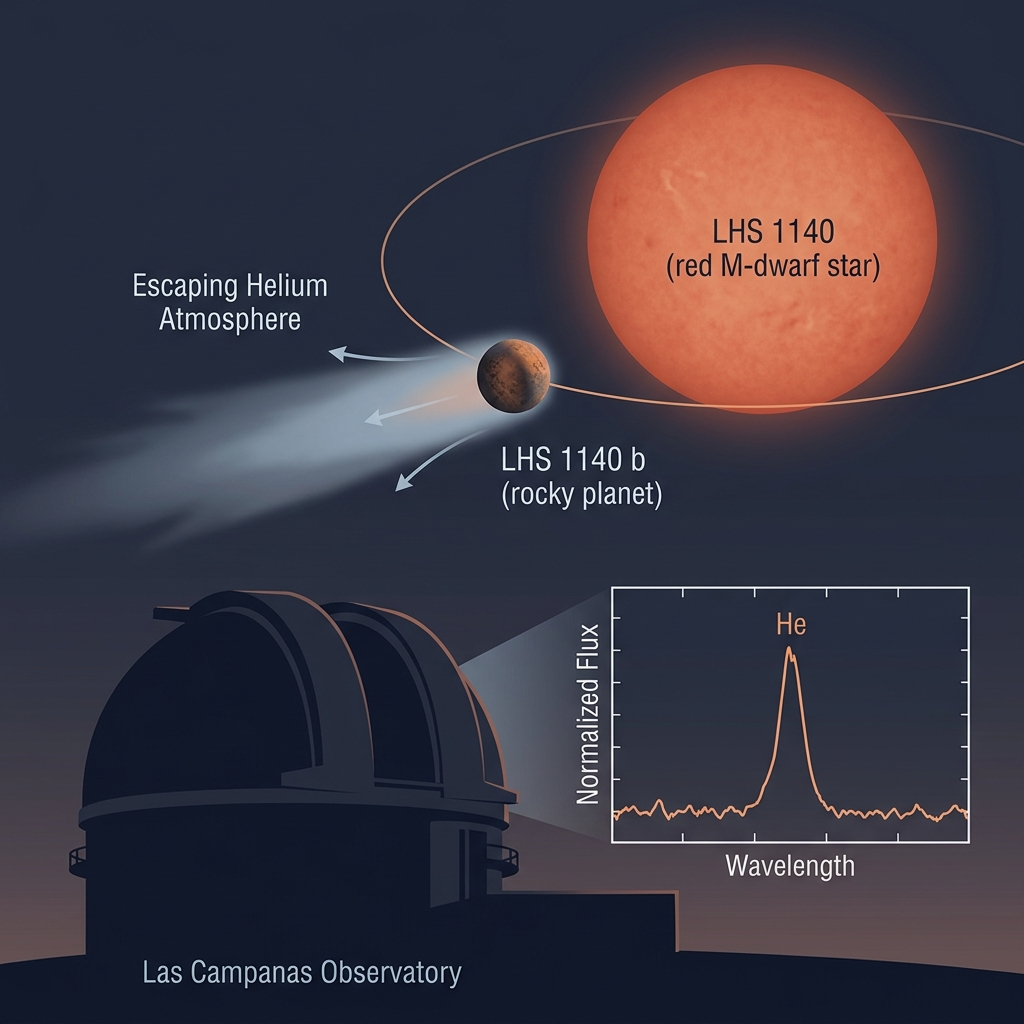
LHS 1140b, a rocky super-Earth orbiting within the habitable zone of an M dwarf star 48 light-years away, became the first such world to show confirmed atmospheric signals when the WINERED spectrograph mounted on the Magellan Clay telescope at Las Campanas Observatory detected escaping helium in 2024 observations. The study, led by Collin Cherubim of Harvard and co-authored by David Charbonneau, Robin Wordsworth, Jason Dittmann, and Shreyas Vissapragada, was published in Science on July 16, 2026 under DOI 10.1126/science.aea9708. What most media coverage missed is that the genuinely remarkable finding is not the detection itself but the inference that this helium has been actively escaping for more than three billion years while remaining present — meaning something inside the planet must be continuously replenishing it. Co-author Jason Dittmann was explicit about the fundamental ambiguity at the heart of this discovery, asking openly whether the planet hosts a genuine steady-state atmosphere or is simply a bare rock that occasionally burps geological gas that immediately escapes into space. The helium signal detected in 2024 was not replicated in 2025 observations, creating a variability problem that complicates interpretation in ways that confident headline language did not reflect. This discovery does not mark the dawn of evidence for extraterrestrial life; it opens a far more fascinating scientific puzzle about how a rocky planet can sustain an escaping atmosphere across geological time, and what that implies for the billions of M-dwarf habitable-zone planets throughout our galaxy.
Key Points
The Historic Significance of the First Habitable-Zone Rocky Planet Atmosphere
Detecting helium on LHS 1140b is the first confirmed atmospheric signal from any rocky planet in a stellar habitable zone, and the significance of this category distinction is genuinely hard to overstate. M-dwarf habitable-zone planets had been accumulating a discouraging track record — TRAPPIST-1 b showed up as a bare rock, TRAPPIST-1 c showed no substantial CO₂ layer, and the Zahnle-Catling Cosmic Shoreline had placed most such planets on the wrong side of the atmosphere-retention boundary. LHS 1140b is the first observational data point to suggest the picture might not be uniformly bleak, and it arrives with a three-billion-year survival estimate attached. M dwarfs constitute roughly 70 percent of all stars in the Milky Way, which means the question of whether their habitable-zone planets can hold atmospheres is directly tied to our estimate of how many potentially life-supporting worlds exist in the galaxy. A meaningful shift in that estimate doesn't adjust the count by a small margin — it can change it by orders of magnitude, affecting not just statistical habitability models but our entire framework for understanding where life might be possible. While a single data point doesn't overturn a consensus, it opens a door that the TRAPPIST-1 results had seemed to close, and it makes the case for investing in follow-up research that could establish whether LHS 1140b is a rare exception or the first confirmed member of a broader class of atmosphere-retaining M-dwarf planets.
The Three-Billion-Year Replenishment Puzzle
The most scientifically underreported aspect of this discovery is the three-billion-year timescale, and it deserves far more attention than headlines about "first atmosphere" provided. ScienceDaily captured the paper's core inference directly: "the atmosphere of LHS 1140 b has survived for more than three billion years." Phys.org reported that when the team modeled the X-ray-driven helium loss rate from LHS 1140, the math showed that without active internal replenishment, helium should have been exhausted from the planet's atmosphere long before now. Something inside this planet must be continuously supplying new helium at a rate that compensates for the ongoing stellar-driven escape — and the identity of that something is currently unknown to science. Candidate mechanisms include volcanic outgassing driven by internal radiogenic heat, tidal heating from gravitational interaction with LHS 1140, or hydrothermal processes at a possible water-rock interface if the planet's anomalously low bulk density indicates a water-world interior. Earth handles a similar situation through plate tectonics and continuous volcanic emissions, but the scale implied at LHS 1140b — if the stable-atmosphere interpretation proves correct — would suggest a substantially more active geological interior than Earth maintains. This transforms the discovery from a static atmospheric detection into a dynamic planetary-physics problem connecting interior structure, heat sources, and volatile cycling across timescales directly comparable to the age of complex life on Earth.
The Double Layer of Certainty in the Detection
The detection involves two distinct levels of confidence that media coverage consistently and problematically merged into one. Charbonneau described the 2024 helium signal as "statistically rock solid," and that assessment applies specifically to the quality of the detection within that observation set — the signal-to-noise, the wavelength identification, the instrument calibration — all of which the team found convincing on their merits. What those solid 2024 statistics do not resolve is whether the helium source is persistent across time or represents a transient event. The 2025 non-detection directly challenges the persistence claim: a stable atmosphere should produce a consistent spectral signature across observing seasons, and one detection followed by one non-detection does not fit that expectation cleanly. The 2024 JWST analysis from Cadieux et al. adds further context, finding tentative evidence for a nitrogen-dominated atmosphere at only 2.3 sigma — far below the 5-sigma standard the field uses to confirm discoveries. Dittmann explicitly raised the "bare rock that sometimes burps up some gas" scenario as a live possibility, which is a remarkable acknowledgment of genuine uncertainty when it comes directly from a co-author of the paper. These two layers — a robust single-season signal against an unresolved multi-season variability question — must be kept distinct for any honest assessment of where the evidence currently stands.
The K2-18b Precedent as a Practical Warning
K2-18b is the most instructive recent parallel for understanding where LHS 1140b currently sits in the scientific verification process, and its story deserves careful attention. In 2023, JWST's initial K2-18b observations produced a reported hint of dimethyl sulfide, and media coverage escalated rapidly to "signs of extraterrestrial life" on the strength of statistics that the underlying data didn't fully support at the claimed level. By 2025, Luque et al. at the University of Chicago had conducted a comprehensive full-wavelength analysis from 0.6 to 12 micrometers and found the DMS evidence insufficient — models that included DMS actually weakened rather than strengthened the overall statistical fit. Stevenson et al. at Johns Hopkins APL published a systematic evaluation against five criteria and found that K2-18b failed to satisfy any of them, with only 12.5 percent of MIRI instrument configurations supporting the DMS feature and the apparent signal appearing consistent with red noise. The time from initial high-profile claim to community reassessment took approximately two years — fast by historical standards, but far too slow to catch the public expectations that had already formed around the initial breathless coverage. LHS 1140b is entering the same stage of the verification cycle, and calibrating expectations to that reality isn't pessimism — it's the scientifically appropriate posture at this stage of the evidence.
The Concrete Observational Road Map Already in Place
Unlike many discoveries that generate excitement without a clear path forward, LHS 1140b has a specific, institutionally funded observational schedule already attached to it. STScI's Rocky Worlds DDT program has designated LHS 1140b a high-priority new target, and Dittmann stated explicitly that JWST will search for water and other compounds within the next four to five years — putting meaningful molecular characterization on a roughly 2029–2030 horizon. The 2026 data challenge closes in August, followed by a November community workshop at which the research community will consolidate its interpretive framework and sharpen the observational strategy for this system. ELT's 2028 first light then provides the next major instrument upgrade, with the ANDES spectrograph capable of simultaneous searches for oxygen, water, carbon dioxide, and methane at sensitivities unavailable to any current facility. This combination of near-term JWST follow-up and medium-term ELT access means the waiting period for substantially better data is measured in years rather than decades, which is a meaningful structural advantage. The scientific uncertainty in the current picture is real, but it is bounded uncertainty — specific instruments with specific capabilities are already pointed at this planet on a defined timeline.
Positive & Negative Analysis
Positive Aspects
- First Evidence That M-Dwarf Habitable-Zone Planets Are Not Uniformly Bare
This discovery provides the first observational data point suggesting that rocky planets in M-dwarf habitable zones are not inevitably stripped of their atmospheres by stellar radiation, overturning what had become the dominant implication of JWST's prior results for the TRAPPIST-1 system. Before this result, TRAPPIST-1 b and c had set a discouraging baseline — consecutively studied habitable-zone rocky planets with no detectable thick atmospheres, reinforcing the Cosmic Shoreline's pessimistic prediction. LHS 1140b breaks that pattern with direct spectroscopic evidence of atmospheric material, and more significantly, with a three-billion-year survival estimate suggesting this is not a recent transient phenomenon. Because M dwarfs account for approximately 70 percent of all stars in the Milky Way, the question of whether their planets can retain atmospheres is the single largest factor in estimating how many potentially habitable worlds exist in the galaxy. Even one confirmed positive case opens the door for follow-up surveys that could establish a frequency — whether LHS 1140b is an exception driven by this system's specific properties or the first confirmed member of a broader, surviving population. The Zahnle-Catling Cosmic Shoreline framework may require revision to accommodate this result, and that revision would cascade through the theoretical models that shape every habitability estimate in contemporary astrobiology and planetary science.
- Demonstrates the Extended Reach of Ground-Based High-Resolution Spectroscopy
The WINERED spectrograph mounted on the Magellan Clay telescope at Las Campanas — a ground-based facility, not a space observatory — detected helium escaping from a planet 48 light-years away, which is a significant and concrete benchmark for the current capability of ground-based spectroscopic technology. The 10,833-ångström metastable helium triplet is a narrow, specific feature requiring high spectral resolution and careful management of Earth's atmospheric contamination to isolate, making this detection technically impressive on its own merits independent of what it implies about the planet. This result establishes a concrete capability baseline for what the Extremely Large Telescope will be able to achieve when its 39-meter primary mirror begins operations in 2028, since ANDES will bring dramatically greater light-gathering area to the same class of measurement. The practical implication for the field is that JWST doesn't need to carry the entire burden of exoplanet atmospheric characterization — ground-based high-resolution spectrographs can make independent and complementary contributions, and can provide the cross-verification that robust science requires. This opens faster pathways to independent confirmation than would be possible if all meaningful observations had to queue for limited and competitive JWST allocation.
- Opens a New Research Frontier in Planetary Interior Dynamics
The inference that helium must be actively replenished over three-billion-year timescales forces a research agenda that moves well beyond binary atmosphere detection into the much richer territory of atmospheric source dynamics and planetary interior processes. The question "does this planet have an atmosphere?" is a yes-or-no milestone; the question "what has been sustaining an escaping atmosphere for three billion years?" demands new theoretical frameworks for volatile cycling in super-Earths, new observational strategies for detecting geological activity indicators at interstellar distances, and new comparative datasets connecting Earth's volcanic cycle to what might be operating at a much larger planetary scale. LHS 1140b's anomalously low bulk density, reported by Cadieux et al. in 2024, hints at a possible water-world or complex interior, and if hydrothermal-vent-style outgassing is occurring at a water-rock boundary inside this planet, it would provide the first potential laboratory for testing whether Earth-analog geochemical processes are occurring on other worlds. The paper's appearance in Science signals that the field considers this research agenda scientifically mature enough to warrant a flagship publication, which will in turn attract sustained theoretical and observational investment.
- JWST Follow-Up Is Already Institutionally Committed and Funded
The transition from "exciting discovery" to "ongoing scientific program" is already guaranteed for LHS 1140b rather than contingent on future competitive proposal success, which is a meaningful structural advantage for this system's continued study. STScI has added it to the Rocky Worlds DDT program — specifically designed to allocate observing time by institutional priority to the most promising rocky world targets — meaning follow-up is funded and scheduled rather than dependent on a proposal process that might not prioritize this system. Dittmann's stated four-to-five-year JWST window translates to a roughly 2029–2030 horizon for meaningful molecular characterization data, and the 2026 data challenge and November workshop will sharpen the community's strategy for what molecules to prioritize and how to interpret the results. This institutional commitment guarantees observational continuity regardless of whether near-term results are immediately exciting or require patient accumulation of transit data across multiple observing cycles. The question the planet raises — what is sustaining its atmosphere against active escape for three billion years — is now attached to a funded, time-scheduled answer-seeking program rather than merely a community wish list.
Concerns
- The 2024/2025 Variability Fundamentally Limits Confident Interpretation
The non-detection in 2025 after a clear detection in 2024 is the single most significant weakness in this discovery's current status, and it's a problem that cannot be explained away easily or without consequences for the interpretation. A genuinely stable planetary atmosphere should produce a consistent spectroscopic signal across multiple observing seasons — the planet's helium content doesn't reorganize itself between our observation windows, assuming the source is truly persistent. One season's detection followed by the next season's non-detection means either the escape rate is genuinely variable in response to stellar activity fluctuations, the signal originates from an intermittent source rather than a permanent atmosphere, or observational factors in one of the two datasets compromised the comparison in ways not yet identified. Dittmann himself acknowledged this uncertainty by explicitly raising the "bare rock with occasional burping outgassing" scenario as a live possibility — an admission that carries substantial weight coming directly from a co-author of the discovery paper. The 2024 JWST analysis from Cadieux et al. found tentative nitrogen-atmosphere evidence at only 2.3 sigma, far below the 5-sigma threshold for confirmed discoveries, compounding the interpretive uncertainty around the entire system. Until the variability is either explained within a coherent stable-atmosphere framework or confirmed as evidence for intermittent geological outgassing, every subsequent conclusion is conditionally dependent on which way this foundational question ultimately resolves.
- The K2-18b Cycle Represents a Real and Demonstrable Structural Risk
K2-18b didn't just produce a specific scientific revision — it revealed a structural vulnerability in how initial atmospheric detections get communicated, amplified, and eventually corrected in the public sphere, and that vulnerability applies directly here. The K2-18b cycle began with a statistically non-negligible signal, escalated through optimistically framed institutional press releases, reached peak public excitement through mainstream media coverage, and then took roughly two years to begin correcting through independent analysis that received a fraction of the original coverage. Only 12.5 percent of the MIRI configurations that Stevenson et al. tested supported the DMS feature that had generated thousands of "signs of life" headlines — a sobering statistic about how initial instrumental results can mislead. The key risk is not that scientists are being dishonest — it's that the institutional incentive structure of science communication encourages confident framing at the announcement stage without creating equivalent incentives for prominent and accessible correction when revisions are required. LHS 1140b is currently at the announcement stage, with headlines already setting public expectations significantly ahead of what independent confirmation and multi-season reproducibility can currently support. The paper behind a paywall makes independent verification harder, and the divergence between Harvard's "first atmosphere found" language and Sci.News's "Potential Atmosphere" framing for the same paper illustrates how interpretive inflation begins before most readers ever access the underlying data.
- Institutional Science Communication Distorts the Signal-to-Noise Ratio
The same paper produced meaningfully different framing from different communicators, and the differences are not trivial or merely stylistic: Harvard's press release stated as apparent fact that this was the "first time anyone has found an atmosphere on a rocky planet in the habitable zone," while Sci.News used the considerably more cautious "Potential Atmosphere" in its headline. Wordsworth called the discovery "a major milestone," while Dittmann raised the live possibility of a bare rock — two members of the same team applying very different confidence levels to the same result. Charbonneau said in the same breath that imagining life on the planet was "perfectly reasonable" and that "we have no evidence of that" — two clauses that deserve equal emphasis and consistently receive unequal treatment when filtered through secondary reporting. The institutional incentive to frame research as dramatically as possible is structural and well-documented: it drives funding attention, citation impact, and public profile for both the researchers and their institutions. But it creates a persistent gap between the careful hedging in the actual paper and the confident assertions that reach most readers. The K2-18b experience demonstrated exactly how costly this gap can become when corrections eventually arrive — the correction never receives the same coverage as the original announcement, and the initial narrative tends to persist in public memory.
- Long-Term Observational Infrastructure Faces Serious and Concrete Budget Uncertainty
Resolving the three-billion-year replenishment mystery fully will ultimately require observational capabilities that go beyond what JWST and ELT can deliver — specifically, the direct spectroscopic access to the planet's own reflected light that NASA's Habitable Worlds Observatory is designed to provide. HWO's coronagraphic technology would enable detection of O₂, O₃, and CH₄ at sensitivities that current or near-term planned instruments cannot achieve in this observing mode, and these measurements are precisely what would allow researchers to distinguish between a biogenic and a purely geochemical explanation for whatever volatile cycle is sustaining LHS 1140b's escaping atmosphere. The problem is concrete: while NASA received $150 million for HWO in FY2026, the FY2027 executive budget request reportedly proposed cutting that to $5 million — a reduction that, if enacted, would make the mid-2040s launch target unrealistic and create a long gap in direct-characterization capability. NASA's January 2026 announcement of industry partner selections for HWO technology development demonstrates continued intent, but intent requires sustained and substantial funding to become operational hardware in orbit. The scientific questions LHS 1140b raises are operating on a timescale that the available budget trajectory may not be prepared to support, and the gap between what current instruments can determine and what definitive answers require may remain open far longer than the science alone would dictate.
Outlook
In the near term, the most important institutional development to track is how the Rocky Worlds DDT program handles LHS 1140b now that it has been designated a priority target. STScI's 2026 data challenge, which opened in April and closes in August, will be followed by a community workshop on November 16–18. That workshop is where the research community will begin consolidating its interpretation of the existing helium data and laying out the observational strategy for what comes next. The most pressing immediate question is the 2025 non-detection: why did the same instrument, looking at the same planet, find nothing the following season? The research team's formal explanation for this variability, when it arrives, will be foundational for everything that follows. If the 2025 silence can be attributed to reduced stellar X-ray activity during that specific observing window — a plausible scenario given that M dwarfs have variable activity cycles — that explanation actually supports the stable-atmosphere interpretation, predicting the signal should return when stellar activity picks up again. If the explanation leans toward episodic geological outgassing, the habitability implications shift significantly. I expect the Cherubim team to attempt additional observations before the end of 2026, and a third detection at confidence levels comparable to 2024 would substantially strengthen the case for a persistent atmosphere rather than an intermittent source.
Independent confirmation from a second telescope facility is the next critical milestone after the variability question is addressed. Scientific consensus requires reproducibility, and a single-instrument, single-season detection — however statistically solid the 2024 dataset appeared to the authors — doesn't satisfy the established standard for an observational fact in this field. The Gemini Observatory and Keck telescopes both possess high-resolution spectrographs capable of targeting the 10,833-ångström metastable helium triplet that WINERED observed, and it would be unusual if competing research teams weren't already planning observations. Independent detections from multiple facilities, especially across different stellar activity states, would transform this from an exciting initial report into a confirmed observational datum. The timeline for this kind of follow-up typically runs six to eighteen months from original publication, placing the earliest plausible confirmation window in early-to-mid 2027. Conversely, if repeated attempts by multiple well-equipped teams consistently return non-detections, the 2024 result will require careful reassessment — not automatic dismissal, but a significantly revised interpretation of what that one season's signal actually represents.
The ongoing reassessment of K2-18b's atmospheric status will also shape the framework within which LHS 1140b gets evaluated by the broader community. The five-criteria standard proposed by Stevenson et al. — covering signal authenticity, molecular identification, non-biological origin exclusion, biological plausibility, and independent confirmation — is gaining traction as a benchmark for evaluating astrobiology-adjacent claims. If this framework becomes the accepted community standard, every atmospheric detection will be measured against it, including LHS 1140b's helium signal. At present, the detection arguably meets the first criterion — the 2024 signal appears to be genuine — but fails on independent confirmation, and the variability question introduces doubt about signal consistency across time. The broader lesson from K2-18b is that the scientific self-correction process is reliable but inherently slow, and public narratives tend to crystallize around initial announcements without efficiently updating as the evidence matures. LHS 1140b is at the announcement stage, and the field will likely apply a more rigorous standard of staged verification precisely because the K2-18b experience demonstrated the costs of moving too fast.
Looking toward the medium term, JWST's upcoming atmospheric characterization campaign for LHS 1140b will be the decisive scientific event in this system's story over the next several years. Dittmann's stated four-to-five-year window translates to meaningful molecular detections — or meaningful non-detections — by roughly 2029 or 2030. The targets in this phase go far beyond helium: water vapor, carbon dioxide, and methane are the molecules JWST's NIRSpec and MIRI instruments are designed to detect in transmission spectroscopy during planetary transits. Water is the one that changes the conversation categorically — it is non-negotiable for life as we understand it, and detecting it in a habitable-zone rocky planet's atmosphere would immediately elevate this system to the top of every priority list in astrobiology. The most probable result from JWST's first observation cycle is the measured and ambiguous kind — tentative spectral features at low-to-moderate significance requiring additional transits and more observing time before any conclusion can be drawn with confidence. That's not failure; it's how careful planetary science actually progresses.
The more optimistic branch of the medium-term story sees JWST delivering molecular signals at confidence levels sufficient to warrant strong statements about atmospheric composition. Water or CO₂ detected at confidence levels well above the 2.3-sigma nitrogen hint from 2024 would constitute evidence of a complex, stable atmosphere and would transform LHS 1140b from a promising target into a confirmed case study for habitable-zone rocky worlds. The more cautious path sees the helium variability persist through additional ground-based and space-based observations, with water searches returning non-detections, and the interpretation drifting toward the "intermittent geological outgassing" scenario Dittmann explicitly raised. Even this outcome isn't a scientific dead end — a planet that periodically outgasses helium is still a scientifically interesting object that teaches us something about super-Earth geophysics under M-dwarf radiation conditions. Both paths produce meaningful knowledge, which is why the follow-up is worth pursuing regardless of which way the data ultimately falls.
The broader context of M-dwarf atmospheric research over this same period will also reshape how LHS 1140b's results are interpreted within the field. JWST is currently working through the TRAPPIST-1 system, with habitable-zone planets d, e, and f still awaiting detailed atmospheric analysis. If any of those worlds returns even tentative atmospheric hints, LHS 1140b's detection becomes a data point in an emerging pattern rather than a singular outlier requiring special explanation. If all TRAPPIST-1 habitable-zone worlds confirm the bare-rock result, LHS 1140b becomes even more puzzling — a genuine exception demanding explanation rooted in this specific planet's unique properties. The 2025 update to the Cosmic Shoreline incorporated new XUV-radiation-based boundary calculations, and one of its key findings was that host-star quiescence is a major variable in atmospheric retention. LHS 1140 is a notably quiet M dwarf, which may be precisely why this planet survived when others didn't. Whether stellar quiescence alone accounts for the difference, or whether the planet's mass, interior composition, and evolutionary history are equally important, will be among the most actively debated questions in planetary atmospheric science over the next five to seven years.
The 2028 first light of the Extremely Large Telescope represents the next qualitative step forward for this line of research. ELT's 39-meter primary mirror paired with the ANDES high-resolution spectrograph will be capable of searching simultaneously for oxygen, water vapor, carbon dioxide, and methane — with a spectral resolution and photon-collecting area that surpasses what JWST can achieve for these specific ground-resolved measurements. LHS 1140b's proximity at 48 light-years makes it a natural early priority for ELT's exoplanet atmospheric program, and the success of Magellan-WINERED in detecting helium at this distance demonstrates that ground-based high-resolution spectroscopy can make genuine contributions to atmospheric characterization at interstellar distances. ANDES operating on a 39-meter mirror takes that capability to an entirely different level. If ELT detects molecular oxygen on LHS 1140b — the most unambiguous potential biological marker currently on the observational target list — that would constitute a finding warranting extraordinary verification efforts across every available facility.
What becomes possible when JWST and ELT are observing the same target in complementary modes is a level of cross-validation that is rare in the history of planetary science. JWST's transit spectroscopy measures how starlight filters through the planet's atmosphere as it crosses the stellar disk, probing the atmospheric limb geometry. ELT's high-resolution direct spectroscopy can observe the planet at multiple orbital phases and probe atmospheric composition from a different geometric angle entirely. These are complementary views of the same system, and the combination directly addresses the variability problem from a new direction: if both a space-based transit instrument and a ground-based direct spectrograph detect consistent signals across different observing geometries and time periods, the case for a stable atmosphere becomes much harder to dispute. This multi-method convergence is precisely what transformed exoplanet science from educated inference to empirical measurement over the past two decades, and LHS 1140b is positioned to be the first habitable-zone rocky world subjected to that full convergence.
The longer-range scenario involves NASA's Habitable Worlds Observatory, targeting a mid-2040s launch with a projected cost exceeding $11 billion. HWO's coronagraphic direct-imaging approach would enable spectroscopy of the planet's own reflected light — not transmission through a transiting atmosphere, but the planet's direct photons — carrying signatures of O₂, O₃, and CH₄ at sensitivities that JWST and ELT cannot match in this observing mode. This is the instrument designed to definitively probe the three-billion-year replenishment mystery, identifying not just which molecules are present but whether their abundances and ratios are consistent with biological processes over geological time. The obstacle is serious and concrete: the FY2027 executive budget request reportedly proposed cutting HWO funding from $150 million to $5 million — a reduction that, if enacted, would make the mid-2040s launch timeline unrealistic. NASA's January 2026 announcement of industry partner selections signals ongoing development momentum, but momentum requires sustained budgetary commitment to become hardware in space. The fundamental questions that LHS 1140b raises may be operating on a timescale that current political will around space science funding is not yet prepared to match.
Taking the full picture together, the realistic trajectory for LHS 1140b is not a single dramatic revelation but a layered series of incremental confirmations or revisions, each building on what came before. The three developments most worth tracking in the coming years are whether independent telescope facilities detect helium at consistent confidence levels across varying stellar activity states, whether JWST identifies any molecular signature more informative than a noble gas, and whether ELT's eventual high-resolution characterization produces the kind of multi-molecule profile that supports confident statements about the atmosphere's nature and longevity. If all three converge positively, this system becomes one of the most scientifically important objects in the history of astronomy. If signals remain inconsistent or molecular searches come up empty, we will have learned something equally important about the atmospheric limits of habitable-zone rocky worlds around M dwarfs — and the three-billion-year replenishment puzzle will remain open, waiting for instruments or methods we haven't built yet. The right posture now is engaged uncertainty: watch the data, resist the urge to sprint past it, and remember that what's already confirmed — helium has survived three billion years of active escape — is itself a scientific puzzle that deserves serious attention entirely on its own terms.
Sources / References
- Helium escaping from the atmosphere of a nearby rocky exoplanet orbiting in a habitable zone. — Science (AAAS)
- Harvard scientists detect atmosphere on distant 'Earth-like' planet. — Harvard Faculty of Arts and Sciences
- New study reveals potential atmosphere on rocky planet of nearby star. — University of Florida News
- Astronomers find the first atmosphere on a rocky world in the habitable zone. — ScienceDaily
- Nearby rocky planet replenishing helium atmosphere. — Phys.org
- Insufficient evidence for DMS/DMDS on K2-18b. — A&A
- K2-18b Does Not Meet the Standards of Evidence for Life. — AJ (IOPscience)
- Rocky Worlds DDT updates: new targets, upcoming observations. — Space Telescope Science Institute