
Why Does Pond Algae Swim Toward the Light — And How That Question Rewrote Neuroscience
Summary
The 2026 Nobel Prize in Physiology or Medicine was awarded to Karl Deisseroth, Peter Hegemann, and Georg Nagel for their discoveries concerning light-gated ion channels and optogenetics — a field that traces its origin to a 1990s question about why single-celled pond algae swim toward light. The channelrhodopsin proteins discovered in the early 2000s open within 0.2 milliseconds of light exposure, and Deisseroth's 2005 demonstration that these algal proteins could control mammalian neurons shifted neuroscience from a science of correlation to one of causation. The technology allows researchers to selectively switch specific types of neurons on or off — among the roughly 90 billion in the human brain — with millisecond timing and single-cell spatial precision, making it possible to establish causal relationships between specific neural circuits and specific behaviors. The sole confirmed human clinical application to date is a 2021 vision restoration case in which a single patient with retinitis pigmentosa identified a notebook on a table in 36 of 39 attempts while wearing specialized light-stimulating goggles, and vision restoration remains the only clinical domain where optogenetics has entered human trials. The exclusion of 2005 first-author Ed Boyden from the prize has renewed debate over whether the Nobel Foundation's three-person cap — a 1968 statutory addition not present in Alfred Nobel's original will — reflects the collaborative reality of modern science. This prize raises questions about the unpredictable compounding returns of basic research, the structural limits of scientific recognition, and the neuroethical stakes of a technology that can already reactivate specific fear memories in mice.
Key Points
Channelrhodopsin: From Pond Algae to the Key That Unlocked the Brain
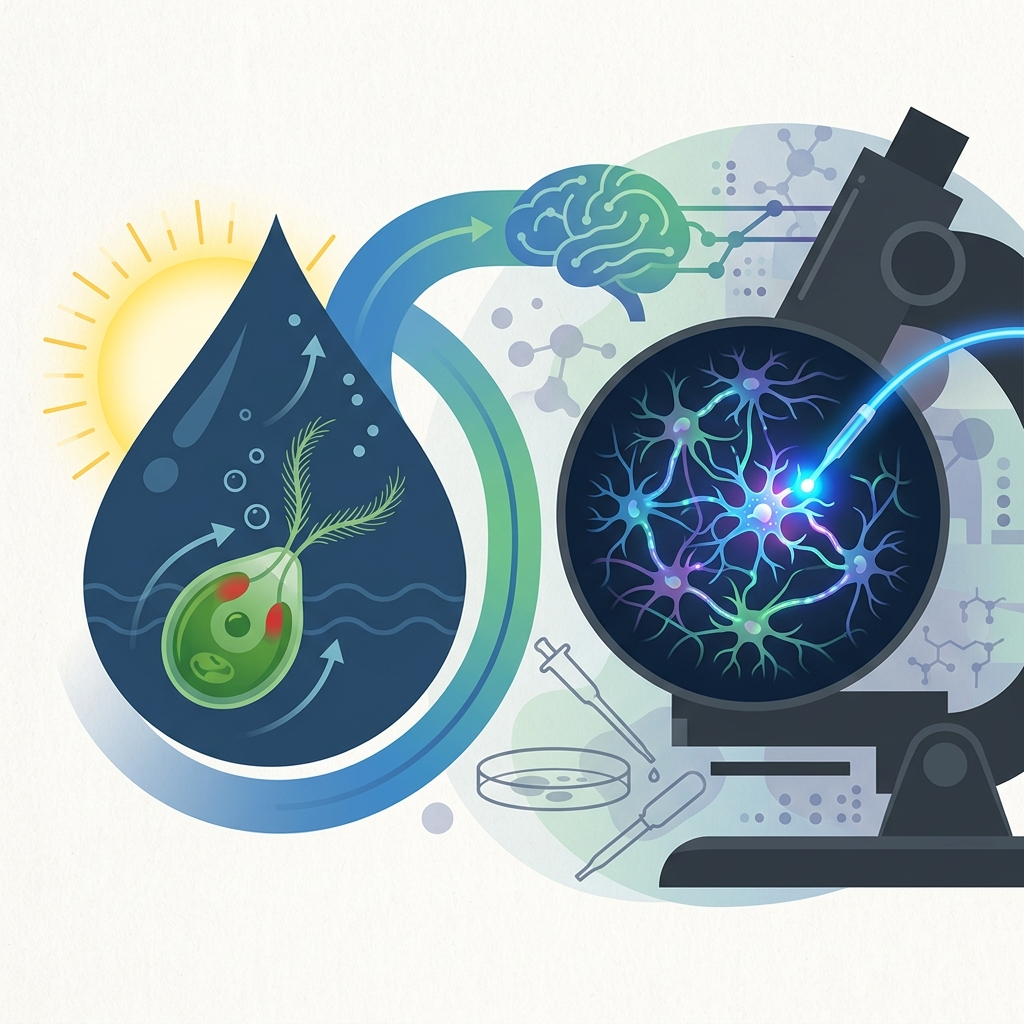
Peter Hegemann began in the early 1990s studying how the single-celled green alga Chlamydomonas senses and swims toward light, and proposed the bold hypothesis that a single protein could simultaneously serve as a light receptor and an ion channel — a claim the field greeted with considerable skepticism, since the prevailing view held that these two functions were always carried out by separate proteins. The critical evidence arrived around the year 2000 when Japanese researchers published Chlamydomonas genomic data revealing two candidate genes, and Georg Nagel confirmed the hypothesis by expressing these genes in Xenopus oocytes and demonstrating that a functional light-gated ion channel was real. What made the algae eyespot so remarkable was its speed: it generates an electrical signal roughly 0.5 milliseconds after light arrives, compared to at least 10 milliseconds for phototransduction in the human eye — twenty times faster — a speed explicable only by a single integrated protein handling both sensing and conductance. Hegemann and Nagel's 2003 paper formally established Channelrhodopsin-2 (ChR2), a molecular switch that opens within 0.2 milliseconds of light, encoding the discovery in its very name: a rhodopsin forming a light-activated channel. The discovery was a stunning vindication of basic biological curiosity — the mechanism by which pond algae navigate light, finally resolved at the molecular level. What nobody had yet demonstrated, and what would change neuroscience entirely, was whether this algal protein could be put inside a mammalian neuron and used to control electrical activity in a brain.
Optogenetics and the Paradigm Shift from Correlation to Causation
Karl Deisseroth, training as a psychiatrist and motivated by a desire to understand the brain circuits underlying his patients' suffering, wrote to Nagel requesting channelrhodopsin DNA, introduced it into cultured rat neurons, and in 2005 published the result: blue light reliably made the neurons fire on command. In 2006 he named the approach "optogenetics," and by 2007 he had inserted optical fibers into the motor cortex of living mice to control whisker movements and stimulate awake neurons to wake sleeping mice on cue. The core capability this created — the ability to selectively switch specific neuron types on and off among the roughly 90 billion in the brain, with millisecond precision — gave neuroscience something it had never previously possessed: a direct tool for establishing causation rather than correlation. Before optogenetics, you could say "this brain region is active when the animal feels fear." After optogenetics, you could say "activating this region causes fear behavior to appear" — and the difference between those two statements is the difference between watching and proving. The shift was not just a new technique; it was a fundamental change in the kinds of questions neuroscience could legitimately ask and answer, transforming the entire paradigm of brain research from observational cartography into causal experimentation.
The Nobel Three-Person Cap: A Structural Constraint That Modern Science Has Outgrown
Ed Boyden was the first author on the landmark 2005 paper and has since led independent optogenetics research at MIT, yet he was excluded from the prize by the three-person limit. According to STAT News, many commentators on social media flagged this exclusion when the prize was announced, while Boyden himself declined to respond when asked for comment. The Nobel Committee's own background document acknowledges Gero Miesenböck, who in 2002 reported the first genetic photosensitization of a non-photoreceptive neuron, and Zhuo-Hua Pan at Wayne State University, who in 2004 applied channelrhodopsin to retinal ganglion cells — meaning the official Nobel documentation itself identifies significant contributors beyond the three recipients. Bibliometric data from the 2023 Frontiers in Neuroscience analysis shows Boyden's optogenetics publication record (56 papers, H-index 37) is actually stronger by those measures than that of recipient Hegemann (49 papers, H-index 30). As Scientific American has noted, the three-person cap was not in Alfred Nobel's original will — it was added in a 1968 revision of the Foundation's statutes, making it an institutional artifact rather than a founding principle. In an era when major scientific advances are products of large collaborative teams, limiting recognition to at most three individuals doesn't accurately capture the distributed reality of how science is actually made.
The First Human Clinical Result: One Patient, Partial Vision, Special Goggles Required
The 2021 study by Sahel and colleagues in Nature Medicine marks the first confirmed demonstration that optogenetics can work in a human being: a single patient who had lost sight to retinitis pigmentosa received an AAV vector delivery of a channelrhodopsin-like protein (ChrimsonR) into retinal ganglion cells, then used specialized goggles incorporating a camera and light-stimulation unit. With the goggles on, the patient correctly identified a notebook on a table in 36 of 39 attempts — a 92% success rate — along with identifying a small staple box 36% of the time, counting glasses 63% of the time, and achieving 78% accuracy on an EEG-based visual cortex decoder. Without the goggles, none of the visual tasks were achievable. This is still a single patient's result, and the dependence on specialized external equipment is a significant practical constraint, but the proof-of-principle it establishes is scientifically substantial: visual information can be transmitted from the retina to the brain using optogenetics. According to the same 2023 Frontiers bibliometric analysis, vision restoration is the only clinical area where optogenetics has reached human trials, with six trials registered — making this result the benchmark against which the field's entire clinical future will be measured. Psychiatric and neurological applications remain at the animal-model stage, and expectations for rapid clinical expansion should be calibrated accordingly.
Memory Circuit Research and the Neuroethical Questions Already Being Asked
In 2012, Deisseroth and 1987 Nobel laureate Susumu Tonegawa successfully reactivated engrams — the specific neural ensembles that encode memories — in mice using optogenetics, and the Nobel popular explanation describes this as "the first experiment to precisely identify the neurons required for a specific memory," directly supporting the hypothesis that memories exist as patterns of activity across specific sets of brain cells. Whether and when this kind of circuit-level memory manipulation could be applied to humans remains genuinely uncertain from a technical standpoint, but the ethical questions it raises are already concrete and serious. Farina and Lavazza (2022), writing in Frontiers in Human Neuroscience, warned that memory modification could threaten "the distinctive features that guarantee personal continuity," and raised specific concerns about the legal implications of erasing criminal memories, the potential for military applications in suppressing fear responses, and the risk of enhancement use cases well outside any medical frame. They argued that the distinction between treatment and enhancement must be socially defined before clinical adoption proceeds, not after. Delaying this discussion until the technology actually arrives risks a repeat of the pattern seen with early CRISPR — where ethical frameworks lagged so far behind the technology that a researcher acted unilaterally before any norms were in place. I think the urgency of beginning this conversation now, when optogenetics is still at animal-model stage for memory applications, cannot be overstated.
Positive & Negative Analysis
Positive Aspects
- A Fundamental Transformation in How We Do Neuroscience
Before optogenetics, neuroscience was largely a science of correlation — you could observe that a brain region became active when an animal experienced a particular emotion or behavior, but you could not prove that the activation was causing the outcome rather than simply accompanying it. Optogenetics changed this by enabling millisecond-precision, cell-type-specific switching of individual neurons, for the first time allowing researchers to establish true causal relationships between specific neural circuits and specific behaviors. Nobel Committee Chair Per Svenningsson captured the magnitude of this shift when he said: "Optogenetics provides opportunities for mapping the brain in a way that we could once only dream of." Without this tool, the 2012 engram reactivation experiment — which directly demonstrated that a specific memory can be encoded in and recalled from an identifiable set of neurons — would have been structurally impossible. The transformation isn't just a new instrument; it's a new epistemological standard for the entire field, one that distinguishes between a brain region being associated with a function and being causally necessary for it. That distinction is one of the most important in all of science, and optogenetics is what made it operationalizable.
- Proof-of-Principle for Human Clinical Application Is Already on the Record
The 2021 Sahel et al. Nature Medicine study established that optogenetics can work in a human patient — not just in animal models. The single patient with retinitis pigmentosa who achieved 92% notebook identification with specialized goggles represents a genuine scientific milestone: it demonstrates that light can carry useful visual information from the retina to the brain, even in a person whose photoreceptors have been destroyed by disease. The fact that only one patient's results exist and that the goggles are a significant practical constraint doesn't diminish the proof-of-principle — it just correctly frames where the field currently stands. Six vision restoration trials are registered according to the Frontiers bibliometric analysis, meaning the infrastructure for generating more substantial clinical data exists and is being used. The Nobel Prize effect may accelerate patient recruitment and additional funding for these trials, meaning the follow-up data that will determine whether this proof-of-principle can scale to a genuine therapy may come sooner than it otherwise would. Vision restoration also opens a conceptual template for other sensory restoration applications that may follow in the longer run.
- The Most Persuasive Case for Basic Science Investment in Years
The trajectory from wondering why pond algae swims toward light to transforming neuroscience is one of the most powerful arguments for basic science investment that exists. This is a line of inquiry that could never have appeared in a corporate R&D strategy document — and yet it seeded a field with 6,824 papers, 24,445-plus researchers, and a 52.82% compound annual growth rate since 2010, according to the 2023 Frontiers bibliometric analysis. At a political moment when basic science budget cuts are being actively proposed in many countries, this prize delivers an almost perfectly constructed argument against the idea that research funding should be limited to projects with foreseeable applications. The asymmetric return structure of basic science — most investments don't generate dramatic applications, but rare ones generate revolutions — is exactly what this story illustrates. One researcher's genuine curiosity about a single-celled organism produced the most consequential neuroscience tool of the past two decades. That is a fact worth keeping in front of every policymaker who reaches for the "delete basic science budget" option.
- A Geographically Distributed Research Ecosystem Built to Last
Optogenetics has spread far beyond any single institution or country, making it a genuinely global research tool with structural resilience against funding disruptions in any one place. The 2023 Frontiers bibliometric analysis shows the United States leading with 3,051 papers, followed by China (623), Germany (616), and Japan (470), with researchers across dozens of countries contributing to the total of more than 24,445 authors. Stanford University's 832 cumulative papers demonstrate the importance of leading research hubs, while the broad geographic spread ensures that the field's progress doesn't depend on any single institution's continued investment. The 2021 peak of 922 papers published in one year, combined with a 52.82% annual growth rate since 2010, indicates the field is still on an accelerating trajectory with no signs of early consolidation. This distributed ecosystem provides structural insurance: even if one major funding source contracts, the global base of contributing researchers means the knowledge base continues to grow. For a field still in the relatively early stages of clinical translation, this kind of breadth and resilience matters enormously for sustaining the long-term research pipeline.
Concerns
- The Technical Barriers to Deep-Brain Human Application Remain Fundamental
For optogenetics to work in the deep brain structures implicated in psychiatric and neurological conditions, two fundamental engineering problems need to be solved. The first is gene delivery: getting a light-sensitive protein expressed in precisely the right neurons at the right levels, via AAV vectors, requires navigating the blood-brain barrier, managing potential immune responses, and ensuring stable long-term expression — none of which is fully solved. The second is light delivery: because skull and brain tissue absorb and scatter light, reaching neurons deep in the brain still requires physically inserting an optical fiber through the skull, which is an invasive surgical procedure with its own risks and limitations. The retina is an ideal initial clinical target precisely because light reaches it naturally, but that convenience disappears completely when the target is the hippocampus, prefrontal cortex, or any other deep structure. Psychiatric applications of optogenetics remain at the animal-model stage, and neuroscience has a documented history of dramatic animal-model successes that failed to translate to human patients. The technical barriers here are not small-scale engineering challenges — they are fundamental physical and biological constraints that will take substantial time and innovation to overcome, and optimism about the timeline should be tempered accordingly.
- The Nobel Three-Person Cap Sends a Damaging Signal to Early-Career Scientists
The structural problem with the Nobel Prize is not just about fairness to the individuals excluded — it's about the message the prize sends to the next generation of researchers. Ed Boyden was the first author on the 2005 paper that launched the field of optogenetics as a brain-circuit tool, has since built a major independent research program at MIT, and has a bibliometric record — 56 papers, H-index 37 — that by standard academic metrics is stronger than at least one of the recipients (Hegemann: 49 papers, H-index 30). The signal this outcome sends to every PhD student and postdoc who reads the news is: even first-author contributions to landmark papers, even careers built on the foundation of that work, may not earn recognition in the field's highest honor. That signal is not neutral. Science's ability to attract and retain exceptional talent depends partly on the reasonable expectation that exceptional contributions will be recognized, and a structural mechanism that systematically filters out early-career researchers from the recognition it confers undermines that expectation. The 1968 statutory three-person cap is not a natural law — it was a policy choice, and policy choices can be revisited.
- The Risk of Oversized Clinical Expectations in the Wake of Nobel Publicity
The Nobel Prize creates enormous public attention, and that attention carries the risk of generating expectations that the field's current clinical reality cannot meet. The only confirmed human result in optogenetics is a single patient achieving partial vision restoration with specialized equipment — a genuine proof-of-principle, but not a deployed therapy. News headlines emphasizing "controlling the brain with light" tend to compress the distance between that proof-of-principle and a clinical treatment for depression, PTSD, or Parkinson's disease — a distance that is, right now, very large. When oversized expectations meet the inevitable slower-than-hoped pace of clinical development, the result is often disillusionment, followed by funding contraction and reduced policy support. This pattern has played out in neuroscience before, most notably in the decade of disappointment following the first wave of enthusiasm around deep brain stimulation for psychiatric conditions. The most important thing the optogenetics research community can do right now — beyond the science itself — is accurate expectation-setting: celebrating what the technology demonstrably can do, being honest about what it cannot yet do, and clearly distinguishing research tools from clinical therapies.
- Ethical and Regulatory Frameworks Are Not Ready for Where the Technology Is Going
The memory reactivation experiments in mice completed in 2012 were, by scientific standards, a remarkable success. They also opened a set of ethical questions that existing regulatory frameworks are not equipped to handle, and for which no international consensus exists. Farina and Lavazza (2022) identified in Frontiers in Human Neuroscience that memory modification poses risks to "the distinctive features that guarantee personal continuity" — raising questions about legal accountability for people whose criminal memories are modified, the potential for non-consensual military applications targeting fear suppression, and the fundamental distinction between treating illness and enhancing cognition. None of these concerns have generated internationally agreed ethical guidelines. The CRISPR precedent is instructive: ethical frameworks lagged so far behind the technology that a researcher in China edited human embryo genomes without meaningful oversight, creating a crisis that the scientific community is still managing. Optogenetics is in a position where the window for developing proactive ethical and regulatory frameworks — before clinical applications expand beyond vision restoration — is open right now, but it will not stay open indefinitely. The urgency of this work is proportional to the pace of technical development, and that pace is accelerating.
Outlook
The most immediate effect of this Nobel Prize will be a global surge of attention and a reorientation of funding flows toward optogenetics. Nobel Prizes have a consistent historical track record of producing spikes in grant applications, student interest, and institutional investment in the recognized field — optogenetics will not be an exception. With Deisseroth, Hegemann, and Nagel's names appearing simultaneously in global headlines, a significant number of researchers, investors, and policymakers are encountering this technology for the very first time. In countries where political arguments over basic science budgets are active, the narrative of "algae research won the Nobel Prize" gives basic research advocates one of their most powerful rhetorical tools in years. I expect this effect to materialize in conference invitations, media appearances, government advisory roles, and new laboratory funding. At the same time, the risk of Nobel-amplified public expectation running ahead of scientific reality is real and should be named. The controversy over Boyden's exclusion will also spread further through scientific social media and mainstream press, and I would not rule out this eventually generating formal reconsideration discussions at the Nobel Foundation about the three-person statutory cap that was added in 1968.
On the clinical front, the most critical near-term test will be the follow-up data from ongoing vision restoration trials. According to the 2023 Frontiers in Neuroscience bibliometric analysis, vision restoration is the only clinical area where optogenetics has entered human trials, with six registered trials. The Nobel Prize as a high-visibility event could increase awareness of these trials, helping with patient recruitment and additional funding. That said, clinical trials operate on scientific rigor as the absolute priority — the Nobel Prize does not accelerate the trials themselves or alter their protocols. Proper clinical data will take the time it takes, and rushing would only undermine the field's credibility. In the near term, the sensible approach is to monitor interim result announcements from existing trials and to watch for new trial initiations. Whether the field's bibliometric growth trajectory — 922 papers published in 2021 alone — accelerates further due to the Nobel effect is also a meaningful data point to track over the coming year.
In the medium term, the development most worth watching will be the continued technical refinement of optogenetics tools themselves. The channelrhodopsin variants in current use are already substantially improved over the early versions, but there remains significant room for progress in expanding the usable light wavelength range, adjusting activation sensitivity, and improving cell-type specificity. The development of red-light or near-infrared-responsive variants is particularly important to the problem of accessing neurons in deep brain structures, because light attenuates rapidly as it passes through skull and brain tissue, meaning that reaching deeper targets currently still requires direct optical fiber insertion. Advances in gene delivery vectors are equally significant. If AAV vector efficiency at crossing the blood-brain barrier improves substantially, the scenario of delivering optogenetics tools into the brain without surgical invasion gets meaningfully closer. The pace of these technical developments will largely determine what the medium-term clinical picture actually looks like. I believe this medium-term window will be the most consequential period for the field's trajectory. Results from multi-site expansions of vision restoration trials and the performance profile of next-generation channelrhodopsin variants are likely to become clear in this window, and those results will set expectations across academia, clinical medicine, and investment communities alike.
Running in parallel through the medium term, the effort to develop a more serious ethical and regulatory framework around optogenetics will almost certainly intensify. Now that the Nobel Prize has positioned this technology in the global public eye, bioethicists and policymakers will engage more actively than before. The memory modification concerns raised by Farina and Lavazza in 2022 currently live mostly in academic discourse, but they will transition into concrete policy debate the moment clinical research shows signs of expanding beyond vision restoration into neurological or psychiatric domains. The specific questions that need working answers in the medium term are: who can be a candidate for this technology, what constitutes meaningful informed consent, and how is the line drawn between treatment and cognitive enhancement? If these conversations do not keep pace with technical development, the field faces the prospect of having to write regulations in retrospect — and retrospective regulation is almost always chaotic, costly, and politically contentious. The early CRISPR gene-editing story, where the ethical framework repeatedly lagged behind the technology and produced the He Jiankui crisis, is a recent and instructive precedent. I think there is a genuine window right now where social frameworks could be developed before the technology creates urgency. With internationally agreed guidelines still absent, the process by which national regulators develop their own positions over the medium term will form the foundation of long-term global norms.
In the longer run, the central question is whether optogenetics can move from vision restoration into other clinical domains. One application discussed in the field is improving cochlear implants: conventional implants rely on electrical stimulation, while light-based stimulation could in principle offer higher spatial resolution and potentially better sound quality. But the path from concept to human clinical trial still involves substantial technical and regulatory hurdles. Applying optogenetics to deep brain regions — replacing conventional deep brain stimulation (DBS) in Parkinson's disease with an optogenetic approach, for example — is currently at the animal-model stage, and the distance to human trials remains considerable. Without resolution of the two fundamental problems of invasive light delivery and long-term gene-delivery safety, clinical expansion in deep brain areas will proceed slowly. Meanwhile, as the Nobel popular explanation implies with the phrase about "understanding the characteristics of diseases," even if direct therapeutic applications remain distant, the causal brain-circuit maps optogenetics generates will provide core information for drug target discovery and for improving the precision of non-invasive brain stimulation technologies.
I don't think optogenetics' long-term value is contingent on direct therapeutic success, though. The causal circuit maps this technology produces could be indispensable inputs to other treatment modalities — drug development, transcranial magnetic stimulation (TMS), transcranial direct-current stimulation (tDCS), and other non-invasive approaches. If optogenetics can definitively establish in animal models that "this specific circuit is the causal origin of this symptom," then human therapy can target that circuit through alternative and less invasive means. Taking this indirect pathway into account, the scientific influence of optogenetics is likely to expand over the long term regardless of whether direct clinical applications succeed on the expected timeline. As a basic research tool, optogenetics has already secured an irreplaceable position in neuroscience. The Nobel Prize formally ratifies that position. The key variables going forward are less about the technology itself and more about the ecosystem surrounding it — the scale and stability of research funding, the pace of talent entry into the field, and how rationally the regulatory environment develops.
It helps to think about the field's future through three scenarios. In the most optimistic scenario, the ongoing vision restoration trials achieve meaningful results and proceed to regulatory approval, the field rapidly expands to cochlear implant improvement and other peripheral nervous system applications, the Nobel Prize effect accelerates both funding and talent inflows, and innovations in gene-delivery technology substantially improve access to deep brain structures. In the base-case scenario, vision restoration sees incremental progress while expansion into other clinical domains proceeds cautiously, the value as a research tool grows steadily and contributes indirectly to other therapeutic development efforts, and the field maintains its overall bibliometric trajectory. In the pessimistic scenario, long-term gene-delivery safety concerns emerge from clinical data, repeated failures in translating animal-model successes to humans dampen clinical enthusiasm, and the field retreats toward pure basic research. Regardless of which scenario plays out, the value of optogenetics as a basic research instrument is not in doubt. The infrastructure of 6,824 papers and more than 24,445 researchers accumulated between 2002 and 2022 guarantees the basic research ecosystem will continue even if clinical translation disappoints expectations.
I should also honestly address the counterargument to my case for basic science. The trajectory from algae phototaxis research to neuroscience revolution is an exceptionally fortunate chain of events — critics can reasonably argue that most basic science never generates such dramatic applications, and that justifying sustained public investment in basic research on the basis of rare outlier successes is not sound public finance logic. This critique deserves a serious response. I don't think the case for basic research rests on a guarantee of transformation. It rests on the asymmetric return structure: most investments in the portfolio don't pay off spectacularly, but the ones that do generate returns so large that they justify the entire portfolio. This is the venture-capital logic of knowledge production — and eliminating the portfolio eliminates any possibility of the exceptional outcome. There is also a real open question about whether optogenetics might eventually be complemented or partially supplanted in some applications by chemogenetics — a technique that controls neurons with specific chemicals rather than light, with the practical advantage of not requiring optical fiber insertion. The two approaches are more complementary than competitive for most applications, but which will prove superior in specific clinical domains over the long horizon remains unresolved, and that is part of what makes this field both dynamic and uncertain.
The long-term evolution of the Nobel Prize itself is also a genuine watch item. The Boyden exclusion debate reflects frustration that has built across multiple prize cycles — LIGO in 2017, CRISPR in 2020, and now this one. With each fresh case, the pressure to revisit the three-person cap intensifies. The probability of the Nobel Foundation taking the dramatic step of amending its statutes is not high in the near term. But over a long enough horizon, discussions about team-based prizes or an expanded recipient limit become realistic possibilities. That is less about optogenetics specifically than about the future of scientific institutions in general — but this prize will be remembered as one of the most recent and visible catalysts for that broader conversation.
The practical takeaway depends on who you are. If you're working in science, the most valuable thing to watch is the follow-up data from vision restoration trials — especially multi-patient results coming after the 2021 single-patient Sahel case reported in Nature Medicine. That will be the real inflection point for the field's clinical credibility. If you're engaged with science policy, keep this prize on record as evidence that pre-competitive basic research deserves stable funding precisely because breakthroughs cannot be pre-selected. If you're interested in neuroscience or bioethics, recognize that optogenetics has opened possibilities extending well beyond treatment — into fundamental questions about memory, identity, and the nature of human agency — and that the social conversation about those possibilities is already overdue. Nobody can predict which pond, which lab, which seemingly pointless question will seed the next revolution. That is the deepest lesson here, and also the strongest reason to keep asking questions.
Sources / References
- The Nobel Prize in Physiology or Medicine 2026 — Press Release — NobelPrize.org — The Nobel Prize in Physiology or Medicine 2026 — Press Release
- The Nobel Prize in Physiology or Medicine 2026 — Popular Information — NobelPrize.org — The Nobel Prize in Physiology or Medicine 2026 — Popular Information
- Nobel Prize in Medicine Goes to Deisseroth, Hegemann, Nagel for Optogenetics — STAT News — Nobel Prize in Medicine Goes to Deisseroth, Hegemann, Nagel for Optogenetics
- Bibliometric Analysis of Optogenetics Research 2002-2022 — Frontiers in Neuroscience — Bibliometric Analysis of Optogenetics Research 2002-2022
- Optogenetic Methods Restore Partial Vision in Blind Patient — Sorbonne / Nature Medicine — Optogenetic Methods Restore Partial Vision in Blind Patient
- It's Time to Rethink the Nobel Prizes — Scientific American — It's Time to Rethink the Nobel Prizes
- Channelrhodopsin Discovery History — PMC / EMBO Reports — Channelrhodopsin Discovery History
- Memory Modification Ethics and Neuroethical Perspectives — Frontiers in Human Neuroscience — Memory Modification Ethics and Neuroethical Perspectives