
The Man Who Buried "Lightbulbs in Reverse" in Antarctic Ice — Nobel Prize, 38 Years Later
Summary
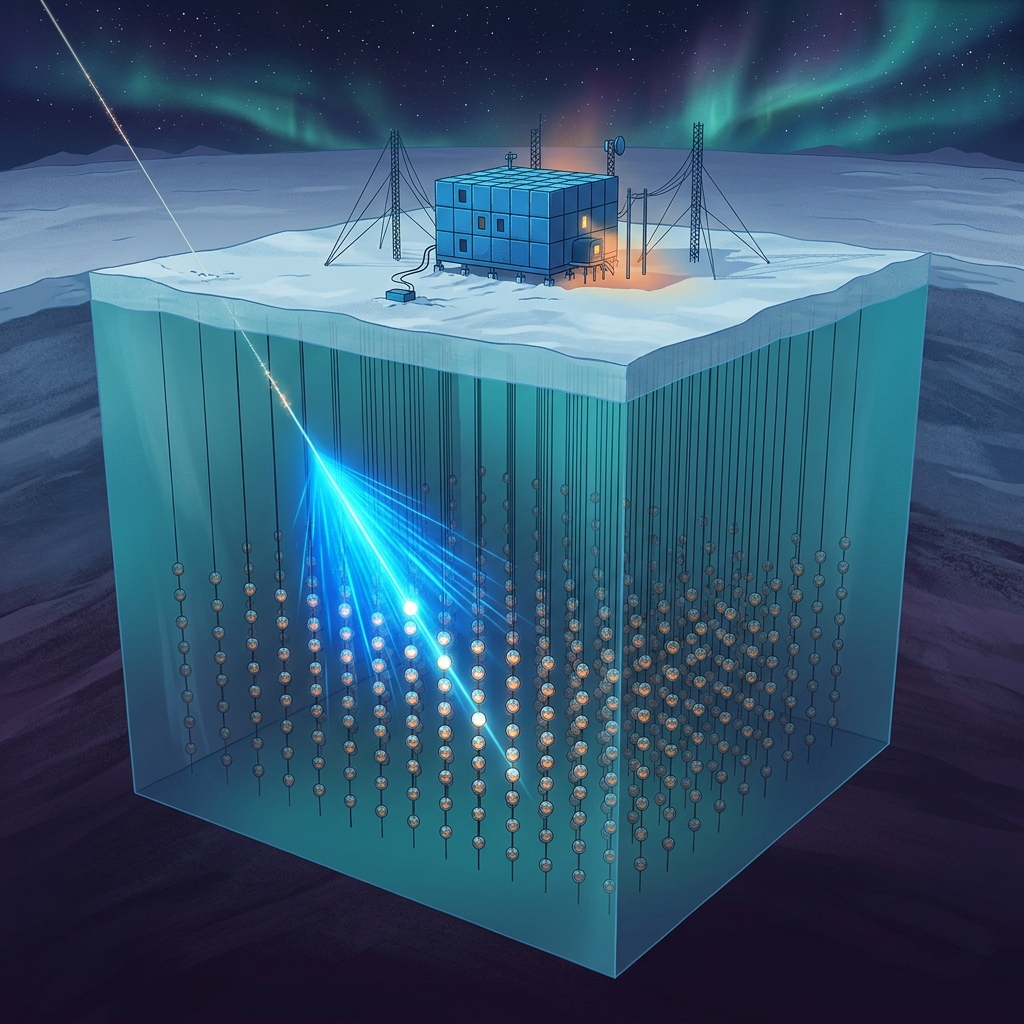
The 2026 Nobel Prize in Physics was awarded to Francis Halzen for his decisive contributions to the IceCube Neutrino Observatory and the discovery of high-energy neutrinos of astrophysical origin — a project he first proposed in 1988 and spent 38 years bringing to fruition. IceCube planted 5,160 light sensors across a full cubic kilometer of Antarctic ice, creating an instrument capable of detecting the ghostly cosmic particles that carry information from extreme environments where light itself cannot penetrate. This landmark achievement gave birth to neutrino astronomy as a fully operational field, one that complements electromagnetic observations and gravitational-wave detection with an entirely new channel for studying the universe. The Nobel committee itself acknowledged the statistical limitations still present in IceCube's source identifications — noting that evidence from the direction of NGC 1068 is "not robust enough to definitively identify NGC 1068 as a neutrino source" — and this scientific honesty underscores how much discovery still lies ahead. In the same year the prize was awarded, the U.S. administration's FY2026 budget request proposed reducing the IceCube line item from $7.94 million to $4 million, while NSF simultaneously signed a five-year, $53 million operational renewal with the University of Wisconsin–Madison, revealing the paradoxical tensions at the heart of basic science funding politics. With IceCube-Gen2 now being planned at eight times the current scale — 8 cubic kilometers — neutrino astronomy has only just turned its first page, and its most extraordinary chapters remain unwritten.
Key Points
The Birth of Neutrino Astronomy as a New Scientific Paradigm
The 2026 Nobel Prize in Physics marks a decisive break in an era when light — electromagnetic radiation in all its forms — was essentially the only channel through which humans studied the cosmos. IceCube operates by installing 5,160 light sensors across a cubic kilometer of Antarctic ice, detecting the faint Cherenkov radiation produced when a high-energy neutrino collides with an ice molecule far below the surface. Neutrinos, in the Nobel committee's own description, "reach us without changing direction or losing energy" — they carry information from extreme environments that light simply cannot penetrate, including the vicinities of black holes and the deep cores of active galactic nuclei. IceCube's first report of evidence for astrophysical neutrinos came in 2013, with confidence building as data accumulated over subsequent years, and more recently the detection of high-energy neutrinos from the galactic plane reached a significance level of 4.5 sigma. Taken together with LIGO's 2015 opening of gravitational-wave astronomy, humanity now observes the universe through three fundamentally different physical channels — electromagnetic radiation, gravitational waves, and neutrinos — creating genuine multi-messenger astronomy for the first time in history. This is not a technical upgrade to an existing paradigm; it is an expansion of the very senses with which humanity perceives the cosmos, and it changes what questions about the universe can even be asked. The historic shift underway here is one of the deepest transformations in the history of observational science, and the Nobel committee's recognition of it in 2026 is an official acknowledgment that a new era has begun.
38 Years of Scientific Vision and the Question of Tenacity
Francis Halzen formally presented the concept of an Antarctic ice-based neutrino observatory at a conference in Poland in 1988, and the 38 years between that first public proposal and the 2026 Nobel Prize represent one of the most vivid demonstrations in modern science of how long a fundamental idea can take to move from concept to recognition. In the 1980s, Halzen was inspired by Soviet researchers attempting to detect neutrinos in Antarctica using radio techniques, and his original contribution was the conceptual shift to optical detection using natural polar ice rather than engineered water tanks or synthetic media. The road from that insight to IceCube passed through the AMANDA precursor experiment, completed in January 2000, and on to IceCube reaching its full size in 2011, according to the Nobel committee — more than 20 years from idea to working instrument. Nobel Committee Chair Mark Pearce specifically cited Halzen's "tenacity and scientific vision" as the qualities that made this achievement possible, a recognition that the prize was not just for a result but for a person's willingness to commit an entire career to an outcome that remained uncertain throughout. The modern research funding ecosystem, with its three-to-five-year grant cycles and tenure structures tied to short-term publication output, makes this kind of career-length commitment structurally more difficult for the current generation of young researchers — and that structural reality deserves honest attention. Halzen's Nobel is therefore not only a scientific milestone: it is a powerful and timely argument for building and preserving the kinds of institutional structures and funding cultures that allow long-horizon basic science to exist and flourish at all. The societies that construct and protect those structures are the ones that eventually collect this kind of return on their investment.
IceCube's Technical Innovation — Making Nature Itself the Telescope
IceCube's most genuinely original contribution is the decision to use the natural Antarctic ice sheet itself as the detection medium, rather than engineering a separate artificial detector. Construction required boring kilometer-deep holes using a sophisticated hot-water drill and then lowering optical modules of 35 centimeters in diameter down each shaft — instruments that Halzen memorably described as "a lightbulb in reverse," capturing light rather than emitting it. The pivotal discovery that made the entire project viable came when teams found that ice below 1,400 meters depth was extraordinarily transparent, allowing light to travel 300 meters — far beyond what anyone had expected before that exploratory work. This finding transformed the project from a speculative concept into a buildable reality, and the Christmas Eve 1993 confirmation of the first successful cable installation captures something of the tension and relief of that validation moment. The full IceCube array spans 86 strings carrying 5,160 sensors across the depth range of 1,450 to 2,450 meters, with bedrock at 2,820 meters. The total construction cost of approximately $279 million is, by the standards of frontier particle physics infrastructure, remarkably economical — a direct and deliberate consequence of working with material that nature provided over millennia. This cost efficiency is not coincidence but a design principle: instead of engineering a detector from scratch, the team borrowed a cubic kilometer of ice that already existed, and in doing so created a replicable model for how large-scale basic science infrastructure can be built intelligently and cost-effectively at the frontier.
The Budget Paradox — A Nobel Year and a Funding Request
In the same year that IceCube received the Nobel Prize, the U.S. administration's FY2026 budget request — as documented by southpolestation.com — proposed reducing the IceCube line item from $7.94 million to $4 million, while the overall NSF budget request was also sharply reduced. It is essential to state this precisely: this was a budget request, not a confirmed congressional appropriation, and the distinction is critical for understanding what actually happened. Simultaneously, in the same year, NSF renewed a five-year, $53 million operational agreement with the University of Wisconsin–Madison for the continued operation and maintenance of IceCube through 2031. NSF Program Director Marion Dierickx described the renewal as an investment that "will enable discoveries across a broad range of disciplines, propel progress in data-intensive science, and strengthen the nation's research enterprise in Antarctica." The apparent contradiction — a reduction request in one document and a long-term operating commitment in another — reflects a structural feature of American science governance: the executive budget proposal begins a legislative process that Congress may substantially modify, while research agencies operate on institutional timelines that extend well beyond any single budget cycle. This paradox is not unique to IceCube; it is a recurring feature of the fundamental tension between political budget cycles measured in single years and the multi-decade timelines that fundamental science requires to produce its results. The Nobel Prize has now injected itself into this equation as a powerful and visible political signal, and how Congress responds to the FY2026 request in the months ahead will be a meaningful indicator of whether that signal translates into sustained financial commitment.
Statistical Limits and the Scientific Case for IceCube-Gen2
Despite IceCube's landmark achievements, neutrino astronomy confronts a fundamental statistical constraint that defines what the current generation can and cannot reliably claim. Although IceCube covers a full cubic kilometer, neutrinos confidently attributed to astrophysical sources still accumulate only slowly, a 2024 review on arXiv describes identified sources as "only a handful in a decade," and the number of specific cosmic sources confirmed as neutrino emitters across the full operational history of the instrument is very small by the standards of observational astronomy. The Nobel committee acknowledged directly that the 79 neutrinos observed from the direction of NGC 1068 constitute evidence "not robust enough to definitively identify NGC 1068 as a neutrino source" — a statement that reflects scientific honesty rather than failure, but that honestly marks the current boundary of what first-generation instruments can achieve. IceCube-Gen2, planned at 8 cubic kilometers with approximately 18,000 optical and radio sensors, aims to raise the cosmic neutrino detection rate tenfold and extend sensitivity to sources five times fainter than those IceCube can currently reach. The U.S. P5 advisory panel recommended federal support for Gen2 in December 2023, with a projected cost of approximately $350 million and a construction period of roughly eight years. The statistical limitations of the current generation are not an argument against neutrino astronomy — they are the clearest and most direct possible scientific argument for investing in the next generation, where the transition from exploration to precision measurement becomes achievable. Scale, in this field, is not ambition; it is a scientific requirement.
Positive & Negative Analysis
Positive Aspects
- Opening a Window onto the Universe That Light Can Never Reach
IceCube and neutrino astronomy have brought about a fundamental expansion in humanity's capacity to observe the cosmos, reaching environments and phenomena that electromagnetic astronomy has always been structurally unable to access. Light — in all its forms, from radio waves to gamma rays — is absorbed and scattered by matter, making the most extreme cosmic environments invisible to any traditional telescope: the immediate surroundings of black holes, the inner cores of active galaxies, the regions deep inside supernova remnants where the most energetic processes unfold. Neutrinos travel through matter essentially undisturbed, carrying information from these inaccessible zones directly to Earth without deflection or energy loss. Combined with LIGO's 2015 opening of gravitational-wave detection, humanity now observes the universe through three distinct physical channels — electromagnetic radiation, gravitational waves, and neutrinos — constituting genuine multi-messenger astronomy for the first time in scientific history. The 2017 detection of a neutrino from the direction of blazar TXS 0506+056, combined with electromagnetic follow-up by approximately 20 observatories worldwide, provided the first concrete demonstration of what this multi-messenger approach can deliver in practice. The paradigm shift this represents is not a marginal technical improvement to existing astronomy; it is an expansion of the sensory reach with which humanity engages with the deepest structures and most violent processes in the universe, and the 2026 Nobel Prize formally and irreversibly recognized it as such.
- A Successful Model of International Scientific Collaboration
IceCube represents a successful model of international scientific cooperation at a scale and under physical conditions that make it genuinely extraordinary. More than 450 scientists from 58 institutions worldwide have participated in building and operating this telescope, doing so under the constraints of working at the most extreme human-inhabited environment on Earth, with active construction windows limited to a few months of Antarctic summer each year and all work requiring precision engineering at depths approaching three kilometers. Sungkyunkwan University in Korea joined the collaboration through an official MOU in 2013 and, as of 2017, ranked as the eighth-largest contributing institution among 47, including specifically leading the delivery of the camera system for the IceCube Upgrade — a technically demanding contribution that went well beyond nominal participation. This project demonstrates concretely that science can transcend national borders to pursue a shared intellectual goal, and it carries particular meaning at a moment of heightened geopolitical tension globally when international cooperation in other domains has become more difficult to sustain. The Antarctic Treaty system has provided the stable international legal framework within which this decades-long collaboration has functioned, proving that scientific curiosity can maintain genuine cooperative structures even when broader political conditions are strained. IceCube-Gen2 will require an even larger and more sustained international partnership, and the existing collaboration's decades-long operational track record provides a credible and tested foundation for building it.
- Cost-Effective Frontier Science Through Natural Medium Utilization
IceCube's total construction cost of approximately $279 million is, by particle physics and astrophysics infrastructure standards, remarkably efficient for the scientific reach it achieved. This efficiency flows directly from the project's core design philosophy: rather than engineering a detection medium from scratch, the team used a cubic kilometer of Antarctic ice that nature had already provided, converting it into a working telescope through the deployment of precision sensors within it. The natural advantages of deep Antarctic ice — permanent darkness, complete absence of biological interference, very low radioactive background, geological stability sufficient to eliminate earthquakes — made it not merely a cost-saving choice but arguably the best available detection medium on Earth for this specific scientific purpose. Beyond the medium itself, the project also leveraged the existing infrastructure and logistical systems at the Amundsen–Scott South Pole Station, further reducing the overhead of working in an extreme environment. The neutrinos being detected carry energies up to a million times higher than anything achievable in ground-based accelerator laboratories, meaning IceCube accesses physics that no amount of additional spending on terrestrial machines could reach. This combination — low construction cost relative to capability, access to otherwise unreachable physics regimes — defines a model for frontier basic science that deserves serious study as research budgets come under increasing pressure worldwide.
- Long-Term Basic Science Investment Powerfully Vindicated
The 38 years from Halzen's 1988 proposal to the 2026 Nobel Prize represent perhaps the most compelling available demonstration that sustained investment in long-horizon basic science produces returns that simply cannot be achieved through short-term approaches. The journey passed through the AMANDA precursor experiment, years of incremental construction under extreme environmental constraints, and the slow accumulation of data that preceded each confident scientific claim — none of which could have been shortened without abandoning the scientific logic entirely. NSF's renewal of a five-year, $53 million operating agreement in 2026 reflects a form of institutional maturity — a willingness to commit to multi-generational continuity — that is not universal across funding systems and deserves recognition as itself a scientific asset. For policymakers worldwide, this award delivers an unambiguous message: basic science that cannot promise near-term economic returns will, given sufficient time and sustained support, fundamentally expand the horizon of human knowledge in ways that could not have been predicted at the outset. One generation's patience becomes the infrastructure on which the next generation's discoveries are built — and the next generation's patient investment becomes the foundation of the generation after that. That compounding logic is what IceCube proves, and it remains the most important practical argument for the kind of long-term research investment that IceCube-Gen2 will now need to secure.
Concerns
- A Fundamental Shortage of Detected Astrophysical Neutrino Events
Despite IceCube's impressive cubic-kilometer footprint, neutrinos that can be confidently attributed to astrophysical origins still arrive only slowly — a rate that is not sufficient for the kind of systematic, high-confidence source identification that observational astronomy typically demands before claiming definitive results. IceCube records more than a hundred million atmospheric particles daily, and separating the rare astrophysical signal from this enormous background is technically demanding to the point where definitively confirmed source identifications remain very scarce after more than a decade of full operation. The Nobel committee acknowledged directly that evidence from the direction of NGC 1068 — 79 observed neutrinos — falls short of what would be needed to "definitively identify NGC 1068 as a neutrino source," and the committee's willingness to state this publicly in its official documentation speaks to the field's honest acknowledgment of its own current limits. The gap between detecting a diffuse population of astrophysical neutrinos and confirming the specific identity of individual cosmic sources is the defining scientific limitation of the current generation of neutrino telescopes, and it is a fundamental consequence of the physical scale that the first-generation instrument could achieve. This limitation is not a reason to abandon neutrino astronomy, but it is an honest recognition that first-generation instruments have reached the boundary of what their physical scale can deliver, and that the transition to Gen2-level statistics is scientifically necessary before the field can fully deliver on its foundational promise.
- Statistical and Methodological Debates in Source Identification
Beyond the raw shortage of events, there are substantive methodological debates within the scientific community regarding how neutrino source identifications are derived and what statistical standards should be used to evaluate them. The analysis of NGC 1068 yields different significance levels depending on whether the full sky is scanned uniformly or a pre-selected source catalog is used as the analysis basis — and critics in the peer-reviewed literature have raised concerns that this catalog was assembled using data from the same observational period being analyzed, introducing a degree of circularity into the significance calculation that is difficult to fully account for after the fact. Such debates are common and healthy in the early stages of a new observational discipline, but they signal clearly that neutrino astronomy has not yet established the community-wide methodological consensus and agreed statistical standards that mature fields develop over decades. The independent search by the ANTARES Mediterranean telescope of the direction flagged by IceCube's 2017 alert found no statistically significant signal — which does not conclusively refute IceCube's result, given ANTARES's smaller effective area, but does underscore the structural problem of relying primarily on evidence from a single detector. A truly robust scientific discipline requires independent confirmation through genuinely independent instruments of comparable sensitivity, and neutrino astronomy has not yet consistently achieved that standard across its most significant claims. Cross-validation through a global network of large-scale observatories is a methodological necessity, not an optional enhancement.
- The Structural Risk of Insufficient Independent Verification
The advancement of neutrino astronomy depends critically on its ability to achieve genuine independent cross-verification of source identifications, and this capacity currently remains structurally limited in ways that will persist for years. The most significant results in neutrino source identification trace back to IceCube data alone, with no instrument of comparable effective area currently available to independently confirm or refute them at equivalent statistical power. KM3NeT's continued deployment in the Mediterranean will help over time, as will the development of other observatories on Lake Baikal and elsewhere, but the timeline for achieving a truly global network with genuine cross-checking capability at IceCube's scale extends well into the future and cannot be significantly accelerated simply by desire. Until multiple instruments of comparable sensitivity and different systematic uncertainties can independently observe and reach agreement on the same sources, neutrino astronomy's most specific claims will remain scientifically provisional in ways that limit their broader acceptance and scientific impact. This limitation cannot be resolved by improved analysis techniques alone — it requires real investment in additional large-scale observatories, which itself competes for the same limited pool of specialized funding and logistical resources that IceCube-Gen2 is also pursuing. The field faces a genuine structural challenge here that will require coordinated international commitment and sustained prioritization over an extended period to resolve effectively.
- The Opportunity Cost of Giant Scientific Infrastructure
The approximately $350 million projected cost and roughly eight-year construction period for IceCube-Gen2 inevitably forces a comparison with the scientific value that could alternatively be produced by different uses of the same level of resources, and that comparison deserves honest examination rather than dismissal. The physical constraints of Antarctica — compressed working seasons typically limited to a few months of Antarctic summer, shared logistics infrastructure, limited simultaneous operational capacity for multiple large construction projects — mean that Gen2 competes not only in financial terms but in operational terms with other research programs conducted at or near the South Pole, including programs in climate science, glaciology, atmospheric chemistry, and astronomy. The broad compression of science spending visible in the U.S. administration's FY2026 budget request signals a political environment in which heavy concentration of resources on a single flagship project can crowd out the diversity of smaller and medium-scale research that sustains a healthy and varied scientific ecosystem with many active researchers. The Nobel Prize strengthens Gen2's political position considerably, but it does not dissolve the underlying opportunity-cost calculation that any serious science policy process must confront. Every major investment in one project is a choice not to fund a different set of projects, and making that trade-off wisely requires more than the political halo of a Nobel Prize — it requires transparent scientific prioritization and genuine community-wide deliberation about what matters most at this moment in time.
Outlook
In the weeks and months immediately following the 2026 Nobel Physics announcement, global attention to neutrino astronomy will sharpen dramatically. The Nobel Prize is among the most powerful instruments humanity has for lifting public awareness and political attention toward a scientific discipline. I believe this effect will prove particularly decisive in discussions about securing funding for IceCube-Gen2. With the U.S. Congress yet to finalize its disposition of NSF's FY2026 budget request, the timing of the Nobel announcement gives science advocates an extraordinarily powerful card. The political difficulty of cutting the budget for a project that just won the Nobel Prize in the same year is real — not insurmountable through process, but costly enough in political terms that it creates genuine resistance. This is my own judgment: the Nobel Prize does not automatically guarantee any outcome in a congressional appropriations process, but it measurably changes the political calculus in the direction of continued support. I'm inclined to think that any legislator who votes to slash IceCube funding the same year it won a Nobel Prize will need a very compelling explanation for their constituents.
In the near term, a second development worth watching closely is the output from the recently completed IceCube Upgrade. This upgrade installed new types of optical modules in the dense core of the existing IceCube detector, substantially improving sensitivity to lower-energy neutrinos and opening new avenues for studying neutrino properties including mass ordering. Halzen himself commented on the five-year NSF renewal: "The generous funding will allow us to further improve the performance of the instrumentation." I see the first scientific results from the Upgrade as an important milestone for gauging the next step-change in neutrino astronomy's capabilities. The combination of improved low-energy sensitivity with new machine-learning-based analysis software, both being deployed under the renewal agreement, creates a genuine possibility that patterns previously hidden in the existing dataset will become visible. This matters because it opens a path to meaningful scientific progress even before IceCube-Gen2 exists, keeping momentum in the field during the years Gen2 will need to plan and build.
Over the medium term — roughly six months to two years out — I expect this to be the decisive window in which IceCube-Gen2's concrete schedule and international funding structure take visible shape. Gen2 is planned at eight times the scale of the current IceCube, at 8 cubic kilometers, with approximately 18,000 optical and radio sensors. The U.S. P5 federal physics advisory panel formally recommended federal support for Gen2 in December 2023. Gen2 aims to raise the cosmic neutrino detection rate tenfold over current IceCube while reaching sources five times fainter than those IceCube can detect. Projected cost stands at approximately $350 million, with a construction timeline of roughly eight years. Some possible timelines have been discussed within the community, but no confirmed construction start date exists as of now. I expect the Nobel Prize to serve as the critical catalyst that converts years of planning discussions into actual funding commitments from international partners, and to accelerate the governance negotiations that a project of this scale requires before construction can begin.
Also worth watching in the medium term is how the relationship between IceCube and its complementary observatories evolves. KM3NeT, under construction in the Mediterranean, uses seawater rather than ice as its detection medium, giving it different systematic properties and different sky coverage compared to IceCube's Antarctic position. KM3NeT has observed extremely high-energy neutrino events that drew significant scientific attention — events in an energy regime where IceCube did not report comparable detections — and this creates a productive scientific tension between the two instruments. I see this tension as healthy: independent measurements in different detection media, cross-checking each other's results, is exactly the methodological rigor neutrino astronomy needs to move beyond single-detector reliance. The broader network carrying DUMAND's legacy — on Lake Baikal, in the South China Sea, off the Canadian coast — may, within roughly two years, begin to cohere into something approaching a genuine global neutrino detection network. That transition would be a significant structural development for the credibility and reach of the entire field.
Related to this, I believe we may approach a meaningful statistical threshold for neutrino source identification within this medium-term window, even without Gen2 being operational. IceCube has now accumulated more than 15 years of observational data, and the five-year NSF renewal includes plans to reprocess this full archive using new machine-learning techniques. The capacity of improved algorithms to surface patterns invisible to earlier analysis methods should not be underestimated — this is how particle physics has repeatedly found surprises hiding in already-collected data. The detection of high-energy neutrinos from the galactic plane at a 4.5-sigma significance level is a promising sign that the existing dataset still holds discoveries waiting to be unlocked. Results from this reanalysis could emerge well before Gen2 breaks ground, building both scientific momentum and a clearer guide for how Gen2's observing strategy should be optimized, creating a productive feedback loop between the current instrument and its planned successor.
From a Korean scientific perspective, medium-term developments are also worth tracking with real attention. Sungkyunkwan University led the delivery of the camera system for the IceCube Upgrade — a technically specific, high-visibility contribution — and as of 2017 was already the eighth-largest contributing institution among 47 in the collaboration. The attention that the 2026 Nobel Prize now draws to neutrino physics in Korea is likely to stimulate both domestic interest and national research investment in this area, creating conditions for a more substantial Korean role in the Gen2 phase. I think there is a genuine strategic opportunity here: if Korea positions itself as a core hardware contributor to IceCube-Gen2, it would represent a meaningful elevation of Korea's international profile in fundamental physics, with compounding returns in researcher training, technology expertise, and scientific reputation. The groundwork has already been laid; what the Nobel Prize does is raise the visibility of that groundwork and strengthen the case for investing further.
Looking further out — two to five years ahead — the construction of IceCube-Gen2 should, if funding comes together as anticipated, begin moving into its active phase. If Gen2 proceeds as planned, the annual cosmic neutrino detection rate would increase tenfold compared to current IceCube, and the detector would reach sources five times fainter. This would directly address the two most fundamental limitations neutrino astronomy currently faces: the shortage of detected events and the uncertainty in source identification. With Gen2 recording vastly more neutrinos per year, neutrino astronomy would transition from an exploratory, discovery-mode science into a field capable of precision measurement and systematic source cataloging. I believe this transition will rank among the most significant turning points in 21st-century physics — as transformative in its domain as the Hubble Space Telescope was for visible-light astronomy, or what the James Webb Space Telescope is now beginning to do for infrared wavelengths.
The most compelling long-range scenario is that neutrinos help finally resolve the century-old mystery of cosmic rays. Since Victor Hess ascended in a balloon in 1912 to discover these high-energy particles, the question of exactly where and how they are accelerated has remained one of physics' great unsolved problems. Neutrinos are produced at the same sites where cosmic rays originate, but unlike cosmic rays, they travel in straight lines undeflected by magnetic fields and unabsorbed by intervening matter — they point directly back to their origin. If Gen2 accumulates sufficient statistics, a systematic map of cosmic accelerators — pinpointing where in the universe these extreme particle acceleration events take place — could begin to emerge. That would constitute a decisive step toward resolving more than a century of mystery about the most violent processes in the known universe. Beyond cosmic rays, neutrino astronomy also carries unique potential in dark matter searches: certain dark matter models predict signals that IceCube-scale detectors are positioned to detect, opening a path from astrophysics deep into the most fundamental open questions in particle physics. IceCube already contributes to measuring neutrino oscillation parameters using atmospheric neutrinos, and Gen2 will sharpen that precision considerably, reinforcing the instrument's value across multiple branches of physics simultaneously.
Of course, all projections carry genuine uncertainty. In the most optimistic scenario, the Nobel Prize's political momentum accelerates Gen2's international funding coalition, construction proceeds smoothly, and operations begin in the 2030s — quickly producing multiple confirmed neutrino source identifications and a first systematic map of cosmic accelerators. In the baseline scenario, Gen2's path is somewhat slowed by funding assembly challenges and Antarctic logistics constraints, but the IceCube Upgrade and KM3NeT data combine to deliver steady incremental progress in the interim, maintaining scientific momentum. In the most pessimistic scenario, tightening national budgets across multiple partner countries force a scaling-back of Gen2's scope or a prolonged delay, with competition from other large Antarctic-based projects proving more acute than anticipated. I believe the baseline scenario is the most realistic: the Nobel Prize provides a meaningful political floor against complete collapse, while genuine logistical and financial constraints make the most optimistic timeline unlikely to hold perfectly. What I am fully confident of, regardless of which scenario unfolds, is that neutrino astronomy will not retreat. A Nobel Prize confers a kind of irreversible legitimacy on a scientific field — the worldwide expansion of neutrino oscillation experiments after the 2015 Nobel Prize is the clearest precedent for exactly this dynamic. The most interesting chapters of neutrino astronomy's story are still ahead, and the 5,160 lightbulbs in reverse buried in Antarctic ice are still gathering the sentences that will write them.
Sources / References
- 2026 Nobel Prize in Physics — Official Press Release — Royal Swedish Academy of Sciences — 2026 Nobel Prize in Physics — Official Press Release
- Ice at the South Pole reveals cosmic particle accelerators (Nobel Popular Science Background) — Royal Swedish Academy of Sciences — Ice at the South Pole reveals cosmic particle accelerators (Nobel Popular Science Background)
- IceCube Neutrino Observatory — Official Site — IceCube/WIPAC, University of Wisconsin–Madison — IceCube Neutrino Observatory — Official Site
- NSF and UW–Madison Renew Five-Year, $53M IceCube Partnership — IceCube Official News — NSF and UW–Madison Renew Five-Year, $53M IceCube Partnership
- South Pole Weekly Report: Final 86th String Installation — IceCube Official News — South Pole Weekly Report: Final 86th String Installation
- IceCube-Gen2 Official Site — IceCube-Gen2 Collaboration — IceCube-Gen2 Official Site
- P5 Advisory Panel Recommends Funding for Next-Generation IceCube — IceCube Official News — P5 Advisory Panel Recommends Funding for Next-Generation IceCube
- NSF FY2026 Budget Request — South Pole Station Summary — southpolestation.com (citing NSF source documents) — NSF FY2026 Budget Request — South Pole Station Summary