
Revenue +345%, Stock +700% — The Real AI Infrastructure Bottleneck Was Never the GPU
Summary
Micron Technology (MU, NASDAQ) shattered semiconductor records in Q3 FY2026 with revenue of $41.46 billion — a 345% year-over-year surge that exceeded analyst consensus by more than $6.2 billion — alongside EPS of $25.11, representing one of the most dramatic single-quarter earnings surprises in semiconductor history. The 700%-plus stock appreciation over the trailing 12 months has vaulted Micron into the trillion-dollar market cap club, a development that signals not merely corporate outperformance but a fundamental realignment in the AI infrastructure value chain, where high-bandwidth memory has displaced GPUs as the true scarce resource. Micron's HBM4 — the vertically stacked memory architecture underpinning NVIDIA's next-generation Vera Rubin GPU — sold out its entire 2026 production run under fixed-price long-term contracts, underscoring a demand-supply gap that Fortune's analysis places at 1.8 times for the full calendar year. While the Q4 guidance of $50 billion — 15% above the Street consensus — reinforces the structural bull case, material risk factors persist: the opportunity cost of below-market fixed-price contracts in a spot market that has risen 25-35%, accelerating competitive pressure from Samsung and SK Hynix in HBM4, and the memory industry's well-documented propensity for boom-bust cycles that Deloitte projects will be amplified by 2.5x global HBM capacity growth in 2027. This analysis examines the strategic trade-offs embedded in Micron's extraordinary run and assesses the sustainability of what may be the most consequential memory supercycle in semiconductor history across short, medium, and long-term horizons.
Key Points
HBM4 Is Now Proven as the Real Bottleneck in AI Infrastructure
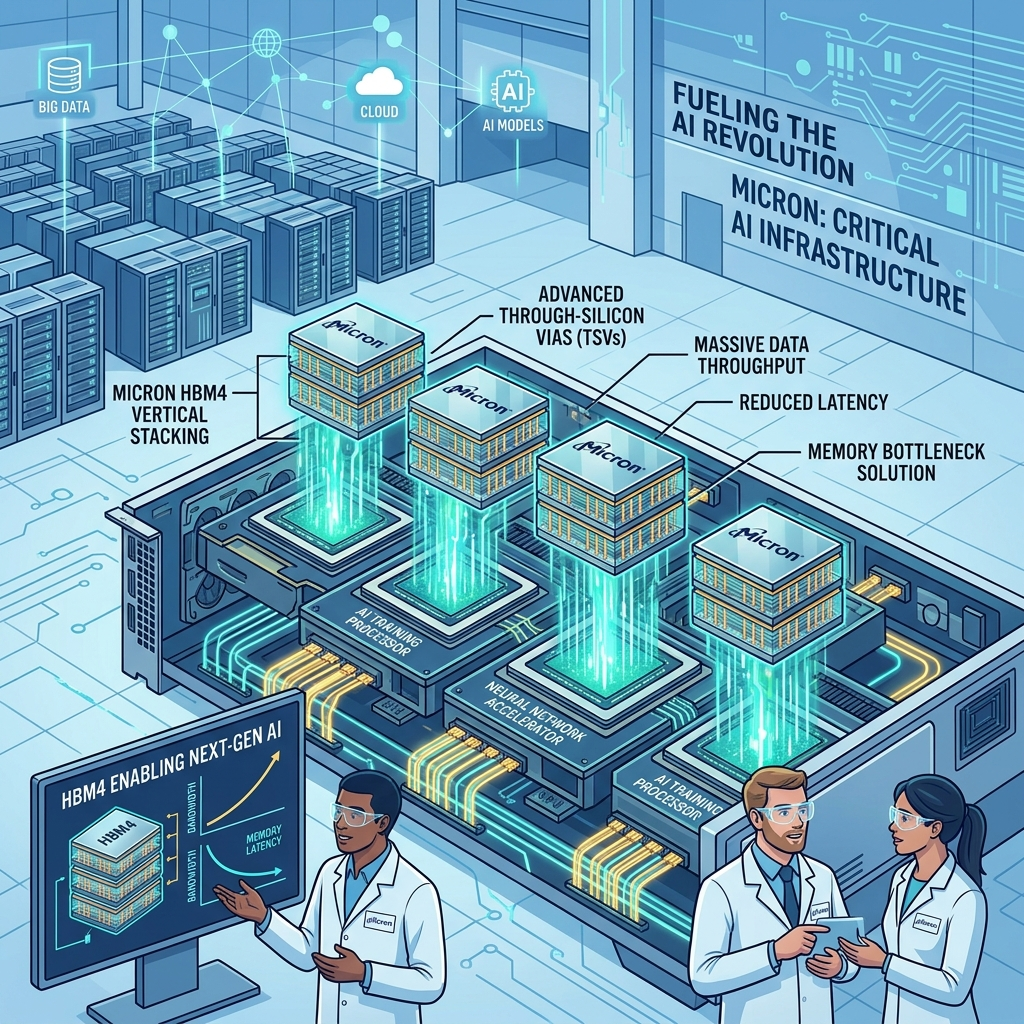
The sold-out status of Micron's entire 2026 HBM4 production under fixed-price long-term contracts is the clearest possible market signal that GPU supply is no longer the binding constraint in AI infrastructure deployment — high-bandwidth memory is. NVIDIA's next-generation Vera Rubin GPU cannot deliver its designed performance without HBM4 feeding it, and that dependency has made Micron the silent gatekeeper of the most valuable computing buildout in history. Fortune's analysis quantifies the imbalance at 1.8 times demand relative to supply for 2026, meaning the memory shortage is more acute than the GPU shortage that captured headlines in 2024 and 2025. Only three companies in the world can manufacture HBM at scale — Micron, SK Hynix, and Samsung — making this a structurally constrained supply situation that cannot be resolved simply by standing up a new fab quickly enough to satisfy near-term demand. The consequence is a fundamental power rebalancing in the semiconductor value chain: the company that controls memory bandwidth controls the throughput of AI itself, and this realization is precisely what propelled Micron into the trillion-dollar market cap club.
Q3 FY2026 Results Rewrote the Semiconductor Earnings Record Book
Micron's Q3 FY2026 revenue of $41.46 billion represents a 345% year-over-year increase, surpassing analyst consensus by more than $6.2 billion in a single quarter — a top-line beat that has no meaningful precedent in the history of a major semiconductor company operating at this scale. EPS of $25.11 versus a consensus estimate of $20.28 represents a 24% beat on the bottom line, and sequential quarter-over-quarter revenue growth of 27% confirms that the growth acceleration is ongoing rather than a one-time normalization from depressed prior-year levels. The Q4 guidance of $50 billion represents a 15% premium to analyst consensus of $43.58 billion, projecting Micron's full fiscal year 2026 revenue above $150 billion — nearly five times the company's annual revenue from just five years ago. This trajectory has repositioned Micron above Intel and approaching TSMC in the global semiconductor revenue hierarchy, a shift in industry pecking order that would have seemed implausible as recently as 2023 when Micron posted record annual losses. The magnitude of these surprises collectively signals that Wall Street's financial models have not yet fully internalized the structural transformation of Micron's business, suggesting meaningful price-target upgrade headroom remains as analyst revisions continue to cascade.
The Fixed-Price Long-Term Contract Strategy Is a Trade-Off, Not Just a Win
Micron's decision to lock its entire 2026 HBM4 production into fixed-price long-term contracts created revenue certainty but simultaneously foreclosed participation in a spot market that has appreciated 25-35% above the contracted price levels since the agreements were executed. Running the back-of-envelope math, Micron may be forgoing approximately $3-5 billion in incremental quarterly revenue compared to what spot-market selling would yield — a trade-off that is not trivial in the context of a $50 billion quarterly guide. The strategic rationale for accepting this cost is genuine and deserves credit: fixed-price supply agreements cement strategic relationships with tier-one customers like NVIDIA, creating customer lock-in effects through the deep customization requirements of HBM4 integration that competitors cannot easily disrupt in the near term. Seeking Alpha's analysis identifies this customer moat as the feature Wall Street is most systematically undervaluing in its Micron models, arguing that the long-term defensibility of the NVIDIA relationship is worth more than the near-term spot-price upside foregone. The honest framing is not that the strategy was wrong, but that investors should understand it as a deliberate and consequential trade-off between near-term revenue maximization and long-term strategic positioning — and the ultimate verdict on that trade-off will only become clear when competitive HBM4 supply arrives in scale in 2027.
Micron's Trillion-Dollar Market Cap Signals a Structural Industry Hierarchy Realignment
Micron's crossing of the trillion-dollar market capitalization threshold is not simply a financial milestone — it is a statement about the permanent reordering of strategic value within the semiconductor industry. For decades, the implicit hierarchy placed logic semiconductor designers above memory manufacturers in terms of valuation multiples, innovation premium, and strategic influence, with memory treated as a commoditized input rather than a differentiating technology. The AI era has disrupted that ordering by revealing that compute performance is ultimately bounded by memory bandwidth, not processor clock speed — and the company that controls memory bandwidth controls the infrastructure upon which the entire AI economy runs. The 12-month stock appreciation of 700%-plus, while substantially driven by recovery from cyclical lows, has also incorporated a genuine rerating of Micron's long-term structural position that persists at the current trillion-dollar level. This rerating will hold only as long as Micron continues to demonstrate that it has escaped — or at least substantially mitigated — the commodity memory treadmill that defined its financial character for most of its 48-year history, making every quarterly earnings report a referendum on that structural transformation thesis.
The 2027 Memory Cycle Risk Is Being Materially Underpriced by the Market
Memory semiconductor markets have a 40-year track record of producing severe boom-bust cycles, and the current AI memory supercycle, while genuinely different in its demand structure, has not repealed the fundamental economics of a market with three competing suppliers simultaneously expanding capacity at maximum speed. Deloitte's semiconductor industry outlook projects global HBM production capacity will approximately 2.5x between 2026 and 2027, driven by concurrent fab expansions at Micron in the US, SK Hynix in Korea, and Samsung in Korea. If AI inference demand growth — the critical swing variable — does not accelerate fast enough to absorb this capacity increase, 2027 will bring the same dynamic that ended every prior memory supercycle: supply exceeds demand, HBM prices fall 20-30%, operating margins compress dramatically, and stocks that were trading at 2x historical P/E multiples re-rate downward sharply. The historical precedent is unambiguous — Micron's stock fell more than 50% in the 2018-2019 downcycle and the company posted record losses in 2023 — and I believe the market is assigning insufficient probability to a repeat of this pattern beginning in 2027. The underpricing of cycle risk is the primary structural vulnerability in the current Micron investment narrative, and monitoring the hyperscaler capex trajectory into 2027 is the most reliable leading indicator available for detecting whether this risk is materializing.
Positive & Negative Analysis
Positive Aspects
- Most Direct Beneficiary of the AI Memory Supercycle
Micron occupies the most structurally advantaged position in the AI infrastructure investment wave, operating as the primary American-domiciled supplier of high-bandwidth memory at a moment when HBM has become the genuine bottleneck resource in AI compute deployment. The company's 2026 HBM4 production sold out entirely under fixed-price contracts, demonstrating demand intensity that far outpaces anything the commodity DRAM era ever generated, and the technical requirements for HBM integration create a supply chain stickiness that prevents hyperscalers from easily pivoting to alternative suppliers within any single product cycle. Fortune's data showing 2026 global HBM demand at 1.8 times supply quantifies the structural tightness of this market in a way that supports premium valuation multiples through at least the first half of 2027. The Big Four hyperscalers — Microsoft, Google, Amazon, and Meta — are collectively committing hundreds of billions in AI infrastructure capex, and a growing proportion of that spending flows directly to memory procurement as AI models scale in size and inference demands compound. This macro tailwind is not a consumer sentiment story that reverses with the business cycle; it is an enterprise infrastructure investment commitment that is multi-year, capital-intensive, and structurally sticky in a way that prior memory demand drivers simply were not.
- Structural Transformation in Profitability and Margin Quality
The EPS of $25.11 in Q3 FY2026 is not just an impressive headline number — it reflects a fundamental change in the quality and character of Micron's earnings profile that distinguishes this period from the commodity-margin cycles of the past. Operating margins exceeding 40% represent roughly a 2-2.5x improvement over the margins that characterized Micron's business during the commodity DRAM and NAND era, driven by the higher value-added nature of HBM4 and the reduction in price-war dynamics that multi-year fixed-price supply agreements facilitate. The predictability of this earnings stream — underwritten by multi-year supply contracts — is exactly the kind of cash flow quality characteristic that institutional investors historically assign meaningful premium multiples to relative to spot-priced commodity manufacturers exposed to quarterly price volatility. If the current margin structure proves durable through 2026 and into the first half of 2027, the case for a permanent upward revision in Micron's historical P/E ceiling becomes compelling on fundamental grounds. The comparison to Intel's foundry division, still operating at significant losses despite being a company with comparable revenue history, underscores just how dramatically Micron's profitability profile has transformed relative to other legacy semiconductor names.
- NVIDIA Partnership Creates a Durable and Defensible Competitive Moat
Micron's role as the primary HBM4 supplier for NVIDIA's Vera Rubin GPU platform creates a competitive moat that goes significantly deeper than a typical vendor-customer relationship in the memory industry. HBM4 integration into an advanced GPU architecture requires extensive co-design collaboration — the physical interface specifications, stacking configurations, thermal management requirements, and verification test suites are all custom-developed for the specific chip pairing, meaning any transition to an alternative supplier requires 12-18 months of re-engineering effort at minimum. Tom's Hardware's reporting on Micron's HBM4E roadmap acceleration suggests the company is consciously staying ahead on the technology curve to ensure that the next generation of NVIDIA GPU programs continues to default to Micron as the path-of-least-resistance supply partner. Seeking Alpha's analytical framework captures this dynamic precisely: the lock-in is not contractual coercion but technological co-dependency, which is the most durable form of competitive advantage in a rapidly evolving market where specifications change every 18-24 months. This partnership is not a supply contract — it is a strategic asset that reinforces itself with each successive product generation, as the depth of integration deepens and the switching costs grow proportionally.
- Magnitude of Earnings Surprises Signals Substantial Analyst Model Revision Headroom
A revenue beat of $6.2 billion above consensus estimates — roughly 18% — signals something more significant than strong operational execution: it reveals that sell-side analyst models have not yet converged on a framework that accurately captures Micron's current revenue capacity or its forward trajectory. When models are systematically wrong in the same direction by this magnitude, the correction process unfolds over multiple quarters as analysts revise targets, P/E multiples are reassigned, and institutional portfolio allocations are adjusted upward to reflect the new market reality. The post-earnings 13.96% gain was notably smaller than the earnings surprise magnitude would historically imply, which is partly explained by large pre-earnings positioning but also suggests the full analyst revision cycle has not yet played out and there is remaining incremental price discovery ahead. Q4's $50 billion guide — 15% above consensus — adds another round of model-revision fuel to this process, as analysts must now revise full-year 2026 and forward 2027 estimates that were built on materially lower revenue assumptions. Each successive analyst upgrade from this point represents incremental price discovery that the current stock price hasn't yet fully reflected.
- Geopolitical Tailwinds and CHIPS Act Create a Policy-Level Competitive Advantage
Micron's status as the last major American-headquartered DRAM manufacturer positions it as a direct beneficiary of US industrial policy at a scale and intensity that few technology companies of comparable size have ever enjoyed. The CHIPS and Science Act directs billions in direct grants and investment tax credits toward Micron's domestic fab expansion programs in New York and Idaho, materially improving the company's return on invested capital for domestic projects and enabling more aggressive research and development spending than the unsubsidized cost of capital would otherwise permit. The broader US-China semiconductor decoupling creates an additional structural advantage: hyperscalers and government customers with procurement considerations tied to national security are explicitly motivated to source AI memory from American-allied suppliers, and Micron is the only truly American option in that category with meaningful production scale. This policy moat compounds over time as geopolitical competition in advanced semiconductor manufacturing intensifies, and the premium attached to domestic-supply provenance for critical AI infrastructure components grows with each passing year of US-China tech decoupling. It is a structural advantage that does not appear in standard revenue models but creates a durable competitive differentiation that Korean competitors Samsung and SK Hynix simply cannot replicate in the US policy environment.
Concerns
- Memory Semiconductor's Decades-Long Boom-Bust Cycle Has Not Been Repealed
Memory semiconductor markets have a 40-year track record of producing some of the most violent boom-bust cycles in all of manufacturing, and there is no precedent in the industry's history for any supercycle being permanent regardless of how strong the underlying demand narrative appeared at the time. The PC-driven boom of the 1990s, the smartphone memory wave of the 2000s, and the cloud server buildout of the 2010s all culminated in severe oversupply corrections that devastated industry profitability and stock prices with painful regularity. In the 2018-2019 downturn, Micron's stock fell more than 50% from its high; in 2023, the company posted the largest annual net loss in its 48-year history as DRAM and NAND prices collapsed. The current AI memory supercycle is genuinely different in its demand structure — enterprise infrastructure commitments are stickier than consumer hardware upgrade cycles — but "different in structure" does not mean immune from the mathematics of three suppliers simultaneously doubling their manufacturing capacity. The fundamental market dynamic that produces boom-bust cycles in memory — the combination of long lead times for capacity additions and aggressive simultaneous expansion by all competitors — has not been structurally altered by the AI era, and dismissing cycle risk on the basis of demand confidence alone is a historically dangerous analytical posture.
- 2027 Fab Capacity Ramp Creates a Credible and Imminent Oversupply Risk
Micron, Samsung, and SK Hynix are all currently constructing or expanding HBM production facilities scheduled to come online in sequential waves through the third and fourth quarters of 2027, and Deloitte's semiconductor industry outlook projects this wave will approximately 2.5x global HBM production capacity relative to 2026 levels. The critical question is whether AI demand growth can absorb this capacity increase without triggering the HBM price correction that has historically followed periods of rapid simultaneous capacity expansion in memory markets. Hyperscaler AI infrastructure spending, which has been growing at 30-40% annually, faces a natural deceleration as the absolute investment base grows — maintaining 30% growth on an $80 billion annual capex base is mathematically more challenging than maintaining it on a $30 billion base. Even a deceleration in demand growth — not an outright contraction, just a slowdown in the rate of increase — would be sufficient to create a modest oversupply condition that sends HBM prices down 15-25%, meaningfully compresses Micron's margins, and catalyzes a re-rating of the stock's elevated multiple that could be severe given where it currently sits relative to historical norms. The timing risk is not hypothetical; it is embedded in the current supply expansion plans of all three manufacturers and becomes an actionable risk event beginning in late 2027.
- Fixed-Price Contract Strategy Generates Substantial Ongoing Opportunity Cost
The decision to sell Micron's entire 2026 HBM4 production volume under fixed-price long-term contracts has created significant revenue certainty but at the cost of participation in a spot market that has appreciated 25-35% above the contracted price levels since the agreements were executed. This gap implies that Micron is currently forgoing an estimated $3-5 billion in incremental quarterly revenue relative to market-clearing spot prices — a quarterly opportunity cost that compounds across the full year to a potential $12-20 billion in annual forgone revenue relative to the theoretical spot-priced maximum. The Q4 guidance of $50 billion, impressive as it is against the $43.58 billion consensus, might have been $60-65 billion or more if Micron had retained even a portion of its production for spot-market opportunistic selling in this environment. Samsung and SK Hynix, which maintain more flexible pricing frameworks allowing some participation in the spot market, will generate higher realized revenue per unit in the current environment even if their total volumes are lower. This revenue and earnings gap relative to an unconstrained pricing strategy is a structural drag on Micron's reported financial performance relative to its theoretical maximum, and it artificially suppresses the stock's momentum relative to the underlying demand environment in a way that competitors can exploit in investor comparisons.
- Samsung and SK Hynix Are Closing the HBM4 Technology Gap Faster Than Consensus Assumes
Micron's technical leadership in HBM4 production yield is the primary justification for its current premium pricing and exclusive supply relationships, but both Samsung and SK Hynix are investing aggressively to close this gap on an accelerated timeline that the market may be underestimating. SK Hynix already holds global volume leadership in HBM3E and has demonstrated the technical competency and manufacturing scale to be a rapid follower in HBM4 — there is no fundamental reason to assume a yield disadvantage will persist structurally beyond the first half of 2027. Samsung, while currently behind in HBM4 yield, brings manufacturing scale advantages and vertical integration across foundry, packaging, and memory that give it a structural cost advantage over Micron that grows more significant as HBM volume scales up. When three suppliers are delivering equivalent product quality at competitive prices, the monopoly premium currently embedded in HBM4 pricing will compress directly, impacting the 40%-plus operating margins that are the foundation of Micron's current elevated earnings multiple and stock price. The market appears to be pricing in a sustained Micron technology lead that industry precedent suggests will last 12-18 months at most before competitive parity is achieved, making competitive normalization a significant and currently underweighted medium-term headwind in consensus financial models.
- Valuation at 2x Historical P/E Multiple Leaves Zero Margin for Negative Surprises
A 12-month stock appreciation of more than 700% has created a valuation profile that requires sustained delivery of above-consensus results every single quarter, with any meaningful downside surprise in revenue, margin, or forward guidance carrying the potential for a severe multiple compression event. The current P/E ratio exceeds Micron's historical average by more than 2x — a premium that is defensible only if the AI memory supercycle extends well into 2027 and 2028 at current intensity and Micron maintains meaningful pricing power against an increasingly competitive HBM market. Institutional investors have begun circulating AI semiconductor valuation-bubble discussions, and in any broad risk-off rotation — triggered by macro deterioration, rate policy surprises, or geopolitical escalation — high-multiple semiconductor growth stocks historically experience the fastest and deepest drawdowns in the sector. The overhang of profit-taking pressure from early investors sitting on 700% gains represents a persistent structural supply of shares that limits the stock's ability to re-rate meaningfully higher on positive news while amplifying the downside acceleration on any negative catalyst. A stock trading at 2x historical average multiples in a cyclically-exposed industry is genuinely one earnings miss or one forward guidance cut away from a 25-30% correction that current market consensus is not adequately pricing into scenario frameworks.
Outlook
Let me lay out how the trajectory looks from here, decomposed by time horizon. The short-term, mid-term, and long-term pictures point in meaningfully different directions for Micron, and the risk-reward profile shifts considerably as you move from the current tailwind environment into the supply expansion zone of 2027 and the technology architecture transitions that could reshape the entire memory market through 2028-2031. What's distinctive about this moment is that you can simultaneously hold a near-term bullish view, a genuinely cautious mid-term perspective, and a deeply uncertain long-term outlook — and all three can be analytically correct at the same time. The discipline required is in refusing to let near-term momentum collapse your scenario thinking into simple linear extrapolation.
The immediate post-earnings environment likely favors Micron. Wall Street analysts are still updating financial models after a quarter that beat revenue estimates by roughly 18%, and the cascade of price-target upgrades that follows a major earnings surprise typically unfolds over 2-4 weeks. Institutional investors rebalancing portfolio allocations to a newly trillion-dollar Micron are also creating a constructive near-term bid in the stock. I estimate 5-10% additional upside is available in the 60-day window before the full implications of a $50 billion Q4 guide are digested by the market. The primary near-term risk is profit-taking pressure from early investors sitting on 700% gains — some will use post-earnings strength as a structured exit point, creating overhead resistance at each successive high. The July FOMC meeting is also a variable worth monitoring: a rate-hold or rate-cut signal broadly benefits high-multiple growth stocks like Micron, while any hawkish surprise could create a near-term headwind. On balance, the path of least resistance in the near term points upward, with the important caveat that upside surprises at this valuation level generate progressively diminishing incremental stock reactions.
The 3-6 month window is where the structural bull thesis faces its first serious empirical test. If Micron delivers on the $50 billion Q4 guide and then guides Q1 FY2027 at a level that sustains the supercycle narrative, the market will begin formally reclassifying Micron from "cyclical memory play" to "structural AI infrastructure compounder" — a shift with meaningful valuation multiple implications. I put the probability of that reclassification occurring within this window at roughly 65%, contingent on one central variable: whether Microsoft, Google, Amazon, and Meta maintain their capital expenditure trajectories without material downward revision. Microsoft guided $80 billion in AI capex for FY2026, and the other three have announced comparable commitments. As long as that spending holds, Micron's demand side is structurally protected and the supercycle narrative survives intact. If any of the four revises capex guidance downward, the read-through will be treated as an AI investment fatigue signal capable of triggering a 10-15% correction in Micron and the broader AI semiconductor complex. That binary risk deserves close monitoring across every hyperscaler earnings cycle in this period.
By the second half of 2026 and into early 2027, the competitive landscape will look materially different from today. Samsung Electronics is targeting HBM4 mass production in H2 2026, and given Samsung's manufacturing scale and capital deployment capacity, I expect them to close the yield gap with Micron significantly by Q1 2027. SK Hynix, already the global HBM3E volume leader, is running parallel HBM4 acceleration programs and is not a passive observer in this competitive dynamic. My projection for HBM4 market share by mid-2027 is approximately Micron 40%, SK Hynix 35%, Samsung 25%. When all three suppliers are delivering at competitive scale and quality, the pricing premium currently underpinning Micron's 40%+ operating margins will face sustained compression. A margin normalization toward 30-35% represents an approximately 15-20% valuation headwind to the stock even if absolute revenue continues to grow — the market re-rates the earnings quality as the monopoly premium erodes. Samsung's structural position — vertical integration across memory, packaging, and foundry — gives it a long-run cost trajectory that Micron cannot easily replicate, making this competitive erosion a structural rather than cyclical risk to the investment thesis.
The second half of 2027 represents the highest-stakes inflection point in this entire outlook. Deloitte's semiconductor report projects global HBM production capacity will roughly 2.5x between 2026 and 2027 as all three manufacturers' new fabs complete sequential ramp-up through Q3 and Q4. Whether this supply surge creates oversupply conditions depends almost entirely on the demand-side math. The critical swing factor is inference market acceleration — I believe inference demand will surpass training demand for the first time in 2027, and inference workloads are more memory-bandwidth-intensive per compute unit than training runs due to their low-latency, real-time access requirements. This inference demand surge could absorb a significant fraction of the new supply, potentially extending supply-demand tightness into H1 2028. However, I remain skeptical of analyses that assume supply growth is fully absorbed without pricing pressure materializing. If hyperscaler capex growth decelerates from the current 30-40% annual pace — which becomes mathematically likely as the absolute investment base grows — a 15-25% HBM price correction becomes a credible scenario. That kind of pricing move would directly impact Micron's margins and, critically, would signal to the market that the supercycle is maturing, triggering a multiple compression that amplifies the earnings impact on the stock price.
The 2028-2029 horizon introduces structural technology variables that could alter the entire memory market landscape in ways that current financial models don't adequately capture. Three developments deserve attention from long-horizon investors. First, CXL (Compute Express Link) memory pooling is entering commercial deployment, enabling more efficient shared memory architectures across data center server pools — if CXL achieves a 15-20% improvement in memory utilization efficiency, the same AI workloads would require proportionally less HBM, pulling the demand-supply balance toward equilibrium faster than current projections imply. Second, the major hyperscalers' custom AI chip programs — Google's TPU, Amazon's Trainium, Microsoft's Maia — are maturing rapidly and beginning to erode NVIDIA's monopoly, but importantly these custom chips all still require HBM memory, so the demand tailwind persists even as the GPU concentration risk diversifies. Third, the enterprise AI agent adoption wave, if it materializes at the scale currently projected, creates an entirely new demand category — millions of on-premise enterprise AI deployments each requiring dedicated memory — that current HBM supply forecasts likely undercount by a material margin. The net of these forces in 2028-2029 is uncertain, but I lean toward continued structural demand growth, with the primary downside risk being efficiency gains outpacing new deployment volumes.
Looking further out at the 2029-2031 period, the most potentially disruptive development on the horizon is Processing-in-Memory (PIM) architecture, which embeds computational capability directly within memory dies, reducing or eliminating the need to shuttle data between processor and memory. If PIM achieves broad commercial traction, it addresses the fundamental memory wall bottleneck that makes HBM so valuable today, and as the bottleneck shrinks, so does HBM's strategic premium. Micron is actively investing in PIM research, and the company's ability to lead this architectural transition rather than be disrupted by it represents one of the pivotal long-term uncertainties for the investment thesis. A second tail risk worth acknowledging — even if low-probability — is quantum computing commercialization in the 2030-2032 timeframe; quantum architectures use fundamentally different memory paradigms, and a broad quantum inflection, which I assign less than 10% probability before 2032 for AI workloads, would represent a structural headwind for HBM demand in the long-duration scenario. Neither risk is imminent, but both belong in an honest long-duration investment framework for a memory thesis.
Synthesizing across these horizons into a scenario framework: the Bull case (25% probability) sees AI inference demand exploding through 2027, absorbing new fab capacity before any meaningful price correction occurs, with Micron's annual revenue crossing $200 billion by FY2028 and the stock delivering 30-50% additional return from today's levels. This scenario requires hyperscaler capex growing at 30%+ annually for at least two more consecutive years, with HBM spot pricing holding near current elevated levels. The Base case (50% probability) — my central view — sees solid but decelerating demand growth, competitive normalization in HBM4 by mid-2027, Micron margins compressing from 40%+ to 30-35%, annual revenue stabilizing in the $160-180 billion range, and the stock trading sideways to -15% from today as the earnings multiple contracts toward historical norms. This scenario does not require a catastrophic demand collapse — just a return to more competitive market dynamics in memory. The Bear case (25% probability) is triggered by simultaneous hyperscaler capex cuts and the 2.5x capacity ramp landing in an environment of slower-than-expected inference adoption, driving HBM pricing down 25-30%, compressing Micron's operating margins toward 20-25%, and potentially pushing the stock 40-50% below its recent peak. The trigger to monitor for the Bear scenario is any guidance revision from the Big Four hyperscalers across the next two earnings cycles.
Before closing, I want to be transparent about where this analysis could be materially wrong in either direction. The biggest upside miss in my base case would be an AI agent adoption curve dramatically faster than any current projection — if every enterprise of meaningful size deploys private AI infrastructure by 2027, the incremental HBM demand could exceed current supply models by a factor of 3-5x, making the Bear scenario effectively impossible and the Bull case look conservative. I could also be wrong about competitive dynamics: Samsung's HBM4 ramp could face persistent yield challenges, extending Micron's monopoly premium well beyond my projected timeline. On the downside, CHIPS Act funding could be redirected or delayed in a shifting policy environment, CXL memory efficiency breakthroughs could arrive faster than anticipated, or geopolitical developments could disrupt the supply chains currently favoring American-domiciled suppliers. For investors holding this analysis, the core message remains: this is a structurally compelling AI infrastructure thesis embedded in a company with genuine cyclical DNA. Respect both dimensions, size accordingly, and do not mistake current momentum for permanent immunity from mean reversion. Use market corrections as disciplined accumulation opportunities rather than panic triggers, and maintain clear conviction criteria that you will honestly revisit as the competitive landscape in HBM4 evolves through 2026 and 2027.
Sources / References
- CNBC Micron Q3 2026 Earnings Report — CNBC — Micron Q3 2026 earnings breaking news, revenue and EPS results, and immediate stock reaction
- StockTitan Micron Q3 Record Results — StockTitan — Official Micron Q3 FY2026 record-breaking quarterly results announcement
- TheStreet Micron Q3 Earnings Call Analysis — TheStreet — CEO Sanjay Mehrotra's key earnings call statements and forward-looking commentary analyzed
- Fortune AI Memory Chip Boom — Fortune — 2026 AI memory chip price surge, global HBM demand-supply analysis, and DRAM shortage depth
- Tom's Hardware HBM4E Technical Analysis — Tom's Hardware — How Micron's HBM4E roadmap ushers in the era of customized AI GPU memory
- Seeking Alpha Micron HBM Underpriced Analysis — Seeking Alpha — Wall Street's systematic undervaluation of Micron's HBM lock-in strategic moat
- Deloitte Semiconductor Industry Outlook — Deloitte — Global semiconductor industry forecast including 2027 HBM capacity growth projections