
They Dug Up 3,000 Roman Wine Jars Inside a Hindu Temple. History Class Has Some Explaining to Do.
Summary
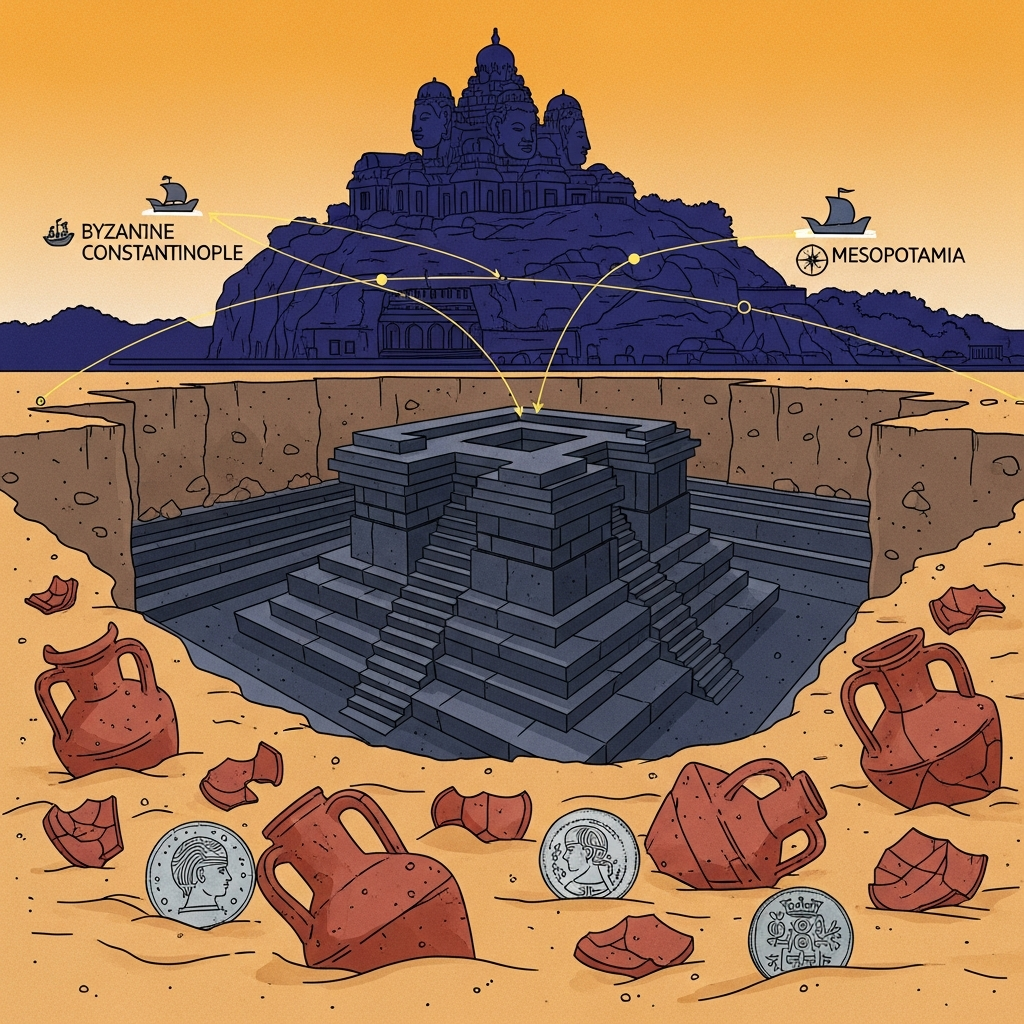
Archaeologists from India's Archaeological Survey of India have unearthed over 3,000 Mediterranean amphorae fragments, 60 Byzantine-era coins, textile dyeing vats, and a sophisticated T-shaped stepped reservoir at Elephanta Island — a UNESCO World Heritage Site just one hour by ferry from Mumbai — definitively repositioning the island from a Hindu pilgrimage site into one of the Indian Ocean's most significant 6th-century commercial hubs. The Kalachuri dynasty under King Krishnaraja (c. 550–575 CE) appears to have operated Elephanta as a sophisticated export-processing and maritime trade node connecting India with Byzantine Constantinople and Mesopotamia, with trade revenues almost certainly funding the construction of the world-famous Shiva Trimurti cave temple complex. This discovery constitutes material proof that systematic, large-scale globalization was operating across the Indian Ocean roughly 900 years before Columbus sailed — a historical reality absent from most world history curricula and a direct challenge to the Eurocentric Age of Discovery narrative that continues to dominate global secondary education. The Maritime Silk Road, which surpassed its overland counterpart in both volume and antiquity, has been systematically underrepresented in Western-influenced historical education, and the Elephanta excavation hands the decolonial history movement its most powerful piece of physical evidence yet. Announced officially in April 2026, this find stands to reshape not only archaeological understanding of early medieval India but also the global narrative of when and where humanity first built a truly interconnected economic civilization.
Key Points
3,000 Mediterranean Amphorae — This Is Direct Trade Evidence, Not Hearsay
A discovery of 3,000-plus Mediterranean amphorae and West Asian torpedo jar fragments on a small island off Mumbai is not a matter of one or two chance artifacts turning up far from their origin. The sheer quantity — and the documented diversity of container types — speaks to something systematic, sustained, and commercially organized over many decades, possibly centuries. For comparison, the Romano-period Indian site of Arikamedu, which established the benchmark evidence for Indo-Roman trade, yielded Mediterranean amphorae in the hundreds. Elephanta's count is quantitatively different in a way that changes the qualitative historical interpretation entirely.
Amphorae were the standard containerized shipping solution of the ancient Mediterranean and Near East, used to transport high-value liquids including wine, olive oil, and the fermented fish condiment known as garum. Finding Mediterranean amphorae in India is not unusual at this point in the archaeological record. Finding 3,000 of them, alongside a brick-built textile dyeing installation, stone anchors, three confirmed harbor zones, and 60 dated coins spanning multiple decades, is a different category of evidence entirely. Roberta Tomber's 2007 Cambridge Antiquity study had already demonstrated that many supposed Roman amphorae at Indian sites were actually Mesopotamian torpedo jars — meaning the trade network was even more multi-directional than previously assumed. The Elephanta find almost certainly includes both types, which means this island was simultaneously connected to Byzantine Constantinople and to Mesopotamian commerce. That is not a local trade stop. That is an international hub.
The Temple Was Built on Trade Revenues, Not Just Faith
The Shiva Trimurti at Elephanta is not simply a large religious carving. It is a three-faced figure representing Shiva as creator, preserver, and destroyer — 5.45 meters tall, cut directly from living basaltic rock, requiring years of skilled labor by multiple artisans working in the most demanding medium imaginable. UNESCO recognized it in 1987 as part of a masterpiece of human creative genius. Creating it required not just religious motivation but enormous, sustained material resources, administrative capacity to organize and supply workers over years, and political authority willing to commit that investment without any guaranteed return.
Indian scholar V.V. Mirashi argued in 1955 that only the Kalachuri dynasty possessed sufficient resources to support such a grand undertaking during the 6th and 7th centuries CE, and that their wealth probably came from the coastal trade opportunities that Konkan provided. For 70 years, that was a compelling hypothesis waiting on physical backing. The 3,000 amphorae, 60 coins, and the industrial textile dyeing infrastructure just handed that hypothesis its long-overdue material evidence. The great Gothic cathedrals of medieval Europe were financed by guild patronage and ecclesiastical taxation. Japan's Todai-ji temple was funded in part by revenues from Nara-period international trade. In every case: faith provides the vision, commerce provides the capital. Elephanta is now its newest confirmed case.
The Maritime Silk Road Was Bigger Than the Overland Route — And Most Textbooks Don't Know It Exists
The term Silk Road was coined in 1877 by German geographer Ferdinand von Richthofen, referring specifically to the overland routes crossing Central Asia. That branding succeeded spectacularly. What Richthofen's framing systematically obscured is that the parallel maritime routes across the Indian Ocean were older in origin, dramatically higher in traded volume, and arguably more geopolitically significant than the camel caravans that captured popular imagination. Springer Nature's Journal of Archaeological Research documented that the period from 300 BCE to 700 CE represented unprecedented growth in the western Indian Ocean, making it one of the greatest trading hubs in the ancient world during precisely the centuries when Elephanta was active.
The Cambridge Journal of Roman Studies addressed the representational problem explicitly, noting that the concept of Indo-Roman trade is itself a product of Eurocentric historical framing — it names the relationship after Rome while erasing the independent contributions of Mesopotamia, Parthia, the Kushan Empire, and East Africa. The actual structure of ancient Indian Ocean commerce was not bilateral Roman-Indian exchange. It was a multi-directional network in which Rome was one significant participant among many. If world history education has systematically misrepresented the structure and scale of ancient Indian Ocean commerce for over a century, then an enormous portion of the pre-1500 CE global story has been effectively invisible to billions of students. The Elephanta discovery doesn't just add a data point to the existing narrative. It adds a data point that the existing narrative has no frame to accommodate.
Columbus Was 900 Years Late — The Age of Discovery Is the Wrong Frame
The phrase Age of Discovery encodes a specific historical argument: that before the late 15th century, meaningful cross-cultural contact and organized long-distance commerce were absent or marginal. The implication is that before da Gama, before Columbus, before Magellan, the various civilizations of the world were essentially living in isolated bubbles of local exchange. This is the story most world history education still tells, implicitly or explicitly.
The evidence makes this picture historically untenable. Pliny the Elder was complaining about Rome's Indian trade deficit in 77 AD, writing that India, China, and Arabia were extracting one hundred million sesterces from our empire per annum at a conservative estimate. Matthew Cobb's 2019 Routledge study estimates that eastern maritime trade may have contributed up to one-third of Rome's total imperial tax revenue. The World History Encyclopedia documents that when Vasco da Gama arrived in Calicut in 1498, he found a vibrant international trade network already in place, whose expanse and wealth was well beyond European imagination — with 1,000 Gujarati merchants and 4,000 to 5,000 sailors already permanently resident in Malacca alone. What the Age of Discovery narrative actually describes is not the beginning of globalization. It describes the European entry into a global commercial system that had been operating for well over a millennium before da Gama was born.
The Kalachuri Dynasty's Economic Genius: What a T-Shaped Reservoir Reveals About Ancient Industrial Strategy
The single most underappreciated artifact in the Elephanta excavation may be the T-shaped stepped reservoir. Measuring 14.7 meters in length, with a width ranging from 6.7 to 10.8 meters, featuring 20 carved stone steps and a depth of 5 meters, this structure was built entirely from stone quarried on the Indian mainland and transported by boat to the island. Someone made a deliberate, expensive, and sustained decision to invest in permanent industrial infrastructure on an island that is physically inaccessible for four months every year due to monsoon ferry closures.
A reservoir of this scale on an island with no natural freshwater source serves one primary industrial function when combined with the textile dyeing vat discovered in the same archaeological context: export-oriented manufacturing requiring large, controlled volumes of water. Textile dyeing for high-quality fabrics commanding premium prices in Byzantine and Mesopotamian markets required substantial water volumes for soaking, mordanting, rinsing, and fixing natural dyes. Today we distinguish between economies that export raw commodities and those that process materials into finished goods before export. The Kalachuri approach to Elephanta appears to have been the 6th-century equivalent of building refineries rather than exporting crude oil — processing raw textiles into premium dyed finished goods on the island, then shipping them across the Indian Ocean at maximum price. The reservoir and dyeing vat are the archaeological fingerprint of that value-addition industrial strategy.
Positive & Negative Analysis
Positive Aspects
- Rebalancing the Eurocentric Historical Narrative
Elephanta's discovery gives the long-running scholarly movement to decolonize world history its most powerful piece of physical evidence yet. For decades, the critique of Eurocentric historiography has operated primarily through theoretical argument and the reinterpretation of existing sources — important work, but work that struggles to break through the inertia of established curricula. A discovery this specific, this dramatic, and this independently verified changes the rhetorical landscape entirely. Over 3,000 Roman wine jars were found inside a Hindu pilgrimage site near Mumbai, confirming that India was a Byzantine trade hub 900 years before Columbus — a single sentence that a 12-year-old can understand and that directly contradicts the foundational assumption most history textbooks still carry.
The precedent from comparable moments in archaeological history is encouraging. The revaluation of Great Zimbabwe in the 1990s fundamentally shifted how African history is taught internationally once the physical evidence was treated seriously. The discovery of the Antikythera mechanism forced a wholesale revision of assumptions about ancient Greek technological sophistication. The SaveAPWorld movement, Duke University Press's Indian Ocean educational guides, and the Association for Asian Studies's public acknowledgment that Indian Ocean trade is being radically reassessed together create an institutional ready-state that this discovery can catalyze. Historical narratives shape national and civilizational self-understanding in ways that have direct political consequences. Correcting the historical record at the level of material evidence is the most durable form of that correction.
- A Long-Overdue Elevation of India's Cultural Heritage Status
Elephanta has been a UNESCO World Heritage Site since 1987, but its listing has primarily emphasized its significance as a Hindu rock-cut temple complex — essentially framing it as a remarkable example of religious and artistic achievement while leaving its economic and civilizational dimensions in the background. The 2026 discovery offers a concrete opportunity to begin correcting that framing — not just for Elephanta, but for the entire portfolio of Indian cultural heritage sites that have commercial and maritime dimensions waiting to be properly examined.
The ripple effects for India's broader cultural diplomacy are potentially significant. A UNESCO World Heritage Site recognized not only for religious art but for its role as a 6th-century international trade hub commands a different kind of global attention — it speaks to economic history, civilizational interconnection, and the deep roots of globalization in ways that a purely religious designation cannot. When the Konkan coast ports of Sopara, Kalyan, and Chaul are properly reexamined in light of Elephanta's evidence, India's ancient commercial footprint becomes part of the global conversation about economic history. India's 44 UNESCO sites represent a portfolio that, properly understood through economic and maritime lenses, tells a story of extraordinary civilizational sophistication and global connectivity that current international perception substantially underrepresents. The revaluation of Elephanta is the first domino in that chain.
- New Scientific Momentum for Maritime Archaeology and Trade History Research
Archaeological research on ancient Indian Ocean trade has historically been constrained by a structural problem: most evidence lies either underwater, in geographically remote coastal areas, or in excavation sites that have received inadequate scientific attention. The Elephanta discovery changes the research landscape in several significant ways. First, it demonstrates that major archaeological evidence for Indian Ocean trade can still be found in accessible, well-documented sites. Second, the methodology employed by ASI's Mumbai Circle provides a replicable template for systematic investigations at other potential trade sites along India's coastline.
The scientific methods now available for analyzing material of this kind have advanced dramatically. npj Heritage Science's 2020 study on torpedo jar characterization demonstrated that chemical provenance analysis can now trace ancient ceramic artifacts to their specific regional production centers with high precision. When that methodology is applied to the 3,000 Elephanta fragments, the results will map specific production centers, likely transit routes, and approximate periods of trade activity at a granularity impossible a generation ago. The discovery also creates institutional momentum for funding additional research at sites like Sri Lanka's Mantai, Yemen's Aden, and East Africa's Kilwa — all likely to contain comparable or related evidence. Oxford, Harvard, and the National University of Singapore are all expanding their Indian Ocean Studies programs, and a high-profile discovery of this kind creates exactly the scholarly urgency that drives funding decisions.
- A Heritage Tourism Opportunity That Could Fund Its Own Preservation
The economic opportunity represented by the Elephanta discovery, if managed correctly, could generate the revenues needed to fund both ongoing archaeological research and long-term site preservation. India's heritage tourism market is projected by Grand View Research to grow from $30.3 billion in 2023 to $47.4 billion by 2030, representing a CAGR of 6.6 percent. The ancient global trade hub, one hour from Mumbai narrative that Elephanta's new identity provides is a qualitatively different attraction proposition than remarkable Hindu temple caves — it appeals to heritage travelers interested in economic history, globalization, and civilizational interconnection, a segment that skews toward higher-spending international visitors.
The geographical positioning is almost absurdly favorable. Elephanta is an hour by ferry from the Gateway of India in one of the world's great international gateway cities. The infrastructure for international visitor access already exists. What has been missing is a compelling, internationally resonant narrative for why a serious heritage traveler should make Elephanta a priority destination. The island where Byzantine wine was traded for Indian textiles 1,500 years before Columbus is precisely that narrative. It positions Elephanta not as a religious curiosity but as a primary destination in its own right — the physical origin point of what we now call globalization. The critical caveat is that tourism revenues are only genuinely beneficial if management infrastructure exists to prevent those revenues from overwhelming and damaging the site they are supposed to fund.
- Accelerating Investment in Non-European Civilizational Research
One of the most persistent structural inequities in global archaeology has been the dramatic concentration of funding on European and Mediterranean ancient history relative to South Asian, East African, and Southeast Asian civilizational history. By some estimates, more than 60 percent of global archaeology research funding has historically been directed toward European and Mediterranean sites. The Elephanta discovery, by establishing that major world-historically significant evidence for pre-European globalization can still be found at accessible sites, makes a powerful case for redirecting some of that investment.
The ASI's excavation budget tells part of the story of what underfunding looks like in practice: approximately $150 million to manage 3,693 protected monuments, meaning an average of roughly $40,000 per protected site per year. A discovery of this magnitude raises the obvious question: what comparable evidence is waiting at other underfunded sites along India's 7,500 kilometers of coastline? The ancient Indian Ocean trade network connected at minimum five major civilizational spheres — Indian, Mesopotamian, East African, Arabian Peninsula, and Mediterranean — and the evidence for that network is distributed across all of them. A coordinated international research program treating these five spheres as parts of a single interconnected historical system would be transformative for the field. The Elephanta discovery provides the symbolic and evidential anchor for making that case to international research funding bodies.
Concerns
- The Very Real Risk of Nationalist Political Capture
The most serious threat to the Elephanta discovery's long-term scholarly value is not scientific uncertainty — it is the documented pattern of archaeological politicization under India's current government. The Hindutva movement has already demonstrated, across multiple high-profile cases, a systematic willingness to leverage archaeological findings for Hindu nationalist political purposes. A 2023 peer-reviewed article in Oxford University's International Affairs journal documented in detail how the Hindu nationalist movement has systematically leveraged heritage to create communal tensions. ArtNews reported the same year that ASI under the current government has become effectively a tool for the search for a Hindu past in service of a Hindu nation.
The Elephanta discovery is structurally vulnerable to exactly this kind of political reframing. The actual historical significance of the find is a story of multicultural, multi-civilizational trade: Byzantine Christian merchants, Zoroastrian Mesopotamian traders, Hindu Indian rulers, and East African commercial intermediaries all participating in a single commercial network. That is a story about human interconnection transcending religious and civilizational boundaries — the opposite of a nationalist narrative. Once that reframing is dominant in Indian state media and educational materials, the international scholarly community's ability to engage with the site on scientific terms becomes severely constrained. For the Elephanta discovery to achieve its genuine scholarly potential, both the Indian government and international scholarly institutions need to actively resist this bifurcation.
- Over-Tourism and the Threat of Irreversible Damage to a Fragile Island Site
The conservation risks posed by increased tourism at Elephanta are not theoretical — they are already beginning to materialize even at the island's current visitor levels, and the geography of the site imposes hard limits that have no equivalent at most major heritage destinations. The island sits in the middle of Mumbai Harbor, accessible only by ferry service that is suspended entirely for four months each year during the monsoon season. The existing stone cave structures have been subjected to decades of wear from visitor contact, atmospheric humidity and salt air, and the vibration and pollution associated with high-volume boat traffic.
The Angkor Wat case is the most instructive comparison. Cambodia's premier heritage site, which receives over five million visitors annually, has experienced documented structural subsidence linked to groundwater depletion from tourism infrastructure development and physical damage to stone surfaces from millions of visitors annually. UNESCO has formally criticized the management of Angkor's tourism growth on multiple occasions. IMPRI India's analysis of India's heritage tourism challenge put it directly: over-commercialization of cultural heritage for tourism, if not managed responsibly, can lead to irreversible damage. The time to design and implement the management framework — entry reservation systems, timed ticketing, hard daily caps, conservation levies on visitor fees — is now, before the visitor surge that this discovery will inevitably trigger. Waiting until the damage is visible is waiting too long for a site where the damage, once done, cannot be undone.
- The Danger of Getting Ahead of the Evidence
Archaeological science moves deliberately by necessity. The excavation of 3,000 amphorae fragments is an extraordinary physical discovery, but the interpretive conclusions that give that discovery its headline-grabbing significance — direct Byzantine trade, Roman wine, 6th-century globalization — depend on analytical work that has not been completed and published yet. Full chemical provenance analysis of the ceramic fabric, carbon dating of associated organic materials, comparative typological study against documented Mediterranean and Mesopotamian assemblages: these are the steps between we found 3,000 pottery fragments and we can confirm these came from Byzantine Constantinople.
The precedent established by Roberta Tomber's 2007 Cambridge Antiquity study makes this caution especially relevant. Tomber demonstrated that a significant portion of artifacts previously classified as Roman amphorae at Indian sites were actually Mesopotamian torpedo jars — vessels that looked broadly similar to casual observation but were manufactured in different regions. This was not a minor correction: it fundamentally changed the picture of which civilizations had direct commercial relationships with which Indian ports. The Bryn Mawr Classical Review's 2019 assessment noted that scholarly estimates of the trade's contribution to Roman imperial revenue range from 10 percent to a third — a threefold range of uncertainty that the popular narrative has largely collapsed into the maximum figure because the maximum figure makes the better headline. Responsible scientific communication requires explicitly acknowledging what has been found, what has been confirmed, and what remains to be established — even when that nuance is inconvenient for the narrative momentum.
- When Archaeological Finds Become Geopolitical Weapons
The Elephanta discovery exists at the intersection of two geopolitical tensions. The first is the longstanding historical competition between India and Pakistan over which nation is the legitimate heir to the civilizational achievements of the subcontinent. The second is the emerging rivalry between India and China over historical narratives of globalization: China has invested heavily in the Belt and Road Initiative framing as a revival of the ancient Silk Road, implicitly positioning China as both the historical originator and present-day leader of Eurasian and Indo-Pacific economic integration.
When archaeological discoveries become entangled in contemporary geopolitical competition, the scholarly process tends to suffer regardless of which side is doing the exploiting. The Greece-Macedonia dispute over the cultural legacy of Alexander the Great lasted for decades, produced genuine diplomatic crises, and left a scholarship environment in which political considerations visibly distorted archaeological interpretation on both sides. The irony is that the actual historical evidence from Elephanta argues against any nationalist or geopolitical appropriation. The 6th-century Indian Ocean commercial network was genuinely multi-polar and multi-civilizational: it required Byzantine shipping capacity, Mesopotamian product supply chains, Indian manufacturing and harbor infrastructure, and East African transit routes to function. No single civilization owned it or could claim sole historical credit for it. That is precisely the story that an honest reading of the Elephanta evidence tells — and it is the story that both nationalist and geopolitical actors are structurally motivated to suppress.
- Conservation Infrastructure and Expert Capacity Are Not Ready for What's Coming
India's archaeological conservation infrastructure faces a structural gap between the scale of its responsibilities and its available resources. ASI managed 3,693 protected monuments in 2025–26 on a budget of approximately $150 million for all operations including excavation, conservation, staffing, visitor management, and research. That works out to a per-monument average of under $40,000 per year, against international standards for heritage site conservation that typically require ten to twenty times that amount for major sites with active visitor programs.
The professional capacity problem is equally real. Full chemical provenance analysis of 3,000 ceramic fragments requires specialist laboratory facilities and expertise that exist at a relatively small number of institutions worldwide. Peer-reviewed publication requires scholars with the specific combination of classical archaeology, ceramic analysis, and Indian Ocean trade expertise. The risk is that underfunded conservation and understaffed professional analysis result in physical deterioration of the site and artifacts while the scholarly discourse remains locked in preliminary conclusions because the definitive analytical work has not been completed. Sites that are excavated before adequate conservation infrastructure is in place have a depressing record in the global history of archaeology. The Elephanta discovery deserves better than that outcome, and ensuring it receives better requires investment decisions to be made now, before the visitor surge and political pressure intensify the management challenges beyond the capacity of existing institutions to handle.
Outlook
In the short term — the next one to six months — the academic community will be the most active responders. ASI's April 2026 announcement is still fresh enough that the peer-review cycle has not fully caught up; scholarly responses to major discoveries typically lag by six months to a year as researchers race to contextualize new findings within existing literature. International archaeological conferences scheduled for late 2026, particularly the World Archaeological Congress and the Indian Ocean World Centre's annual meetings, will almost certainly feature Elephanta as a priority session. I would expect a minimum of 15 to 20 dedicated academic presentations as scholars from multiple disciplines — archaeology, economic history, art history, religious studies — compete to establish their interpretive frameworks first. The real inflection point arrives when ASI publishes the chemical provenance analysis of those 3,000 amphorae fragments. That is when the scholarly debate will break fully open, and the findings will either confirm or complicate the initial direct Byzantine trade narrative.
On the tourism side, near-term visitor growth is almost guaranteed. Elephanta currently sees around 1,000 visitors per day, translating to roughly 400,000 to 500,000 annually when you exclude the four months when monsoon conditions shut down the ferry service from Mumbai. A 20 to 30 percent increase in visitation seems conservative given the global media coverage. For scale: ASI's entire portfolio of protected heritage sites attracted just 552,571 foreign visitors in all of 2023. A significant Elephanta surge would be nationally meaningful. The Maharashtra state government and Mumbai tourism authorities will almost certainly incorporate this discovery into their international marketing campaigns — ancient global trade hub, one hour by ferry from Mumbai is a compelling pitch that writes itself for heritage travel audiences in Europe, East Asia, and North America.
The medium-term picture — six months to two years from now — is where the truly transformative changes begin to take shape. India's NCERT, the body responsible for setting national school curricula, was already in preliminary discussion about revising its world history content before this announcement landed. The Elephanta discovery now provides NCERT with domestically sourced, internationally validated material evidence for a dedicated Maritime Silk Road unit in secondary history education. I would put the probability of a meaningful Indian curriculum revision appearing in middle and high school history textbooks by 2027 at approximately 60 percent. Beyond India's borders, this discovery lands in a global educational environment already trending in its favor. The AP World History curriculum in the United States has been under sustained pressure from advocacy movements to increase non-European civilizational representation. Duke University Press has published dedicated Indian Ocean history teaching guides. These structural shifts were already underway; the Elephanta evidence accelerates them by providing exactly what curriculum designers and educators need — a specific, dateable, geographically defined discovery that demonstrates pre-European globalization at the material level, not just the theoretical one.
The UNESCO angle also deserves close attention over this medium-term window. Elephanta's current World Heritage listing is framed around its artistic and religious significance as a Hindu rock-cut temple complex. An expanded or revised nomination acknowledging its role as a 6th-century international maritime trade hub would be both historically accurate and internationally significant. Serial UNESCO nominations already exist — the overland Silk Road was listed as a serial World Heritage Site — establishing a direct precedent for eventually linking Elephanta with other ancient Indian Ocean trading ports into a coordinated Maritime Silk Road heritage route connecting Sri Lanka's Mantai, East Africa's Kilwa, and Arabia's Aden. The formal process for a revised nomination typically takes two to three years, meaning India could potentially file by 2027 or 2028 for committee review in 2028 to 2029.
Looking five or more years out, the long-term implications center on a potential paradigm shift in how world history as a discipline conceptualizes the pre-European period. Historical scholarship has been moving away from Eurocentrism for decades, but that movement accelerates dramatically when it has concrete physical evidence rather than only theoretical argument. Oxford, Harvard, and the National University of Singapore are all expanding their Indian Ocean Studies programs. By 2030, it is entirely plausible that major university world history survey courses will treat the Maritime Silk Road and the overland Silk Road with genuinely equal weight. Research output in this field will likely increase by 150 to 200 percent over the next five years, based on observable trends in academic publishing. The ancient commercial reality that eastern maritime trade may have contributed up to one-third of Rome's total imperial revenue could enter mainstream public understanding in a way it currently has not.
The long-term tourism opportunity is also significant and underappreciated. A Maritime Silk Road cultural heritage circuit — starting at Elephanta near Mumbai, moving through Sri Lanka's Galle, crossing to Zanzibar in East Africa, and continuing to Oman's historic port cities — would give international travelers a historically rich alternative to saturated European heritage tourism itineraries. India's heritage tourism market is projected by Grand View Research to grow from $30.3 billion in 2023 to $47.4 billion by 2030, at a CAGR of 6.6 percent. Layering a first globalization narrative onto that baseline growth trajectory represents a meaningful premium in destination positioning and visitor spending.
In the Bull Case — which I would assign roughly a 30 percent probability — ASI's follow-up excavations produce additional material definitively confirming direct Byzantine trade. The chemical provenance analyses come back cleanly supporting the initial interpretation. The Indian government partners with UNESCO on a genuine scholarly revision of Elephanta's World Heritage designation. In this scenario, the discovery achieves the cultural resonance of the Rosetta Stone or the Dead Sea Scrolls. India's heritage tourism growth accelerates beyond the 6.6 percent baseline CAGR. The Indian Ocean becomes a standard topic in global secondary history education within a decade.
In the Base Case — my highest-probability scenario at around 50 percent — scholarly validation proceeds slowly and carefully over the next five to ten years. Peer-reviewed papers accumulate. Chemical analyses are completed and partially complicate, partially confirm the initial interpretation. Academic consensus gradually consolidates around recognizing Elephanta as a major ancient trade site. But the timeline for this to filter into mainstream curricula and popular historical consciousness is 15 to 20 years, not 5. The tourism uptick happens but stays moderate. The political capture risk materializes in partial ways: nationalist framing, some international scholarly pushback, a degree of credibility friction that slows but does not ultimately stop the broader reassessment.
In the Bear Case — which I would put at 20 percent probability — the chemical provenance analysis returns results that partially contradict the initial interpretation. Perhaps a significant fraction of those 3,000 fragments turn out to be locally manufactured vessels imitating Mediterranean styles rather than genuine imports. Meanwhile, the Indian government aggressively frames the discovery as proof of ancient Hindu civilizational supremacy, triggering international scholarly disengagement from a site now perceived as politically compromised. The 2023 Oxford Academic study on Hindutva and UNESCO documented exactly this pattern playing out at other Indian sites — the risk is not hypothetical. This scenario does not make the discovery irrelevant, but it would substantially reduce the international scholarly momentum required to actually change how history is taught.
Where could my analysis go wrong? The most obvious failure mode is the chemical analysis. Tomber's 2007 work already corrected the Roman and Mesopotamian misclassification once, and the same methodological rigor applied to Elephanta could revise the story in ways we cannot yet predict. I am also likely being optimistic about the speed of educational reform — curriculum change is notoriously slow even when the evidence is overwhelming, and I may be systematically underestimating institutional inertia in large national education systems. Whatever the eventual shape of this story, I believe the foundational conclusion is durable: the Indian Ocean was operating a sophisticated global commercial economy for centuries while Europe was barely aware of its own periphery. The only question is how long it takes for our history textbooks to finally catch up to what the ground has been trying to tell us.
Sources / References
- Insights on India: Elephanta Island 1,500-Year-Old Archaeological Discoveries — Insights on India
- Drishti IAS: 1500-Year-Old Stepped Reservoir on Elephanta Island — Drishti IAS
- NewsCanvas Education: Elephanta Island Current Affairs — NewsCanvas Education
- UNESCO World Heritage Centre: Elephanta Caves Official Listing — UNESCO World Heritage Centre
- Wikipedia: Elephanta Caves — Wikipedia
- Live History India: The Kalachuris — Mysterious Makers of Elephanta — Live History India
- Anthropology International: India Maritime Silk Road Ancient Trade Routes — Anthropology International
- Sanskriti IAS: Elephanta Island Reservoir Discovery — Sanskriti IAS
- Cambridge Antiquity: Roberta Tomber 2007 Rome and Mesopotamia Importers into India — Cambridge University Press Antiquity
- Routledge: Matthew Adam Cobb 2019 The Indian Ocean Trade in Antiquity — Routledge
- npj Heritage Science Nature: Indian Ocean Trade Connections Torpedo Jars 2020 — npj Heritage Science Nature Publishing Group
- Oxford Academic International Affairs: From Hinduism to Hindutva Civilizational Internationalism and UNESCO 2023 — Oxford Academic International Affairs
- World History Encyclopedia: Indian Ocean Trade Before the European Conquest — World History Encyclopedia