
38 Skeletons Found in a 600-Year Sealed Tomb — And That's Just 7% of the Site
Summary
A sealed elite tomb at Chan Chan, Peru — the ancient Chimú capital — has been opened for the first time in roughly 600 years, revealing 38 sets of human remains along with copper tools and skulls coated in the rare mineral cinnabar, all in an unlooted state that is almost without parallel in Andean archaeology. Prior to this find, everything scholars knew about how Chimú elites were buried came from platforms that had been systematically ransacked since the colonial era — meaning the entire field of Chimú funerary studies had been built on inference from vandalized rubble rather than direct observation. What makes the discovery simultaneously exhilarating and unsettling is a single statistic: roughly 7% of Chan Chan's total area has ever been excavated, so the overwhelming majority of the Americas' largest pre-Columbian adobe city lies still buried underground, unexamined and unprotected. Chan Chan entered UNESCO's World Heritage list and its list of sites in danger simultaneously in 1986, and it continues to face compounding threats from accelerating El Niño flooding cycles, organized looting networks, and chronic underfunding. This intact funerary chamber is not simply an archaeological success story — it is a mirror held up to five centuries of colonial plunder, colonial historiography, and the structural inequity that has kept the Chimú civilization in the shadow of the Inca for generations of global scholarship.
Key Points
Discovery of an Unlooted Elite Tomb — A Turning Point in Chimú Archaeology
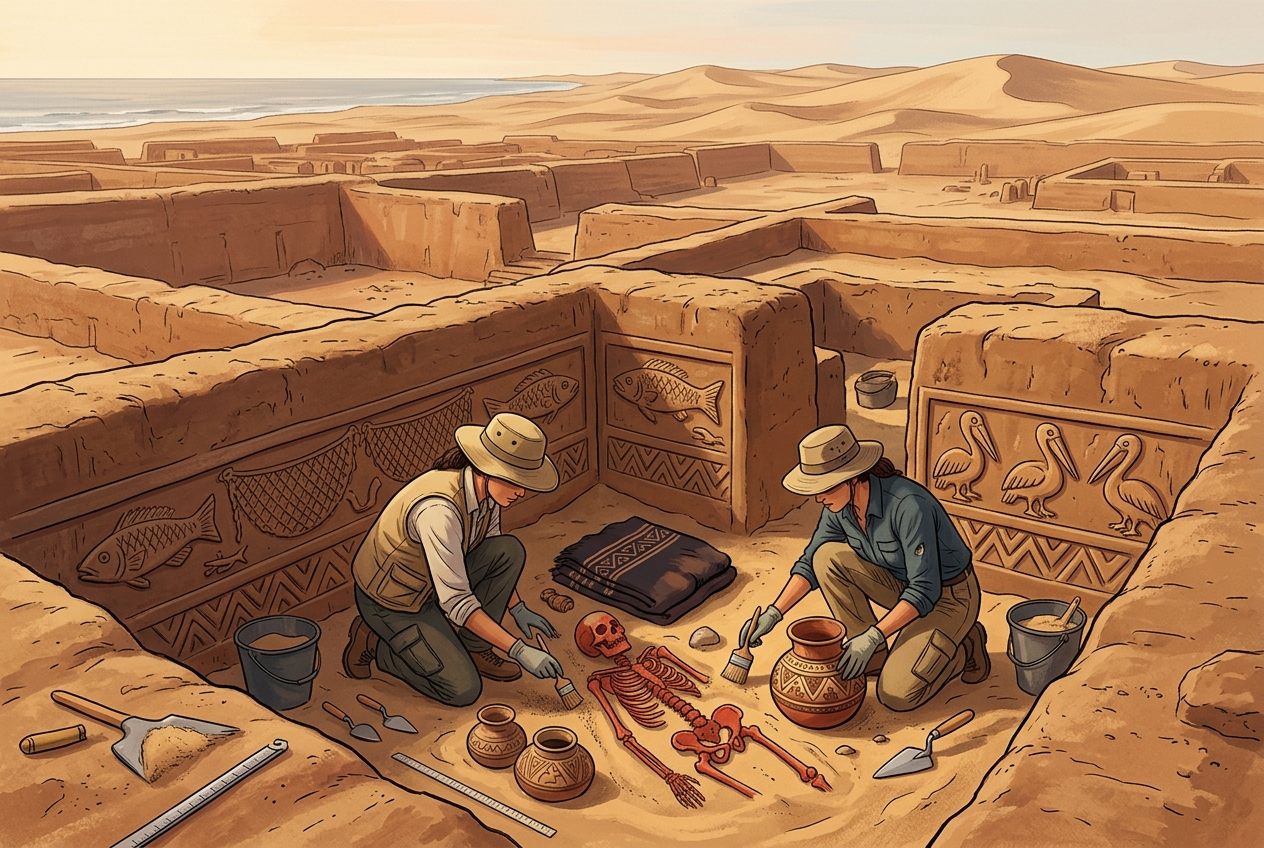
The discovery of an elite Chimú burial chamber at Chan Chan — sealed for roughly 600 years and found unlooted — is without precedent in the history of Chimú archaeological research. Excavation director Jorge Meneses has stated that Peruvian archaeologists had never before encountered an intact elite funerary platform of this kind, making this the first opportunity to observe Chimú burial practice in its original configuration rather than in the vandalized state that has characterized every previous excavation of comparable sites. The tomb's structure descends approximately eight feet via a stone-sealed entrance into a three-room complex: a central chamber containing a single elite individual, an empty chamber, and a chamber holding approximately 20 sets of remains along with grave goods. Elsewhere on the same funerary platform, 18 additional sets of remains were found, bringing the total to 38. Two copper axes and two copper chisel-like tools were recovered, and many of the remains had their skulls coated in cinnabar — a rare mercury mineral compound whose presence in significant quantity across multiple individuals tells us something important about Chimú trade networks and the symbolic role of rare materials in elite burial rituals. Anthropologist Ari Caramanica described the tomb as providing something close to a complete picture of an intensely meaningful context organized around a single elite individual, and the value of that completeness lies in the fact that the spatial relationships between persons, objects, and rooms can now be read as a structured text for the first time in the study of this civilization.
Looting Is Not Theft — It's the Systematic Destruction of Context
What looting removes from a burial site is not only the object itself — it is the relationship between that object and everything surrounding it, which is the information that makes the object archaeologically meaningful. National Geographic's reporting made explicit that prior to this discovery, everything known about elite Chimú burial practices came from platforms that had been looted and destroyed since colonial times, meaning the entire scholarly understanding of Chimú funerary culture rested on inference from vandalized wreckage rather than direct observation of intact arrangements. When a looter extracts a gold ornament from a burial chamber, the spatial logic of the arrangement — who was placed centrally, what was placed nearby, which direction objects faced, what the empty adjacent room signified — is destroyed permanently and beyond reconstruction. Peru's government estimated, according to a 2012 InsightCrime report, that approximately $18 million worth of artifacts is stolen from Peru annually, while Interpol has estimated global illegal antiquities trafficking at more than $4 billion per year, and the U.S. Immigration and Customs Enforcement at up to $8 billion. That scale of activity confirms this is not opportunistic petty crime but a structured transnational supply chain, with impoverished rural communities at one end and wealthy international collectors at the other. The unlooted status of this particular tomb is not just archaeologically exceptional — it is a stark demonstration, by contrast, of how completely five centuries of organized looting have deleted the vocabulary through which Chimú civilization once expressed its relationship with death and social hierarchy.
The Structural Bias That Buried the Chimú Beneath the Inca
The Chimú Empire ruled the northern Peruvian coast from roughly A.D. 900 to 1470, controlled a coastline of roughly 1,000 to 1,300 kilometers, and built a capital at Chan Chan covering more than seven square miles with perhaps 40,000 inhabitants at its peak — larger than any Inca city — and yet most globally educated people can name Machu Picchu without ever having heard of Chan Chan. That disproportion is not accidental: it is the product of specific historical mechanisms that systematically erased the Chimú from the surviving documentary record. The Spanish conquistadors arrived and negotiated with Inca nobility, generating written records that, however distorted, allowed Inca history to survive in documentary form. The Chimú, meanwhile, had their ruling class physically relocated to Cusco following the Inca conquest around 1470, so when the Spanish came to the northern coast there were no surviving Chimú elites present to represent their own civilization's history. The civilization was erased not because it was inferior — Chan Chan was the Americas' largest pre-Columbian adobe city, and its administrative systems and craft production, which engaged perhaps as many as 12,000 artisans, represented a level of organizational sophistication comparable to anything the Inca built — but because the people who could have told its story were gone before anyone asked. This historiographical gap is precisely why this discovery matters beyond its archaeological significance: data from an intact Chimú elite burial, accumulated and analyzed over time, has the potential to restructure the Andean historical narrative away from Inca-centrism toward a more pluralistic understanding of the civilizations that preceded and shaped the Inca world.
Chan Chan's Unexcavated 93% — Possibility and Peril in the Same Number
Excavation director Meneses has stated that roughly 7% of Chan Chan's total area has been excavated — which means more than 90% of the Americas' largest pre-Columbian adobe city remains buried underground and unexamined. The fact that a discovery described as a find of the decades emerged from within that 7% should inspire neither simple optimism nor simple dread, but both simultaneously: optimism that the remaining ground may hold equally significant or more significant intact tombs, and dread that those hypothetical tombs are at this moment exposed to the same compounding threats that have already compromised much of what was previously lost. Chan Chan was placed on both UNESCO's World Heritage list and its list of sites in danger in 1986, and it remains on the danger list four decades later — which is itself a measure of how inadequate the conservation response has been relative to the scale of the problem. The threats are multiple and simultaneous: organized looting networks, El Niño flooding events, rising groundwater, and salt crystallization are all actively degrading adobe structures from inside and out. What I find most important to sit with is that the 7% figure is not a marker of progress — it is a measurement of how much of one of the ancient world's great cities we have never examined, and the statistical implication for the unexamined 93% is both extraordinary and terrifying in equal measure.
Climate Change and the Structural Underfunding of Chan Chan's Conservation
Chan Chan faces a structural imbalance between the pace at which climate threats are intensifying and the pace at which conservation resources are being mobilized, and that imbalance has been widening rather than narrowing in recent years. A 2015 Vice report documented that Peru's government had allocated $615,000 for El Niño preparedness at Chan Chan at that time, with 90 workers assigned to roof installation, drainage maintenance, and adobe wall reinforcement — a figure that works out to roughly $30,000 per square kilometer for a site covering more than seven square miles of densely layered adobe architecture. Henry Gayoso, who served as Chan Chan's conservation project director at that time, stated that El Niño events had shifted from occurring roughly every 25 years to every three or four years — a compression that is not merely a quantity change but a structural disruption of the entire conservation model, since adobe structures designed around a 25-year recovery cycle are now absorbing repeated major flood stress with only a fraction of the recovery time. I think the underappreciation of this point in current coverage is significant: it is not that the budget needs to be slightly larger, it is that the threat environment has transformed while the conservation infrastructure has not kept pace. If this year's discovery generates international interest that translates into increased funding and a genuine international cooperative program for Chan Chan, that funding will need to be sustained well beyond the news cycle — because the long-term structural relationship between climate acceleration and conservation capacity is the variable that will ultimately determine whether the 93% is ever safely reached.
Positive & Negative Analysis
Positive Aspects
- First Opportunity to Observe Chimú Funerary Culture in Its Original Arrangement
Before this discovery, the entire corpus of knowledge about how Chimú elites were buried derived exclusively from platforms that had been looted and destroyed since colonial times, making every scholarly hypothesis about Chimú funerary culture an inference from vandalized evidence rather than direct observation. This tomb — with its three-room structure, its 38 sets of remains, its copper tools, and the cinnabar applied to many of the skulls — provides the first dataset in which the original spatial relationships between persons and objects are fully intact and readable as a structured whole. That intact context allows researchers to test decades of accumulated assumptions and to begin tracing the provenance of Chimú artifacts currently sitting decontextualized in museums around the world back to something closer to their original meaning. The cinnabar application alone — rare, trade-dependent, and applied across multiple individuals — opens entirely new questions about the Chimú's trade networks and the symbolic economy of their elite burial practices that simply could not have been formed without an unlooted example to study. This single chamber has the potential to shift the baseline of Chimú scholarship fundamentally, functioning as the first reference point against which everything previously inferred from damaged sites can now be checked and, where necessary, revised.
- Reigniting International Interest in a Long-Overshadowed Civilization
The Chimú have historically received a fraction of the scholarly and public attention that the Inca command, despite having built the largest pre-Columbian city in the Americas and operated one of the ancient world's more sophisticated imperial systems across over a thousand kilometers of coastline. This discovery changed that, at least momentarily: major English-language outlets gave it prominent simultaneous coverage, and Gabriel Prieto's characterization of it as a discovery of the decades drove the story into mainstream global awareness, giving the name Chimú a public profile it has never previously enjoyed. That kind of concentrated attention, when it crystallizes around a genuine archaeological milestone, can initiate a productive chain reaction — academic conference invitations, documentary productions, and most importantly, competitive funding applications for continued excavation at Chan Chan. The excavation team has announced plans to continue working through 2027, signaling institutional momentum to sustain rather than a one-time event, and if international scholars and institutions convert their current interest into concrete financial support, it becomes possible to accelerate work on the remaining unexcavated area at a pace that might actually begin to outrun the threats currently facing it. The key question is whether the window of heightened attention can be converted into durable structural outcomes before the next news cycle displaces it.
- A Working Model for Locally Led, Decolonized Archaeology
This excavation was directed by Peru's Ministry of Culture and Peruvian archaeologists — not by a foreign university or international expedition — and that fact carries significance beyond the administrative level. For most of the 19th and early 20th centuries, South American archaeology meant European and North American institutions discovering sites and removing their most valuable contents to distant collections, with interpretation following from the removing institution rather than from the originating culture. Meneses' statement that Peruvian archaeologists had never before encountered an intact elite Chimú platform as the primary agents of discovery carries two meanings simultaneously: the academic significance of the find itself, and the fact that it was found, interpreted, and will be presented to the world by Peruvians operating within Peru's own institutional framework. This is a structural departure from colonial-era archaeological practice, and it matters because interpretation shapes narrative, and narrative shapes how a civilization is understood by the rest of the world. Whether this model can be adequately resourced and sustained, and whether international collaboration that the site will clearly need can be structured around Peruvian leadership rather than displacing it, is the critical question for the excavation's next phase.
- A Reference Point for Recontextualizing Chimú Artifacts in Collections Worldwide
The practical consequence of having one intact elite Chimú burial as a documented reference point is that systematic recontextualization of Chimú artifacts in museum collections around the world becomes possible for the first time. Objects removed from Chan Chan and similar sites over centuries sit in display cases labeled as Chimú metalwork or ceramics, stripped of the relational data that would allow any viewer to understand their original meaning. The original arrangement documented in this tomb — what kinds of objects accompanied which kinds of individuals, how they were spatially distributed, what rare materials were systematically applied to which remains — provides a template against which those decontextualized objects can now begin to be interpreted in ways that were previously impossible. In the context of international repatriation movements that are already gaining considerable momentum, this reference data strengthens the scholarly case for returning artifacts not only on moral grounds but on the grounds that an integrated research program — returned objects compared against original context data — could produce insights that neither the originating country nor the holding institution can achieve independently. This is a genuinely new kind of argument in repatriation debates, and it emerges directly from the existence of this single intact tomb.
Concerns
- The Looting and Climate Threats to the Unexcavated 93% Are Not Diminishing
The 7% of Chan Chan that has been excavated yielded one of the most significant Andean archaeological finds in decades — but the remaining 93% continues to sit exposed to the same compounding threats that have already eliminated most of the context from the portions previously reached. Organized looting has been a structural feature of Chan Chan since the colonial period, and Peru's government estimate of approximately $18 million in annual artifact theft nationwide, alongside Interpol's global estimate of more than $4 billion in illegal antiquities trafficking per year, establishes that the demand side of this pipeline shows no sign of weakening. El Niño events, which Henry Gayoso observed have shortened from a roughly 25-year cycle to every three or four years, deliver repeated flooding to structures built from adobe — a material that cannot survive indefinite exposure to accelerated moisture cycles without deteriorating from the outside in. Groundwater rise and salt crystallization compound the flooding threat by attacking adobe structures from below and within simultaneously, meaning the various threats are mutually reinforcing rather than sequential and therefore much harder to address with the resources available. The race between archaeology and destruction at Chan Chan is not a metaphor — it is a literal competition with a measurable pace, and the current rate of excavation relative to the rate of damage does not clearly favor archaeology.
- Chronic Underfunding Has Left Chan Chan Structurally Vulnerable for Decades
Chan Chan has been on UNESCO's list of World Heritage Sites in Danger since 1986 — four decades — and the fact that it remains on that list is a direct measure of how little the structural gap between resources and threats has closed in that time. The 2015 Vice report documented a government allocation of $615,000 for El Niño preparedness, with 90 workers responsible for drainage, roofing, and wall reinforcement across more than seven square miles of adobe architecture — a resource level that amounts to roughly $30,000 per square kilometer for a site of extraordinary density and fragility. Even allowing for investment increases since that report was published, the structural disproportion between the scale of the threat environment and the resources deployed has not been fundamentally resolved. The underfunding of Chan Chan relative to better-publicized heritage sites in other parts of the world reflects a broader pattern in global heritage investment that systematically under-resources non-Western sites with lower touristic profiles and weaker institutional advocates in international bodies. The consequence is not abstract: every year that passes with the current resource gap in place is a year in which irreversible deterioration of the unexcavated remainder accelerates, and each season's damage compounds on the previous season's rather than being repaired.
- The Tension Between Excavation and Conservation Cannot Be Fully Resolved
Excavation is inherently destructive and irreversible: opening a tomb permanently changes the conditions under which its contents are preserved, exposing stable underground material to oxygen, temperature variation, and humidity shifts that initiate deterioration the moment the seal is broken. UNESCO's World Heritage Committee has historically recommended against excavation at Chan Chan without adequate conservation infrastructure in place, and conservation specialist Roxana Loaísa has emphasized the necessity of assessing each material and establishing proper preservation conditions before any decisions about storage or display are made — a process that is difficult to scale at the pace that the threat environment demands. The genuine dilemma is that leaving the 93% in place is not a neutral act of preservation under current conditions, because ongoing threats from looting, flooding, and structural degradation are not paused while we wait for better resources to materialize. At the same time, increasing excavation pace without a corresponding increase in conservation capacity produces discoveries that cannot be adequately preserved or documented, creating a different kind of irreversible loss. Digital documentation technologies — three-dimensional scanning, ground-penetrating radar, photogrammetry — offer partial mitigation of this dilemma, but deploying them at the scale Chan Chan requires demands exactly the kind of sustained international investment that has not yet materialized.
- Discovery Narratives Can Distract from the Ongoing Emergency
The same headlines that make the case for Chan Chan's importance to global audiences also risk producing a cognitive pattern in which the site is mentally filed as recently discovered and therefore probably fine now — when the opposite is closer to the truth. News coverage frames archaeological discoveries as endpoints: a tomb was found, researchers are amazed, the story is told and set aside. But the actual situation at Chan Chan is that a sealed chamber survived by accident, and the conditions that threatened its survival — looting, climate change, inadequate funding — are fully operational across the unexcavated 93% today and will remain so after the current news cycle ends. There is a historical pattern in archaeological coverage where a major find generates a spike of international attention that dissipates within months without producing lasting changes to funding or policy, and the risk of that pattern repeating here is significant. If the current wave of media interest does not translate into concrete outcomes — sustained international cooperative programs, increased conservation budgets, systematic non-invasive survey of remaining areas — while the world is still paying attention, the momentum will likely fade before it produces structural change. The discovery worth celebrating becomes, in that scenario, a story that was consumed rather than acted on.
Outlook
In the short term — the next one to six months — the most immediate priority is intensive analysis of the 38 sets of remains and the tomb's material contents. The excavation team has already announced plans to continue working through 2027, and during that period bioarchaeological work will ramp up significantly. DNA extraction, isotopic analysis to understand diet and migration patterns, and kinship analysis to determine how the individuals in the central, peripheral, and communal rooms were related to one another are all near-term priorities. The cinnabar applied to many of the skulls deserves particular attention: it is a mercury compound that required specialized trade networks to acquire in significant quantity, and its application across multiple individuals suggests something about Chimú elite funerary practice we have never been able to observe in original context before. The empty room — containing no remains and no objects — will also be the subject of intense debate. Whether it was a deliberately reserved ritual space, an unfinished element of the burial sealed before completion, or something else entirely will shape interpretations of the whole chamber's meaning in ways that cannot be predicted yet.
Equally important in the short term is the question of what the international media attention actually translates into in practical terms. Major English-language outlets all gave the discovery prominent coverage, and Gabriel Prieto's description of it as a discovery of the decades drove the story into mainstream global awareness. For the first time, the name Chimú has entered broad public consciousness outside specialized academic circles. This window of attention has the potential to generate a cascade of consequences: invitations to international academic conferences, documentary productions, and most critically, funding applications for additional excavation work. From Peru's Ministry of Culture's perspective, this discovery is one of the strongest arguments in a generation for elevating Chan Chan on the priority list for UNESCO's endangered heritage programs and securing international public funding. But media cycles are short, and the window will not stay open indefinitely.
A key technological question in the near term is what role digital recording tools can play in both documenting this tomb and surveying the unexcavated remainder of the site. Three-dimensional scanning, photogrammetry, and ground-penetrating radar have advanced dramatically in recent years. If this chamber is recorded as a complete digital twin — a fully navigable three-dimensional reconstruction of the original arrangement — researchers around the world can analyze the spatial relationships without requiring physical access to a fragile site. More broadly, applying ground-penetrating radar to Chan Chan's unexcavated 93% could allow subsurface structures to be identified non-invasively, providing a map of what lies underground before the decision to excavate is even made. The limitation, of course, is cost and specialized personnel: these are not cheap technologies to deploy at scale, and the resource levels currently available at Chan Chan make large-scale adoption of the full toolkit difficult.
In the medium term — roughly six months to two years out — the central question shifts to how this single intact chamber reshapes the broader framework of Chimú archaeological scholarship. Because all prior knowledge of elite Chimú burial practices derived from looted contexts, this tomb is the first opportunity to test whether existing scholarly hypotheses about Chimú funerary culture were actually correct. If the findings align with what researchers had inferred from damaged sites, those methods of inference receive retrospective validation. If they diverge — and I think divergence is entirely plausible — then decades of accumulated academic consensus may need fundamental revision. Either outcome represents a turning point: this discovery will mark a before-and-after divide in Chimú studies. Another medium-term consequence is the possibility of launching systematic recontextualization projects for Chimú objects currently displayed without context in museum collections around the world. For the first time, a reference point exists — an original arrangement — against which decontextualized artifacts can be compared and potentially reinterpreted.
On the conservation side, I expect significant pressure to mount on Chan Chan's protection regime within the next two years. The 2015 conservation budget of $615,000 for El Niño preparedness with 90 workers assigned to a site of more than seven square miles was structurally inadequate at the time, and the acceleration of El Niño frequency from a roughly 25-year cycle to every three or four years — as Henry Gayoso observed directly — has only deepened that inadequacy since. That compression is not just a frequency change: it means the site has less recovery time between major flooding events, and cumulative damage accumulates faster than any conservation response can address at current funding levels. If international cooperation and sustained investment are not secured within this window of heightened attention, the scholarly momentum generated by this discovery risks dissipating without producing the physical on-the-ground changes that Chan Chan actually needs.
Looking further ahead — three to five years — the most consequential variable is whether additional unlooted tombs are discovered in Chan Chan's unexcavated 93%. The fact that one was found within the excavated 7% suggests the statistical possibility that others exist. If additional intact chambers are found, the field's understanding of Chimú funerary culture, social structure, and cosmological beliefs could expand exponentially. If this single tomb remains the only intact reference point for an extended period, the risk of over-generalizing from a single data point becomes real: we cannot know whether this chamber represents standard elite Chimú practice or an exceptional case without comparators. I want to be honest about that uncertainty rather than allow one extraordinary find to carry more analytical weight than it can bear.
Also in the longer-term frame, the question of indigenous community participation in the excavation and interpretation process will become unavoidable. In contemporary archaeological practice there is growing recognition that excavation decisions are not purely academic — they directly engage the cultural identity and sovereignty claims of descendant communities. How communities along Peru's northern coast relate to Chimú heritage, and what role they play in determining how the remains and objects are handled and interpreted, has not been prominently addressed in current coverage. But these questions will surface. And how the excavation leadership navigates them will shape the project's long-term legitimacy and sustainability in ways that purely technical decisions about excavation methodology cannot address on their own.
Mapping out the range of plausible outcomes: the most optimistic scenario involves this discovery's momentum translating into a coordinated international conservation and excavation program, the site's excavated proportion rising meaningfully over the next decade, and additional intact tombs emerging that allow comparative analysis to establish Chimú scholarship as a discipline able to sit alongside Inca studies with its own robust evidentiary base. The base scenario involves solid scholarly analysis of this specific tomb while Chan Chan's overall excavation pace fails to outrun looting and climate damage — additional data trickles in, but the structural conditions facing the unexcavated 93% do not substantially improve, and this discovery feeds a handful of academic papers and documentaries without triggering durable institutional change. The most pessimistic scenario involves El Niño frequency continuing to accelerate, conservation budgets remaining flat, international attention fading within months, and this single tomb standing for decades as the only intact window into Chimú elite burial — while the material it could have been compared to degrades irreversibly underground. The key bifurcation point in all three scenarios is identical: whether the international attention generated by this discovery converts into sustained funding and institutional commitment, or evaporates with the news cycle. The answer to that question will determine the shape of Chimú archaeology for a generation.
Sources / References
- Archeologists Stunned by Discovery of the Decade — The Daily Beast (2026-09-11) — Archeologists Stunned by Discovery of the Decade
- Unlooted Tombs Shed Light on the Incan Empire's Greatest Rivals — National Geographic (2026-09-17) — Unlooted Tombs Shed Light on the Incan Empire's Greatest Rivals
- Archaeologists Just Opened a Pre-Incan Tomb Sealed for 600 Years — Gizmodo (2026-09-16) — Archaeologists Just Opened a Pre-Incan Tomb Sealed for 600 Years
- 600-year-old funerary platform discovered in Peru — The Art Newspaper (2026-09-18) — 600-year-old funerary platform discovered in Peru
- Why Chan Chan Is a UNESCO Site in Danger — Chan Chan Peru Guide — Why Chan Chan Is a UNESCO Site in Danger
- Peruvian Mummy's Return Points to Artifact Trafficking in LatAm — InsightCrime (2012, updated 2023) — Peruvian Mummy's Return Points to Artifact Trafficking in LatAm
- Chimu Civilization — World History Encyclopedia — Chimu Civilization
- Peru's Great Urban Experiment — Archaeology Magazine (2023-05/06) — Peru's Great Urban Experiment
- Climate Change Might Be Destroying This Ancient Peruvian Archaeological Site — Vice (2015-06-15) — Climate Change Might Be Destroying This Ancient Peruvian Archaeological Site